
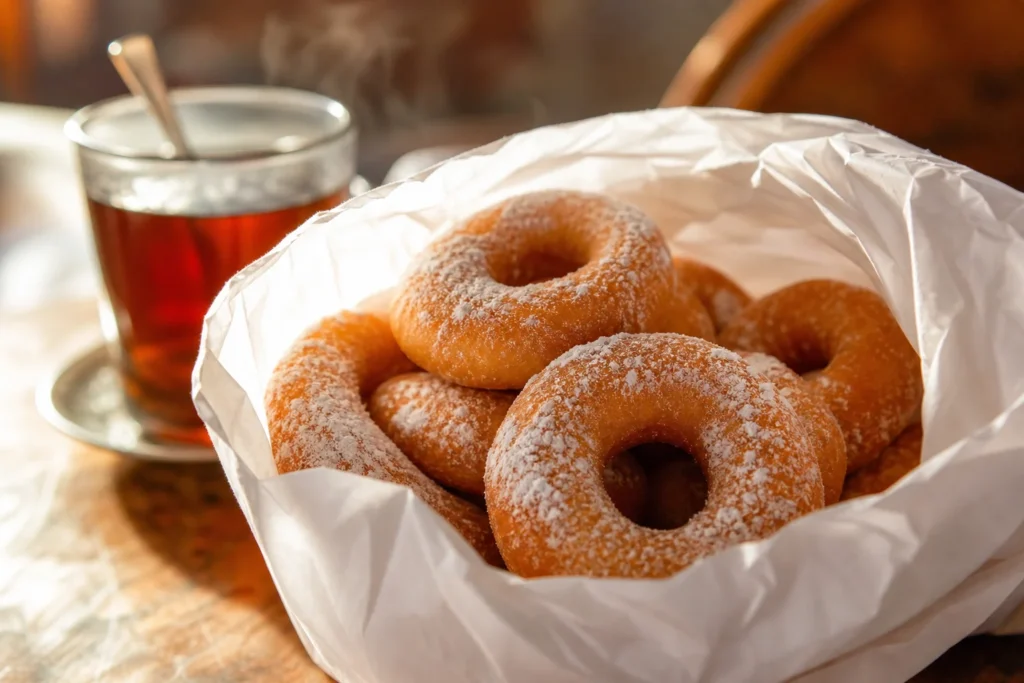
This article is for anyone craving the authentic taste of Saint Petersburg without the queue. Learn how to make pyshki at home and achieve that crispy-outside, fluffy-inside texture that made these pastries a Soviet-era symbol.
The recommended option is a traditional yeast dough method, which takes about 3–4 hours total (mostly waiting for the dough to rise) and produces golden ring-shaped doughnuts. Follow these steps to recreate what the famous Pyshechnaya bakery on Bolshaya Konyushennaya Street has been frying since 1958.
Quick answer: Mix yeast dough, let it rise twice, form into rings using your fingers, fry in hot oil until golden on both sides, and dust with powdered sugar. Total time: 3–4 hours. Cost: budget ingredients.
At a Glance
| Type | Desserts & sweets |
|---|---|
| Local name | пышки |
| Origin | Saint Petersburg, Russia |
| Servings | 2–4 servings (makes about 15 pieces) |
| Total time | 3–4 hours (mostly rising time) |
| Difficulty | Easy |
History and Story of Pyshki, Saint Petersburg
Pyshki gained prominence during the Soviet period, when Saint Petersburg was called Leningrad. The most famous pyshki in Russia come from a single address: the Pyshechnaya on Bolshaya Konyushennaya Street in St. Petersburg, opened in 1958 during the Khrushchev era and never closed since. Before the Bolshaya Konyushennaya shop became iconic, pyshki were a standard output of Soviet city bakeries alongside ponchiki and pretzels. The ring shape distinguished them from ponchiki and allowed them to fry more evenly, the hole letting heat circulate through the center. Soviet bakers standardized the weight and sugar content, and the form changed little across the country.
Ingredients
- 230 g all-purpose flour
- 150 ml warm water
- 2 g active dry yeast
- 20 g granulated sugar
- 15 g butter, melted
- Pinch of salt
- Vegetable oil for frying
- Powdered sugar for dusting
How Pyshki, Saint Petersburg Is Made
Step 1: Activate the yeast
In a bowl, dissolve the yeast and sugar in warm water. Stir well and let it sit for 5–10 minutes until frothy. This tells you the yeast is alive and ready to work.
Tip: The water should feel warm to your fingertip but not hot; too much heat kills yeast.
Step 2: Make the dough
Add the melted butter to the yeast mixture, then pour in the flour and salt. Mix until you have a sticky, wet dough. The dough should be soft and slightly sticky—this is normal and will make the pyshki light and airy. If kneading by hand, use a silicone scraper or spatula to avoid adding extra flour.
Tip: Don't knead as you would bread; just mix until no dry flour remains. Over-working the dough makes pyshki dense.
Step 3: First rise
Grease a bowl with vegetable oil, place the dough inside, and cover with plastic wrap or a damp cloth. Let it rest in a warm place for about 1 hour until roughly doubled in size. A warm corner of the kitchen, or an oven with the light on, works well.
Tip: Don't rush this; cold dough won't rise properly and your pyshki will be dense.
Step 4: Second rise and portioning
Gently knead the dough once or twice, then divide it into small balls about 30 g each (roughly the size of a walnut). Place each ball on an oiled surface and let them rest for 15–20 minutes. They should puff up slightly. Oil your hands to prevent sticking; do not use flour, as it will burn during frying.
Tip: Uniform size matters: smaller pyshki cook too fast on the outside, larger ones stay raw inside.
Step 5: Heat the oil
Pour vegetable oil into a deep saucepan or deep fryer to a depth of at least 4 inches. Heat to 180°C (350°F). Test the temperature with a wooden skewer: if bubbles form around it, the oil is ready. Never let oil smoke.
Tip: A cooking thermometer removes guesswork. If you don't have one, a small piece of dough should immediately bob to the surface and sizzle.
Step 6: Form and fry the rings
Using your thumb and middle finger, gently poke a hole through the center of each dough ball to form a ring. Carefully drop the ring into the hot oil. Fry 2–3 at a time, never crowding the pan. After 1–2 minutes, turn each ring with a fork or tongs and fry the other side for 1–2 minutes until deep golden brown. The rings should bob to the surface and puff up.
Tip: Fry in batches; crowding the pan lowers oil temperature and makes them greasy instead of crispy.
Step 7: Sugar and serve
Remove each finished pyshka with a slotted spoon or tongs and place on paper towels to drain briefly. While still warm, place them in a bowl or on a plate and dust generously with powdered sugar. Shake gently so the sugar sticks. Serve immediately with hot tea or coffee with condensed milk.
Tip: Eat them within 10 minutes of leaving the fryer, before the crispy crust softens and the sugar begins to dissolve into the oil.
Variants
- Unfilled ring-shaped pyshki dusted with powdered sugar (the classic Saint Petersburg version)
- Ball-shaped pyshki without a hole, sometimes filled with jam (an older regional variation)
- Large pyshki made with heavier dough and more butter for a richer flavor
Common Mistakes to Avoid
- Using flour instead of oil on your hands when forming rings: flour burns in hot oil and makes the pyshki taste acrid.
- Letting the dough rise in a cold place: cold dough won't rise properly, and your pyshki will be heavy and dense.
- Frying too many at once: crowding the pan drops the oil temperature, turning them greasy instead of crispy.
- Not eating them immediately: the crust hardens and becomes chewy after 15 minutes. Unlike regular doughnuts, pyshki are a food for right now, not later.
- Using water that is too hot: this kills the yeast and stops the dough from rising.
- Oil that is too cool: the dough will soak up oil and feel heavy; too hot, and they burn outside while remaining raw inside.
How to Order and Eat It
Pyshki are eaten with powdered sugar and typically paired with tea or condensed-milk coffee. It must be eaten within minutes of leaving the fryer, before the crust softens and the sugar dissolves into the oil. This is why the Bolshaya Konyushennaya shop has never installed seating: the pyshka is not a pastry you linger over.
To order: Пышку, пожалуйста [Pyshku, pozhaluysta]
Russia Vibes Tips
- The name pyshki comes from the Russian word pyshny, meaning fluffy or puffed. The dough's rise in hot oil—not baking—is what creates the characteristic airy texture. Watch them puff up dramatically in the oil: this is what makes them pyshki and not just fried dough.
- Use a mixer if you have one: the dough is deliberately sticky and wet, which feels wrong if you're used to bread-making. A mixer handles it better and develops the dough without adding extra flour that makes them heavy.
- Cold butter and cold oil are your enemies. Warm the butter before adding it, and keep the oil hot. Pyshki are all about speed and heat: slow frying leads to oil-soaked, greasy results.
- The first rise is the long one. Don't skip it or rush it. The second rise is short (15–20 minutes) because the dough is already trained to rise. Uneven rising produces misshapen, dense pyshki.
- If your oil temperature drops after frying several batches, let it come back up before the next batch. You can test this by dropping a tiny piece of dough in: it should sizzle and immediately float. If it sinks, wait longer.
- Powdered sugar dust falls off quickly, so carry pyshki in a bag or box if taking them anywhere. The iconic image of someone eating one straight from a paper bag while walking is not just atmosphere—it's practical.
Explore Nearby Pyshki, Saint Petersburg
Related guides
 Nevsky Prospekt Area, Saint Petersburg: What Lies Along It
Main image: AI-generated illustration. It may not show the place exactly as it looks.
Browse more: All Food & Drink · All Food & Drink in Saint Petersburg · All Other · All Saint Petersburg
FAQ
What is the difference between pyshki and ponchiki?
Both are Russian fried doughnuts dusted with sugar. The main difference: pyshki are ring-shaped with a hole in the center, while ponchiki are typically solid ball-shaped without a hole. In Saint Petersburg, the ring version is called pyshki; in Moscow, both are often called ponchiki. The hole in pyshki allows heat to circulate and the dough to fry more evenly.
Why is the dough so sticky?
The wetness is intentional. Sticky dough produces light, fluffy pyshki with an airy crumb. If you add extra flour to make it less sticky, you will end up with dense, heavy pyshki. Trust the recipe and use a scraper or oiled hands instead of more flour.
Can I make pyshki ahead of time?
Not really. Pyshki are meant to be eaten fresh and hot, within 10 minutes of frying. After that, the crispy crust softens and the sugar begins to absorb oil, changing the texture completely. They don't keep well and taste best the moment they leave the fryer.
Can I bake pyshki instead of frying them?
No. Pyshki are defined by their deep-fried ring shape and crispy exterior. Baking produces a different texture entirely—more like a baked doughnut or bun, not a pyshka. The oil frying is essential to the dish.
What is condensed milk coffee?
Strong hot coffee poured into a glass or cup with a spoonful or two of sweetened condensed milk stirred in. The thick sweetened milk gives the coffee a rich, slightly caramel flavor. It's a traditional pairing with pyshki in Russia and was a practical way to sweeten and cool coffee during Soviet times.
Can I fill pyshki with jam or custard?
Traditional Saint Petersburg pyshki are unfilled rings dusted with sugar. Filled versions exist in other regions, but they are not the classic pyshka. If you want to try filling them, inject jam or custard after frying while still warm, using a syringe or small spoon.
How hot should the oil be?
180°C (350°F) is the target. Too cool and the pyshki absorb oil and become greasy; too hot and they brown before the inside cooks through. Use a cooking thermometer if you have one. If not, a small test piece of dough should immediately bob to the surface and sizzle.
Why do my pyshki stay flat and not puff up?
Usually because the yeast was not activated properly (too hot or too old), the dough didn't rise long enough, or the oil was too cool. Flat pyshki can also result from overworking the dough. Let dough rise fully in a warm place, and keep oil at 180°C.
Russia Vibes is a one-person project. A coffee keeps it going
How we research and update our guides
About this guide: AI assistance and accuracy
This guide is created with the help of AI and is based on official sources where available. Mistakes can still happen. Opening hours, prices, rules and other details are given to the best of our knowledge as of the date shown and can change without notice. It offers general recommendations only, not professional, legal or travel advice. Please confirm important details with the official source before you travel; you are responsible for your own plans and decisions.

Take this guide with you
Get a free PDF of this guide to print or read offline: key facts, tips and a map link on a few clean pages.
Report an issue on this page
Paying for your trip: please read
International sanctions affect payments between Russia and many other countries. In practice, cards issued in the EU, the UK, the US and several other countries often do not work in Russia, Russian cards usually do not work abroad, and some booking platforms, airlines and payment providers limit or suspend their services for Russia. The situation changes frequently.
We do not give legal or financial advice, and this site does not encourage anyone to break or circumvent sanctions. Whatever you plan, you are responsible for following the laws and regulations that apply to you, including those of your country of residence and citizenship.
Many travelers still organise their stay lawfully. It is worth asking your bank or payment provider what is currently permitted, contacting hotels, tour operators and carriers directly about the payment methods they accept, and checking which services are open to customers from your country. Clarify payment, cancellation and refund terms before you commit to a booking, and keep your plans flexible.
Partner links on this site may not be available in every country, and prices, availability and rules in our guides can differ from what you see when you book.