
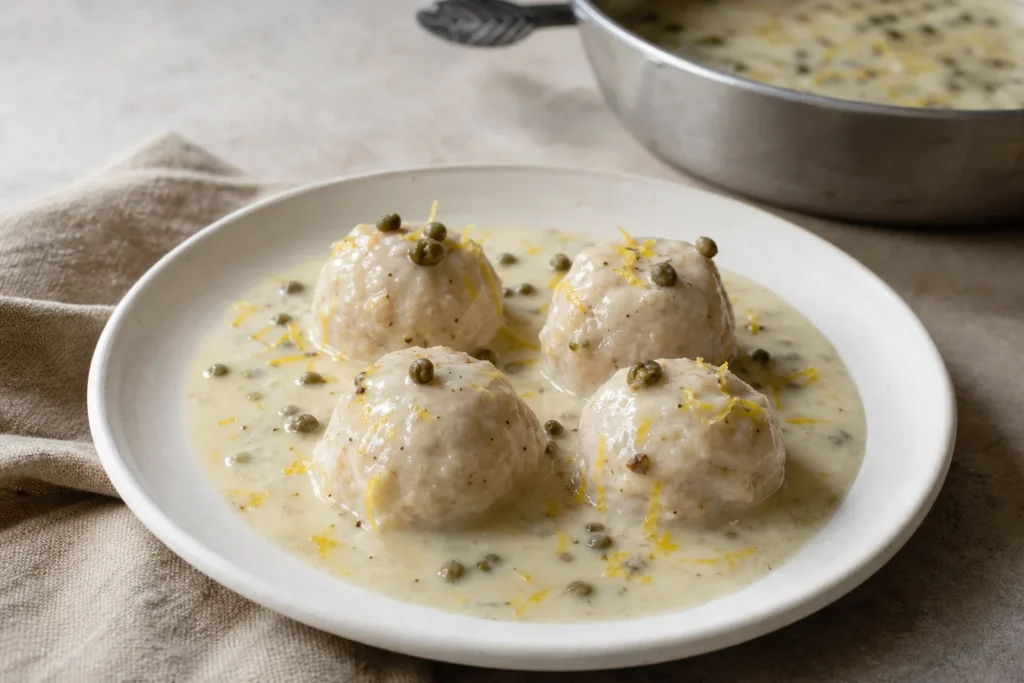
Königsberg Klopse are a classic German dish from East Prussia, named for the city that became Kaliningrad. If you’re interested in making this historical comfort food at home, this guide shows you how to prepare tender meatballs simmered in a delicate broth and finished with a tangy, creamy sauce. The recommended approach is gently poaching the meatballs rather than frying them, which keeps them pale and tender.
This dish works well for 2–4 people as a main course with boiled potatoes or rice on the side. The entire preparation takes under an hour. Königsberg Klopse recipe how to make them starts with simple pantry staples: ground meat, bread, eggs, and capers.
Quick answer: Soak bread, combine with ground beef and pork, onion, eggs and anchovy paste to form meatballs, poach gently in broth, then thicken the cooking liquid with a butter-flour roux and finish with cream, capers and lemon juice. Total time: 45–50 minutes. Cost: ₽₽
At a Glance
| Type | Dishes |
|---|---|
| Local name | Кёнигсбергские клопсы |
| Origin | Königsberg Klopse is a traditional German dish that originated in the city of Königsberg, which is now known as Kaliningrad and is part of Russia. It is a popular dish in German cuisine, particularly in the region of East Prussia. Königsberger Klopse originated in East Prussia and took its name from Königsberg, the former Prussian capital and Baltic port now known as Kaliningrad. In the city itself, the dish was commonly called Saure Klopse, or sour meatballs. |
| Servings | 2–4 servings |
| Total time | 45–50 minutes |
| Difficulty | Easy |
History and Story of Königsberg Klopse, Kaliningrad
The dish has been around for centuries and was traditionally made with veal, gently poached, and served in a pale sauce with capers and lemon. An 1845 recipe from Praktisches Kochbuch für die bürgerliche und feine Küche combines minced beef and pork with eggs, milk-soaked bread, pepper and chopped anchovies. Displaced East Prussians carried Königsberger Klopse into other parts of Germany. The dish became more than a regional specialty: it was a reproducible memory of a home many families could no longer visit.
Ingredients
- 250 g ground beef
- 250 g ground pork
- 1 stale bread roll or 2 slices white bread
- 1 medium onion
- 2 eggs
- 1–2 tablespoons anchovy paste (optional)
- 2 tablespoons capers
- 200 ml heavy cream or sour cream
- 1 litre beef broth
- 2 tablespoons butter
- 2 tablespoons flour
- 1 lemon
How Königsberg Klopse, Kaliningrad Is Made
Step 1: Prepare the bread
Tear the stale bread roll into small pieces or use bread slices. Place in a bowl and cover with water or milk. Let soak for 10–15 minutes until soft. Squeeze out all excess liquid and set aside.
Tip: Day-old crusty white rolls work best. If using fresh bread, it will be too wet.
Step 2: Mix the meatballs
In a large bowl, combine the squeezed bread, ground beef, ground pork, finely chopped onion, eggs, and anchovy paste if using. Mix gently with your hands until just combined—do not overmix or the meatballs will be dense. Season with salt and pepper. Shape into 12–16 golf-ball-sized meatballs.
Tip: If the mixture feels too sticky, add a tablespoon of breadcrumbs. The meatballs should hold together but feel soft.
Step 3: Prepare the broth
Pour beef broth into a large pot and bring to a gentle simmer over medium heat. Do not let it boil hard. Add a quartered onion, 1 bay leaf, and a few whole black peppercorns if you have them.
Tip: Keep the broth at a low simmer—rolling boil will cause the meatballs to break apart.
Step 4: Cook the meatballs
Carefully lower the meatballs into the simmering broth. They should be barely covered. Maintain a gentle simmer, cover the pot partially, and cook for 12–15 minutes until they float and are cooked through. Do not boil vigorously.
Tip: The meatballs will stay pale because they are poached, not browned. This is correct.
Step 5: Remove meatballs and strain broth
Use a slotted spoon to transfer the cooked meatballs to a warm plate. Strain the cooking broth through a fine sieve, discarding the onion, bay leaf and peppercorns. Measure out 300 ml of the strained broth for the sauce.
Tip: Set the meatballs aside and keep them warm, loosely covered with foil.
Step 6: Make the sauce
In a saucepan, melt the butter over medium heat. Whisk in the flour to form a smooth paste (roux) and cook gently for 1–2 minutes without browning. Gradually pour in the reserved warm broth, whisking constantly to prevent lumps. Simmer until the sauce begins to thicken, about 2 minutes.
Tip: Whisk slowly and steadily. If lumps form, strain the sauce through a fine sieve.
Step 7: Finish the sauce
Remove from heat. Stir in the heavy cream or sour cream, capers (with a little brine), and juice from half a lemon. Taste and adjust with a pinch of salt, white pepper, and more lemon juice if needed. Return the meatballs to the sauce and warm gently for 1–2 minutes.
Tip: Add lemon juice gradually—too much will make the sauce sharp and bitter.
Variants
- Using veal instead of beef and pork (traditional but less common today)
- Substituting sour cream for heavy cream (traditional in some versions)
- Adding a pinch of ground nutmeg or allspice to the meatball mixture
- Garnishing with fresh parsley or chives
- Serving with boiled potatoes, rice, or egg noodles instead of plain broth
Common Mistakes to Avoid
- Using hot broth when adding the roux: cold or room-temperature broth whisked slowly into the roux prevents lumps. Adding boiling broth all at once causes the flour to seize.
- Boiling the meatballs hard: vigorous boiling breaks them apart. Keep the heat low and the broth at a gentle simmer only.
- Overmixing the meatball mixture: this makes them dense and rubbery. Mix just until the ingredients are combined.
- Browning the meatballs: frying or browning changes the colour and texture. They should stay pale from poaching.
- Adding lemon juice too early: citrus can curdle cream. Always add it at the very end, off the heat if possible.
- Forgetting the bread: bread soaked and squeezed is essential, not optional. It makes the meatballs tender and light, not dense.
How to Order and Eat It
Königsberg Klopse are eaten as a main course with the meatballs and sauce spooned together onto a plate. Serve alongside boiled potatoes, rice, or egg noodles to absorb the tangy sauce. Eat with a fork and spoon. The sauce is the heart of the dish—do not leave it on the plate.
To order: Кёнигсбергские клопсы [Königsberg Klopse]
Diet and Allergens
- Contains eggs
- Contains anchovies
Russia Vibes Tips
- The pale colour of the meatballs and sauce is intentional and traditional—never brown the meatballs. This sets Königsberg Klopse apart from typical German meatballs.
- Anchovy paste is optional but highly recommended. It dissolves into the meat and adds savoury depth without any fishy taste. Start with a teaspoon and taste the finished sauce before adding more.
- Make the dish a day ahead and reheat gently in a low oven. The flavours meld overnight and the meatballs stay tender. Do not boil the sauce when reheating.
- The capers are not just garnish—their brine contributes to the sauce's tangy flavour. Include some of the liquid from the jar when adding them.
- If you have no bread to soak, fresh breadcrumbs soaked in milk for 5 minutes work as a substitute, but stale bread gives a better texture and is easier to work with.
Explore Nearby Königsberg Klopse, Kaliningrad
Browse more: All Food & Drink · All Food & Drink in Kaliningrad · All Kaliningrad · All Other
FAQ
Can you use all beef or all pork instead of a mixture?
Yes, but veal or a blend of beef and pork gives the best flavour and texture. All pork works well and is common today because veal is expensive. All beef can be dry; if using it, ensure the meat is not too lean.
What is the purpose of the anchovy paste?
The anchovies do not make the dish taste fishy. It adds savoury depth. It dissolves completely into the meat and enhances the overall flavour. Omit it if you have a strong aversion, but add a pinch of extra salt to compensate.
Why do you poach instead of fry the meatballs?
Königsberger Klopse are lighter, softer, and served in a tangy sauce rather than a brown gravy. They're gently poached instead of fried, which gives them a very different texture and flavour.
Can you use sour cream instead of heavy cream?
Yes. Sour cream is traditional in some versions and gives a sharper tang. Use the same amount as heavy cream, but add it off the heat to prevent it from breaking or separating.
What if the sauce breaks or curdles?
If heavy cream curdles, remove it from heat immediately and whisk in a tablespoon of cold milk or broth. If the sauce has lumps from the roux, strain it through a fine sieve. For future batches, keep broth temperature moderate and whisk the roux slowly.
Can you freeze Königsberg Klopse?
Yes. Cook the meatballs and sauce together, cool completely, and freeze in an airtight container for up to 3 months. Thaw slowly in the refrigerator and reheat gently on the stovetop or in a low oven, never at a boil.
What is the traditional side dish?
They are usually accompanied by boiled potatoes or rice. Boiled potatoes are the most authentic choice. Egg noodles or egg pasta are also common in modern versions.
Why is it called 'Klopse'?
The term 'Klopse' refers to the meatballs that are the central component of the dish. The word comes from Swedish köttbullar and refers to the round shape.
Russia Vibes is a one-person project. A coffee keeps it going
How we research and update our guides
About this guide: AI assistance and accuracy
This guide is created with the help of AI and is based on official sources where available. Mistakes can still happen. Opening hours, prices, rules and other details are given to the best of our knowledge as of the date shown and can change without notice. It offers general recommendations only, not professional, legal or travel advice. Please confirm important details with the official source before you travel; you are responsible for your own plans and decisions.

Take this guide with you
Get a free PDF of this guide to print or read offline: key facts, tips and a map link on a few clean pages.
Report an issue on this page
Paying for your trip: please read
International sanctions affect payments between Russia and many other countries. In practice, cards issued in the EU, the UK, the US and several other countries often do not work in Russia, Russian cards usually do not work abroad, and some booking platforms, airlines and payment providers limit or suspend their services for Russia. The situation changes frequently.
We do not give legal or financial advice, and this site does not encourage anyone to break or circumvent sanctions. Whatever you plan, you are responsible for following the laws and regulations that apply to you, including those of your country of residence and citizenship.
Many travelers still organise their stay lawfully. It is worth asking your bank or payment provider what is currently permitted, contacting hotels, tour operators and carriers directly about the payment methods they accept, and checking which services are open to customers from your country. Clarify payment, cancellation and refund terms before you commit to a booking, and keep your plans flexible.
Partner links on this site may not be available in every country, and prices, availability and rules in our guides can differ from what you see when you book.