
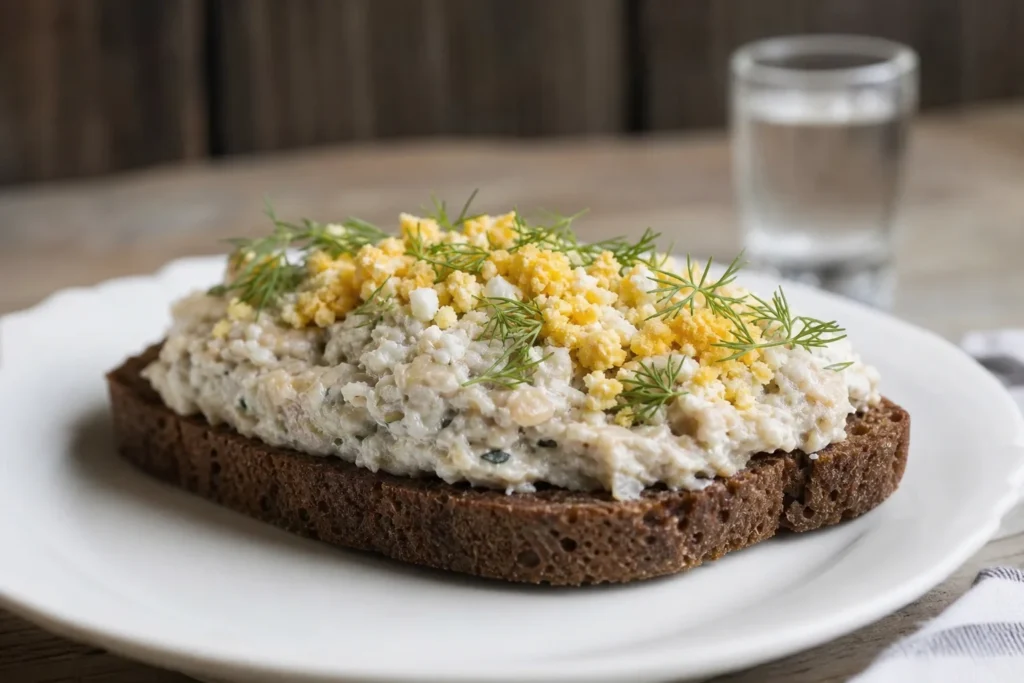
Herring forshmak is a savory appetizer made primarily from chopped salted herring, hard-boiled eggs, onions, apples or potatoes, and bread or soaked matzah, often seasoned with vinegar or oil. If you want to learn how to make herring forshmak Kaliningrad style, this guide takes you through the simple preparation of this classic dish that has roots in the Baltic region.
The dish originates from East Prussia (today part of Poland, Lithuania, and the Russian exclave of Kaliningrad), where it was called vorschmack (which roughly means “appetizer”) and consisted of fried herring. The recommended approach is to prepare it cold as a pâté, the modern Jewish interpretation that became popular in Russia and across the former Soviet Union.
Quick answer: Chop salted herring with hard-boiled eggs, onions, apples, and soaked bread, season with vinegar or oil, and serve cold spread on rye bread or crackers. Total time: 20–30 minutes (most time spent soaking bread and cooling eggs).
At a Glance
| Type | Dishes |
|---|---|
| Local name | форшмак |
| Origin | East Prussia (today part of Poland, Lithuania, and the Russian exclave of Kaliningrad) |
| Servings | 2–4 servings |
| Total time | 20–30 minutes |
| Difficulty | Easy |
History and Story of Herring Forshmak, Kaliningrad
The dish originates from East Prussia (today part of Poland, Lithuania, and the Russian exclave of Kaliningrad), where it was called vorschmack and consisted of fried herring. It originated in northern Germany and came to Russia as part of a foreign cuisine thanks to Peter the Great. At that time, forshmak was a hot appetizer served in Prussia, and so it was in Russia, too.
Forshmak became part of Jewish cuisine around the same time. Under Catherine the Great, Russia introduced the so-called Pale of Settlement, a boundary of territories in the western provinces where Jews were allowed to reside. These regions were not wealthy, which was reflected in their cooking. And so the Jewish version of forshmak uses the most inexpensive products. The dish was adopted and brought eastwards by Ashkenazi Jews which transformed it into a cold appetizer, a pâté made of chopped brined herring.
In a cross-cultural transformation, forshmak was the only Jewish dish to have been assimilated into Soviet cuisine. It remains a popular component of the Russian zakuski tables on holidays and in social gatherings, where it is typically served with shots of vodka.
Ingredients
- 300–400 g salted herring fillets
- 3 hard-boiled eggs
- 1 medium onion
- 1 tart apple (Granny Smith or similar)
- 2–3 slices white bread
- 1 tbsp vinegar or vegetable oil
- Salt and black pepper to taste
- Optional: butter
How Herring Forshmak, Kaliningrad Is Made
Step 1: Soak the bread
Place white bread (crust removed) into a small bowl submerged in room-temperature water and soak for about 10 to 20 minutes until it is completely tender. Drain the bread from the water.
Tip: Squeeze out excess moisture after draining to prevent the forshmak from becoming too wet.
Step 2: Prepare the herring
Rinse the herring fillets under cold water and pat dry with paper towels. Cut them into small pieces. Check for any remaining bones.
Tip: Use lightly salted herring; heavily salted varieties may need an extra soak in water or weak tea to reduce saltiness.
Step 3: Hard-boil the eggs
Boil eggs for 8–9 minutes until fully hard-boiled, then cool in cold water and peel. You can divide them into whites and yolks if you wish to reserve some yolk for garnish.
Tip: Cooling eggs quickly in cold water makes them easier to peel.
Step 4: Chop all ingredients
Place the onion, apple and soaked bread into a food processor and run until the ingredients are finely chopped. Add the herring and pulse the mixture about 5 times until it is finely chopped and incorporated, making sure not to over-process the mixture. Add hard-boiled eggs and pulse a few more times until they are finely chopped and incorporated well.
Tip: If you prefer a chunkier texture, chop ingredients by hand with a knife instead of using a food processor.
Step 5: Season and combine
Transfer the chopped herring mixture into a mixing bowl. Add the vegetable oil or vinegar and stir to combine. Taste for seasoning, adding salt or additional vinegar if needed. Some recipes add a pinch of sugar.
Tip: If your herring was already packed in oil, use vinegar; if it was in brine, use oil for balance.
Step 6: Chill before serving
Refrigerate before serving. The flavours develop as it sits cold.
Tip: Forshmak can be made a day ahead and keeps refrigerated for several days, making it ideal for advance preparation.
Variants
- Lithuanian and Belarusian version: fewer ingredients, seasoned with salt and pepper only, without apples
- Odessa version: includes apples and white bread, more refined preparation
- Meat-based forshmak: combines ground beef or veal with herring (traditional Russian hot version)
- Finnish vorschmack: ground meat mixed with anchovies or sprats, served hot
Common Mistakes to Avoid
- Over-processing the mixture into a paste: forshmak should have some texture from small pieces of herring and egg, not be completely smooth.
- Using very old or extremely salty herring without soaking: this creates an unpalatable dish. Taste the herring first; soak in water or weak tea if too salty.
- Forgetting to squeeze out soaked bread: excess water makes the forshmak wet and muddy rather than spreadable.
- Skipping the cold rest: forshmak tastes better after chilling, as the flavours meld and the texture sets.
- Adding only vinegar or only oil to dried herring: if herring was cooked in oil, add vinegar; otherwise, add oil—balance matters.
- Using sweet apples: the tartness of a sour apple (like Granny Smith) is essential to cut through the richness of herring and eggs.
How to Order and Eat It
The dish is typically served cold, often spread on rye bread or crackers. Forshmak is particularly good served on black Russian bread. It is typically served with shots of vodka as part of Russian zakuski tables on holidays and in social gatherings. Forshmak can also be served as part of a cold appetizer spread with other traditional dishes like pickled vegetables and cured fish. According to Jewish dietary laws, the herring-based forshmak is a pareve (neutral) dish and can be consumed by observant Jews in meals that serve dairy or meat.
To order: Форшмак из селёдки [forshmaak iz selyodkee]
Where to Try Herring Forshmak, Kaliningrad
Kaliningrad
 SEASONS Restaurant, Kaliningrad Baltic, Modern European
Main image: AI-generated illustration. It may not show the place exactly as it looks.
Russia Vibes Tips
- Quality herring matters: use good-quality salted herring from a reliable source. Baltic herring (if available) has a milder flavour than Atlantic varieties.
- Soak old or heavily salted herring in weak tea rather than plain water: this traditional method (mentioned in historical recipes) firms up the fish and reduces excessive saltiness without adding plain water taste.
- Make forshmak the day before: the flavours develop overnight, and it keeps well in the refrigerator for 3–4 days, making it perfect for advance preparation for gatherings.
- Garnish with crumbled hard-boiled egg yolk and fresh dill or scallions just before serving: this adds visual appeal and fresh flavour to cut through the richness.
- If your forshmak is too salty, grate a raw apple and stir it in: the acidity and natural sweetness help balance excessive salt.
- Store in a glass container with parchment paper directly on the surface to prevent the forshmak from drying out or absorbing fridge odours.
Explore Nearby Herring Forshmak, Kaliningrad
Browse more: All Food & Drink · All Food & Drink in Kaliningrad · All Kaliningrad · All Other
FAQ
Is forshmak a cold appetizer or can it be served hot?
As it moved East, it got changed into a cold appetizer made of brined or pickled herring. Old Russian cookbooks, however, feature hot or baked forshmak made with meat, fish or a mix of both. The modern version widely served today is cold, but historical Russian recipes include baked versions.
Does forshmak contain allergens?
Forshmak typically contains fish (herring), eggs, and gluten (from bread). It may be made in facilities that process other allergens. Always check ingredient labels on commercial herring and bread.
Can I make forshmak without apples?
Unlike the Hasidic version, which contains apples and is seasoned with lemon, the Lithuanian and Belarusian version features few ingredients and is only seasoned with salt and pepper. Yes, you can omit apples for a more traditional regional variation, though they add important tartness.
What if I cannot find salted herring?
Use jarred marinated herring or herring in brine (rinse it first), but avoid heavily smoked varieties. The herring should be mild enough that the other ingredients (apple, egg, bread) remain flavourful.
How long can forshmak be stored?
Properly refrigerated in a sealed container, forshmak keeps for 3–4 days. It should not be frozen, as the texture becomes grainy. Keep it covered to prevent it from absorbing fridge odours.
Why is forshmak called an appetizer?
Forshmak is a Yiddish word meaning "foretaste" or "appetizer" that most likely originated from the German word "vorschmack". It is meant to be served in small portions before a meal to stimulate the appetite.
Is forshmak vegetarian or vegan?
No. Forshmak is made from herring (fish) and hard-boiled eggs, so it is neither vegetarian nor vegan. It is, however, kosher pareve (neutral) under Jewish dietary law, as it contains neither meat nor dairy.
What is the difference between forshmak and 'shuba' (dressed herring)?
Forshmak is a smooth chopped pâté spread, typically served on bread. Dressed herring (sel'd pod shuboy) is a layered salad with diced herring, grated vegetables, eggs, and mayonnaise. They are distinct dishes from different traditions.
Russia Vibes is a one-person project. A coffee keeps it going
How we research and update our guides
About this guide: AI assistance and accuracy
This guide is created with the help of AI and is based on official sources where available. Mistakes can still happen. Opening hours, prices, rules and other details are given to the best of our knowledge as of the date shown and can change without notice. It offers general recommendations only, not professional, legal or travel advice. Please confirm important details with the official source before you travel; you are responsible for your own plans and decisions.

Take this guide with you
Get a free PDF of this guide to print or read offline: key facts, tips and a map link on a few clean pages.
Report an issue on this page
Paying for your trip: please read
International sanctions affect payments between Russia and many other countries. In practice, cards issued in the EU, the UK, the US and several other countries often do not work in Russia, Russian cards usually do not work abroad, and some booking platforms, airlines and payment providers limit or suspend their services for Russia. The situation changes frequently.
We do not give legal or financial advice, and this site does not encourage anyone to break or circumvent sanctions. Whatever you plan, you are responsible for following the laws and regulations that apply to you, including those of your country of residence and citizenship.
Many travelers still organise their stay lawfully. It is worth asking your bank or payment provider what is currently permitted, contacting hotels, tour operators and carriers directly about the payment methods they accept, and checking which services are open to customers from your country. Clarify payment, cancellation and refund terms before you commit to a booking, and keep your plans flexible.
Partner links on this site may not be available in every country, and prices, availability and rules in our guides can differ from what you see when you book.