
Updated
Kaliningrad has no metro, so getting around relies on buses (the main system), trams, trolleybuses, and minibuses. There is no single transport card system like in larger Russian cities, but payment is straightforward: tap a contactless card or bank card reader, pay a conductor in cash, or show proof of a Volna Baltiky card (Kaliningrad’s local transport card).
This guide covers using buses, trams and trolleybuses in the city centre and outlying areas. Most journeys take 15–40 minutes depending on distance and traffic.
Quick answer: Buy a Volna Baltiky card or bring a contactless bank card, board at any marked stop, tap to pay, and tap again on exit. Buses run frequently with no exact timetable; trams (routes 3 and 5) run through the centre; minibuses charge more.
At a Glance
| Total time | 5–10 minutes to board; journey time 15–40 minutes depending on route |
|---|---|
| Typical cost | ₽ |
What You Need Before You Start
- Contactless bank card (Russian bank preferred) or Volna Baltiky transport card
- Cash in roubles as backup (not all conductors use card readers)
- Yandex Maps or go2bus app to check route numbers and stops
- Comfortable walking shoes (many bus stops have no shelter)
- Luggage: costs the same as a ticket
Compare Your Options
| Option | Duration | Price | Notes |
|---|---|---|---|
| Bus | Variable; 15–45 minutes depending on distance and traffic | ₽ | Most common option. Over 100 regular routes plus minibuses. Buses run roughly every 10 minutes on main routes. No exact timetable; departure times are approximate. Pay by card, cash or transport card. Frequent stops mean slower journeys but good for short distances. |
| Tram | 25–50 minutes for centre routes | ₽ | Two central routes (3 and 5) run through the city centre. Fixed stops, reliable in bad weather, slower than buses due to street traffic. Same payment system as buses. Popular with locals and tourists for sightseeing. |
| Minibus (marshrutka) | Similar to bus; varies by route | ₽ | Routes 50–99. Faster than buses because they stop on request rather than at every stop. Higher fare than regular buses. No discounts available. Pay to the conductor with card or cash. Good for longer distances if you know where to get off. |
| Trolleybus | 20–40 minutes depending on route | ₽ | Four routes operating since 1975. Modern electric buses run overhead on fixed lines, so they are reliable. Less frequent than buses but faster in congestion. Same payment as buses. Quieter and smoother ride than diesel buses. |
| Taxi or ride-hailing app | 10–25 minutes depending on distance and traffic | ₽₽ | Private taxis have no meters; agree fare in advance. Apps like Yandex Go and Gett operate in Kaliningrad. More expensive than public transport but direct to your destination. Useful late at night when public transport is limited or stopped. |
| Walking | Varies; many sights are 15–30 minutes apart on foot | Free | The city centre is compact and walkable. Good maps app is essential. Shoes with grip help; some streets and squares are cobbled. |
₽ budget · ₽₽ moderate · ₽₽₽ upscale · ₽₽₽₽ splurge. Price levels are estimates compared with typical prices for visitors.
Step-by-Step Instructions
Step 1: Locate your bus stop
Open Yandex Maps or go2bus.ru (select Kaliningrad from the list) and search your route. Note the bus number (route numbers are painted on the side and front). Walk to the marked stop—they are signed with route numbers and timetable boards, though timetables are approximate. Buses run about every 10 minutes on main routes but wait times are unpredictable.
Tip: If unsure of your stop, ask locals or use the Yandex Transport app to see real-time bus positions and remaining stops.
Step 2: Approach the bus
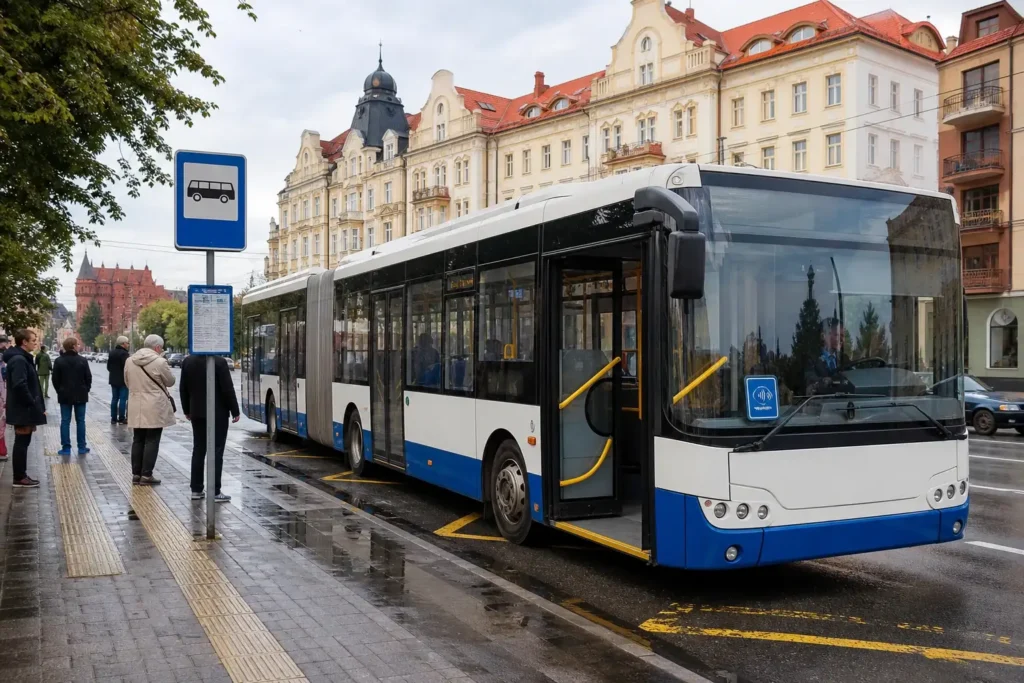
Wave clearly or step back from the kerb to indicate you want to board. The driver will usually stop if they see you. Do not stand in the roadway. Buses (especially large articulated ones) fill quickly during rush hours (8–9 AM and 5–7 PM). Minibuses (routes 50–99) are smaller and faster but stop on request anywhere along the route.
Tip: Avoid standing close to the vehicle until it has fully stopped.
Step 3: Board and tap to pay
Enter through the front door (or middle doors on articulated buses). Look for a contactless payment machine—usually mounted on a pole near the driver. Tap your contactless bank card or Volna Baltiky transport card on the reader. The machine will beep and display confirmation. If using a card, the fare deducts automatically.
Tip: Machines accept tap payments from cards and smartphone wallet payments (Apple Pay, Google Pay via compatible Russian bank apps).
Step 4: Pay by cash if needed
If you do not have a card, a conductor (usually a woman) will walk through the bus collecting fares. Flag them down or they will approach you. Tell them your destination or how many people are travelling. Pay in cash—exact change is not required. They issue paper tickets or mark your payment on a conductor's list.
Tip: Always keep small notes and coins. Not all conductors have change for large notes, and some buses (especially newer ones) rely only on card readers.
Step 5: Exit at your stop
Press the button or cord to signal your stop. Most buses announce stops (in Russian) via a speaker, though it is not always clear. Watch for familiar landmarks or check the Yandex Maps countdown as you approach. Exit through the rear door (or middle doors) when the bus stops. Look behind before stepping into traffic.
Tip: If travelling late, sit near the driver or driver's cabin where it is brighter and busier. Do not sit near the back at night if alone.
Step 6: Tap out if required
Some buses require tapping your card again on exit to complete the payment. If using a conductor or cash, no exit tap is needed—your ticket or payment is final. Check the reader display; if it shows 'tap out', use the same card you tapped on entry.
Tip: Tap correctly to avoid double charges. The machine will beep and show your remaining balance.
Step 7: Using trams
Trams (routes 3 and 5) run through the city centre and are slower than buses but more scenic. Enter from the side door, tap your card on the reader, find a seat, and tap again on exit. Trams stop at fixed stops marked on the street. They are often crowded during rush hours but are reliable.
Tip: Trams run on tracks, so you cannot miss the stop—they follow a fixed route. Use them for longer central journeys where buses may be stuck in traffic.
Step 8: Using trolleybuses
Trolleybuses (overhead electric buses) operate on four routes. They use the same payment system as buses—tap your card or pay cash. Entry and exit is via side doors. Trolleybuses are less frequent than buses but run on a fixed overhead line, so they are reliable in bad weather.
Tip: Trolleybuses are quieter than diesel buses and good for a smoother ride on longer routes.
Common Mistakes to Avoid
- Assuming there is a metro like in larger Russian cities. Kaliningrad has no metro—use buses, trams and trolleybuses instead.
- Not carrying cash or a card. Some older buses lack card readers, and many conductors prefer cash for speed. Always carry both.
- Missing your stop because announcements are in Russian and unclear. Watch the Yandex Maps counter and familiar streets instead. Ask the driver or conductor to announce your stop.
- Boarding a minibus (route 50–99) expecting the same fare as a regular bus. Minibuses charge more. Check the route number first.
- Trying to pay exact bus fare to a conductor—most do not have change. They accept any amount and return change or note your overpayment for a future trip.
- Waiting at an informal stop instead of a marked one. Buses stop at marked stops only (marked with route numbers and shelters). Stand at the marked stop and wave clearly.
- Not tapping your card on exit if prompted. This completes payment and prevents double charges. Check the reader display to see if 'tap out' is required.
Tickets, Payment and Booking
Tickets and payment
- There is no booking or advance ticketing for city buses, trams and trolleybuses. Pay as you go.
- Tap a contactless bank card (from a Russian bank preferred) or smartphone wallet (Apple Pay, Google Pay linked to a Russian bank account) on the reader mounted on the bus.
- Foreign visitors with international bank cards may tap on some readers, but not all machines accept them. Always carry cash as backup.
- Buy a Volna Baltiky transport card at kiosks, metro-style ticket booths or some shops to recharge via a Russian bank account. Tap this card on any reader.
- Pay a conductor in cash if no card reader is working. Conductors board the bus during or after departure and collect fares by walking through.
- No day passes or unlimited tickets are currently sold. Every journey costs one fare.
- Do not buy from unofficial sellers or website brokers. Pay only to the conductor, driver or official payment machines.
- Check the Volna Baltiky app or call the transport authority for current fare updates, as prices change occasionally.
Helpful Links
Compare hotel pricesSearch flights
Advertisement: these are partner links. If you book or buy through them, we may earn a commission at no extra cost to you.
Russia Vibes Tips
- Download the Yandex Maps app before you travel. It shows real-time bus positions, remaining stops, and alerts you when to exit. Go2bus.ru and the Volna Baltiky app are alternatives but Yandex is most reliable and widely used.
- Travel outside rush hours (before 8 AM, between 10 AM–4 PM, after 7 PM) for a less crowded experience and faster movement. Buses are packed during 8–9 AM and 5–7 PM on weekdays.
- Tram routes 3 and 5 pass major city landmarks and are good for orientation and sightseeing, even if not the fastest way to travel. The tram passes the Kaliningrad Cathedral, Königsberg Gate and other historic sites.
- If a bus is full or does not stop, the next one usually arrives within 10 minutes on main routes. Do not chase a moving bus; wait safely at the stop. During heavy rain or snow, buses arrive less frequently due to traffic.
- Carry small roubles for fares if using cash. Notes of 500 or 1000 rubles are harder to break on the bus. Small coins and notes (50–200 rubles) speed up payment.
- If lost, ask the driver or conductor directly—most speak enough English or will point you in the right direction. Kaliningrad locals are generally helpful to confused visitors.
Explore Nearby Use Public Transport in Kaliningrad
Sights near Use Public Transport in Kaliningrad
 Königsberg Cathedral, Kaliningrad · typical visit: 2–3 hoursOpen daily 10:00–19:00
Main image: AI-generated illustration. It may not show the place exactly as it looks.
Browse more: All How-To · All How-To in Kaliningrad · All Kaliningrad · All Metro and Trains
FAQ
Is there a metro in Kaliningrad?
No. Kaliningrad has no metro system. Public transport consists entirely of buses, trams, trolleybuses and minibuses. Buses are the main mode of transport.
Can I use my international bank card to pay on buses?
It depends. Contactless readers on some buses accept international cards, but not all machines do. Always carry cash in roubles as backup. Foreign cards from non-Russian banks often do not work on older readers.
How often do buses arrive?
Buses run approximately every 10 minutes on main routes, but there is no fixed timetable. Frequency depends on the route and time of day. Expect longer waits in the evening or on Sunday. The Yandex Maps app shows real-time predictions.
How much does a bus ticket cost?
A single journey costs the same regardless of distance. Minibuses (routes 50–99) cost slightly more than regular buses. Exact amounts vary occasionally; use the Yandex Maps app or ask locals for current fares. No day passes are sold.
Do I need to tap my card on exit?
Can children or seniors travel for free?
Discounts for children and seniors are not widely published or available to tourists. Residents with local ID cards may qualify, but foreigners are usually charged the standard fare. Check with locals or the Volna Baltiky app for current policy.
What time do buses stop running?
Most buses run from early morning (5–6 AM) until 11 PM or midnight. Night buses do not exist. Late arrivals should use a taxi or ride-hailing app after midnight. Check the Yandex Transport app for your route's last departure time.
Are trams and trolleybuses as frequent as buses?
No. Trams run less frequently than buses (typically every 15–20 minutes) on only two central routes (3 and 5). Trolleybuses (four routes) are also less frequent. For reliability and speed, use buses where possible; use trams and trolleybuses for specific routes or sightseeing.
Russia Vibes is a one-person project. A coffee keeps it going
How we research and update our guides
About this guide: AI assistance and accuracy
This guide is created with the help of AI and is based on official sources where available. Mistakes can still happen. Opening hours, prices, rules and other details are given to the best of our knowledge as of the date shown and can change without notice. It offers general recommendations only, not professional, legal or travel advice. Please confirm important details with the official source before you travel; you are responsible for your own plans and decisions.

Take this guide with you
Get a free PDF of this guide to print or read offline: key facts, tips and a map link on a few clean pages.
Report an issue on this page
Paying for your trip: please read
International sanctions affect payments between Russia and many other countries. In practice, cards issued in the EU, the UK, the US and several other countries often do not work in Russia, Russian cards usually do not work abroad, and some booking platforms, airlines and payment providers limit or suspend their services for Russia. The situation changes frequently.
We do not give legal or financial advice, and this site does not encourage anyone to break or circumvent sanctions. Whatever you plan, you are responsible for following the laws and regulations that apply to you, including those of your country of residence and citizenship.
Many travelers still organise their stay lawfully. It is worth asking your bank or payment provider what is currently permitted, contacting hotels, tour operators and carriers directly about the payment methods they accept, and checking which services are open to customers from your country. Clarify payment, cancellation and refund terms before you commit to a booking, and keep your plans flexible.
Partner links on this site may not be available in every country, and prices, availability and rules in our guides can differ from what you see when you book.