
This guide covers the best historical sites and monuments in Nizhny Novgorod, curated for visitors seeking to understand the city’s strategic importance and cultural heritage. Whether you’re interested in medieval military architecture, Orthodox religious sites, or imperial-era buildings, this list features eleven essential destinations spanning five centuries of Russian history.
Each entry has been selected for its accessibility to visitors, architectural significance, and role in the city’s story—from the founding of Nizhny Novgorod in 1221 to the 19th-century transformation that made it Russia’s greatest trading centre.
At a Glance
| # | Place | Best for | Good to know |
|---|---|---|---|
| 1 | Nizhny Novgorod Kremlin | Medieval fortress, 13 towers | Located at the confluence of two rivers on Kremlevskaya Hill; Kremlin Park metro station. Free to walk the walls and grounds; paid admission for tower exhibitions and archaeological sites. |
| 2 | Church of the Nativity of the Most Holy Mother of God (Stroganov Church) | Ornate religious monument, colourful domes | Located on the Upper Posad (Upper Settlement) overlooking the Volga; Poltavskaya metro station nearby. Paid entry. |
| 3 | Pechersky Ascension Monastery | Ancient spiritual centre, cave church complex | Located on Ilynskaya Hill in the historic centre; Gorkovskaya metro station. Paid admission to some areas. |
| 4 | Nizhny Novgorod Fair (Main Fair Building) | 19th-century trading palace, Classicist architecture | Located in the old Kanavino district on the right bank of the Volga; railway station area. Accessible for events; check official website for current exhibitions. |
| 5 | Alexander Nevsky Cathedral | Byzantine style, 19th-century imperial cathedral | Kanavinsky district near Fair grounds; railway station nearby. Paid admission. |
| 6 | Obelisk to Minin and Pozharsky | 1828 monument, national unity symbol | Located in the Kremlin; nearest to Kremlin Park metro station. Free to view. |
| 7 | Church of St. John the Baptist | Medieval church, historic square location | Located on National Unity Square (Minin and Pozharsky Square) on Rozhdestvenskaya Street. Free or small donation to view. |
| 8 | House of Peter the Great | 17th-century merchant mansion, museum | Historic centre, near Upper Posad; several metro stations within walking distance. Paid entry to museum. |
| 9 | Cathedral of the Archangel Michael | Medieval religious site, Kremlin interior | Inside the Kremlin fortress; enter via Kremlin Park. Paid admission to fortress exhibitions. |
| 10 | Spassky Old Fair Cathedral | Imperial-era cathedral, Fair landmark | Fair area (old Kanavino district); railway station vicinity. Paid admission. |
| 11 | Monument to the Gorky Residents – Valiant Home Front Workers | Soviet memorial complex, Kremlin site | Kremlin; enter via Kremlin Park. Free to view as part of fortress grounds. |
| 12 | Bolshaya Pokrovskaya Street | Historic neighbourhood, 19th-century architecture | Historic city centre; accessible from multiple metro stations including Gorkovskaya. Free to walk and view facades. |
How We Chose
Entries were selected based on:
- Verified current operation and public accessibility
- Architectural or historical significance confirmed by official sources and scholarly research
- Geographic distribution across the main historic districts: the Kremlin, Upper and Lower Posads, and the Fair area
- Relevance to understanding Nizhny Novgorod’s development as a medieval fortress, spiritual centre, and trading hub
- Practical visitability for tourists without specialized access requirements
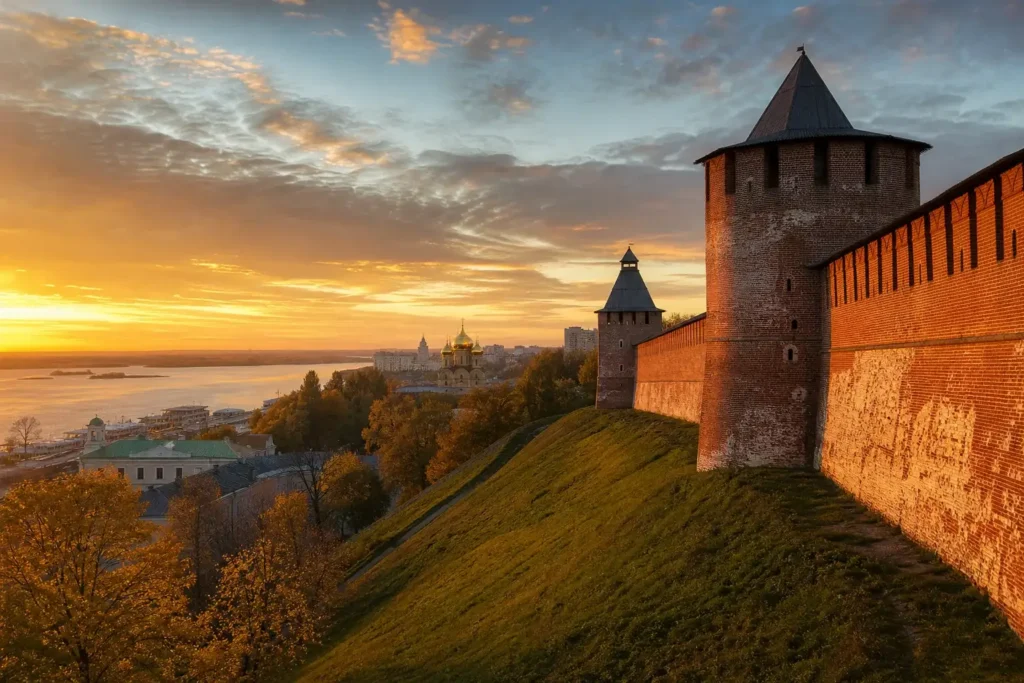
1. Nizhny Novgorod Kremlin – Medieval fortress, 13 towers
The heart of the city and Russia's most formidable eastern defensive fortress, built between 1508 and 1515 under Ivan III by Italian architect Pietro Francesco. The two-kilometer red brick walls, reaching up to 22 meters in height, connect 13 towers, each with its own unique history. The fortress was never captured by the enemy, a testament to its incredible power and well-thought-out design. Walk the ramparts for panoramic views of the Volga and Oka rivers converging below.
Good to know: Located at the confluence of two rivers on Kremlevskaya Hill; Kremlin Park metro station. Free to walk the walls and grounds; paid admission for tower exhibitions and archaeological sites.
Tip: Visit in late afternoon for golden-hour photography of the red brick walls and river views; the fortress is less crowded then, and the light transforms the brick facade.
2. Church of the Nativity of the Most Holy Mother of God (Stroganov Church) – Ornate religious monument, colourful domes
Stroganov Church is a beautiful religious monument in Nizhny Novgorod, called after famous industrialist Grigory Stroganov who lived here in the late 19th century. This fascinating church was built at his expense. The church towers over the riverbank with its wedding-cake layers and multicoloured domes. It is one of the few religious monuments in the city that was not destroyed at the time of the USSR.
Good to know: Located on the Upper Posad (Upper Settlement) overlooking the Volga; Poltavskaya metro station nearby. Paid entry.
Tip: The interior is as ornate as the exterior; climb to the upper levels if allowed to see views of the Volga and the Kremlin from a different perspective.
3. Pechersky Ascension Monastery – Ancient spiritual centre, cave church complex
Founded approximately in 1330, this monastery on Ilynskaya Hill is one of Nizhny Novgorod's oldest spiritual centres. The complex features the Ascension Cathedral with its distinctive architectural style and adjacent supporting churches. The monastery occupies a sacred site that has drawn pilgrims for nearly 700 years and contains multiple shrines and chapels.
Good to know: Located on Ilynskaya Hill in the historic centre; Gorkovskaya metro station. Paid admission to some areas.
Tip: The monastery is less crowded than the Kremlin but equally rewarding; allow time to explore the quiet courtyards and learn about the site's continuous monastic history.
4. Nizhny Novgorod Fair (Main Fair Building) – 19th-century trading palace, Classicist architecture
The Main Fair House is a unique architectural monument located in the city centre. At one time, the greatest fair in the Russian Empire was held in this luxurious building with rich interior. In 1817, Nizhny Novgorod became the country's main trading city. The massive Classicist structure visible from the Kremlin represents the city's pivot from military stronghold to commercial capital. Nowadays, different cultural events are held in this fascinating building.
Good to know: Located in the old Kanavino district on the right bank of the Volga; railway station area. Accessible for events; check official website for current exhibitions.
Tip: View the building's imposing riverside facade from the embankment or cross-Volga bridges; the Fair remains best appreciated from outside unless special events open it to visitors.
5. Alexander Nevsky Cathedral – Byzantine style, 19th-century imperial cathedral
The Alexander Nevsky Cathedral is a Russian Orthodox cathedral church located in the Kanavinsky city district of Nizhny Novgorod, founded on 15 July 1868 by Alexander II of Russia, and consecrated on 20 July 1881. The cathedral is located on the former territory of the Nizhny Novgorod Fair. This grand Byzantine-style edifice replaced earlier fair buildings and stands as a monument to imperial religious authority in a merchant city.
Good to know: Kanavinsky district near Fair grounds; railway station nearby. Paid admission.
Tip: Combine a visit with viewing the adjacent Spassky Old Fair Cathedral for a complete picture of 19th-century religious architecture in the Fair area.
6. Obelisk to Minin and Pozharsky – 1828 monument, national unity symbol
Nizhny Novgorod has preserved from pre-revolutionary times the only monument: an obelisk erected in 1828 in the Nizhny Novgorod Kremlin in honour of the leaders of the people's militia of 1612 Kuzma Minin and Dmitry Pozharsky. In 1612, Kuzma Minin and Prince Dmitry Pozharsky organized an army for the liberation of Moscow from the Poles and Lithuanians. The monument commemorates the city's pivotal role in Russian national history.
Good to know: Located in the Kremlin; nearest to Kremlin Park metro station. Free to view.
Tip: Stand at the obelisk and imagine the thousands of citizens Minin gathered here 400 years ago to march westward and liberate Moscow—a turning point in Russian history.
7. Church of St. John the Baptist – Medieval church, historic square location
The Church of St. John the Baptist is one of the oldest Orthodox churches in Nizhny Novgorod, mentioned from the 15th century. The stone church was consecrated in 1683, again on November 4, 2005. The Church of the Nativity of John the Baptist is one of the city's most famous. This is the spot from which Kuzma Minin encouraged Nizhny's inhabitants to rise up and defend Moscow.
Good to know: Located on National Unity Square (Minin and Pozharsky Square) on Rozhdestvenskaya Street. Free or small donation to view.
Tip: The church sits amid monuments and statues on the square; visit when evening light illuminates the Upper Posad hillside across the Volga.
8. House of Peter the Great – 17th-century merchant mansion, museum
The House of Peter the Great is a symbolic attraction of the city. This is a small stone mansion that was built in the 17th century and belonged to the rich merchant. According to some data, Peter I repeatedly stayed here. Since the 19th century, the historical building serves as a small museum. This modest house illustrates the living conditions of wealthy merchants before the 18th-century transformation.
Good to know: Historic centre, near Upper Posad; several metro stations within walking distance. Paid entry to museum.
Tip: The house is small but atmospheric; it captures the domestic scale of pre-imperial merchant life before Nizhny became a vast trading centre.
9. Cathedral of the Archangel Michael – Medieval religious site, Kremlin interior
The Cathedral of St. Michael the Archangel was built in 1227. Located within the Kremlin fortress, this medieval cathedral is one of the oldest religious structures in the city and reflects the spiritual role the fortress played alongside its military function. The cathedral interior and exterior display centuries of renovation and religious use.
Good to know: Inside the Kremlin fortress; enter via Kremlin Park. Paid admission to fortress exhibitions.
Tip: This site is best explored as part of a full Kremlin visit; combine it with visits to the towers and walls for a complete understanding of medieval city life.
10. Spassky Old Fair Cathedral – Imperial-era cathedral, Fair landmark
The magnificent domed Spassky Old Fair Cathedral was designed by the architect of St Isaac's Cathedral in St Petersburg. Built to reflect imperial architectural standards, this cathedral stood on the grounds of the great annual fair and represents the merger of state power and commercial life in 19th-century Nizhny Novgorod. Its distinctive dome dominates the Fair district skyline.
Good to know: Fair area (old Kanavino district); railway station vicinity. Paid admission.
Tip: The cathedral's dome is visible from across the Volga; photograph it from the embankment or from near the Nizhny Novgorod Fair building.
11. Monument to the Gorky Residents – Valiant Home Front Workers – Soviet memorial complex, Kremlin site
The memorial complex is located on the territory of the Nizhny Novgorod Kremlin opposite the Dmitrievskaya Tower. This 20th-century addition to the Kremlin commemorates the city's (then called Gorky) industrial contribution to Soviet victory in World War II, when the city sent to the front a huge amount of military equipment and ammunition. The monument reflects the city's transformation from merchant centre to industrial powerhouse.
Good to know: Kremlin; enter via Kremlin Park. Free to view as part of fortress grounds.
Tip: The memorial offers reflection on the city's Cold War history and stands in stark contrast to the medieval fortress walls around it—showing how one physical space contains centuries of Russian history.
12. Bolshaya Pokrovskaya Street – Historic neighbourhood, 19th-century architecture
This major street in the historic centre preserves late 19th and early 20th-century merchant buildings, administrative structures, and cultural institutions. Bolshaya Pokrovskaya Street is a lively area home to many restaurants, bars, and historical buildings. Walking this street reveals the urban development that followed Nizhny's boom as a trading centre and provides context for understanding how a medieval fortress city transformed into a modern centre.
Good to know: Historic city centre; accessible from multiple metro stations including Gorkovskaya. Free to walk and view facades.
Tip: Visit early morning or late evening when the street is less crowded; notice the details of building facades—plaques, decorative stonework, and surviving original shopfronts.
Russia Vibes Tips
- Buy a combined ticket for Kremlin exhibitions at the main entrance if you plan to enter multiple towers; this is significantly cheaper than paying for each separately.
- Start at the Kremlin early (around 09:00) to avoid tour groups and see the fortress walls glowing in clear morning light; afternoon tours peak between 14:00–16:00.
- The riverside embankment offers the best photo angles of the Kremlin's red brick walls and towers from across the Volga; plan an early morning or sunset visit for dramatic lighting.
- Many churches require modest dress (covered shoulders and knees); check whether specific sites are open for worship hours before visiting, as some may close during services.
- Most sites are concentrated in two walkable areas: the Kremlin and surrounding Upper Posad, and the Fair district; plan separate half-day visits rather than trying to see everything in one day.
- Bring a good map or use offline maps, as street signs in the old city are sparse and winding lanes can be confusing; key sites have clear directional markers from main streets.
Explore Nearby Best Historical Sites & Monuments, Nizhny Novgorod
Browse more: All Culture Lists · All Guides · All Guides in Nizhny Novgorod · All Nizhny Novgorod
FAQ
Is the Nizhny Novgorod Kremlin a single museum, or are there separate admission areas?
The Kremlin fortress is largely an open archaeological complex where you can walk the walls and grounds for free. Individual towers and exhibition spaces inside charge separate fees; a combined ticket for multiple exhibitions is available at the entrance. Not all towers are always open.
How long does it take to visit the Kremlin?
Allow 1–2 hours to walk the walls, view the Archangel Michael Cathedral, and see the main monuments without entering exhibitions. If you want to enter tower exhibitions and museums inside, add another 2–3 hours depending on your interests.
What is the best time of year to visit these historical sites?
Late spring (May–June) and early autumn (September–October) offer the most comfortable weather and clearest light for photography. Summer can be crowded; winter is cold but provides dramatic skies and fewer tourists.
Can I visit these sites with a guide?
Yes; official English-speaking guides can be arranged at the Kremlin entrance or through hotel concierges. Independent visits are also straightforward as sites are well-signposted and many have informational plaques in English.
Are these sites accessible for visitors with limited mobility?
The Kremlin walls have uneven historic surfaces and steep sections, making full traversal difficult for wheelchair users; however, the main ground level and several exhibition spaces are accessible. Church interiors vary; most have steps. Check with individual sites beforehand.
Which historical sites are free to visit?
Free sites include walking the Kremlin walls and grounds, viewing monuments and memorials in the Kremlin, walking past Bolshaya Pokrovskaya Street facades, and external views of churches. Entering churches, museums, and tower exhibitions requires paid admission.
Are photos allowed in the churches and monasteries?
Photography is generally permitted in main church spaces but often forbidden inside the altar area or during services. Some sites charge a photo fee. Always ask before photographing; flash photography is never permitted inside churches.
How far are these sites from central hotels and public transport?
Most major sites are within walking distance of metro stations or tram stops. The Kremlin is 15–20 minutes walk from the railway station and 10 minutes from Kremlin Park metro. The Fair district is near the railway station. A metro card covers most travel efficiently.
Russia Vibes is a one-person project. A coffee keeps it going
How we research and update our guides
About this guide: AI assistance and accuracy
This guide is created with the help of AI and is based on official sources where available. Mistakes can still happen. Opening hours, prices, rules and other details are given to the best of our knowledge as of the date shown and can change without notice. It offers general recommendations only, not professional, legal or travel advice. Please confirm important details with the official source before you travel; you are responsible for your own plans and decisions.

Take this guide with you
Get a free PDF of this guide to print or read offline: key facts, tips and a map link on a few clean pages.
Report an issue on this page
Paying for your trip: please read
International sanctions affect payments between Russia and many other countries. In practice, cards issued in the EU, the UK, the US and several other countries often do not work in Russia, Russian cards usually do not work abroad, and some booking platforms, airlines and payment providers limit or suspend their services for Russia. The situation changes frequently.
We do not give legal or financial advice, and this site does not encourage anyone to break or circumvent sanctions. Whatever you plan, you are responsible for following the laws and regulations that apply to you, including those of your country of residence and citizenship.
Many travelers still organise their stay lawfully. It is worth asking your bank or payment provider what is currently permitted, contacting hotels, tour operators and carriers directly about the payment methods they accept, and checking which services are open to customers from your country. Clarify payment, cancellation and refund terms before you commit to a booking, and keep your plans flexible.
Partner links on this site may not be available in every country, and prices, availability and rules in our guides can differ from what you see when you book.