
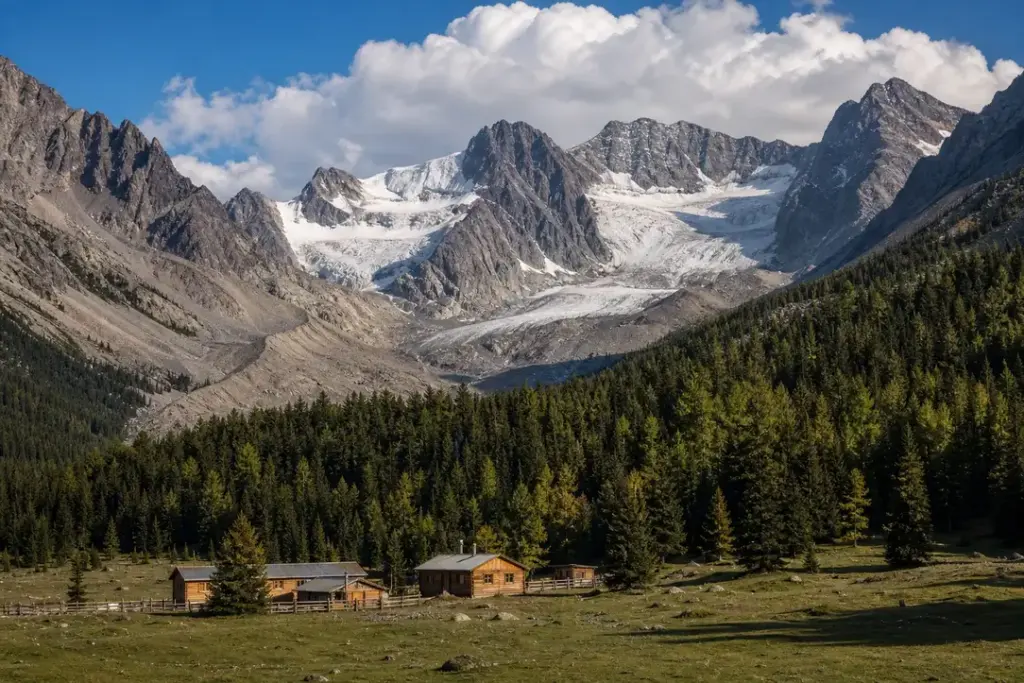
Aktru Glacier sits high in the northern Chuyskiy Range of the Altai Mountains, about 400 km southeast of Gorno-Altaysk along the Chuysky Trakt highway. The site comprises several connected glaciers—Maliy (Small) Aktru, Bolshoy (Big or Large) Aktru, and the separated Leviy (Left) and Praviy (Right) Aktru—that descend from peaks above 3,700 m to valleys around 2,200 m.
The Aktru mountaineering camp, established in 1938, sits at roughly 2,150 m and serves as the gateway to these ice fields. Unlike the more crowded Belukha peak to the west, Aktru remains relatively untouched, making it the destination for serious trekkers and climbers who want an authentic alpine experience.
Quick Facts
| Russian name | Ледник Актру |
|---|---|
| Built / opened | 1938 |
| Address | Aktru Valley, near Kurai, Altai Republic Google MapsApple MapsYandex Maps2GIS |
| Best time to visit | Late June through early September. July and August are warmest; daytime highs reach 15–18°C at camp but can drop to freezing at night. Snow patches linger in gullies until July.June brings wildflowers and long daylight but occasional snow and unstable weather. September offers clearer skies and fewer biting insects but rapidly shortening days and cold nights.Crowds peak in July–early August; late June and September are less busy. The camp operates year-round but winter access is difficult and most facilities are minimal. |
| Recommended duration | 3–6 hours for day hikes; 2–5 days for trekking expeditions |
What Is (and Isn't) Part of a Visit to Aktру Glacier, Altai Mountains?
| Part | Status | Notes |
|---|---|---|
| Maliy Aktru Glacier and moraine hike | Included in the standard ticket | The accessible lower portions and terminal moraine can be visited on foot without special equipment during summer. Ice trekking requires a guide or alpine experience. |
| Blue Lake hike and Bolshoy Aktru Glacier viewpoint | Included in the standard ticket | Day hike from camp; trail is established and marked. Route does not require technical climbing, but altitude and steepness demand acclimatization. |
| Sukhanov Ring circuit and Sachki Lake | Included in the standard ticket | Moderate acclimatization hike around the Aktru Gorge. Suitable for most fitness levels. |
| Technical climbing on peaks (Aktru, Upi, Snezhnaya, Maashey) | Separate ticket or institution | Requires a mountaineering guide, technical climbing skills, and ice climbing equipment. Organized through tour operators. |
| Accommodation in camp huts or tents | Separate ticket or institution | The Aktru camp offers basic wooden huts and tent sites. Bookings typically handled through tour agencies or directly with camp management. |
| Guided multi-day treks to Maashey Gorge or beyond | Separate ticket or institution | Extended treks outside the main Aktru valley require guides, porters and separate booking through trekking operators. |
Why Visit Aktру Glacier, Altai Mountains?
Aktru offers something rare in the Altai: accessibility to high-altitude glaciers without extreme technical difficulty. The most popular hikes—to Maliy Aktru and the vivid Blue Lake at the foot of Bolshoy Aktru—require no climbing equipment, just solid fitness and acclimatization. Summer paths are established across glacier moraines and rocky terrain.
The scenery changes dramatically with altitude, from cedar and larch forests to bare alpine ridges and hanging glaciers. The research station here (run by Tomsk State University) has monitored climate change for decades, and the visible retreat of the glaciers tells a stark story.
Highlights of Aktру Glacier, Altai Mountains
Maliy (Small) Aktru Glacier
The smaller but most accessible glacier, extending from 3,714 m to 2,246 m on the northern slope of the North Chuyskiy Range. Established as a glaciological reference site since the 1950s, this glacier has retreated noticeably in recent decades and remains the subject of constant measurement by researchers. A 2–3 hour walk from camp crosses moraine (loose glacier deposits) and older ice fields.
Tip: Arrive early to see the glacier in clear light before afternoon clouds develop. The surface looks alien and textured up close—bring sturdy boots with good ankle support.
Blue Lake (Goluboe Ozero)
A vivid glacial lake at around 2,870 m altitude, nestled below Bolshoy Aktru Glacier. The water's intense blue-green color comes from suspended glacial silt. The trail gains 700 m elevation over 5 km and is steep, especially the final stretch. Views from the lake overlook the massive glacier and the ragged Aktru peak (4,040 m).
Tip: This hike takes 5–6 hours round trip and demands moderate alpine fitness. Many visitors underestimate the altitude and steepness; acclimatize the day before and start early. Bring sun protection and a windproof layer.
Bolshoy (Big) Aktru Glacier
The largest glacier in the Aktru basin, spanning roughly 6 square kilometers. Once part of a single massive glacier that split during retreat around 1960, it now appears as the Right and Left Aktru divisions. The glacier is visible from the Blue Lake route and dominates the upper gorge landscape with its sprawling white expanse and terminal moraine.
Tip: The glacier is best appreciated from the Blue Lake viewpoint or from the ridge walks that circle the Aktru Gorge. Do not attempt to walk directly onto the ice without a guide unless you are experienced; crevasses can be hidden.
Sukhanov Ring and Sachki Lake Circuit
A moderate 7.5 km circular route starting from the Aktru camp that loops through the Aktru Gorge. It passes Sachki Lake (a small alpine lake with a rest shelter), crosses recent moraine terrain, and reaches a waterfall with a viewing platform. The full circuit takes 2.5–3 hours and requires minimal scrambling.
Tip: This is the best acclimatization hike on arrival day. The viewing platform above the waterfall offers unobstructed views of Small Aktru Glacier and surrounding ridges without the altitude gain of the Blue Lake route.
Alpine Meadows and Cedar Forest Transition Zone
The lower trails pass through stands of Siberian cedar and larch before ascending into bare alpine terrain. This ecotone shows the stark ecological change over just a few hundred meters of elevation gain. Early summer (June–July) brings wildflower blooms in clearings.
Tip: Insects (especially biting midges) are heaviest at dusk near the forest. Start hikes early and bring a head net if hiking in early July. The forest provides shelter if afternoon weather deteriorates.
Aktru Research Station
Located at 2,150 m within the valley, this Tomsk State University facility has continuously monitored glacier mass balance and climate since the mid-20th century. Visitors may glimpse researchers' equipment and field camps, though the station itself is a working scientific site, not a public museum. The archive of measurements provides some of the world's best glacier retreat documentation.
Tip: The 'House of Glaciologists' near camp often displays photographs and simple explanations of glacier dynamics and recent climate trends. Ask camp staff if any researchers are present; some welcome casual conversations.
Atmosphere
Aktru feels like a genuine alpine basecamp: weathered wooden huts and tents scattered across a high valley, surrounded by rock, ice and sky. The Aktru camp occupies a clearing where the forest abruptly yields to bare tundra and scree. In high summer (June–August), the meadows hold wildflowers and birds, but the breeze carries the chill of glacial melt. Mornings are still and translucent; afternoons often bring sudden cloud and wind.
The place draws trekkers and mountaineers rather than casual tourists. Conversations in the banya (sauna) and over camp meals mix Russian, English, and other languages. A peculiar solitude hangs over the upper glacier basins—you may hike for hours seeing only fellow trekkers and the research team. The light in summer never fully disappears; dusk lingers until midnight, and the sky brightens again an hour later.
History of Aktру Glacier, Altai Mountains
Aktru entered the scientific record in 1952, when Soviet glaciologists began systematic measurements on Maliy Aktru. The mountaineering camp was established as early as 1938, making it one of the oldest continuous alpinist bases in the Soviet Union. From the start, the site attracted serious climbers and researchers rather than tourists.
The most dramatic glaciological event on record occurred around 1960–1964, when the single Bolshoy Aktru Glacier split into two separate masses (Left and Right Aktru) as it retreated. This splitting was a visible marker of rapid melt driven by rising regional temperatures. Between 1952 and 2008, the total glacier area in the Aktru basin shrank by about 7.2%, with Maliy Aktru losing roughly 8.6% of its extent. The retreat has been one of the best documented in the world because researchers placed benchmarks (fixed survey points) on the ice and revisited them annually.
Since the early 2000s, the rate of retreat has slowed in some years, though the overall downward trend continues. The Aktru station now sits within Tomsk State University’s Laboratory of Glacioclimatology and remains the main research hub for understanding climate impacts in the southern Siberian mountains. Modern monitoring combines field surveys with satellite data.
Tickets and Booking for Aktру Glacier, Altai Mountains
Aktru Glacier has no entrance fee. Access is on foot from the Aktru mountaineering camp, which sits 8 km inland from the nearest road end. To reach camp, hire a 4×4 vehicle (UAZ or GAZ truck) from Kurai village or book a guided tour from Gorno-Altaysk, Aktash or other Altai towns. Expect 3–4 hours of rough-road driving from Kurai.
Most visitors book multi-day or day-trip packages through tour operators based in Gorno-Altaysk or Novosibirsk. These include vehicle transport, camp accommodation, meals and a guide. Independent visitors can drive their own 4×4 or hire a driver and vehicle locally. A guide is not mandatory for day hikes but strongly recommended given altitude and navigation.
The camp operates year-round, though winter access is difficult and summer (June–September) is the main season. Day hikes can be tackled in a single long day from Kurai, but overnight stays at camp allow acclimatization and a more relaxed pace. Check with local tour operators for current road conditions and camp availability, especially early and late in the season.
Suggested itineraries Aktру Glacier, Altai Mountains
Full day from Kurai
Depart Kurai early (06:00–07:00) in a 4×4. Arrive at camp by mid-morning. Walk the Sukhanov Ring circuit (2.5–3 hours). Return to vehicle by afternoon. Drive back to Kurai by evening. Minimal acclimatization; suited to visitors with 1–2 days in the Altai region.
2 days
Day 1: Drive to camp, settle in, acclimatize with the short Sachki Lake circuit or rest. Day 2: Hike the full Blue Lake route to the glacier viewpoint (5–6 hours) or visit Maliy Aktru Glacier. Overnight at camp. This allows better altitude adjustment before ambitious hiking.
3–4 days
Day 1: Arrive, acclimatize. Day 2: Sukhanov Ring circuit or short Sachki Lake walk. Day 3: Full Blue Lake and Bolshoy Aktru Glacier hike. Day 4: Optional sunrise hike to Maliy Aktru or ridge walk, then drive out. Allows comfortable pacing and flexibility for weather.
5–7 days
Combine day hikes, overnight camping expeditions to Blue Lake region, and optional guided ascents of nearby peaks (Upi, Snezhnaya). Include time for weather delays and full acclimatization. Suitable for trekkers planning onward journeys to Belukha or other Altai highlands.
How to Get to Aktру Glacier, Altai Mountains
Aktru lies roughly 400 km from Gorno-Altaysk (the capital of Altai Republic) along the Chuysky Trakt highway. Most travelers fly into Gorno-Altaysk from Moscow or Novosibirsk, then travel overland.
From Gorno-Altaysk or Novosibirsk: Book a guided tour package (2–7 days, departing frequently in summer) or hire a private driver with a 4×4 vehicle. Tour operators handle vehicle, guide, camp booking and often meals. Day-trip packages leave daily in peak season.
Independent travel: Drive the scenic Chuysky Trakt south toward Kosh-Agach. At Kurai village (about 300 km south of Gorno-Altaysk), turn east toward the Altru Valley. From Kurai to the camp is roughly 30 km of rough road requiring a high-clearance 4×4. Hire a local driver in Kurai (expect moderate cost for a day) or arrange a UAZ rental in advance.
Bus option: A daily bus runs from Gorno-Altaysk toward Kosh-Agach, passing through Kurai. The journey is long and timing is unreliable; most travelers prefer guided tours or private 4×4 hire. From Kurai, arrange 4×4 transport onward to camp.
Accessibility
Aktru is not wheelchair accessible. Access requires a 3–4 hour drive on rough mountain roads and then hiking at altitude (2,150–2,900 m). The camp has basic wooden huts and tent sites with cold water and outdoor toilets. There are no medical facilities; serious illness or injury requires evacuation by helicopter, which is costly and weather-dependent.The Sukhanov Ring hike is suitable for fit hikers of all ages. The Blue Lake route is steep and altitude-dependent; not recommended for those with heart conditions or severe altitude sensitivity. Those with mobility limitations should contact tour operators in advance to discuss individual options.
Food Nearby
The Aktru camp has a communal mess hall and basic kitchen. Most organized tours include meals. Independent visitors should bring sufficient food from Kurai or larger towns, as nothing is sold at camp. Drinking water is available from meltwater streams; boil or filter it.Kurai village (30 km away) has a small shop and simple café. Gorno-Altaysk and larger towns on the Chuysky Trakt offer restaurants and markets for supplies.
What to Bring
Sturdy hiking boots with good ankle support, waterproof jacket, fleece or down layer (nights freeze even in summer), sun hat and sunscreen (intense UV at altitude), water bottle or hydration pack, high-energy snacks, first-aid kit, blister tape, and a headlamp (midnight twilight requires some light). Trekking poles ease steep descents.For overnight trips, a sleeping bag (comfort rating −5°C or lower) and pad are essential. Insect repellent helps in June–July. Bag rules and security: keep valuables and documents in your tent or hut; wildlife is not a concern but petty theft is uncommon in this remote setting.
Best Views and Photo Spots of Aktру Glacier, Altai Mountains
Viewing platform above the waterfall (Sukhanov Ring circuit)
Unobstructed vista of Maliy Aktru Glacier in the distance, the Aktru Gorge cliffs, and lower slopes. The foreground includes the waterfall and cascade, with the glacier visible against the far headwall.
Best time: Late afternoon light (16:00–19:00) when the western sun illuminates the glacier; morning (06:00–09:00) when shadows are long and the sky is clearest.
Blue Lake shoreline
The vivid glacial blue water fills the immediate foreground; Bolshoy Aktru Glacier rises directly beyond, with Aktru peak and surrounding ridges in the background. Dramatic high-altitude landscape.
Best time: Mid-morning (09:00–11:00) when the sun is high and light is neutral, or sunset (19:00–21:00) when the peaks glow golden and the lake is calm and mirror-like.
Sachki Lake rest shelter
Small alpine lake with low relief; surrounding forest and meadow transition zone below. Peaks visible from higher vantage points near the lake.
Best time: Early morning or overcast days when the shallow lake surface reflects the sky and surrounding slopes.
Camp clearing looking toward Aktru peak
Wide panorama of the upper valley with the camp in the foreground, cedar forest giving way to bare slopes, and the Aktru peak massif dominating the distant skyline.
Best time: Sunrise (03:30–05:00 in late June) when mist rises from the valley and the peak catches first light.
Moraine of Maliy Aktru (middle distance)
Barren glacial debris field with ice remnants, sparse pioneer plants, and bare rock walls. Striking abstract landscape showing deglaciation in real time.
Best time: Midday when contrast is high, or overcast when textures in the moraine stand out clearly.
Photography Rules
Photography is unrestricted. The setting offers dramatic contrasts: ice fields, rock, wildflowers and vast sky. Best light is early morning and late evening when the sun rakes the glaciers. Overcast afternoons are common and reduce visibility. Drones are not permitted. Bring a UV filter to protect lenses from intense reflected sunlight off ice and snow.
Family Suitability
Families with children 12+ in good fitness can manage day hikes on the Sukhanov Ring (easy) and lower portions of the Blue Lake trail (moderate). The Sachki Lake walk is accessible for ages 10+. Younger children tire easily at altitude; the 3–4 hour drive on rough roads is uncomfortable and may trigger motion sickness.The camp itself is rustic. There are no specific facilities for young children (changing tables, high chairs). Cold water outdoor showers and basic toilets may deter families seeking comfort. Acclimatization is especially important for children; allow extra rest days. Guides recommend minimum physical fitness for all participants on the Blue Lake hike (700 m elevation gain). Strollers are not feasible.
Russia Vibes Tips
- Acclimatize on arrival. Spend your first day at camp doing the Sukhanov Ring circuit (2.5 hours, minimal elevation gain) rather than rushing to Blue Lake. This cuts altitude sickness risk and makes the next day's longer hike far more enjoyable.
- Start hikes by 07:00–08:00. Afternoon weather deteriorates reliably; afternoon thunderstorms develop on 60% of summer days. An early start gets you above the clouds and back to camp before lightning risk peaks (typically 14:00–18:00).
- Bring more water and snacks than you think necessary. The altitude suppresses appetite but dehydration is common. Drink at least 3 liters daily and eat high-calorie foods (nuts, energy bars, dried fruit) constantly rather than three meals.
- The Maliy Aktru trail is quieter and less crowded than Blue Lake. If you have two days at camp, visit Maliy Aktru in the morning and Blue Lake the next day. The smaller glacier offers equally dramatic ice and moraine views with fewer hikers.
- Hire a guide if it's your first time at high altitude or if weather is uncertain. Guides know safe routes through moraine and can navigate sudden weather; the cost (₽₽) is modest and the safety benefit substantial. Local guides based at camp can be booked on arrival.
- Do not underestimate the chill. Even on sunny days, wind sweeps the upper slopes and temperature drops 10°C in shade. Layer aggressively and keep your windproof jacket accessible at all times, not packed away.
Explore Nearby Aktру Glacier, Altai Mountains
Related guides
 Altai Mountains: Best Places, Scenic Routes and Travel Tips
Main image: AI-generated illustration. It may not show the place exactly as it looks.
Browse more: All Altai Mountains · All Landmarks · All Sightseeing · All Sightseeing in Altai Mountains
FAQ: Aktру Glacier, Altai Mountains
Is Aktru Glacier accessible without mountaineering skills?
Yes. Day hikes to Maliy Aktru Glacier and Blue Lake follow established trails and require no ice axes or technical climbing. However, they do demand moderate fitness and acclimatization to 2,800+ meter altitude. Guided hikes reduce risk and increase enjoyment.
What is the difference between Maliy and Bolshoy Aktru glaciers?
Maliy (Small) Aktru is a 2.7 square kilometer glacier on the north slope of the range. Bolshoy (Big) Aktru is roughly 6 square kilometers and is seen from the Blue Lake trail. Originally one glacier, they split around 1960 as retreat accelerated. Both are impressive, but Blue Lake offers better views of the larger mass.
Can I visit Aktru as a day trip from Gorno-Altaysk?
Technically yes but exhausting. The round-trip drive is 8+ hours, leaving only 2–3 hours for hiking. Most day trips from Gorno-Altaysk are booked through tour operators and involve the Sukhanov Ring hike only. Overnight stays at camp allow proper acclimatization and better hiking.
What is the main hazard at Aktru?
Altitude sickness (caused by rapid ascent to 2,800+ m) and sudden afternoon weather. Crevasses on the main glacier bodies are a risk if you wander off marked paths. Streams can swell with glacial melt during warm afternoons. Hiring a guide and starting early mitigate all three risks.
How much does a guided tour cost?
Multi-day guided packages from Gorno-Altaysk range from moderate to upscale depending on group size, camp accommodation quality, and meals. Day trips are budget to moderate. Inquire with local tour operators for current pricing and availability.
Is the Blue Lake route safe for children?
For fit children 12+, yes, with a guide and acclimatization. The trail is steep and the altitude can trigger headaches or nausea in younger or less-acclimatized kids. Parents must judge their child's fitness honestly; guides cannot be held responsible if children struggle.
Can I climb Mount Aktru (4,044 m)?
Yes, but only with a mountaineering guide and technical climbing skills. The ascent involves rock and ice climbing. It typically requires 3–5 days and is booked separately through specialized alpine operators, not day-trip tours.
Does Aktru Glacier exist year-round?
Yes. The glacier does not disappear, though it retreats annually. It is most accessible June–September. Winter access is possible but roads are hazardous and facilities minimal; only experienced mountaineers should attempt winter visits.
Russia Vibes is a one-person project. A coffee keeps it going

Take this guide with you
Get a free PDF of this guide to print or read offline: key facts, tips and a map link on a few clean pages.
Report an issue on this page
Paying for your trip: please read
Payments and bookings between Russia and many other countries are currently restricted. In practice, cards issued in the EU, the UK, the US and several other countries often cannot be used in Russia, Russian cards usually cannot be used abroad, and some booking platforms, airlines and payment providers limit or pause their services for Russia. The situation changes frequently.
We do not give legal or financial advice, and this site does not encourage anyone to break any rule that applies to them. Whatever you plan, you are responsible for following the laws and regulations that apply to you, including those of your country of residence and citizenship.
Many travelers still organise their stay without problems. It is worth asking your bank or payment provider what is currently possible, contacting hotels, tour operators and carriers directly about the payment methods they accept, and checking which services are open to customers from your country. Clarify payment, cancellation and refund terms before you commit to a booking, and keep your plans flexible.
Partner links on this site may not be available in every country, and prices, availability and rules in our guides can differ from what you see when you book.
How we research and update our guides
About this guide: AI assistance and accuracy
This guide is created with the help of AI and is based on official sources where available. Mistakes can still happen. Opening hours, prices, rules and other details are given to the best of our knowledge as of the date shown and can change without notice. It offers general recommendations only, not professional, legal or travel advice. Please confirm important details with the official source before you travel; you are responsible for your own plans and decisions.
* Affiliate link: as an Amazon Associate we earn from qualifying purchases at no extra cost to you.