
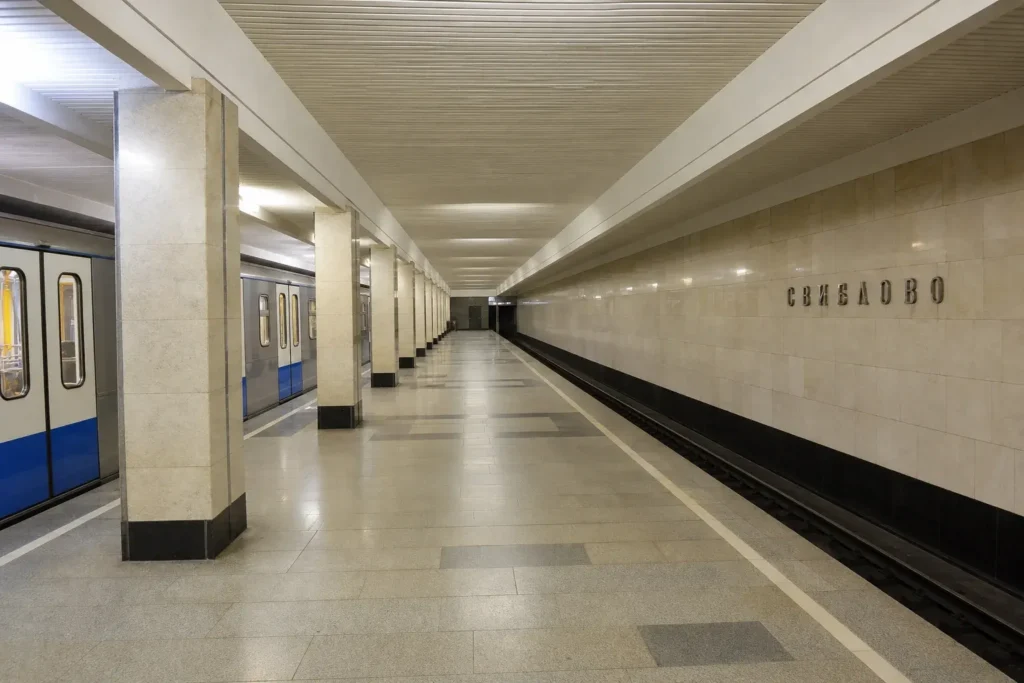
The Nizhny Novgorod Metro opened on 20 November 1985 as Gorky Metro, making it the third metro system in Russia after Moscow and Saint Petersburg. The system operates two lines connecting the Lower City’s industrial neighbourhoods and railway hub with the historic Upper City on the right bank of the Oka River.
Today the network runs 15 stations across 21.6 km. The metro handles roughly 92,700 daily passengers and remains the fastest way to cross the Volga-Oka valley that splits the city. Trains run from early morning until just after midnight, with higher frequency during peak hours.
Quick Facts
| Russian name | Нижегородский метрополитен |
|---|---|
| Type | Transport hub |
| Built / opened | 1985 |
| District | Nizhny Novgorod |
| Opening hours | Daily 05:15-00:15 |
| Admission | ₽ |
| Best time to visit | The metro runs year-round. Passenger volume peaks during morning rush hours (07:00–09:00) and evening rush (17:00–19:00), especially on weekdays. Midday and late evening are quieter. Winter (November–March) brings higher commuter traffic as surface transport is less reliable. Summer (June–August) is slightly quieter. The system is indifferent to weather (being underground), so visit whenever suits your schedule. Saturday and Sunday daytime travel is generally lighter than weekdays. |
How to Get to and from Nizhny Novgorod Metro, Nizhny Novgorod
| Option | Duration | Price | Notes |
|---|---|---|---|
| Single ticket | Valid for one journey | ₽ | Purchased from ticket windows or machine booths at station entrances. Cash or contactless card accepted. Transfer to a connecting line requires a second ticket. |
| Transport card (contactless) | Reloadable | ₽ | Cheapest option for multiple journeys or multi-day visits. Available at ticket booths and kiosks. Can be used on all city transport (metro, buses, trams). Recharge at booths or online (if you have a Russian bank account). |
| Day pass (unlimited travel) | 24 hours | ₽₽ | If available, check at ticket booths. Allows unlimited travel on metro and surface transport within the pass validity period. |
₽ budget · ₽₽ moderate · ₽₽₽ upscale · ₽₽₽₽ splurge. Price levels are estimates compared with typical prices for visitors.
Why Visit Nizhny Novgorod Metro, Nizhny Novgorod?
The Nizhny Novgorod Metro offers an efficient shortcut across one of Russia’s geographically divided cities. Line 1 links the major railway hub at Moskovskaya with the Upper City terminus at Gorkovskaya, crossing the industrial Avtozavod district. Line 2 reaches Strelka, where the Volga and Oka converge. The system is fast, affordable and a practical necessity for exploring different neighbourhoods without relying on surface traffic.
Highlights of Nizhny Novgorod Metro, Nizhny Novgorod
Gorkovskaya Station and the Upper City
Gorkovskaya is the northern terminus of Line 1, opened in 2012, and the sole metro station serving historic Upper City on the right bank of the Oka River. The station lies beneath Gorky Square in Nizhny Novgorod's oldest neighbourhoods. Construction took four years and involved building the Metromost bridge approach. The station is notable as the city's gateway to pre-Soviet monuments and the Kremlin area without crossing to the industrial left bank.
Tip: Exit at Gorkovskaya and walk uphill to reach the Kremlin walls and historic squares; the district has steep streets.
Moskovskaya Station Interchange
Moskovskaya is where Line 1 and Line 2 cross and is the largest metro interchange in Russia by original design criteria. Built in an open cut between 1977 and 1985 with two separate platform levels for each line, the station connects to the Moskovsky Railway Station above (rebuilt 2018) and City Rail terminals. The station's five-span shallow-column hall typifies early Soviet metro engineering.
Tip: Allow extra time to navigate between lines; signage is in Cyrillic, but colour-coded line markings help.
Strelka Station and the River Confluence
Strelka opened on 13 June 2018 as part of preparations for the FIFA World Cup. The station serves the Strelka district where the Volga and Oka rivers converge, an area that has undergone urban renewal. This terminal on Line 2 extends the metro into a previously underserved neighbourhood and is the newest of the system's 15 stations.
Tip: The area above Strelka is a modern embankment and park; bring a camera for river views.
Avtozavodskaya and Komsomolskaya Stations
These paired stations on Line 1, opened 8 August 1987, serve the massive GAZ automobile factory in the Avtozavod district. The names reflect the factory's history and Communist-era nomenclature. Both are shallow-column stations in the industrial south; Komsomolskaya station is named after the factory's checkpoint.
Tip: This district is working-class Nizhny; above ground you see factory walls and residential blocks typical of Soviet industrial neighbourhoods.
Park Kultury Station and Southern Terminus
Park Kultury is the southern terminus of Line 1, opened 15 November 1989, situated at the edge of the Avtozavodsky Culture Park in the city's south. The station was originally planned as Zhdanovskaya during design. A tunnel crack required temporary closure just three days after opening but the line has operated stably since.
Tip: The park above is a local recreation spot; this is the least crowded station, making it good for photos of a quieter Soviet-era platform.
Burnakovskaya and Kanavinskaya on Line 2
These two stations opened together on 20 December 1993, marking the start of Line 2. Burnakovskaya is a three-span shallow-column station with an island platform; Kanavinskaya connects to the railway hub. Both reflect the extended construction timeline from Soviet planning through post-Soviet implementation, with renamed stations reflecting ideology shifts (Kuibyshevskaya became Burnakovskaya).
Tip: Line 2 traffic moves on the left, contrary to other Soviet metros; this was an experimental design choice.
Chkalovskaya, Zarechnaya and Leninskaya on Line 1
Three of the six original stations that opened on 20 November 1985. Chkalovskaya is named after Soviet test pilot Valery Chkalov; Zarechnaya means 'beyond the river'; Leninskaya commemorates Lenin. Together with Dvigatel Revolyutsii, Proletarskaya and Moskovskaya, these formed the first 7.8 km line from downtown to the industrial zone.
Tip: These stations show consistent Soviet-era decoration and are less crowded than modern additions; good for understanding the original metro design.
Burevestnik and Line 2 Extension
Burevestnik (meaning 'petrel') is the western terminus of Line 2, opening on 9 September 2002—a 9-year gap after the initial two stations. Named after Maxim Gorky's novel, the station extends service northwest and was intended to anchor a much longer second line. Construction resumed in stages, with Strelka following 16 years later.
Tip: Burevestnik marks the metro's longest gap between openings; it shows how political priorities shifted construction timelines.
Atmosphere
The Nizhny Novgorod Metro feels like a functional, working transit system without the monumental grandeur of Moscow. Stations are quiet compared to major metro cities, with local commuters rather than crowds of tourists. Platforms are lit in flat Soviet-era fluorescents, tiled in pale colours, with no ornate mosaics or sculpture.
During peak hours (07:00–09:00 and 17:00–19:00), trains fill with factory workers and office employees. Off-peak, you may share a train car with only a handful of other passengers. The sound is the rumble of heavy Soviet rolling stock, the screech of brakes at platforms and the hiss of opening doors. Announcements are in Russian only; station names are repeated in Cyrillic script on signage and electronic displays.
The system feels Soviet in origin and Soviet in pace—functional, no-frills and punctual. Graffiti is minimal. The air smells of metal and concrete rather than perfume or food.
History of Nizhny Novgorod Metro, Nizhny Novgorod
Planning for a metro in Gorky (as Nizhny Novgorod was called from 1932 to 1990) began in the Soviet era, but serious construction started late. On 17 December 1977, the first piles for Leninskaya station were driven into the ground, marking official commencement of Line 1. The scale of the undertaking was enormous: the metro had to tunnel under a major city split by two rivers and cope with difficult geology.
Tragedy struck during construction. On 13 July 1984, walls collapsed in the pit at Moskovskaya station, killing two student workers who were assisting the construction brigade. Gorky residents thereafter spoke of student ghosts haunting the tunnels—a legend that persists in local folklore, though historically unverified.
On 20 November 1985, the Gorky Metro opened to the public with Line 1’s first section: a 7.8 km line with six stations running from Moskovskaya through the lower city to Park Kultury. Extensions followed: Avtozavodskaya and Komsomolskaya opened 8 August 1987; Kirovskaya and Park Kultury were extended 15 November 1989. The system was renamed Nizhny Novgorod Metro when the city recovered its historical name in 1990.
Line 2 development proved slower. After extended Soviet-era planning, construction began in the early 1990s. Two stations, Kanavinskaya and Burnakovskaya, opened 20 December 1993, creating the second line. Burevestnik followed nearly a decade later on 9 September 2002. The most recent expansion came in 2012, when Gorkovskaya station opened on 4 November, finally connecting the metro to the Upper City. The Strelka station opened 13 June 2018, coinciding with the FIFA World Cup, extending Line 2 to the Volga-Oka confluence.
Tickets and Payment at Nizhny Novgorod Metro, Nizhny Novgorod
Tickets and Payment: Tickets are purchased at manned windows or automated booths at every station entrance. Single tickets or reloadable contactless transport cards are the standard options. Russian citizens and certain foreign residents (with residency registration) receive discounts; verify your eligibility at the booth.
Machines accept coins and banknotes; some accept contactless payment. English instructions are typically not available on machines, so asking a booth attendant is safer. The contactless card (Активная карта) is cheaper per journey than single tickets and works on all Nizhny public transport.
Foreigners without Russian bank accounts cannot automatically recharge cards online but can reload them at any station booth or ticket kiosk. Bring small bills or use the machine change feature carefully.
For all ticket categories, concessions and current fares, visit the operator’s official website (search for Nizhegorodskoye Metro); tariffs and policies change and may vary by residency status.
Flights, Transfers and Planning
How to Get to Nizhny Novgorod Metro, Nizhny Novgorod
The metro has 15 stations spread across two lines. Every significant neighbourhood, railway hub and business district has an interchange or nearby station.
From Nizhny Novgorod Railway Station (Moskovsky Vokzal): Exit the station building and enter the metro directly via Moskovskaya station (Line 1 or Line 2). No separate walk is needed—the station is integrated into the station complex.
From City Centre: Leninskaya and Chkalovskaya stations on Line 1 serve downtown. Gorkovskaya (opened 2012) is the gateway to the historic Upper City and Kremlin.
From Strelka (Volga-Oka confluence): Take Line 2 to Strelka station (newest, opened 2018). The embankment and riverside parks are immediately above ground.
Metro entrances are marked with a large Cyrillic M. Follow the signage (colour-coded by line) down stairs or escalators to platforms. Exits are similarly marked; most lead to major streets and squares above.
Accessibility
The metro system was not designed with modern wheelchair accessibility standards. Stations are accessed by stairs and escalators only; no lifts are provided at most stations. Gorkovskaya, the newest station (2012), may have partial accessibility features, but this should be verified directly with the operator. People with mobility difficulties should enquire at Moskovskaya (the main interchange and railway hub station) about any available options or assistance.
Food Nearby
No food vendors operate inside metro stations or tunnels. Cafes and food options cluster around major stations above ground—near Leninskaya, Moskovskaya and Gorkovskaya. Railway station buffets and small shops are located in the Moskovsky Vokzal complex connected to Moskovskaya. Kiosks selling drinks and snacks operate in station halls but are limited.
What to Bring
Bring small coins or banknotes for a single ticket if using a cash booth; machines may have limited change. A reloadable transport card is more convenient for repeat trips. Comfortable walking shoes are advisable as platforms are level but crowds at peak hours require patience. The system runs from 05:15 to 00:15; plan late-night travel accordingly, as alternatives (taxis, walk) may be necessary after midnight.
Photography Rules
Photography is permitted inside stations and on trains for personal use. Flash photography may disturb other passengers but is not prohibited. Tripods are not typically allowed on platforms or in tunnels due to safety regulations. Ask station staff if unsure. No restrictions apply to exterior station photos.
Family Suitability
The metro is suitable for families with children. Stations are safe and well-lit. Prams can be carried down stairs or taken on escalators (keeping them to the side). Children under a certain age (typically under 7) may travel free or at reduced fare—check the operator's website for current policy. The system is efficient and fast-moving, so journey times are short. However, stations lack baby-changing facilities, so plan ahead. Peak-hour crowding is intense and may be uncomfortable with small children.
Russia Vibes Tips
- Line 2 traffic moves on the left (counter to other Soviet metros). When standing on a platform, remember trains approach from the opposite side—keep alert when boarding.
- Station names on signs are in Cyrillic only. Learn the Cyrillic names of your destination or screenshot the station name to show a local if you need directions.
- The system is small but useful: Moskovskaya is the primary interchange; Line 1 connects downtown to south; Line 2 reaches the river confluence (Strelka) and north. Plan routes by landmark neighbourhood, not by distant stops.
- Contactless cards are cheaper than single tickets but require Russian banking setup to reload online. Buy a card and reload at station booths for repeat visits.
- Running times shift in late evening. Trains become less frequent after 22:00; if you must travel late, verify the next train time at the platform display before the previous train departs.
- Moskovskaya can be confusing: trains for Line 1 and Line 2 use separate platform levels. Signage uses colour-coding; follow the red M for Line 1, blue M for Line 2.
Where to Find Nizhny Novgorod Metro, Nizhny Novgorod in Russia
More chains in Russia
 Central Market Transport Hub, Irkutsk
Main image: AI-generated illustration. It may not show the place exactly as it looks.
 Yunost Island Pier, Irkutsk
Main image: AI-generated illustration. It may not show the place exactly as it looks.
Related guides
 Gorkovskaya: Metro Access to Nizhny Novgorod’s Upper CityOpen daily 05:15–00:15
Main image: AI-generated illustration. It may not show the place exactly as it looks.
 Kanavino, Nizhny Novgorod: Fair, Station and Riverbank History
Main image: AI-generated illustration. It may not show the place exactly as it looks.
 Bolshaya Pokrovskaya: Nizhny Novgorod’s Historic Pedestrian Street
Main image: AI-generated illustration. It may not show the place exactly as it looks.
 Unity Day Celebrations in Nizhny Novgorod: History and Observance
Main image: AI-generated illustration. It may not show the place exactly as it looks.
 Andrey Sakharov Festival: Classical Music and Human Rights in Nizhny Novgorod
Main image: AI-generated illustration. It may not show the place exactly as it looks.
Browse more: More in Nizhny Novgorod · All Airports & Transport · All Airports & Transport in Nizhny Novgorod · All Nizhny Novgorod · All Other Hubs
FAQ: Nizhny Novgorod Metro, Nizhny Novgorod
Is the Nizhny Novgorod Metro easy to navigate for tourists without Russian?
Moderately. All station names are in Cyrillic script on signs and on train announcement displays. There are only 15 stations and two lines, so the system is small. Learn your destination station name in Cyrillic or take a screenshot. Most locals are helpful if you show a written station name, though English speakers are few. The colour-coded line system (red, blue) helps identify routes visually.
What is the cheapest way to use the metro?
Buy a reloadable contactless card (Активная карта) at any station booth and load it with credit. Fares per journey are lower on a card than single cash tickets. Reload at station booths with cash. For a one-time visit, a single ticket is adequate but costs slightly more.
Can I transfer between lines without buying a new ticket?
No. Each journey, even with a transfer between lines, requires either a separate ticket or use of a contactless card (which deducts fare once per journey, not per line). Plan accordingly and purchase a card for multiple trips.
What time does the metro open and close each day?
The system opens at approximately 05:15 and closes at approximately 00:15 (just after midnight). The exact times may vary slightly by day, so check current schedules at station information booths or the operator's website if planning late-night travel.
How often do trains run?
During peak hours (morning and evening commute), trains run every few minutes. Off-peak (midday, night), intervals are longer—typically 10–15 minutes. Late evening after 22:00, frequency decreases further. Schedules are posted at platforms and on electronic displays.
Is the metro accessible for wheelchair users?
The system has limited accessibility. Most stations access only by stairs and escalators, with no lifts. The newest station, Gorkovskaya (2012), may have improved access, but this must be verified directly with the operator. Contact the metro information line before planning a visit if accessibility is essential.
Does the metro connect to the railway station?
Yes. Moskovskaya station (served by both Line 1 and Line 2) is directly integrated with Moskovsky Vokzal (Nizhny Novgorod Railway Station). Exiting the train station leads directly to the metro platforms; no separate walk is necessary.
Where can I buy a metro ticket?
At manned ticket windows or automated booths located at the entrance to every station. Booth staff can explain fare options (single tickets vs. reloadable cards). Machines accept coins and banknotes; some accept contactless card payment. Staff can assist in English only at major hubs like Moskovskaya.
Russia Vibes is a one-person project. A coffee keeps it going
How we research and update our guides
About this guide: AI assistance and accuracy
This guide is created with the help of AI and is based on official sources where available. Mistakes can still happen. Opening hours, prices, rules and other details are given to the best of our knowledge as of the date shown and can change without notice. It offers general recommendations only, not professional, legal or travel advice. Please confirm important details with the official source before you travel; you are responsible for your own plans and decisions.

Take this guide with you
Get a free PDF of this guide to print or read offline: key facts, tips and a map link on a few clean pages.
Report an issue on this page
Paying for your trip: please read
International sanctions affect payments between Russia and many other countries. In practice, cards issued in the EU, the UK, the US and several other countries often do not work in Russia, Russian cards usually do not work abroad, and some booking platforms, airlines and payment providers limit or suspend their services for Russia. The situation changes frequently.
We do not give legal or financial advice, and this site does not encourage anyone to break or circumvent sanctions. Whatever you plan, you are responsible for following the laws and regulations that apply to you, including those of your country of residence and citizenship.
Many travelers still organise their stay lawfully. It is worth asking your bank or payment provider what is currently permitted, contacting hotels, tour operators and carriers directly about the payment methods they accept, and checking which services are open to customers from your country. Clarify payment, cancellation and refund terms before you commit to a booking, and keep your plans flexible.
Partner links on this site may not be available in every country, and prices, availability and rules in our guides can differ from what you see when you book.