

Khachapuri is the national dish of Georgia, and in Sochi—a Black Sea resort city just south of the Caucasus—it has become a local staple. The Adjarian version, boat-shaped and topped with a raw egg and butter, is the most iconic form you’ll find in Sochi restaurants and street vendors. This how-to guide teaches you how to make khachapuri at home, using a simple yeast dough and a blend of melted cheeses that create that characteristic molten, buttery center.
You will achieve a complete dish ready to serve, with a crispy-edged dough boat and a warm, runny yolk that mixes into the cheese. The recommended approach uses instant yeast for speed and common cheeses that replicate the traditional Georgian blend.
Quick answer: Make a yeast dough, fill it with a blend of mozzarella and feta cheese, shape it into an open boat, bake until the cheese melts, then top with a raw egg and butter. Total time: approximately two and a half hours. Serves two to four people.
At a Glance
| Type | Dishes |
|---|---|
| Local name | Хачапури |
| Origin | Khachapuri probably dates back to the 12th century when Georgia experienced a period of renaissance, though the first written record of the dish dates to 1725. The word "khacha" in Georgian means "curdled cheese" and "puri", which comes from India and means "bread". Given Adjara's location on the Black Sea, it is said to be a representation of a boat, the sea, and the sun. In 2014 during the Olympic Games in Sochi, 175,000 units of khachapuri were sold in restaurants in the Russian city, which has many gastronomic traditions in common with Georgia. |
| Servings | 2–4 people |
| Total time | 2 hours 15 minutes to 2 hours 30 minutes |
| Difficulty | Easy |
History and Story of Khachapuri, Sochi
Khachapuri holds a special place in Georgia’s heart as its national dish and has even earned a spot on the list of Georgia’s intangible cultural heritage. Adjarian khachapuri, originating from Adjara, is a boat-shaped khachapuri with cheese, butter, and an egg yolk in the middle. Traditionally, tangy imeruli and sulguni cheeses are used. Each Georgian region has developed its own variation—the Imeretian version is round and completely enclosed, while the Megrelian style has extra cheese on top. The earliest forms of this dish likely emerged in the mountainous regions of Georgia, where shepherds would prepare simple flatbreads filled with local cheeses. These early iterations were practical, providing sustenance for those who worked long hours in the fields or tended to livestock.
Ingredients
- 350 g all-purpose flour
- 160 ml warm milk
- 1 tbsp olive oil
- 1 tsp instant dry yeast
- 1 tsp salt
- 1 tsp sugar
- 300 g low-moisture mozzarella cheese, shredded
- 150 g feta cheese, crumbled
- 2–4 eggs (one per serving)
- 30 g butter
- Salt and black pepper to taste
How Khachapuri, Sochi Is Made
Step 1: Prepare and activate the dough
In a large mixing bowl, combine the warm milk with salt, sugar, and instant yeast. Stir gently until the yeast dissolves, about one minute. The milk should be warm to the touch but not hot—around 38–43°C (100–110°F). If it is too hot, it will kill the yeast; if too cold, it won't activate.
Tip: Use a thermometer if you have one, or test with your finger; it should feel comfortably warm, like a bath.
Step 2: Mix the dough
Sift the flour into the milk mixture one-third at a time, whisking as you go. After incorporating all the flour, add the olive oil. Using your hands or a dough hook, knead the mixture for 5–8 minutes until it becomes a smooth, elastic dough that pulls away from the sides of the bowl. The dough should be slightly sticky but manageable.
Tip: If the dough sticks too much to your hands, dust with a little extra flour, but do not add too much or the bread will become dense.
Step 3: Let the dough rise
Transfer the dough to a lightly oiled bowl, turning it to coat all sides. Cover the bowl with plastic wrap or a damp kitchen towel. Leave it in a warm spot—a kitchen counter away from drafts or near (but not directly on) a radiator—for 45–60 minutes, or until the dough has roughly doubled in volume. Poke it gently with your finger; it should spring back slowly.
Tip: If your kitchen is cold, place the covered bowl inside a turned-off oven with just the oven light on to create a warm environment.
Step 4: Prepare the filling
While the dough rises, combine the shredded mozzarella and crumbled feta cheese in a bowl. Mix gently with your hands or a spoon until evenly distributed. Do not compress or overmix; the cheese should remain loose. Set aside. This filling will melt into a creamy sauce as the khachapuri bakes.
Tip: If your feta is very wet, drain it on paper towels first to prevent excess moisture in the filling.
Step 5: Shape the khachapuri into boats
Divide the risen dough into two equal portions (for generous servings) or four equal portions (for smaller servings). On a lightly floured work surface, gently stretch and flatten each piece into a rough oval about 15 cm long. Fold the longer sides inward slightly, rolling them toward the center and leaving a gap of about 5 cm down the middle. Twist the ends gently to seal them, creating a boat shape with an open channel in the center for the cheese filling.
Tip: Work gently to avoid deflating the dough. If it springs back, let it rest for two minutes before reshaping.
Step 6: Fill and bake
Place the boats on a baking sheet lined with parchment paper. Divide the cheese filling equally among the boats, piling it into the central channel. Preheat your oven to 200°C (400°F). Bake the khachapuri for 15–18 minutes, or until the dough is light golden and the cheese is bubbling at the edges. The filling should look molten but not brown.
Tip: Keep an eye on the oven; every oven bakes differently. You want the cheese to bubble, not split or char.
Step 7: Top with egg and butter, then finish baking
Remove the khachapuri from the oven. Working quickly, crack one egg over the center of each boat, letting it settle on top of the molten cheese. Add a small pat of butter (about 7–8 grams) on top of the egg. Return to the oven for 3–4 minutes, just until the egg whites are set but the yolk remains runny and glossy. Remove and serve immediately while hot.
Tip: If you prefer the yolk slightly firmer, leave it in the oven for one more minute, but do not exceed five minutes total or the yolk will be fully cooked.
Variants
- Imeruli khachapuri: round, closed flatbread filled entirely with cheese, most common in western Georgia
- Megruli khachapuri: round shape with extra cheese layered on top as well as inside
- Achma: square, multi-layered preparation resembling lasagne, served at celebrations
- Gurian khachapuri: crescent-shaped, filled with cheese and chopped boiled eggs
- Ossetian khachapuri: filled with potato and cheese instead of cheese alone
Common Mistakes to Avoid
- Using milk that is too hot (above 46°C) when activating the yeast. This kills the yeast and the dough will not rise. Let the milk cool slightly before mixing if it has just been heated.
- Opening the oven door repeatedly while the khachapuri bakes, causing temperature drops and uneven cooking. Resist the urge to check until the dough is golden.
- Filling the cheese cavity too high before baking. When it melts, it can overflow onto the baking sheet. Pile it into a generous mound, but stay within the boat edges.
- Adding the egg at the beginning of baking instead of the end. If the egg cooks for the full baking time, the yolk will become hard. Add it only in the final few minutes.
- Using pre-shredded bagged cheese, which contains anti-caking agents (often starch) that prevent smooth melting. Always shred cheese from a block or use fresh soft cheese like feta.
- Skipping the rest period after shaping. Dough needs a short rest after reshaping before baking, or the boats will shrink in the oven and the filling will become too concentrated.
How to Order and Eat It
Eating Adjarian khachapuri involves mixing the egg yolk with the cheese and butter just before indulging, and then tearing bits of the crusty bread to dip into this creamy, savory filling. This interactive dining experience is part of the charm, highlighting both the culinary flair and social aspect of Georgian dining. The boat arrives at the table steaming. Pierce the runny yolk with your fork or the edge of a torn piece of crust so it mixes into the melted cheese and butter. Tear off pieces of the crusty bread edges and use them to scoop up the molten filling. Eat while hot; khachapuri hardens quickly as it cools. It is traditional to sit down and share one boat with a friend or family member.
To order: Хачапури [khachapuri]
Diet and Allergens
- vegetarian
- contains dairy
- contains egg
- typically contains gluten
Where to Try Khachapuri, Sochi
Nizhny Novgorod
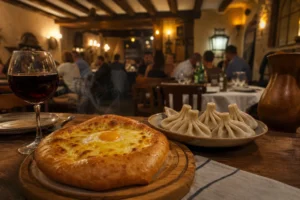 Khachapuriya, Nizhny Novgorod Georgian
Main image: AI-generated illustration. It may not show the place exactly as it looks.
Russia Vibes Tips
- In Sochi, khachapuri is sold in bakeries and restaurants throughout the city, especially near the waterfront and in residential neighborhoods. If you do not want to make it from scratch, look for a bakery (булочная) advertising 'Хачапури' or stop at a Georgian restaurant. It costs significantly less to buy than to dine.
- The egg should always be raw when it hits the hot cheese. Some recipes call for cooking it separately or adding it earlier; do not follow these. The interaction between the raw egg and molten cheese is essential to the dish's character.
- If you cannot find true Georgian cheeses like sulguni or imeruli (which is difficult outside Georgia and the Caucasus), a blend of low-moisture mozzarella and crumbled feta is the closest accessible substitute. The mozzarella provides stretch and mildness; the feta adds the tangy saltiness.
- Khachapuri is best eaten immediately after baking. If you must reheat leftover khachapuri, place it in a warm (160°C) oven for 5–8 minutes with a cover to prevent the crust from hardening further. The filling will not restore its original ooze, but it will warm through.
- For a richer, more indulgent version, use salted butter for both the filling mix and the final topping, and add a pinch of dried dill or minced chives to the cheese. These are optional but traditional touches.
Explore Nearby Khachapuri, Sochi
Browse more: All Food & Drink · All Food & Drink in Sochi · All Other · All Sochi
FAQ
Can I make khachapuri with regular yeast instead of instant yeast?
Yes, but it will take longer. Active dry yeast requires a proofing step: dissolve it separately in warm water with a pinch of sugar and wait 10 minutes until foamy before adding it to the other ingredients. The total rising time may extend to 90 minutes or more. Instant yeast mixes directly into the flour and dough, saving time.
What if my egg yolk cooks completely during baking and is no longer runny?
This means the egg was in the oven too long. For next time, add the egg only in the final 3–4 minutes of baking, after the cheese is already bubbling. If it happens once, simply crack a fresh raw egg into the center when you remove the khachapuri from the oven and the residual heat will warm it without cooking the yolk fully.
Is khachapuri vegetarian?
Yes, most traditional khachapuri is vegetarian, made from dough, cheese, egg, and butter. However, some modern variations or restaurant preparations may include meat. Always check if you have dietary restrictions.
Can I freeze khachapuri dough to make it later?
Yes. After the first rise, divide and shape the dough into boats, place them on a baking sheet, cover tightly with plastic wrap, and freeze for up to three months. Thaw at room temperature or in the refrigerator for 4–8 hours, then fill and bake as normal. The thawed dough may need a brief 15-minute rest before filling if it has not fully returned to room temperature.
What is the difference between Adjarian and Imeruli khachapuri?
Adjarian khachapuri is boat-shaped, open-faced, and topped with a raw egg and butter at the end. Imeruli khachapuri is round and completely enclosed with cheese mixed inside; no egg is added to the top. Adjarian is more visually striking and popular in restaurants; Imeruli is more common for everyday eating in Georgia.
Why does my cheese filling escape from the sides during baking?
The boat walls may be too thin or the filling too abundant. When shaping, ensure the walls are at least 1 cm thick and roll them up firmly to contain the filling. Do not overfill; pile the cheese to a mound, but keep it within the boat boundary. If overflow still occurs, reduce the oven temperature by 10°C and extend baking by 2–3 minutes to allow the dough to set before the cheese fully melts.
Can I make khachapuri with other types of cheese?
The traditional blend is imeruli and sulguni, which are tangy Georgian cheeses. Outside Georgia, a mix of mozzarella and feta works best because it mimics the texture and flavor. Ricotta or goat cheese can replace feta for a softer filling. Do not use very hard cheeses like Parmesan, as they do not melt smoothly into the creamy sauce that defines khachapuri.
How do I know when the dough has risen enough?
The dough should roughly double in size, and when you poke it gently with a floured finger, the indentation should spring back slowly over a few seconds. If it springs back immediately, it needs more time. If the indentation stays, it may be overproofed; try shaping it anyway, as the second rise (before baking) is often shorter and can still yield good results.
Russia Vibes is a one-person project. A coffee keeps it going
How we research and update our guides
About this guide: AI assistance and accuracy
This guide is created with the help of AI and is based on official sources where available. Mistakes can still happen. Opening hours, prices, rules and other details are given to the best of our knowledge as of the date shown and can change without notice. It offers general recommendations only, not professional, legal or travel advice. Please confirm important details with the official source before you travel; you are responsible for your own plans and decisions.

Take this guide with you
Get a free PDF of this guide to print or read offline: key facts, tips and a map link on a few clean pages.
Report an issue on this page
Paying for your trip: please read
International sanctions affect payments between Russia and many other countries. In practice, cards issued in the EU, the UK, the US and several other countries often do not work in Russia, Russian cards usually do not work abroad, and some booking platforms, airlines and payment providers limit or suspend their services for Russia. The situation changes frequently.
We do not give legal or financial advice, and this site does not encourage anyone to break or circumvent sanctions. Whatever you plan, you are responsible for following the laws and regulations that apply to you, including those of your country of residence and citizenship.
Many travelers still organise their stay lawfully. It is worth asking your bank or payment provider what is currently permitted, contacting hotels, tour operators and carriers directly about the payment methods they accept, and checking which services are open to customers from your country. Clarify payment, cancellation and refund terms before you commit to a booking, and keep your plans flexible.
Partner links on this site may not be available in every country, and prices, availability and rules in our guides can differ from what you see when you book.