
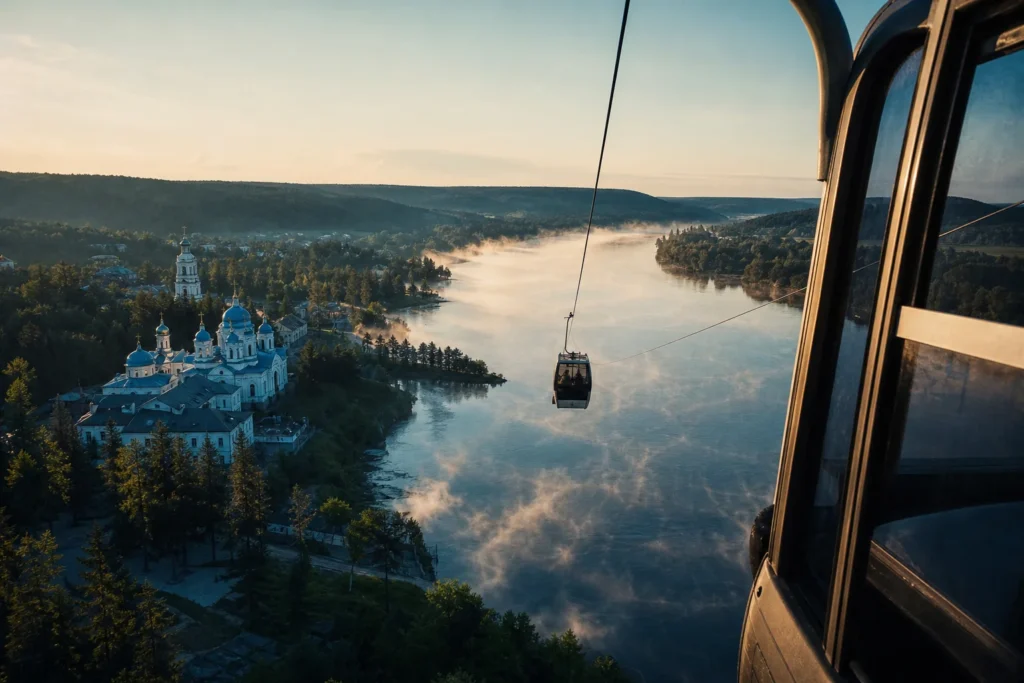
Bor sits across the Volga River from Nizhny Novgorod, directly reachable by a soaring aerial tramway that holds the record for Europe’s longest unsupported span over water. For most visitors, this Bor day trip works as a half-day excursion from the larger city—a chance to step away from the crowds and explore a quieter, often overlooked side of the Volga.
The town feels refreshingly unpretentious. A handful of Orthodox churches, a brick museum of Soviet military hardware, a pine-forested park, and the riverbank itself are the main attractions. Most visitors can walk the core in 3–4 hours on foot, making Bor ideal for those wanting a break from urban sightseeing without traveling far.
Quick Facts
| Russian name | Бор |
|---|---|
| Distance from the nearest major city | 420 km |
| Travel time from the nearest major city | 5–6 hours by train to Nizhny Novgorod, then 15–20 minutes by cable car or bus |
| Address | Bor, Nizhny Novgorod Oblast, Russia OpenStreetMap · Google Maps |
| Best time to visit | Spring (April–May) and autumn (September–October) offer mild weather and clear skies; the river and forests are especially beautiful. Summer (June–August) is warmest but can be humid; parks are crowded with local families on weekends. Winter (November–March) is cold and gray, though the cable car ride is surreal in snow. Weekday mornings are quietest; weekends bring day-trippers, especially Saturday and Sunday afternoons. |
| Recommended duration | 4–5 hours |
What Is (and Isn't) Part of a Visit to Bor, Nizhny Novgorod?
| Part | Status | Notes |
|---|---|---|
| Cable Car Ride (both directions) | Included in the standard ticket | One ticket covers the round-trip journey across the Volga. |
| Museum of Military Equipment in the Open Air | Separate ticket or institution | Requires a separate paid admission ticket; not included in cable car fare. |
| Bor Local Lore Museum | Separate ticket or institution | Separate paid admission required. |
| Church visits (Assumption, Sergiyevskaya Sloboda, others) | Included in the standard ticket | Entry to active Orthodox churches is free, though donations are customary. Photography inside may be restricted. |
| Walking parks and riverbank areas | Included in the standard ticket | Mokhovyye Gory park, town center, riverfront, and monuments are free to access. |
| Nizhny Novgorod Kremlin and other Nizhny Novgorod attractions | Outside / not part of it | Bor is a separate destination across the river. Nizhny Novgorod's attractions require a return journey and separate tickets. |
How to Get from the nearest major city to Bor, Nizhny Novgorod
| Option | Duration | Price | Notes |
|---|---|---|---|
| Cable Car from Nizhny Novgorod | 5 minutes ride; 5–10 minutes walk to cable car station from Nizhny Novgorod center | ₽ | The aerial tramway departs regularly throughout the day (frequency varies seasonally; check locally). This is the most scenic and memorable way to arrive. The cable car station on the Nizhny Novgorod side is accessible from the central waterfront near the Kremlin. Return by the same route. |
| Bus or Minibus from Nizhny Novgorod | 20–30 minutes depending on route and traffic | ₽ | Several bus routes cross the Volga bridges and connect Nizhny Novgorod's center to Bor. This is cheaper than the cable car but lacks views. Local bus stations and kiosks sell tickets; ask at your hotel or hotel desk for the correct number. Buses run regularly but less frequently than in the city center. |
| Taxi or Ride-Share from Nizhny Novgorod | 15–25 minutes depending on traffic and starting point | ₽₽ | A private vehicle offers flexibility and comfort, especially if you're traveling with luggage or want to set your own schedule. Apps like Yandex.Taxi operate in Nizhny Novgorod and can find drivers to Bor. Agree on the fare in advance if using a street taxi. |
₽ budget · ₽₽ moderate · ₽₽₽ upscale · ₽₽₽₽ splurge. Price levels are estimates compared with typical prices for visitors.
Why Visit Bor, Nizhny Novgorod?
The cable car alone is worth the crossing: the 861-meter ride across the Volga offers unobstructed views and a genuine adrenaline rush. Bor’s quiet charm—tree-lined streets, modest Orthodox churches, and the hum of a real working town—provides a contrast to Nizhny Novgorod’s louder tourist infrastructure.
The city is known as Russia’s “Glass Capital” because of its historic glassworks, which has supplied automotive glass to European manufacturers. Visitors who enjoy off-the-beaten-path exploration will find Bor refreshingly free of souvenir shops and tour buses. The Museum of Military Equipment in the Open Air is quirky and absorbing, and the natural beauty of Mokhovyye Gory (Moss Mountains) offers riverside hiking.
Highlights of Bor, Nizhny Novgorod
Cable Car (Nizhny Novgorod–Bor Cableway)
The soaring aerial tramway spans 861 meters above the Volga—the longest unsupported span over water in Europe. The ride takes about 5 minutes and climbs steeply, offering bird's-eye views of the river, cliffs, and both banks. The cable car was opened in 1967 and modernized since. It connects the historic Nizhny Novgorod side to Bor's main district. The experience feels thrilling and retro at once. Arrive early or late in the day to avoid crowded periods.
Tip: Sit on the left side of the cabin for views toward Nizhny Novgorod's skyline. On windy days, the car may rock noticeably—exhilarating for some visitors, unsettling for others with vertigo.
Museum of Military Equipment in the Open Air
An unconventional open-air museum displaying Soviet-era tanks, helicopters, artillery, and armored vehicles in a large courtyard. The collection captures Cold War and Afghan War hardware in various states of preservation and decay, which paradoxically adds to its appeal. Visitors can walk around freely and sometimes climb on or peer inside older pieces. The museum sits a 10-minute walk from the cable car station and requires its own ticket. Expect 45 minutes to an hour here.
Tip: Go early in the morning when the light is better for photography and before school groups arrive. The site has minimal shade; bring water and a hat.
Church of the Assumption of the Blessed Virgin Mary
A traditional Russian Orthodox church with a white-washed exterior and golden cupola, located in the town center near the cable car station. The interior features icon-filled wooden iconostasis and soft candlelight. Built in its current form in the 19th century, it remains an active parish church. Visitors should remove shoes and dress modestly; women may be asked to cover their heads. It typically closes midday and reopens for evening services.
Tip: Visit in the late afternoon when the golden light hits the white walls and golden domes. If the doors are locked during the day, a caretaker usually appears if you ring the bell.
Sergiyevskaya Sloboda Church Complex
A riverside church ensemble featuring a blue-and-white chapel and adjacent monastery buildings on a small rise. The complex is older and more weathered than the central Assumption Church, with charm deriving partly from its restored-yet-humble appearance. It overlooks the Volga and sits in a quieter part of town, about 15–20 minutes' walk from the main cable car area. The setting is peaceful and less visited than other churches.
Tip: The approach path is steep and unpaved; wear proper shoes. The complex is most picturesque in late-afternoon sun. Combine this with a walk through nearby Mokhovyye Gory for a natural extension.
Mokhovyye Gory (Moss Mountains) Park
A natural forest park with pine and birch trees, walking trails, and riverbank views. Despite the modest name, it is a genuine break from town noise—locals call it the "lungs" of Bor. Several trails wind through the woods and descend to rocky Volga-side clearings. The park sits north of the central town, about 20–25 minutes' walk from the cable car. It requires no admission and is free to explore.
Tip: Morning is best for wildlife spotting and photography. The trails are muddy after rain; wear good footwear. Bring a picnic if you want to sit by the water.
Bor Local Lore Museum
A small municipal museum housed in a Soviet-era building, displaying historical artifacts, photographs, and exhibits about the city's glass and industrial heritage. The collection includes traditional crafts, Soviet-period objects, and displays on local history. The museum is understated and rarely crowded. It is located inland from the cable car, about 10 minutes' walk, and requires a separate admission ticket. Plan 45 minutes to an hour.
Tip: The labeling is in Russian; a basic guide (in English or other languages) may be available at the desk. Photography may be restricted inside; ask first.
Monument to St. Sergius of Radonezh
A bronze statue of the medieval saint Sergius, erected in a small plaza in the town center. Sergius is the patron of the Sergiyevskaya Sloboda complex. The statue is simple and powerful, and the plaza is a natural gathering point and photo spot. It sits within easy walking distance of the cable car station and takes only a minute to view, but it anchors the town's spiritual identity.
Tip: The plaza is often quiet in the early morning; visit then for clear photographs without crowds.
Volga Riverbank and City Center
Bor's waterfront and town center blend into one continuous, walkable zone. Tree-lined streets, small cafés, a local market, and modest shops occupy the area around International and Pushkin streets. The Volga shoreline offers views back toward Nizhny Novgorod's dramatic escarpment. There are benches, small parks, and riverside paths where locals stroll. This area costs nothing to explore and captures the authentic rhythm of a Russian provincial town.
Tip: The city center fills with local shoppers on Saturday mornings; if you prefer quieter exploration, visit on a weekday or early morning.
Atmosphere
Bor feels like a working town untouched by tourism machinery. Streets are quieter than Nizhny Novgorod’s center; you hear birdsong as often as car horns. The river is ever-present—a constant visual reference point, especially from higher streets where the Volga stretches northward in a wide, slow curve.
Weekday mornings are peaceful, with occasional walkers and cyclists; late afternoons bring schoolchildren and after-work strollers. The cable car station buzzes briefly during changeovers, then settles. Churches anchor neighborhoods with subdued bells and the scent of incense on service days. Local cafés are modest, catering to residents rather than visitors. The overall mood is reflective, even melancholic in its way—a place where time moves slightly slower than elsewhere.
History of Bor, Nizhny Novgorod
Bor’s recorded history is shorter than Nizhny Novgorod’s. The town was formally established in the 18th century as a settlement on the Volga’s left bank, though the area had long been inhabited. The real growth came in the 19th century with the arrival of glass manufacturing, which became the economic heart of the town and continues to define its identity today.
The Orthodox churches visible today—including the Church of the Assumption and Sergiyevskaya Sloboda—date primarily to the 19th century, though they replaced or reused earlier religious buildings. They reflect the piety and prosperity that early glass merchants brought to the settlement.
In the Soviet era, Bor was formalized as a “satellite city” (sputnik) of Nizhny Novgorod, a concept that designated it as a companion urban center dependent on but separate from its larger neighbor. The cable car, completed in 1967, became a symbol of this relationship, literally connecting the two cities. Industrial expansion during this period built out Bor’s modern districts and cemented its role as a glass and manufacturing hub. The Museum of Military Equipment preserves hardware from the Soviet military-industrial complex, reflecting the era’s technological and ideological priorities.
Today, Bor remains economically tied to its glass industry and to Nizhny Novgorod’s orbit, but it has retained a distinct, quieter character. Residents cherish the town’s slower pace and river setting, even as the larger neighbor across the water has modernized rapidly.
Tickets and Booking for Bor, Nizhny Novgorod
| Ticket | Price | Includes |
|---|---|---|
| Cable Car (round-trip) | ₽ | One complete journey from Nizhny Novgorod to Bor and return. Tickets are purchased at the cable car station on either bank. |
| Museum of Military Equipment in the Open Air (admission) | ₽ | Access to the outdoor military hardware museum and grounds. |
| Bor Local Lore Museum (admission) | ₽ | Entry to the town history museum; guided tours may be available for a small additional fee (ask at the desk). |
₽ budget · ₽₽ moderate · ₽₽₽ upscale · ₽₽₽₽ splurge. Price levels are estimates compared with typical prices for visitors.
The cable car operates daily, typically from morning until evening (exact hours vary by season). Tickets are bought on-site at the cable car station on either bank immediately before boarding; no advance online booking is required. The museum and local lore museum have separate on-site ticket booths. If you speak no Russian, the staff at these venues usually speak basic English or can show you an information leaflet. Church visits are free but donations are appreciated. For current opening hours and any temporary closures, check locally at your hotel in Nizhny Novgorod or call ahead to the Bor tourism office (contact details available through Nizhny Novgorod’s main tourism website).
Plan and Book
Suggested itineraries Bor, Nizhny Novgorod
3–4 hours on site
Start with the cable car (30 minutes round-trip, including boarding). Walk to the Assumption Church in the town center (10 minutes). Visit the Military Equipment Museum (50 minutes). Lunch at a local café. Walk the riverbank and Volga viewpoints (30 minutes). Return via cable car or bus. This pace allows time for photos and short breaks without rushing.
Half day (5–6 hours on site)
Morning cable car crossing. Visit the Assumption Church and Sergiyevskaya Sloboda complex (1 hour combined). Explore the Local Lore Museum (45 minutes). Lunch at the town center (1 hour). Walk Mokhovyye Gory park and riverbank (1–1.5 hours). Return via cable car late afternoon. This covers the main sights without fatigue.
Full day from Moscow
Take a 5–6 hour train from Moscow to Nizhny Novgorod (early morning or overnight). Arrive in Nizhny Novgorod by late morning. Spend 1–2 hours in the Kremlin area if time allows. Take cable car to Bor around midday. Follow the half-day Bor itinerary above (5–6 hours). Return to Nizhny Novgorod by evening train. This requires careful timing; overnight rail is often more practical.
How to Get to Bor, Nizhny Novgorod
From Nizhny Novgorod city center to Bor:
- Cable car (recommended): The cable car station is located on the Nizhny Novgorod waterfront near the Kremlin and Central Embankment. Walk from the Kremlin area downhill toward the water; signs point to the cableway station (Kanatnaya doroga). The journey takes 5 minutes. On the Bor side, exit the cable car station and follow the main pedestrian paths downhill into the town center (about 5–10 minutes’ walk).
- Bus or minibus: From Nizhny Novgorod’s central areas, look for buses heading to Bor (ask locals or at your hotel). They typically depart from major intersections or transit hubs. Journey time is 20–30 minutes depending on traffic.
- Taxi or ride-share: Use the Yandex.Taxi app or hail a street taxi. Specify “Bor” or a destination in Bor (e.g., “Cable Car Station Bor” or “Town Center Bor”). Journey time is 15–25 minutes.
- Personal vehicle: Rent a car in Nizhny Novgorod and drive across one of the Volga bridges to Bor’s main districts. Parking is available in the town center and near attractions.
Accessibility
The cable car is accessible but involves stairs at the station and a step-up into the cabin; mobility-impaired visitors may find this challenging without assistance. The town center is mostly flat and walkable on paved streets. The Museums of Military Equipment and Local Lore have level or ramp access at their entrances; check with staff about elevator availability inside. Church interiors may have steps; many Orthodox churches do not accommodate wheelchairs easily. Mokhovyye Gory park trails are steep and unpaved, not suitable for wheelchairs or strollers. Public restrooms are limited; ask at cafés or museums.
Food Nearby
The town center around International and Pushkin streets has local cafés, small restaurants, and a market (Central Market). Options range from traditional Russian food (borscht, pelmeni, cutlets) to simple fast food and pizza. Bakeries sell fresh bread and pastries. There are no internationally known restaurant chains in central Bor, but modest family-run establishments serve good, inexpensive meals. Bring water and snacks if spending the full day, especially if exploring Mokhovyye Gory park, which has no food vendors.
What to Bring
Comfortable walking shoes (trails and riverbanks are uneven and muddy in wet weather). A light jacket or sweater even in warm months; riverside areas are cooler and windier. Sun protection (hat, sunscreen) for the cable car and open areas. Water bottle (refill at cafés). A small day pack for the museum and walking. Binoculars for bird-watching in the park. Modest dress (long skirts or trousers, covered shoulders) if entering Orthodox churches; women may wish to bring a scarf for head-covering. The cable car is secure; bags are not X-rayed.
Best Views and Photo Spots of Bor, Nizhny Novgorod
Cable Car mid-span
From inside or during the ride, the Volga stretches in both directions with the Nizhny Novgorod escarpment visible on the far bank. The perspective is unique—few other vantage points offer this aerial view of the river.
Best time: Early morning or late afternoon for soft, golden light. Midday sun creates harsh shadows inside the cabin.
Sergiyevskaya Sloboda Church, riverside view
The blue-and-white chapel framed by pine trees, with the Volga in the background. This composition captures Bor's quiet, devotional atmosphere.
Best time: Late afternoon when the sun illuminates the white walls and golden domes; the church glows against the darker water.
Mokhovyye Gory park, forest clearing overlooking the Volga
Birch and pine trees frame a view down to the water, with the opposite bank in the distance. The natural composition is intimate and peaceful.
Best time: Early morning when mist rises from the water and light filters through the canopy. Autumn (September–October) adds golden leaf color.
Town center, Volga riverbank promenade
Local life—fishermen, walkers, benches—with the Nizhny Novgorod skyline visible across the water. This captures Bor's everyday character.
Best time: Evening, just before sunset, when the light is warm and locals are out walking.
Photography Rules
Photography is permitted outdoors throughout Bor and on the cable car (tripods not allowed on the cable car). Inside churches, photography is often prohibited or restricted; ask permission before shooting. The Military Equipment Museum and Local Lore Museum may restrict flash or indoor photography; check at the entrance. Drones are not permitted in populated areas.
Family Suitability
Bor is family-friendly for ages 6 and up. The cable car excites children and is safe with supervision. Mokhovyye Gory park is ideal for running and playing, though trails are steep for very young legs. The Military Equipment Museum appeals to children interested in tanks and aircraft. Church visits are possible if children can sit quietly for a short time. The town center is safe and pedestrian-friendly; stroller access varies on unpaved paths and church steps. Cafés are welcoming but often modest in amenities. A half-day visit suits families well; a full day can tire younger children.
Russia Vibes Tips
- Time your cable car crossing for early morning or late afternoon. Midday brings tour groups and the sun is harsh. The light during golden hour (before sunset) is spectacular from the cable car and frames Bor's churches beautifully.
- Start at the cable car station and walk the town in a loose circle: down to the central Assumption Church, then toward Sergiyevskaya Sloboda or the Military Equipment Museum, then back via the riverbank. This avoids backtracking and creates a natural flow.
- The Museum of Military Equipment is quirky and singular—very few tourists know about it. Go early before school groups arrive, and bring a camera; the hardware is photogenic and the open-air setting is atmospheric.
- Most signage and menu boards in Bor are in Russian only. Download a translation app (Google Translate camera mode works well) for menus and directions. Staff at the cable car and museums usually understand basic English or gestures.
- If you've rented a car in Nizhny Novgorod, drive to Bor and park in the town center (parking is free and plentiful). This gives you flexibility to visit Mokhovyye Gory and return at your own pace without waiting for buses.
- Don't miss the walk along the Volga riverbank—it's free, peaceful, and offers the best light for photography. Locals fish and rest here; sitting on a bench with a view is as valid a use of time as museum visits.
Explore Nearby Bor, Nizhny Novgorod
Browse more: All Day Trips · All Day Trips in Nizhny Novgorod · All Hidden Russia · All Nizhny Novgorod
FAQ: Bor, Nizhny Novgorod
Is Bor worth visiting if I'm only in Nizhny Novgorod for one day?
Yes, but budget 3–4 hours. Take the cable car first (memorable in itself), walk the town center and one church, then return. Skip the museums if time is tight. The cable car ride alone justifies the trip.
Do I need to book cable car tickets in advance?
No. Buy tickets on-site at the station. The cable car runs throughout the day; wait times are usually short except on busy weekend afternoons. In summer, go early or late.
What is the 'Glass Capital' reference all about?
Bor has been famous for glass manufacturing since the 19th century. A major glassworks factory here supplies automotive glass to European car makers. Visitors rarely see the factory itself (it's an industrial facility), but the heritage is part of local identity and explained in the Local Lore Museum.
Can I have lunch in Bor, or should I eat in Nizhny Novgorod?
Simple, affordable lunch is available in Bor's town center—local cafés serve Russian food. Quality is decent, prices low. For sit-down dining, eat before leaving Nizhny Novgorod or eat casually in Bor and rely on Nizhny Novgorod's restaurants for dinner.
Is the Military Equipment Museum indoors or outdoors?
Outdoors. Tanks, helicopters, and artillery are displayed in an open courtyard. There's minimal shade. Bring a hat and water, especially in summer. Rain makes the site muddy but not inaccessible.
Are the Orthodox churches open to visitors, or only for worship?
Both. Churches are active parishes, so they host services (usually mornings and evenings). Visitors may enter during services or quiet hours to look around. Dress modestly; women may be asked to cover their heads. Photography inside is often prohibited; ask first.
How long does the cable car ride take?
About 5 minutes each way. Loading and unloading add another 5–10 minutes. The entire experience (wait, ride, exit) typically takes 15–20 minutes.
Can I walk from Nizhny Novgorod to Bor instead of taking the cable car?
No. The Volga is wide and bridges are for vehicles only. The cable car or bus/taxi are the only practical options. The cable car is far more scenic.
Russia Vibes is a one-person project. A coffee keeps it going
How we research and update our guides
About this guide: AI assistance and accuracy
This guide is created with the help of AI and is based on official sources where available. Mistakes can still happen. Opening hours, prices, rules and other details are given to the best of our knowledge as of the date shown and can change without notice. It offers general recommendations only, not professional, legal or travel advice. Please confirm important details with the official source before you travel; you are responsible for your own plans and decisions.

Take this guide with you
Get a free PDF of this guide to print or read offline: key facts, tips and a map link on a few clean pages.
Report an issue on this page
Paying for your trip: please read
International sanctions affect payments between Russia and many other countries. In practice, cards issued in the EU, the UK, the US and several other countries often do not work in Russia, Russian cards usually do not work abroad, and some booking platforms, airlines and payment providers limit or suspend their services for Russia. The situation changes frequently.
We do not give legal or financial advice, and this site does not encourage anyone to break or circumvent sanctions. Whatever you plan, you are responsible for following the laws and regulations that apply to you, including those of your country of residence and citizenship.
Many travelers still organise their stay lawfully. It is worth asking your bank or payment provider what is currently permitted, contacting hotels, tour operators and carriers directly about the payment methods they accept, and checking which services are open to customers from your country. Clarify payment, cancellation and refund terms before you commit to a booking, and keep your plans flexible.
Partner links on this site may not be available in every country, and prices, availability and rules in our guides can differ from what you see when you book.