
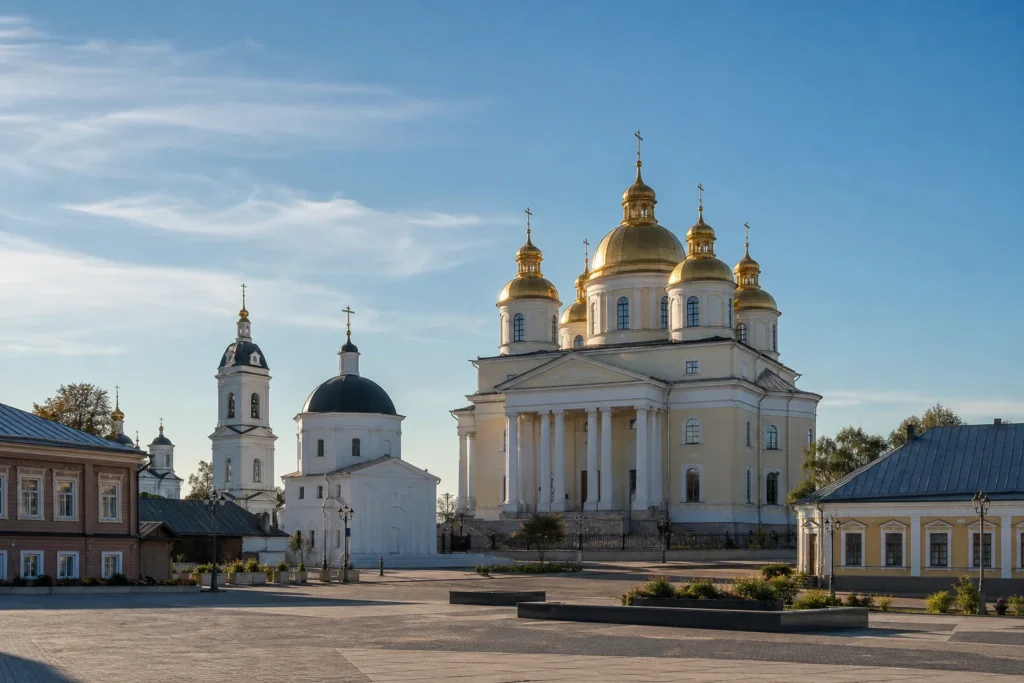
Arzamas is the only city in the Nizhny Novgorod region to have the status of a historical settlement of federal significance. An easy day trip from Nizhny Novgorod by train or bus, this small merchant town retains the atmosphere of 19th-century provincial Russia. The center clusters around Cathedral Square, where oversized neoclassical and baroque churches dominate wooden merchant houses and narrow lanes.
In 2022, the city center was fully restored, allowing it to regain its 19th-century appearance. You can see all the city’s attractions in two days, and one light day will be enough for the most significant places. Most often tourists stop in Arzamas for a short walk around the center when passing through the city, or visit it as a one-day excursion from Nizhny Novgorod.
Quick Facts
| Russian name | Арзамас |
|---|---|
| Distance from the nearest major city | 410 km |
| Travel time from the nearest major city | 7 hours by train |
| Built / opened | 1578 |
| Address | Arzamas, Nizhny Novgorod Oblast, Russia OpenStreetMap · Google Maps |
| Best time to visit | Spring (April–May) and autumn (September–October) offer pleasant weather and lower crowds. Summer (June–August) is busy but warm; church interiors are cooler on hot days. Winter (November–February) transforms the city into a quiet, snow-covered landscape, but museums may have reduced hours. Avoid May 9 (Victory Day) and major Russian holidays when museums may close and train seats sell out. Mid-week visits (Tuesday–Thursday) are quieter than weekends. |
| Recommended duration | 4–6 hours |
What Is (and Isn't) Part of a Visit to Arzamas, Nizhny Novgorod?
| Part | Status | Notes |
|---|---|---|
| Cathedral Square and city center churches | Included in the standard ticket | Open to visitors; most are active Orthodox churches with regular services. Enter respectfully, especially during services. |
| Museum of the Russian Patriarchate | Separate ticket or institution | Separate admission ticket required; located on Cathedral Square. |
| Arzamas History and Art Museum | Separate ticket or institution | Separate ticket required; displays local history, crafts, and art. |
| Gaidar House Museum | Separate ticket or institution | Small house museum; separate ticket. Limited hours; ask locally before visiting. |
| Transfiguration Monastery of the Savior | Included in the standard ticket | Active monastery on city outskirts; accessible to visitors but less visited than Cathedral Square. |
| Sarov nuclear research site | Outside / not part of it | The closed city of Sarov (historically called Arzamas-16) is a separate sealed location east of the main city and inaccessible to tourists. |
How to Get from the nearest major city to Arzamas, Nizhny Novgorod
| Option | Duration | Price | Notes |
|---|---|---|---|
| Train from Nizhny Novgorod | 1.5–2 hours | ₽ | Sodruzhestvo PPK operates a train from Arzamas 2 to Nizhny Novgorod Moskovskiy station twice daily. From the railway station "Moskovskaya" in Nizhny Novgorod, at least five trains depart daily to the station" Arzamas-2", and on the way make a stop at the station "Arzamas-1". The journey takes 2-3 hours, the cost is 232 rubles. Direct connection; most reliable for day trips. Suburban trains depart regularly throughout the day. |
| Bus from Nizhny Novgorod | 2–2.5 hours | ₽ | You can get to Arzamas by bus from the Shcherbinki bus station; a minibus service runs from there to the Arzamas bus station. You will need to purchase a ticket for buses going to Lukoyanov, Voznesenskoye or Pervomaisk. Departure time: Every hour. More frequent than trains but slightly longer journey. |
| Taxi or ride-share from Nizhny Novgorod | 2–2.5 hours | ₽₽ | Most flexible option; direct point-to-point service. Convenient if traveling with luggage or in a group. May be reserved through Yandex.Taxi or Uber. Pricier than public transport but faster door-to-door. |
₽ budget · ₽₽ moderate · ₽₽₽ upscale · ₽₽₽₽ splurge. Price levels are estimates compared with typical prices for visitors.
Why Visit Arzamas, Nizhny Novgorod?
Arzamas was founded by Ivan the Terrible and became an important town on the trade route between Moscow and the east of Russia. Many of the city’s buildings from the 19th and 20th centuries have survived which has led to the city being named a Historical City of Russia. The Cathedral Square provides a concentrated window onto Russian Orthodox architecture: the monumental Resurrection Cathedral, the delicate St. Nicholas Convent, and smaller churches all within a few steps.
In 1802, Russia’s first provincial art school was opened in Arzamas. Its founder was Alexander Stupin. Many masters studied at the school who were to go on to make their contributions to Russian painting and architecture. Above all it was Vasily Perov, the creator of such famous paintings as “The Troika” and “Hunters at a Halt”.
Highlights of Arzamas, Nizhny Novgorod
Cathedral Square (Sobornaya Square)
The heart of the city, Cathedral Square (Sobornaya Ploshchad), is a real open-air architectural ensemble. The square sits where the walls of the fortress once converged. Three major churches face each other across the stone plaza: look for the massive five-domed Resurrection Cathedral on the north side, the intimate whitewashed St. Nicholas Convent to the east, and the Church of the Icon of the Mother of God (called Life-Giving Spring) opposite. A market and local cafés edge the square, creating an everyday rhythm alongside the sacred architecture.
Tip: Arrive early morning to see the square before midday crowds. The churches' interiors open for services; ask locally for current visiting hours if doors are locked.
Resurrection Cathedral
This majestic temple, built in the first half of the 19th century to commemorate the victory in the Patriotic War of 1812, is striking in its scale and beauty. The cathedral is designed in the Neoclassical style and dominates the city's historic center. Its monumental appearance, five domes, and rich facade decor draw the attention of all visitors. Inside the cathedral, frescoes and icons of great artistic and historical value have been preserved.
Tip: The cathedral's best-lit interior hours are mid-morning to early afternoon. Dress respectfully (shoulders and knees covered) if entering during services or quiet times.
St. Nicholas Convent
No less significant and interesting to visit is the Nikolayevsky Convent. This is one of the oldest monasteries in Arzamas, founded back in the 16th century. The monastery complex includes several churches, monastic cells, and utility buildings. The whitewashed walls and modest cupolas make a deliberate contrast to the Resurrection Cathedral across the square. It remains an active women's monastery with a peaceful, orderly atmosphere.
Tip: Convents typically have quieter periods mid-afternoon. Knock gently if the gate appears closed; small groups may be welcomed by the sisters.
Museum of the Russian Patriarchate
This is the only museum in the world whose exhibitions are entirely devoted to the life of the Russian patriarchs. The main part of the expositions is dedicated to Patriarch Sergius – a native of the city. Located on Cathedral Square, the museum occupies a restored merchant building. The exhibits trace the role of the Patriarchate in Russian history, with particular focus on 20th-century religious life.
Tip: Allow 1–2 hours for a thorough visit. Guides available; request one if you want context on exhibits. The museum sometimes closes for restoration—check locally before visiting.
Arzamas History and Art Museum
Housed in a period building on Kalinina Street, this local museum traces the city's story from ancient Mordvinian times through the 19th-century merchant era and into the Soviet period. The museum houses a vast collection of artifacts and artworks, showcasing the city's past and its contribution to Russian culture. From ancient artifacts to contemporary art pieces, the museum offers a comprehensive overview of Arzamas' historical and artistic significance.
Tip: Smaller exhibits than major city museums, so 1 hour usually suffices. Labels in Russian; request a guide for English explanations if needed.
Transfiguration Monastery of the Savior
Arzamas's most ancient monastery is the Monastery of the Transfiguration of the Savior, founded in 1556. The preserved Cathedral of Our Savior was the city's first stone building. Set slightly apart from the city center, this monastery predates the fortress itself. The cathedral's interior holds frescoes from different eras, showing the layers of the city's spiritual life.
Tip: Less visited than Cathedral Square; good for quiet reflection. Located on the outskirts—ask directions or use Yandex Maps to find it.
Gaidar House Museum
Famous person who lived part of his years in Arzamas is the writer Arkady Gaidar. In the house where his family lived, a museum was created. Gaidar (1904–1941) was a celebrated Soviet author of adventure novels for youth. The modest wooden house contains personal effects, manuscripts, and period photographs showing his life and work in the city.
Tip: Small, intimate space best for those interested in early Soviet literature. About 30 minutes to view. Ask at the tourist information point for opening hours.
Atmosphere
Arzamas feels suspended in the 19th century. Cathedral Square is the living heart: on weekdays, pensioners sit on benches between the churches, a market operates at one edge, and church bells mark the hours. Narrow residential streets branch off, lined with low timber houses painted pale blue, yellow or green—corrugated iron and pastel colors typical of the Russian provincial aesthetic.
The city moves slowly. Shops close for lunch; cafés serve pelmeni (dumplings) and tea. In summer, grass grows between street tiles. The predominant sound is church bells, especially at Sunday services when voices echo from open doorways. Winter transforms the whole scene into a muted, snow-covered landscape where the golden domes stand out against white skies. There are no crowds, and most visitors are pilgrims rather than tourists.
History of Arzamas, Nizhny Novgorod
Arzamas was founded in 1578, during the reign of Ivan the Terrible, in the lands populated at the time by Mordvins. In 1576 the town welcomes first eminent Russian military leader Grigory Bobrov-Schenyatiev, and this year is considered to be the year Arzamas is founded. The need for a large military stronghold arose after the conquest of Kazan in 1552. Tsar Ivan the Terrible actively expanded the borders of the Russian State, but the threat of raids by nomadic tribes persisted until the 17th century.
At the Arzamas Historical and Art Museum, one can see a plan of the fortress. It had three sides formed by the Tesha and Sorochka rivers, as well as a deep ravine. The fortress walls were made of wood, and in 1726, they were finally dismantled after another fire.
Arzamas participates in events, well-known in Russia – in 1670 rebel Stepan Rasin gathers hordes of his followers and conquers town after town. He stops near Arzamas, and in case of invading the town, Russian history would have been totally different, because behind the town lie Moscow and Central Russia.
In 1779, Empress Catherine II declared Arzamas a district town of the Nizhny Novgorod Governorate. Thanks to its advantageous geographical location, the city became an important trade center. Arzamas merchants quickly grew wealthy, which was reflected in the city’s appearance. Various merchant guilds built churches and temples that became the pride of Arzamas. In 1802, Russia’s first provincial art school was opened in Arzamas. Its founder was Alexander Stupin. Many masters studied at the school who were to go on to make their contributions to Russian painting and architecture.
In 1869, Leo Tolstoy experienced an episode known as “The Terror of Arzamas” while passing through the area. In September 1869, Leo Tolstoy passed through Arzamas on business and, late one night in his hotel room, suddenly experienced an unprecedented sense of sorrow and terror. The city continued as a modest provincial center through the 19th and 20th centuries, largely bypassed by industrial development, which preserved its architectural heritage.
Tickets and Booking for Arzamas, Nizhny Novgorod
| Ticket | Price | Includes |
|---|---|---|
| Museum of the Russian Patriarchate | ₽ | Entry to permanent exhibitions on Russian Patriarchate history and Patriarch Sergius. |
| Arzamas History and Art Museum | ₽ | Entry to local history, crafts, and art collections. |
| Gaidar House Museum | ₽ | Entry to the writer Arkady Gaidar's former residence with personal effects and manuscripts. |
₽ budget · ₽₽ moderate · ₽₽₽ upscale · ₽₽₽₽ splurge. Price levels are estimates compared with typical prices for visitors.
Museum tickets are purchased at each venue on-site. Most attractions are open daily; confirm hours before visiting, as smaller museums sometimes close mid-week or for lunch. Churches are free to enter but are active places of worship; expect to remove shoes or wear modest clothing (long sleeves, covered knees). Rates for Russian citizens and concessions differ. Check the Nizhny Novgorod tourist information website for complete opening hours and current admission details.
Plan and Book
Suggested itineraries Arzamas, Nizhny Novgorod
4 hours on site
Arrive by train mid-morning. Walk to Cathedral Square (5 minutes from Arzamas-1 station). Spend 1.5 hours viewing the Resurrection Cathedral, St. Nicholas Convent, and other churches on the square. Visit the Museum of the Russian Patriarchate (1 hour). Lunch at a local café (30 minutes). Take a departing train back to Nizhny Novgorod by early evening.
6 hours on site
Morning train to Arzamas. Cathedral Square churches (1.5 hours). Museum of the Russian Patriarchate (1 hour). Lunch (30 minutes). Arzamas History and Art Museum (1 hour). Explore residential streets and merchant houses off the square (30 minutes). Return by train in late afternoon.
Full day (8+ hours)
Early train or car. Cathedral Square and churches (2 hours). Museum of the Russian Patriarchate (1 hour). History and Art Museum (1 hour). Lunch (1 hour). Gaidar House Museum (30 minutes). Walk to Transfiguration Monastery of the Savior (30 minutes). Explore quieter residential areas. Late afternoon return to Nizhny Novgorod.
How to Get to Arzamas, Nizhny Novgorod
By suburban train: From Nizhny Novgorod’s Moskovsky (Moskovskaya) Railway Station, take a suburban electric train to Arzamas-1 or Arzamas-2 station. The journey takes 1.5–2 hours. From the station, walk 5 minutes north to reach Cathedral Square (the city center). Trains depart at least five times daily; buy tickets at the station or at electronic kiosks.
By bus: Depart from Shcherbinki (Щербинки) bus station near Nizhny Novgorod center. Buses run every hour to Arzamas; journey time 2–2.5 hours. Get off at the central bus station (автовокзал) and walk or take a local bus into the center.
By taxi or ride-share: Use Yandex.Taxi, Uber, or Yandex.Maps to order a car. Journey time 2–2.5 hours door-to-door. Ask your driver to drop you at Cathedral Square (Sobornaya Ploshchad).
Accessibility
Cathedral Square itself is flat and pedestrian-friendly. Most churches lack wheelchair ramps and have steep interior stairs; accessibility depends on individual buildings. Pavements in the residential areas are uneven. The railway stations have platforms and accessible toilets. Museums lack elevators; ask staff about ground-floor displays if mobility is limited. Taxis are the easiest transport for those with reduced mobility. The city's scale is small, but uneven terrain and lack of universal accessibility standards mean visitors with mobility challenges should plan carefully and ask locally for support.
Food Nearby
Cathedral Square and the adjacent market have simple food kiosks selling pirozhki (baked pies), chebureki (fried pastries), and hot drinks. Small cafés and stolovaya (canteen-style restaurants) line side streets near the square, serving pelmeni, borscht, and traditional Russian fare at budget prices. No upscale restaurants; dining focuses on home cooking and casual meals. Bring snacks and water if you plan to explore outlying monasteries or spend a full day walking.
What to Bring
Comfortable walking shoes (streets are uneven and cobbled in places). In summer, sunscreen and a hat; the square offers little shade. In winter, warm clothing, as churches are unheated. A light scarf or shawl to cover shoulders if entering churches during services. Small bills (rubles) for museums and small vendors; not all accept cards. A small day bag; bag checks are not routine but may occur at monasteries.
Best Views and Photo Spots of Arzamas, Nizhny Novgorod
Cathedral Square looking north toward Resurrection Cathedral
The five golden domes of the Resurrection Cathedral dominate the frame. The neoclassical facade and stonework catch afternoon light beautifully. The modest scale of Cathedral Square keeps the church monumental but intimate—classic provincial beauty.
Best time: Afternoon (2–4 pm) when light rakes across the stone facades from the west. Autumn and spring light is soft and warm.
From the steps of St. Nicholas Convent, looking toward the Resurrection Cathedral
The whitewashed convent walls frame the cathedral's domes in the background. The contrast of modest convent simplicity with baroque cathedral complexity tells the story of Arzamas' dual spiritual and commercial life.
Best time: Late morning light; shadows still show the convent's architecture clearly.
Church of the Icon of the Mother of God (Life-Giving Spring) from the square's southeast corner
The smaller church's elegant roofline and the market stalls at its base show everyday life alongside sacred architecture. This is the authentic mix that makes the square compelling.
Best time: Mid-morning or early afternoon, when market vendors are present and light is even.
Residential streets branching west from Cathedral Square
Pastel-colored timber houses, corrugated iron fences, and street lamps create a frozen-in-time scene. Small details—window frames, door handles, carved eaves—reward close attention.
Best time: Soft morning light emphasizes texture and color. Less crowded than the square.
Photography Rules
Exterior photography of churches is welcome and encouraged; no restrictions. Interior photography is sometimes limited during services. Flash and tripods are generally discouraged inside sacred spaces. Museums typically prohibit photography or charge a photography fee; ask at entry. Drones are not permitted in the city center or near religious buildings.
Family Suitability
Arzamas suits families with older children (8+) interested in history and architecture. Cathedral Square is safe and walkable; young children can run on the stone plaza. However, churches require quiet behavior and respectful dress. The city lacks dedicated children's attractions (playgrounds, kids' museums). Museums are small and low-key, suiting calm learners. A full day may bore restless toddlers; 3–4 hours is more realistic for families with young children. Stroller access is challenging on cobbles and uneven streets. The pace is slow and contemplative, not action-packed—families seeking buzz and energy should look elsewhere.
Russia Vibes Tips
- Arrive mid-morning to claim a spot on the Cathedral Square benches before local pensioners settle in. This gives you time to photograph the square with few people before crowds arrive after lunch.
- Ask locals or your hotel in Nizhny Novgorod for the current opening hours of smaller museums before leaving. Gaidar House Museum keeps irregular hours and sometimes closes without notice.
- Plan your return train carefully. The last suburban train to Nizhny Novgorod departs in late evening. Check the station schedule before exploring, or you'll face a costly taxi ride back.
- If you visit on a weekend, Sunday services in the cathedral (usually 8–10 am) attract pilgrims and create an authentic atmosphere, but entry for tourists may be limited. Ask outside the church door.
- The city center is only a 10-minute walk from both railway stations. If you arrive at Arzamas-2 station (the main one), just walk north; signs point toward the center.
Explore Nearby Arzamas, Nizhny Novgorod
Browse more: All Day Trips · All Day Trips in Nizhny Novgorod · All Hidden Russia · All Nizhny Novgorod
FAQ: Arzamas, Nizhny Novgorod
Is Arzamas worth a day trip from Nizhny Novgorod?
Yes, if you enjoy quiet provincial towns and 19th-century architecture. Allow 4–6 hours on site. Arzamas is not a high-energy, must-see destination, but it offers an authentic glimpse of merchant-era Russia rarely changed since the 1800s. It works best as part of a slower travel pace or combined with other nearby towns.
What's the fastest way to get to Arzamas from Nizhny Novgorod?
Suburban train from Moskovsky Station takes 1.5–2 hours direct. It's also the cheapest and most frequent option (at least 5 trains daily). Taxi is faster (2–2.5 hours) but costs more.
Which museums are must-sees in Arzamas?
The Museum of the Russian Patriarchate is unique worldwide and gives deep context on Russian religious history. The History and Art Museum covers local heritage. Gaidar House Museum is small and specialized; worth it only if you know Gaidar's Soviet-era children's novels. Churches on Cathedral Square are free and the main attraction.
Do I need to book tickets in advance?
No. All museums are low-volume and sell tickets on-site. Churches are free and always open (though services may restrict access at certain times). Booking transport in advance is wise during peak summer weeks.
What should I wear inside the churches?
Dress respectfully: long sleeves and knees covered (long skirts or pants). Women may cover hair with a scarf during services. Remove shoes or wear soft soles inside. During non-service hours, standards are more relaxed, but modesty is still expected.
How long should I spend in Arzamas?
4 hours is enough for Cathedral Square and one museum. 6 hours allows two museums and residential streets. A full 8-hour day gives time for quieter monasteries and slower exploration. Most visitors spend half a day.
Is Arzamas the same as the nuclear city Sarov (Arzamas-16)?
No. Sarov is a separate closed city 60 km away, off-limits to tourists. Arzamas (the town discussed here) is open and freely accessible. Do not confuse the two.
Where can I eat in Arzamas?
Simple cafés and stolovayas (Russian canteen-style eateries) serve pelmeni, borscht, and traditional fare. Market kiosks sell pirozhki and chebureki. No upscale restaurants. Plan meals for lunch hours (1–2 pm) when most places are open; some close mid-afternoon.
Russia Vibes is a one-person project. A coffee keeps it going
How we research and update our guides
About this guide: AI assistance and accuracy
This guide is created with the help of AI and is based on official sources where available. Mistakes can still happen. Opening hours, prices, rules and other details are given to the best of our knowledge as of the date shown and can change without notice. It offers general recommendations only, not professional, legal or travel advice. Please confirm important details with the official source before you travel; you are responsible for your own plans and decisions.

Take this guide with you
Get a free PDF of this guide to print or read offline: key facts, tips and a map link on a few clean pages.
Report an issue on this page
Paying for your trip: please read
International sanctions affect payments between Russia and many other countries. In practice, cards issued in the EU, the UK, the US and several other countries often do not work in Russia, Russian cards usually do not work abroad, and some booking platforms, airlines and payment providers limit or suspend their services for Russia. The situation changes frequently.
We do not give legal or financial advice, and this site does not encourage anyone to break or circumvent sanctions. Whatever you plan, you are responsible for following the laws and regulations that apply to you, including those of your country of residence and citizenship.
Many travelers still organise their stay lawfully. It is worth asking your bank or payment provider what is currently permitted, contacting hotels, tour operators and carriers directly about the payment methods they accept, and checking which services are open to customers from your country. Clarify payment, cancellation and refund terms before you commit to a booking, and keep your plans flexible.
Partner links on this site may not be available in every country, and prices, availability and rules in our guides can differ from what you see when you book.