
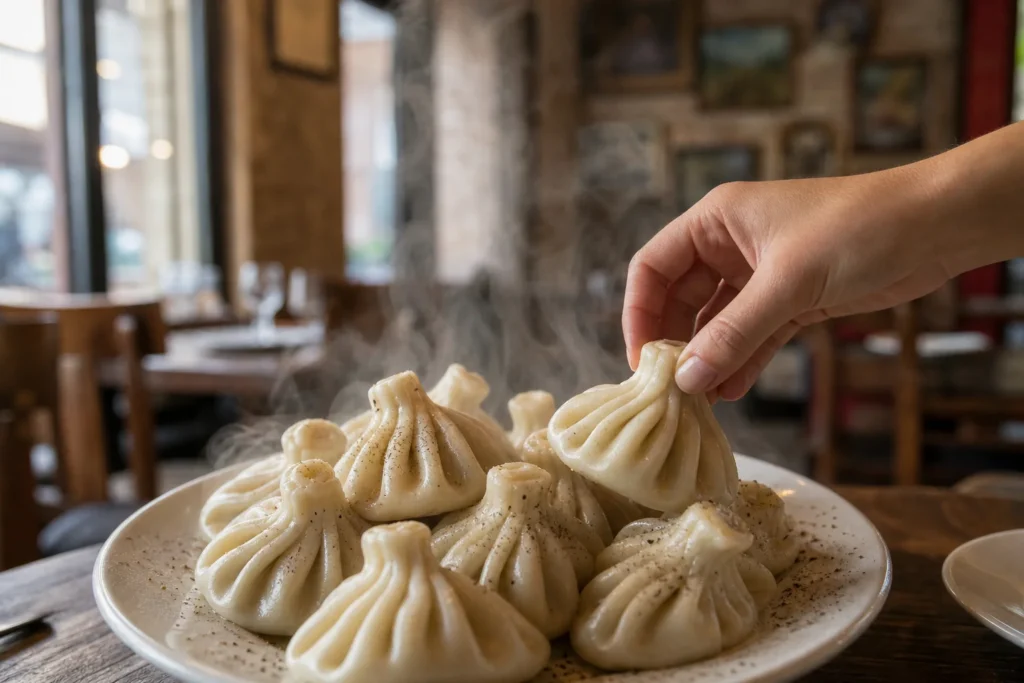
If you’re curious about khinkali, the legendary Georgian dumplings now served across Russia’s restaurants and food scenes, this guide explains what they are and how to eat them properly. Whether you encounter them in Sochi or anywhere else, khinkali have a specific eating ritual—and it’s not optional if you want to enjoy the filling correctly.
You’ll learn the step-by-step technique that keeps the hot broth inside instead of on your plate, plus what makes a good khinkali and how to make them at home. The recommended approach: pick one up by the knot, bite carefully, sip the broth, then eat the dumpling—never with a fork.
Quick answer: Hold the dumpling by its twisted top knot, bite a small hole in the side, sip out the hot broth, then eat the rest. Takes about 15–20 minutes to eat a serving of 6–8 dumplings.
At a Glance
| Type | Dishes |
|---|---|
| Local name | Хинкали |
| Origin | Khinkali originate in the mountainous regions of eastern Georgia. The invention of the dish is credited to the Mokhevians, as well as the Pshavians, Mtiuletians, and Khevsurians. Khinkali originated in the mountainous regions of Georgia, where they were traditionally prepared by shepherds and farmers. The dish was created as a hearty and portable meal, designed to be cooked over open fires and carried easily during long mountain journeys. |
| Servings | 2–4 servings (6–10 dumplings per person) |
| Total time | 2 hours (including 1 hour dough rest) |
| Difficulty | Medium |
History and Story of Khinkali, Sochi
Khinkali originate in the mountainous regions of eastern Georgia. The invention of the dish is credited to the Mokhevians, as well as the Pshavians, Mtiuletians, and Khevsurians. One theory holds that shepherds invented them: meat was chopped by hand, wrapped in dough, and boiled in a cauldron right up in the mountains. Another theory suggests the dish arrived from the East with the Mongol invasions of the 13th century, and Georgians adapted it to their own taste. The famous “pleats” (the twisted top of the dumpling) became a symbol of craftsmanship: the more folds a cook could create, the more respected they were.
Ingredients
- 300 g all-purpose flour
- 250 ml water
- 1 teaspoon salt (for dough)
- 225 g ground beef
- 225 g ground pork
- 1 large onion, finely diced
- 40 g fresh cilantro, chopped
- 100–150 ml cold water or broth (for filling)
- Black pepper to taste
How Khinkali, Sochi Is Made
Step 1: Make the dough
Make a well in the center and add the egg and 1 cup of the water. Stir the egg and water into the flour with a fork. Add more water as needed to form a soft dough. Remove the dough to a lightly floured work surface and knead until smooth and supple, about 5 to 6 minutes. Cover and set aside for at least 20 minutes to rest. A longer rest of 30–60 minutes helps the dough relax and roll thinner.
Tip: Knead firmly to develop gluten; this dough must be strong enough to hold hot liquid without breaking.
Step 2: Mix the meat filling
Use an equal combination of ground beef and ground pork for the traditional filling. Combine the meat with the finely diced onion, chopped cilantro, salt, and black pepper in a large bowl. Mix thoroughly by hand to distribute the spices evenly throughout.
Tip: Use fatty cuts of meat; lean meat produces a dry filling with no broth.
Step 3: Add water to the filling
Adding water to the filling creates a delicious broth inside the dumpling. Knead the water into the filling until it has been absorbed, meaning there's no liquid pooled at the bottom of the bowl. Add it gradually, a few tablespoons at a time, stirring with a fork until fully absorbed. This liquid becomes the soup inside the dumpling as it cooks.
Tip: If the filling is too dry, you'll have no broth; too wet and it will leak out during cooking.
Step 4: Roll and cut the dough
Divide the rested dough into two portions. Roll one portion on a floured surface until very thin, about 1–2 mm. Use a large glass or 3-inch cookie cutter to cut out circles of dough. You'll need about 8–12 circles depending on how full you want them.
Tip: Work quickly; dough that dries out becomes hard to fold and seal.
Step 5: Fill and fold each dumpling
Place about 1 tablespoon of filling in the center of each circle. Pull the edges up to gather above the filling, then fold and pleat the dough to form a tight, twisted knot at the top. Squeeze the knot together to make sure it is a firm seal. The pleats seal in the broth and are a sign of skill—8–10 folds per dumpling is the standard in good restaurants.
Tip: A poorly sealed knot will leak broth into the boiling water and ruin the dumpling.
Step 6: Boil the khinkali
Generously salt a large pot of water and add bay leaves. Bring it to a boil. In batches, add the khinkali (about a dozen at a time depending on the size of your pot) and use a spoon to gently move them around so they don't stick to the bottom. Once they float, boil for another 6–7 minutes.
Tip: Don't overcrowd the pot; dumplings need space to move and maintain water temperature.
Step 7: Serve immediately
Lift with a slotted spoon and serve immediately with lots of black pepper. Khinkali must be eaten hot, straight from the water, while the broth inside is at its best. Arrange them in a mound on a plate and grind black pepper generously over them.
Variants
- Mountain version (mtiuluri): khinkali are made small, with a more pungent filling and more herbs. City version (kalakuri): larger, milder in flavour, with thinner dough.
- Cheese, mushrooms, mashed potato, or lamb fillings.
- Seafood khinkali (less common but found in some restaurants).
- Vegetarian versions using only herbs and cheese, no meat.
Common Mistakes to Avoid
- Using lean meat or too little fat in the filling—produces a dry dumpling with no broth inside.
- Piercing the dumpling with a fork or knife during eating—breaks the dough and lets the precious broth escape onto the plate. Hands only.
- Rushing the dough rest—dough that hasn't rested properly springs back when you try to roll it thin, making it thick and chewy instead of tender.
- Boiling too many at once in a small pot—overcrowding drops the water temperature and causes dumplings to stick together or absorb water instead of staying firm.
- Waiting too long to eat them—khinkali cool quickly and lose their appeal. The broth inside must be hot and the dough still glossy.
- Making the filling too wet or too dry—without water, there's no broth; with too much, it leaks out during cooking. The filling should absorb the liquid completely until it's loose and juicy but not separating.
- Not sealing the top knot firmly enough—the knot must be tight to trap the broth and keep it from escaping into the boiling water.
How to Order and Eat It
No knives or forks. This is not snobbery — it is a technical necessity. Inside the khinkali is hot broth, and if you pierce it with cutlery the juice flows onto the plate. The correct method: Pick it up by the topknot — with two fingers, firmly, so it does not fall. Turn it over — topknot up, base toward you. Bite a small hole at the base — a small, careful bite to create an opening. Drink the broth — tilt and draw in all the juice. This is the most valuable part of the khinkali; do not lose a drop. Eat the meat and dough — several bites; the khinkali is hot, there is no rush. Leave the topknot on the plate — it is used to count how many you have eaten. Make the first bite small. The broth is scalding hot. Experienced eaters take a tiny bite first, release some steam, then drink the juice. That way you do not burn your lips.
To order: Хинкали [khinkali]
Diet and Allergens
- Contains pork and beef
- Typically contains gluten
Where to Try Khinkali, Sochi
Kaliningrad
 Kavkaz, Kaliningrad Georgian, Armenian, Azerbaijani, Caucasian
Main image: AI-generated illustration. It may not show the place exactly as it looks.
Kazan
 Pashmir Restaurant, Kazan Uzbek, Tatar, European, Middle Eastern
Main image: AI-generated illustration. It may not show the place exactly as it looks.
 Dadiani, Kazan Georgian
Main image: AI-generated illustration. It may not show the place exactly as it looks.
Nizhny Novgorod
 Khachapuriya, Nizhny Novgorod Georgian
Main image: AI-generated illustration. It may not show the place exactly as it looks.
 BaklaDzhan, Nizhny Novgorod Georgian, Armenian, Lebanese
Main image: AI-generated illustration. It may not show the place exactly as it looks.
 Dzhani Restorani, Nizhny Novgorod Georgian and Caucasian
Main image: AI-generated illustration. It may not show the place exactly as it looks.
Sochi
 Mamino, Sochi Sochi home cooking (Caucasian, Russian, Georgian)
Main image: AI-generated illustration. It may not show the place exactly as it looks.
 Belye Nochi, Sochi Georgian, Caucasian
Main image: AI-generated illustration. It may not show the place exactly as it looks.
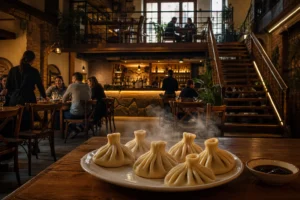 Dom Khinkali, Sochi Georgian, Caucasian
Main image: AI-generated illustration. It may not show the place exactly as it looks.
Vladivostok
 Hlopok Chaihona, Vladivostok Uzbek, Caucasian, Georgian
Main image: AI-generated illustration. It may not show the place exactly as it looks.
Russia Vibes Tips
- Order khinkali in groups of 4–6, not in a single large order. A normal serving is 6–10 pieces per person. Order 5 to start, then get more. Khinkali disappear surprisingly fast.
- Watch locals eating them first if you're unsure. In a good khinkali restaurant, 8–10 folds per piece is the standard — a sign of the cook's skill. The more folds, the higher the qualification. This tells you whether you're at a good place.
- The method of eating khinkali is part of its identity: spilling the broth is considered a lost pleasure, and the untouched dough knots on the plate traditionally show how many were eaten. Locals notice who's eating with forks.
- The knot at the top is not meant to be eaten—it's thick and undercooked on purpose, designed as a handle. Some find it tough; others leave it on the plate entirely.
- Make the first bite small enough to release steam before you sip. The broth temperature can be higher than boiling water, and it's easy to burn your lips on your first khinkali.
- Black pepper is the traditional and often only seasoning added at the table. Pepper first. Georgians grind plenty of black pepper over the heap before anyone starts. It's the only seasoning most people add.
Explore Nearby Khinkali, Sochi
Browse more: All Food & Drink · All Food & Drink in Sochi · All Other · All Sochi
FAQ
What's the difference between mountain and city khinkali?
In the mountain version (mtiuluri), khinkali are made small, with a more pungent filling and more herbs. The city version (kalakuri) appeared later: larger, milder in flavour, with thinner dough.
Why is there broth inside khinkali?
Adding water to the filling creates a delicious broth inside the dumpling. The water is kneaded into the filling until it has been absorbed. As the khinkali cooks, this absorbed liquid becomes a hot, savory soup that's meant to be sipped before eating the dumpling itself.
Do you really not eat the top knot?
Eat your way around the dough and filling, and put the topknot back on your plate. It's thick and undercooked by design, a handle rather than food. You can eat it if you wish, but traditionally it's left behind.
What happens if you use a fork?
Inside the khinkali is hot broth, and if you pierce it with cutlery the juice flows onto the plate. The entire point of khinkali is the broth inside; piercing it defeats the purpose.
Can you make khinkali with other fillings?
Khinkali can be filled with cheese, mushrooms, mashed potato, or lamb. The classic is spiced beef and pork with onion and cilantro, but regional and vegetarian versions exist.
How many should I order?
A normal serving is 6–10 pieces per person. Order 5 to start, then get more. Khinkali disappear surprisingly fast.
Where does khinkali come from?
Khinkali originate in the mountainous regions of eastern Georgia. The invention of the dish is credited to the Mokhevians, as well as the Pshavians, Mtiuletians, and Khevsurians.
How do I know if a khinkali is good?
Good khinkali arrive glossy, heavy, and slightly tense. Pick one up and you can feel the liquid weight inside. Bad khinkali feel limp, overworked, or suspiciously dry before you even bite them.
Russia Vibes is a one-person project. A coffee keeps it going
How we research and update our guides
About this guide: AI assistance and accuracy
This guide is created with the help of AI and is based on official sources where available. Mistakes can still happen. Opening hours, prices, rules and other details are given to the best of our knowledge as of the date shown and can change without notice. It offers general recommendations only, not professional, legal or travel advice. Please confirm important details with the official source before you travel; you are responsible for your own plans and decisions.

Take this guide with you
Get a free PDF of this guide to print or read offline: key facts, tips and a map link on a few clean pages.
Report an issue on this page
Paying for your trip: please read
International sanctions affect payments between Russia and many other countries. In practice, cards issued in the EU, the UK, the US and several other countries often do not work in Russia, Russian cards usually do not work abroad, and some booking platforms, airlines and payment providers limit or suspend their services for Russia. The situation changes frequently.
We do not give legal or financial advice, and this site does not encourage anyone to break or circumvent sanctions. Whatever you plan, you are responsible for following the laws and regulations that apply to you, including those of your country of residence and citizenship.
Many travelers still organise their stay lawfully. It is worth asking your bank or payment provider what is currently permitted, contacting hotels, tour operators and carriers directly about the payment methods they accept, and checking which services are open to customers from your country. Clarify payment, cancellation and refund terms before you commit to a booking, and keep your plans flexible.
Partner links on this site may not be available in every country, and prices, availability and rules in our guides can differ from what you see when you book.