
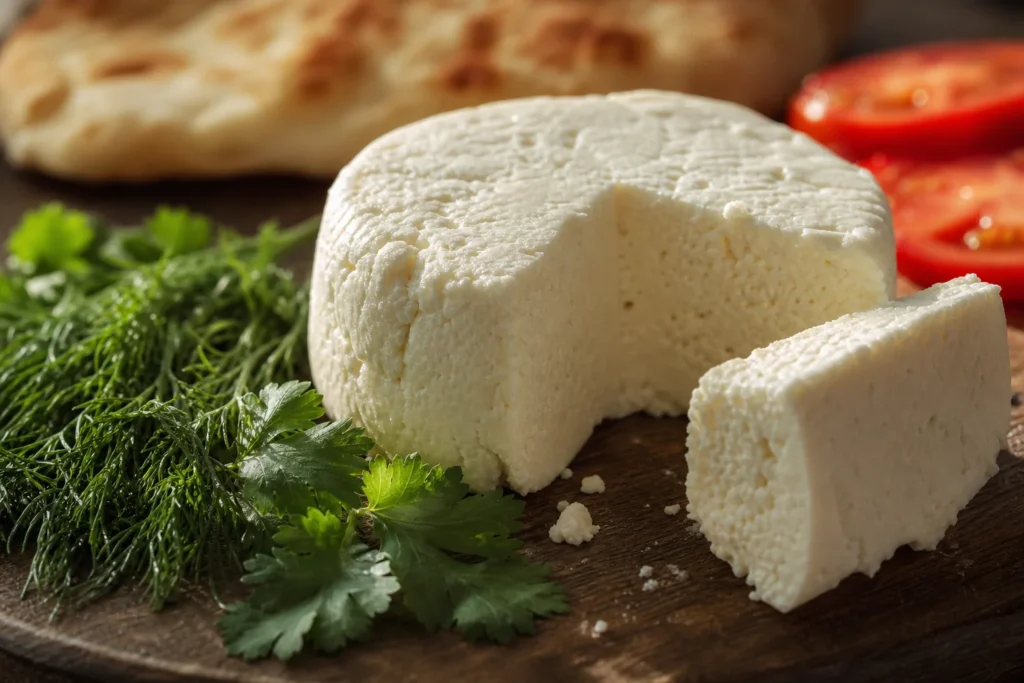
Adyghe cheese is a traditional soft cheese from the Caucasus region that sits at the heart of Circassian cuisine. This article shows you how to make Adyghe cheese at home using basic dairy products and simple acid-curdling methods. The recommended approach uses kefir and whole milk, taking 30–40 minutes of active time plus overnight draining.
The finished cheese has a mild, slightly salty flavour and a soft, crumbly texture. It does not melt when heated, making it ideal for both fresh eating and cooking.
Quick answer: Heat whole milk to near boiling, add kefir to curdle the milk solids, strain through cheesecloth, salt the curds, and let drain overnight under light pressure. The finished cheese is ready to eat immediately after draining, or can be stored in the refrigerator for several days.
At a Glance
| Type | Dishes |
|---|---|
| Local name | адыгейский сыр |
| Origin | The cheese derives its name from the Republic of Adygea in the North Caucasus, where local communities developed this cheese centuries ago as a way to preserve milk using simple brining techniques. It became known in Russia after the annexation of the North Caucasus in the 19th century. |
| Servings | 2–4 people |
| Total time | 30–40 minutes active time; overnight or 10–12 hours draining time |
| Difficulty | Easy |
History and Story of Adyghe Cheese, Sochi
The people of Adygea consume a lot of dairy products, and Adygei cheese is a major part of it. This mild type of cheese does not melt when baked or fried, and can be crumbled. Adyghe cheese doesn’t melt when heated. It is also incredibly delicious eaten fresh with ripe tomatoes, lots of fresh herbs (like cilantro and dill), and warm flatbread.
Ingredients
- 1 litre whole cow's milk
- 250 ml kefir (or plain yogurt)
- 5 grams salt
- Cheesecloth or fine-weave kitchen cloth
- Colander or sieve
- Large saucepan
- Spoon for stirring
How Adyghe Cheese, Sochi Is Made
Step 1: Heat the milk
Pour the milk into a saucepan and place it on the fire. Bring the milk to a boil. The milk should reach approximately 95°C but does not need to roll at a rolling boil.
Tip: Use whole milk with at least 3% fat for the richest result.
Step 2: Add kefir and curdle
Add kefir to the milk in a thin stream and wait until curd flakes appear. Stir gently as you pour. This should take 1–2 minutes. Curd flakes will appear on the surface. As soon as this happens, turn off the fire. After a few minutes, the flakes will disappear, and the serum will take on a clear or slightly greenish tint.
Tip: If using yogurt instead of kefir, stir the mixture more thoroughly to distribute the yogurt evenly.
Step 3: Strain the curds
As soon as the flakes sink to the bottom of the pan and the whey becomes transparent, drain the mass into a colander previously covered with gauze. Salt the resulting mixture to taste. Let the curds rest in the colander for 2–3 minutes before proceeding.
Tip: Save the drained whey if you want to brine the cheese later in a salt solution for extra flavour.
Step 4: Press and drain
Squeeze our mixture well, wrap it in cheesecloth and put a press on top. Leave the cheese for 10 hours, during which time all the excess whey will drain. Use a weight such as a plate with a light object on top (a can of food, for example).
Tip: Place the cheesecloth bundle over a bowl or in a colander to catch the draining liquid. Turning the bundle halfway through draining ensures even moisture loss.
Step 5: Finish and store
After draining, unwrap the cheese and transfer to a plate or bowl. The cheese is now ready to eat fresh. For longer storage, wrap in plastic or place in an airtight container and refrigerate. Soak the cheese for 2–5 days in a salt solution, depending on the desired salinity of the product. The aged mass must be sent to the refrigerator for 2–3 days, after which the snack is considered ready.
Tip: Fresh cheese has a mild, milky flavour. Brining increases saltiness and extends shelf life to 1–2 weeks.
Variants
- Brined cheese: soak finished cheese in salt solution (salt dissolved in whey) for 2–5 days for a more robust, salty flavour
- Smoked cheese: traditionally smoked over fruit-tree sawdust for a distinctive smoky note
- Herb-infused: add dill, parsley, or thyme while salting the curds
- Dried cheese: historically dried whole for long journeys and reconstituted in water or soup
Common Mistakes to Avoid
- Using pasteurized milk at too low a temperature. The milk must reach near-boiling point for the kefir to curdle properly and separate the whey.
- Pouring kefir in too quickly. Add it slowly in a thin stream while stirring to ensure even curdling and avoid lumps.
- Squeezing the curds too hard during draining. Excessive pressure can make the finished cheese dense and rubbery rather than soft and crumbly.
- Draining for too short a time. Even if the cheese feels firm after 10 hours, it may still contain excess whey. Under-drained cheese will be wet and will not hold its shape well.
- Storing fresh cheese without refrigeration. Once made, Adyghe cheese is perishable and must be kept cold. Unbrined fresh cheese keeps for 3–4 days in the fridge; brined cheese lasts 1–2 weeks.
How to Order and Eat It
Eat fresh Adyghe cheese immediately after making, still warm or at room temperature. Serve alongside ripe tomatoes, fresh herbs such as dill and cilantro, and warm flatbread. The cheese is also excellent in salads, can be fried without melting, or crumbled into cooked dishes. It is added to salads, khachapuri, and is also eaten with wine.
To order: Адыгейский сыр, пожалуйста [Adygeiskii syr, pozhaluysta]
Diet and Allergens
- vegetarian
- gluten-free
Russia Vibes Tips
- Kefir or yogurt used must be fresh and active (with visible live cultures) to curdle the milk effectively. Check the date on the container and use within the best-before window.
- If you cannot find kefir, plain live-culture yogurt works equally well. Some recipes use vinegar instead, but kefir or yogurt produce a milder, more authentic flavour.
- The whey left after draining can be kept for future batches (it strengthens over 2 days of fermentation at room temperature) or used in soups, baking, and other cooking.
- For the fastest result, use the vinegar method: heat milk to 75°C, add 15 ml vinegar mixed with 20 ml water, stir until curds form, and strain. This takes 15 minutes total but gives a slightly tangier cheese.
- Wrap the finished cheese in cloth and refrigerate for a drier, firmer texture, or store in a closed container with a little whey to keep it softer and moister.
Explore Nearby Adyghe Cheese, Sochi
Browse more: All Food & Drink · All Food & Drink in Sochi · All Other · All Sochi
FAQ
How is Adyghe cheese different from other soft cheeses?
This mild type of cheese does not melt when baked or fried, and can be crumbled. This property makes it unique among soft cheeses and ideal for cooking. The texture is soft and crumbly rather than spreadable.
Can I use any kind of milk?
Yes, whole cow's milk is standard, but traditionally, Adyghe cheese was made from milk, goat or sheep. Currently, it is prepared from cow's milk, which makes it possible to get cheese at home, right in the kitchen. Use pasteurized whole milk rather than ultra-high-temperature (UHT) treated milk, as UHT can inhibit curdling.
How long does homemade Adyghe cheese keep?
Fresh, unsalted cheese keeps 3–4 days in the refrigerator. Brined cheese (soaked in salt solution) keeps 1–2 weeks. Always store in an airtight container or wrapped in cloth in the coldest part of the fridge.
What if my milk does not curdle?
Check that your kefir or yogurt is fresh and contains active cultures. Milk treated with ultra-high-temperature processing (UHT) may not curdle properly; use regular pasteurized milk instead. Ensure the milk reaches near-boiling point (around 95°C) before adding the kefir.
Can I make Adyghe cheese with lactose-free milk?
Lactose-free milk can be used, as the curdling is triggered by the acidity of the kefir or yogurt, not by lactose. The result should be just as successful.
Do I need any special equipment?
No. You need only a saucepan, cheesecloth or fine kitchen cloth, a colander or sieve, and a spoon. A thermometer helps, but is not essential if you watch for visual cues (bubbles appearing, cheese rising to the surface).
Is homemade Adyghe cheese safe to eat?
Yes, when made with pasteurized milk and stored properly. These facilities follow traditional methods while adhering to modern hygiene standards to ensure consistent quality. Always use clean utensils and store the finished cheese in the refrigerator.
What are the ingredients in store-bought Adyghe cheese?
Store-bought versions contain milk, kefir or whey, salt, and sometimes herbs and spices. Making it at home lets you control the salt level and add your own flavourings.
Russia Vibes is a one-person project. A coffee keeps it going
How we research and update our guides
About this guide: AI assistance and accuracy
This guide is created with the help of AI and is based on official sources where available. Mistakes can still happen. Opening hours, prices, rules and other details are given to the best of our knowledge as of the date shown and can change without notice. It offers general recommendations only, not professional, legal or travel advice. Please confirm important details with the official source before you travel; you are responsible for your own plans and decisions.

Take this guide with you
Get a free PDF of this guide to print or read offline: key facts, tips and a map link on a few clean pages.
Report an issue on this page
Paying for your trip: please read
International sanctions affect payments between Russia and many other countries. In practice, cards issued in the EU, the UK, the US and several other countries often do not work in Russia, Russian cards usually do not work abroad, and some booking platforms, airlines and payment providers limit or suspend their services for Russia. The situation changes frequently.
We do not give legal or financial advice, and this site does not encourage anyone to break or circumvent sanctions. Whatever you plan, you are responsible for following the laws and regulations that apply to you, including those of your country of residence and citizenship.
Many travelers still organise their stay lawfully. It is worth asking your bank or payment provider what is currently permitted, contacting hotels, tour operators and carriers directly about the payment methods they accept, and checking which services are open to customers from your country. Clarify payment, cancellation and refund terms before you commit to a booking, and keep your plans flexible.
Partner links on this site may not be available in every country, and prices, availability and rules in our guides can differ from what you see when you book.