
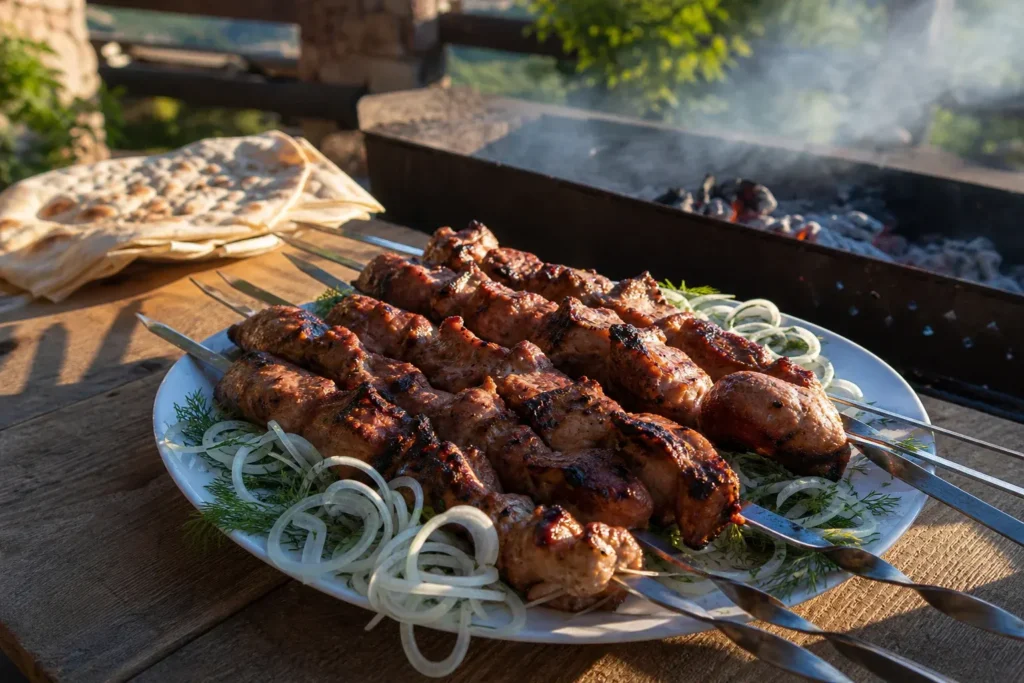
Shashlik is one of Russia’s most iconic summer dishes—meat cubes that have soaked overnight in a tangy, onion-rich marinade, threaded onto metal skewers, then grilled over charcoal until the outside chars and the inside stays juicy. If you’re planning to make a homemade shashlik recipe and want to understand the technique, this guide walks you through the essential steps and common mistakes.
This is for anyone with access to a grill (charcoal preferred, though gas works) and patience to marinate properly. You’ll produce restaurant-quality skewers with a smoky crust, tender meat, and the balance of acid and spice that makes shashlik distinctive. The recommended approach is pork or lamb, marinated overnight with onions, vinegar, and black pepper, then grilled hot and fast.
Quick answer: Cube 600–800 g of pork or lamb shoulder, mix with sliced onions, vinegar, and spices in a bowl, cover and refrigerate overnight (at least 12 hours). Thread onto metal skewers the next day, grill over charcoal over high heat for 10–15 minutes, turning frequently until browned outside. Total time: 12–24 hours (mostly marinating) plus 20 minutes to grill and rest. Cost is moderate to upscale depending on meat quality.
At a Glance
| Type | Dishes |
|---|---|
| Local name | шашлык |
| Origin | The dish originated in the Caucasus region and spread across Eastern Europe and Central Asia, gaining popularity in Russia and the former Soviet republics in the 19th century. The word shashlik entered English from Russian shashlyk, of Turkic origin; in Turkic languages, shish means 'skewer'. Russians borrowed the method of making shashlik from Caucasus peoples, and it became a staple outdoor grilling food. |
| Servings | 2–4 people (4–6 skewers) |
| Total time | 12–24 hours (marinating), plus 20 minutes (grilling and resting) |
| Difficulty | Easy |
History and Story of Shashlik, Sochi
The origins of shashlik trace back many centuries. It is said that shashlik originated from nomadic groups inhabiting the Caucasus and Central Asian regions, only entering Russia around the 18th century. The name comes from the Turkic word Shish, meaning skewer. The word was adopted into Russian in the 18th century. From the 19th century it became popular across much of the Russian Empire and later across much of the Eastern Bloc. In modern post-Soviet culture, shashlik is a whole summer ritual—the grill, the coals, friends, and cubes of marinated meat on long skewers.
Ingredients
- 600–800 g pork shoulder or lamb leg, trimmed
- 2 medium onions
- 3–4 tbsp white wine vinegar or lemon juice
- 3 tbsp vegetable oil
- 1 tsp salt
- 1 tsp black pepper
- Metal skewers (4–6, depending on serving size)
- Access to a charcoal grill or mangal
How Shashlik, Sochi Is Made
Step 1: Prepare and cube the meat
Cut the meat into sufficiently large cubes (about 4×4 cm) so it does not dry out during grilling. Trim away excess fat. Place the cubes in a large non-reactive bowl (glass or ceramic works well).
Step 2: Make the marinade
Mix diced onion rings, vinegar or lemon juice, oil, salt, and black pepper in the bowl. Mix the meat by hand (ideally using gloves) so that all ingredients are evenly distributed. Squeeze the onion to release its juices. The acid from the vinegar or lemon will begin to tenderize the meat.
Step 3: Marinate overnight
Always start preparation the night before you plan to serve. Overnight marinating in the refrigerator is best. Cover the bowl tightly and refrigerate for at least 12 hours, preferably 18–24 hours. The longer the marinating, the more tender and flavorful the meat becomes.
Tip: Do not skip this step. The onion juice and acid are essential for tenderizing the meat and building flavor.
Step 4: Remove meat and prepare skewers
Drain the meat and pat dry with paper towels. Thread the meat cubes onto metal skewers, leaving a small space between each piece to allow heat to circulate. You can intersperse vegetables (onion pieces, bell pepper chunks) if desired, but the classic preparation is meat only.
Step 5: Heat the grill and prepare coals
Shashlik is traditionally grilled over charcoal, not an open flame. Allow charcoal to burn until it is gray-white and very hot. If using a mangal (the traditional low metal tray grill), position the grill grate about 10–15 cm above the coals. For a standard grill, preheat to high heat.
Step 6: Grill and turn frequently
Do not turn the meat until a nice crust forms on the bottom side. Once you turn, rotate the skewers every 2–3 minutes to ensure even cooking. Some prefer it slightly pink (about 12 minutes); well done will take about 20 minutes. The meat should have a dark, caramelized crust outside.
Tip: Keep the skewers moving to prevent charring on one side only. A slight pink center in lamb or pork is safe and keeps the meat juicy.
Step 7: Rest and serve
Remove the skewers from the grill. Serve immediately on a platter, ideally on a base of fresh onion and sprinkled with chopped herbs (dill, parsley). Usually served with bread, fresh onion, and herbs.
Variants
- Pork shashlik (pork shoulder or neck): rich and fatty, most common in Russian cuisine
- Lamb shashlik: traditional Caucasian style, more assertive flavor
- Chicken shashlik: leaner, milder, often marinated in sour cream or yogurt instead of vinegar
- Beef shashlik: less common than pork or lamb, requires longer marinating
- Fish shashlik (salmon or sturgeon): delicate, requires minimal marinating to avoid drying out
- Vegetable and mixed shashlik: onion, bell pepper, tomato, or mushrooms interspersed with meat
Common Mistakes to Avoid
- Skipping or shortening the marinade. The acid in the vinegar or lemon juice is what tenderizes the meat and develops flavor; marinating for less than 12 hours leaves the meat tough.
- Using the wrong cut or too-lean meat. Shashlik needs fat to stay juicy on the grill. Pork shoulder, lamb leg, and fattier cuts are ideal; lean cuts dry out quickly.
- Turning the skewers constantly. Frequent flipping prevents a proper crust from forming. Wait until the first side browns deeply before turning, then rotate every 2–3 minutes.
- Grilling over direct flame or too-low heat. Open flame and low heat will scorch the outside before the inside cooks. Use charcoal that has burned down to glowing embers, or a gas grill on high.
- Cutting the meat too small. Small pieces dry out and fall apart. Aim for 4×4 cm cubes or larger.
- Forgetting to pat the meat dry before grilling. Excess marinade liquid on the meat will steam it rather than sear it. Drain and blot before threading onto skewers.
How to Order and Eat It
Shashlik is traditionally eaten off the skewer, directly onto a plate or onto flatbread. Place the cooked meat in the center of a plate surrounded by fresh raw onion slices, chopped fresh herbs (dill or parsley), and warm flatbread or lavash. Eat with your hands, dipping pieces into the onion and herbs. Some serve with adjika (a spicy tomato sauce) or a simple tomato dip on the side. The charred exterior, tender interior, and contrast of cold raw onion with hot meat is the essence of the dish.
To order: Дайте мне шашлычок, пожалуйста [Day-te mnye shashlychok, pozhaluysta] (Give me a shashlik skewer, please)
Where to Try Shashlik, Sochi
Sochi
 Vostochny Kvartal, Sochi Uzbek, Eastern, Caucasian
Main image: AI-generated illustration. It may not show the place exactly as it looks.
 Belye Nochi, Sochi Georgian, Caucasian
Main image: AI-generated illustration. It may not show the place exactly as it looks.
Yekaterinburg
 Khmeli Suneli, Yekaterinburg Georgian
Main image: AI-generated illustration. It may not show the place exactly as it looks.
Russia Vibes Tips
- Overnight marinating is non-negotiable. If you marinate for only a few hours, the meat will still be tough. Plan to start the evening or morning before you grill.
- Invest in high-quality metal skewers (called shampuri in Russian). Wooden skewers will char and eventually burn, no matter how much you soak them. Metal skewers conduct heat and are reusable.
- Don't waste the marinade onions. After grilling, thinly slice a few of the marinated onion rings and serve them alongside the meat. They add tang and complement the charred crust.
- Let the charcoal burn down fully before grilling. Fresh charcoal produces too much smoke and flame. Wait until the coals are gray and glowing hot, with a thin layer of ash on top.
- If grilling in a group, have all your skewers threaded and ready before anyone lights the grill. The window for perfect cooking (high heat, just-right doneness) is short—typically 12–15 minutes.
- The meat should have a dark, almost charred crust on all sides. This is not burning; it is the Maillard reaction that creates the signature flavor and texture. Aim for deep brown to black exterior.
Explore Nearby Shashlik, Sochi
Browse more: All Food & Drink · All Food & Drink in Sochi · All Other · All Sochi
FAQ
Can I marinate shashlik for just a few hours?
No. The minimum is 8–10 hours, but overnight (12–24 hours) is strongly recommended. The acid in the vinegar or lemon juice takes time to penetrate and tenderize the meat fibers. Shorter marinating times will result in tough, flavorless meat.
What if I don't have a charcoal grill?
A gas grill on high heat will work, though the flavor will be less smoky. An oven broiler is a last resort but produces inferior results. The defining characteristic of shashlik is the charcoal smoke and crust, so charcoal is ideal.
Can I use wooden skewers?
Wooden skewers can be used if soaked in water for 30 minutes first, but they will char and eventually burn. Metal skewers (shampuri) are traditional and conduct heat evenly, ensuring the meat cooks properly. Metal is highly recommended.
What is the difference between shashlik and shish kebab?
Shashlik and shish kebab are nearly identical. Both are grilled marinated meat on skewers. Shashlik is the Russian and Central Asian term and traditionally emphasizes the marinade and charcoal cooking. The preparation and taste are essentially the same.
Can I grill shashlik if I include vegetables?
Yes. Onion, bell pepper, tomato, and mushroom are all suitable. Add them between meat cubes on the same skewer. Note that vegetables cook faster than meat, so push them slightly to the side of the skewer or add them in the last few minutes to prevent burning.
Is shashlik safe to eat slightly pink inside?
Yes, pork and lamb can safely be eaten with a slightly pink center when grilled to medium-rare (internal temperature around 60–63°C / 140–145°F). Beef can be served rarer. Check that the outside is well-browned and cooked through.
How do I know when shashlik is done?
The meat should have a dark, caramelized crust on all sides. Pierce a thick piece with a knife; if it is firm and cooked through but not dry, it is ready. Total grilling time is typically 12–15 minutes over high heat. Lamb and pork are done at a slightly higher temperature than beef.
Can I prepare the marinade in advance?
Yes. You can prepare the marinade (onions, vinegar, oil, spices) in the bowl and keep it covered in the refrigerator for up to 24 hours before adding the meat. Add the meat and refrigerate together overnight for best results.
Russia Vibes is a one-person project. A coffee keeps it going
How we research and update our guides
About this guide: AI assistance and accuracy
This guide is created with the help of AI and is based on official sources where available. Mistakes can still happen. Opening hours, prices, rules and other details are given to the best of our knowledge as of the date shown and can change without notice. It offers general recommendations only, not professional, legal or travel advice. Please confirm important details with the official source before you travel; you are responsible for your own plans and decisions.

Take this guide with you
Get a free PDF of this guide to print or read offline: key facts, tips and a map link on a few clean pages.
Report an issue on this page
Paying for your trip: please read
International sanctions affect payments between Russia and many other countries. In practice, cards issued in the EU, the UK, the US and several other countries often do not work in Russia, Russian cards usually do not work abroad, and some booking platforms, airlines and payment providers limit or suspend their services for Russia. The situation changes frequently.
We do not give legal or financial advice, and this site does not encourage anyone to break or circumvent sanctions. Whatever you plan, you are responsible for following the laws and regulations that apply to you, including those of your country of residence and citizenship.
Many travelers still organise their stay lawfully. It is worth asking your bank or payment provider what is currently permitted, contacting hotels, tour operators and carriers directly about the payment methods they accept, and checking which services are open to customers from your country. Clarify payment, cancellation and refund terms before you commit to a booking, and keep your plans flexible.
Partner links on this site may not be available in every country, and prices, availability and rules in our guides can differ from what you see when you book.