
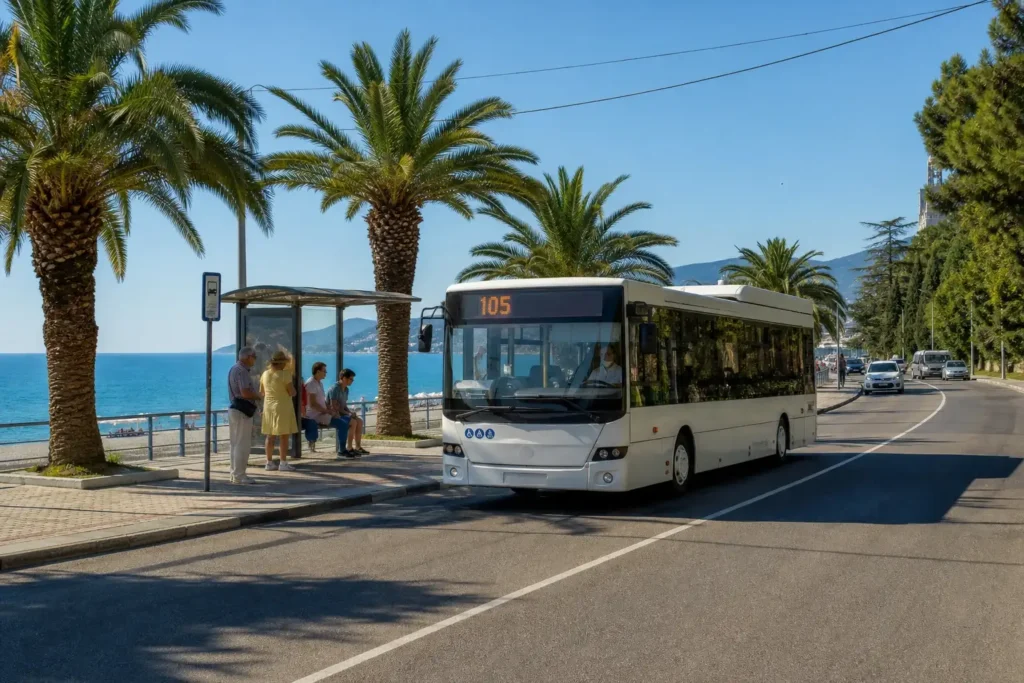
Whether you’re arriving at the airport, exploring the beach districts, or heading to mountain resorts, navigating Sochi requires understanding its three-part transport system: city buses with fixed fares, minibuses (marshrutkas) that fill gaps, and commuter trains that serve remote areas. Unlike most Russian cities, Sochi has no metro, trams or trolleybuses—buses and minibuses are the backbone. The recommended option for first-time visitors is to use city buses (routes 1–99) for short trips, marshrutkas for flexibility, and trains for longer suburban journeys.
This guide shows you where to board, how to pay, and the practical differences between each service so you can navigate like a local.
Quick answer: Over 200 bus routes operate in Sochi, covering all Greater Sochi districts. For city trips: flag a bus, board, pay cash to the driver, and ride. Routes 1–99 have fixed fares for any distance; routes 100+ charge by distance. Most trips take 15–40 minutes; total cost is budget-friendly.
At a Glance
| Total time | 15–45 minutes for a typical city journey (not counting wait time) |
|---|---|
| Typical cost | ₽ |
What You Need Before You Start
- Cash in Russian rubles (preferred; cards not always accepted)
- Knowledge of your destination stop name in Russian or English
- Comfortable shoes and willingness to stand if buses are crowded
- No need for advance booking—board as vehicles arrive
Compare Your Options
| Option | Duration | Price | Notes |
|---|---|---|---|
| City buses (routes 1–99) | 15–40 minutes per journey | ₽ | Over 200 routes with comfortable, air-conditioned buses; frequent service. Fixed fare for all distances within city limits. Most reliable for tourists. Operate 06:00–00:00. |
| Marshrutkas (minibuses) | 15–40 minutes, often faster than buses | ₽ | Minibuses duplicate bus routes but are much more frequent. Flag the driver to stop; wave at approaching marshrutka; ask driver to stop near your destination; can exit anywhere (not just stops). Less comfortable than buses but more direct. Pay driver on entry or exit. |
| Commuter trains (Lastochka) | 45 minutes airport to city; varies for other routes | ₽₽ | Sochi Airport has its own railway station connected to airport via walking bridge. Regional trains (Lastochka) run a few times daily (more in high season) with stops in Adler (10 min), Khosta and Matsesta, reaching Sochi station in about 45 minutes. Fastest option from airport. Buy tickets at stations or online. |
| Suburban buses (routes 100+) | Variable; 1–2 hours to mountain areas | ₽₽ | Routes 100 and above have flexible fares depending on travel distance. Connect Greater Sochi (Adler, Krasnaya Polyana, Lazarevskoe). Less frequent than city buses. Pay driver based on destination. |
| Fixed-route taxis (unofficially marshrutkas) | Similar to buses; more flexible routing | ₽ | Private minibuses operating on semi-fixed routes with longer or branched paths than official buses. Rare for tourists; useful if bus stops not convenient. Hail like marshrutkas. |
₽ budget · ₽₽ moderate · ₽₽₽ upscale · ₽₽₽₽ splurge. Price levels are estimates compared with typical prices for visitors.
Step-by-Step Instructions
Step 1: Locate a bus stop
A stop with the same name can be located at four different places at once, in each direction. Look for a shelter with a pole or signpost displaying route numbers. Ask locals or check your map app if unsure. Routes on the seafront near hotels are easy to spot.
Tip: If no shelter exists, stand where buses naturally slow down—drivers know the stops even if they are unmarked.
Step 2: Check the route number
Route numbers from 1 to 99 are city buses; numbers 100 and above serve suburban routes. City routes (1–99) have one flat fare regardless of distance. Suburban routes (100+) charge more the farther you go. Watch approaching buses—the number displays on the front.
Tip: Popular tourist routes include 99 (ring route of Central Sochi), 3K (to Matsesta), 105 (to airport and Krasnaya Polyana).
Step 3: Board the bus
Most buses are air-conditioned and comfortable. Pay the driver as you get on (for inter-district buses) or before you get off (for inner-city buses). Step up and move toward the middle or back to make room. State your destination or nod to confirm you understand.
Tip: Buses run from about 06:00 to 00:00 (midnight). Evening services are less frequent.
Step 4: Pay the driver
Hand cash to the driver or a conductor standing near the door. Inner-city routes (1–99) cost a fixed fare. State your stop name if it's a suburban route so the driver calculates the correct fare. Drivers always have change.
Tip: Cards are accepted on some routes but cash is more reliable, especially on smaller minibuses.
Step 5: Request your stop
Watch the street signs or listen for announcements (if available). When close to your destination, ring the bell or ask the driver in Russian ( 'Vot tut?' = 'Here?'). The bus will stop at the next designated stop.
Tip: Locals often call out their stops or tap the driver on the shoulder—this is normal and expected.
Step 6: Exit the bus
Press the rear door button or push the door. Step down carefully onto the street. Check traffic before moving away from the stop. On some older buses, you may need to push the door manually.
Tip: During rush hours (07:00–09:00 and 17:00–19:00) buses are crowded; be prepared to stand or board a marshrutka instead.
Common Mistakes to Avoid
- Confusing route numbers: routes 1–99 have fixed fares anywhere in the city; routes 100+ cost more based on distance. Many visitors overpay suburban routes or underpay.
- Looking for a transport card like Moscow's Troika: Sochi has no unified transport card system. Always pay cash or card directly to the driver.
- Assuming all stops are clearly marked: Not all transport stops are equipped; some are marked only with a road sign or are unmarked. Ask locals if unsure.
- Missing your stop: Drivers don't always announce stops clearly. Watch street signs or use your phone's GPS; don't hesitate to ask other passengers or the driver before boarding which stop is yours.
- Waiting for a metro that doesn't exist: Sochi has no trams or trolleybuses. Buses and marshrutkas are the only ground transport; plan accordingly.
- Boarding the wrong direction: Same route number can run in opposite directions from the same stop. Check the bus front display or ask the driver 'Vy edete v...?' (Are you going to...?).
Tickets, Payment and Booking
Where to buy tickets: Buses and marshrutkas: pay the driver in cash on board. Commuter trains: buy at ticket windows at railway stations or via online ticket platforms (ask your hotel for details).
Payment methods: Cash is reliable everywhere. Bank cards are accepted on some city bus routes but not guaranteed on all minibuses or small routes. Payment on buses is made at entrance in cash or by bank card, but bank cards may not be accepted on certain routes due to poor coverage; it is better to have cash in stock.
For foreign visitors: No special tourist passes or cards exist. Pay per ride. No advance booking needed for buses or marshrutkas—just board when they arrive. Avoid unofficial taxis and unmarked vehicles.
Helpful Links
Compare hotel pricesSearch flights
Advertisement: these are partner links. If you book or buy through them, we may earn a commission at no extra cost to you.
Russia Vibes Tips
- Use a maps app (Google Maps or Yandex.Maps) to plan your route: enter your destination and it will show available buses, marshrutkas, or trains with estimated times. Crucial since stops are not always obvious.
- Carry small bills and coins: drivers give change, but having exact or close-to-exact money speeds boarding. Tourist areas have ATMs, but remote stops may not.
- Morning and evening rush hours (07:00–09:00 and 17:00–19:00) mean buses are crowded and marshrutkas are faster. Off-peak (midday, late evening) buses are less busy and more comfortable.
- For airport arrival: Bus services 105 and 105s depart from the airport to central Sochi a couple of times per hour. Look for the signpost marked 'To Sochi' on the Arrivals level floor. Trains are faster (45 min vs. 60 min) but buses are cheaper.
- Learn three destination stops: 'Zheleznodorozhnyi vokzal' (railway station), 'Avtovokzal' (bus terminal), and 'Pliazh' (beach). These anchor points help you orient rides across the city.
- Marshrutka trick: if a full marshrutka passes, wait 5–10 minutes for the next one rather than waiting 30+ minutes for a half-empty bus. Marshrutkas run frequently on the same routes.
Explore Nearby Getting around Sochi by public transport
Related guides
 How to Use the Metro, Saint Petersburg: Lines, Transfers and Tickets
Main image: AI-generated illustration. It may not show the place exactly as it looks.
 How to Book a Taxi or Ride-Hailing Car, Saint Petersburg: Booking Tips
Main image: AI-generated illustration. It may not show the place exactly as it looks.
 How to Get from Pulkovo Airport to the City Centre, Saint Petersburg: Bus, Metro and Taxi
Main image: AI-generated illustration. It may not show the place exactly as it looks.
Browse more: All How-To · All How-To in Sochi · All Metro and Trains · All Sochi
FAQ
Is there a metro or tram in Sochi?
Sochi does not have any trams or trolleybuses, nor a metro system. Buses and minibuses are the primary public transport. A light metro was planned for the 2014 Olympics but abandoned.
How much does a bus ride cost?
Inner-district buses cost a fixed fare. City routes (1–99) are one price for any distance. Suburban routes (100+) vary by destination. Exact amounts change; pay the driver or ask locals for current fares.
Can I use my credit card to pay for buses?
Some city buses accept cards, but bank cards may not be accepted on certain routes due to poor coverage, so it is better to have cash in stock. Marshrutkas almost always require cash.
How do I know which bus to take if I don't speak Russian?
Use Google Maps or Yandex.Maps to search your destination and it will show available bus routes with numbers. Write down the route number and destination in Russian or show it to the driver on your phone. Ask hotel staff to write your destination on a piece of paper.
What is a marshrutka and how is it different from a bus?
Marshrutkas are minibuses that duplicate bus routes but run much more frequently. Flag the driver to stop; wave at approaching marshrutka; ask driver to stop near destination; exit anywhere, not just stops. Less comfortable but more flexible than regular buses.
How do I get from the airport to central Sochi?
Two options: Bus services 105 and 105s depart from airport to central Sochi a couple of times per hour (60 min, budget). Or take regional train (Lastochka) from airport railway station (45 min) for faster travel. Follow floor signs marked 'To Sochi' or 'To Railway Station.'
Do I need to book bus tickets in advance?
No. Buses and marshrutkas operate on frequent schedules and you pay on board when you arrive at the stop. Simply board as they come. Commuter trains have more limited service; buy tickets at the station or online.
Can I take buses to Krasnaya Polyana ski resort or Adler?
Bus 105 and 135 from airport go to Krasnaya Polyana. Route 167 goes from central bus terminal to Adler. These are suburban routes (numbers 100+) with distance-based fares.
Russia Vibes is a one-person project. A coffee keeps it going
How we research and update our guides
About this guide: AI assistance and accuracy
This guide is created with the help of AI and is based on official sources where available. Mistakes can still happen. Opening hours, prices, rules and other details are given to the best of our knowledge as of the date shown and can change without notice. It offers general recommendations only, not professional, legal or travel advice. Please confirm important details with the official source before you travel; you are responsible for your own plans and decisions.

Take this guide with you
Get a free PDF of this guide to print or read offline: key facts, tips and a map link on a few clean pages.
Report an issue on this page
Paying for your trip: please read
International sanctions affect payments between Russia and many other countries. In practice, cards issued in the EU, the UK, the US and several other countries often do not work in Russia, Russian cards usually do not work abroad, and some booking platforms, airlines and payment providers limit or suspend their services for Russia. The situation changes frequently.
We do not give legal or financial advice, and this site does not encourage anyone to break or circumvent sanctions. Whatever you plan, you are responsible for following the laws and regulations that apply to you, including those of your country of residence and citizenship.
Many travelers still organise their stay lawfully. It is worth asking your bank or payment provider what is currently permitted, contacting hotels, tour operators and carriers directly about the payment methods they accept, and checking which services are open to customers from your country. Clarify payment, cancellation and refund terms before you commit to a booking, and keep your plans flexible.
Partner links on this site may not be available in every country, and prices, availability and rules in our guides can differ from what you see when you book.