
Updated
Khosta, a microdistrict in the Khostinsky City District, sits 20 kilometers south of central Sochi on the Black Sea coast. This former 19th-century settlement—granted town status in 1899—is now the southern anchor of Greater Sochi, separated from the busier central beaches by green valleys and served by its own railway station and harbour.
Unlike central Sochi’s crowds and modern sprawl, Khosta offers a quieter seaside experience. The compact central microdistrict clusters hotels, sanatoriums, shops and restaurants along a pebbled waterfront, while the vast Khostinsky District extends far inland into mountains cloaked in national park, reaching the borders with the Republic of Adygea. For visitors, the appeal lies in simpler beach rhythms and proximity to nature reserves rather than resort infrastructure.
Quick Facts
| Russian name | Хоста |
|---|---|
| Address | Khosta, Khostinsky City District, Sochi, Krasnodar Krai 354024 OpenStreetMap · Google Maps |
| District | Khostinsky City District |
| Best time to visit | Late May to early June and September to early October offer warm sea temperatures, fewer crowds than July–August, and comfortable afternoon temperatures. Spring (April–May) can be rainy. Summer (July–August) is hot, crowded, and sometimes humid; beaches and the Dendrarium fill with tour groups. Winter is mild but often cloudy and wet; some cafés and shops close seasonally. Weekday visits, especially early morning, avoid weekend and holiday crowds. |
| Recommended duration | 1–2 days |
What Is (and Isn't) Part of a Visit to Khosta, Sochi?
| Part | Status | Notes |
|---|---|---|
| Khosta Microdistrict (compact centre) | Included in the standard ticket | The main resort core with beaches, railway station, shops, restaurants and hotels; freely walkable and accessible year-round. |
| Sochi Dendrarium | Separate ticket or institution | Separate paid ticket; entrance at 74 Kurortny Prospekt, 1 kilometre uphill from the microdistrict centre. Part of Sochi National Park. |
| Khostinsky Tisosamshitovaya Grove | Separate ticket or institution | No entrance fee; publicly accessible relic forest 1 kilometre northeast of the microdistrict centre. Part of Sochi National Park. |
| Mount Akhun and Observation Tower | Separate ticket or institution | Mountain hike or road vehicle required; 2.7–4 kilometres northeast of microdistrict centre. May charge small fee at tower; verify locally. |
| Agura Waterfalls | Separate ticket or institution | Hiking destination 3.8 kilometres from microdistrict centre; part of Sochi National Park. No entrance fee for the trail. |
| Khostinsky City District (wider administrative area) | Outside / not part of it | Stretches 15 kilometres south along coast to Adler; most of it is national park and mountain settlements, not typically visited as a single entity by tourists. |
Why Visit Khosta, Sochi?
The Sochi Dendrarium, Russia’s oldest botanical collection, sits just uphill from the railway station—a 49-hectare landscape of subtropical plants collected since 1892, accessible by cable car for views across sea and mountains. The compact microdistrict’s pebble beaches offer calmer water than central Sochi, with water-sports rentals and seasonal cafés. Mount Akhun, towering 663 metres above the district, holds a 1911 stone observation tower at its peak; the hike or road ascent opens panoramic views from Adler to central Sochi. Nearby, the Khostinsky Tisosamshitovaya Grove—a relic subtropical forest of yew and boxwood—offers shaded woodland trails without the Dendrarium’s crowds.
How Khosta, Sochi Is Laid Out
Khosta microdistrict (the compact centre) sits in the mouth of the Khosta River, with the railway station at its eastern edge, a small shopping district and sanatoriums clustered within 500 metres of the waterfront, and public beaches divided into short sections by old Soviet-era concrete breakwaters.
The much larger Khostinsky City District stretches 15 kilometres along the coast from central Sochi south to Adler, encompassing mountain settlements, sanatorium complexes, and large tracts of Sochi National Park. Most natural attractions—Mount Akhun, Agura Waterfalls, relic forests—lie 2–5 kilometres outside the microdistrict centre, accessible by local bus, taxi, or excursion transport. Visitors planning to explore widely should base themselves in the compact microdistrict but arrange day trips or car hire to reach major sights.
Highlights of Khosta, Sochi
Sochi Dendrarium (Arboretum)
Occupying a terrace of Bald Mountain overlooking the sea since 1892, this 49-hectare botanical collection holds more than 1,800 species of plants—including 76 species of pine, 80 of oak, and 24 of palm—from subtropical regions worldwide. A cable car rises to upper terraces; below, ponds and Italian-style gardens create a living museum of landscape design. The park is divided by Kurortny Prospekt and connected by an underground tunnel. Sergei Khudekov, a Russian publisher and art collector, established it as a private garden; it became part of Sochi National Park in 2012.
Tip: Buy a combined ticket that includes cable car access; the 20-minute journey from the railway station by bus or minibus makes it the easiest major attraction to reach without a car.
Mount Akhun Observation Tower
This 663-metre limestone peak, traditionally sacred to the Ubykh people, crowns a 1911 Romanesque stone tower built by a local landowner. The panorama from its base—stretching from Adler in the south to central Sochi in the north, with the Caucasus Mountains inland and the Black Sea to the west—is considered the finest coastal view in the district. A road switchbacks up one side; trails descend through mixed forest on the other.
Tip: Go early morning or late afternoon in summer to avoid midday heat on the exposed road; the hike takes 45 minutes to an hour from the trailhead near Khostinsky Tisosamshitovaya Grove.
Khostinsky Tisosamshitovaya Grove
A protected relic subtropical forest of yew and boxwood trees, rare in Russia, thriving on the cool northern slope of the Caucasus. The grove occupies about 1.4 square kilometres and is threaded with shaded walking loops. Signs mark a small ring (roughly 1 kilometre) and a larger circuit; the small ring has English signage. Unlike the Dendrarium, there is no entrance fee and few visitors, making it an intimate refuge.
Tip: The small ring trail is easier and takes 30–45 minutes; bring water, as there are no refreshments in the grove. Wear closed shoes for forest walking.
Khosta Microdistrict Beaches
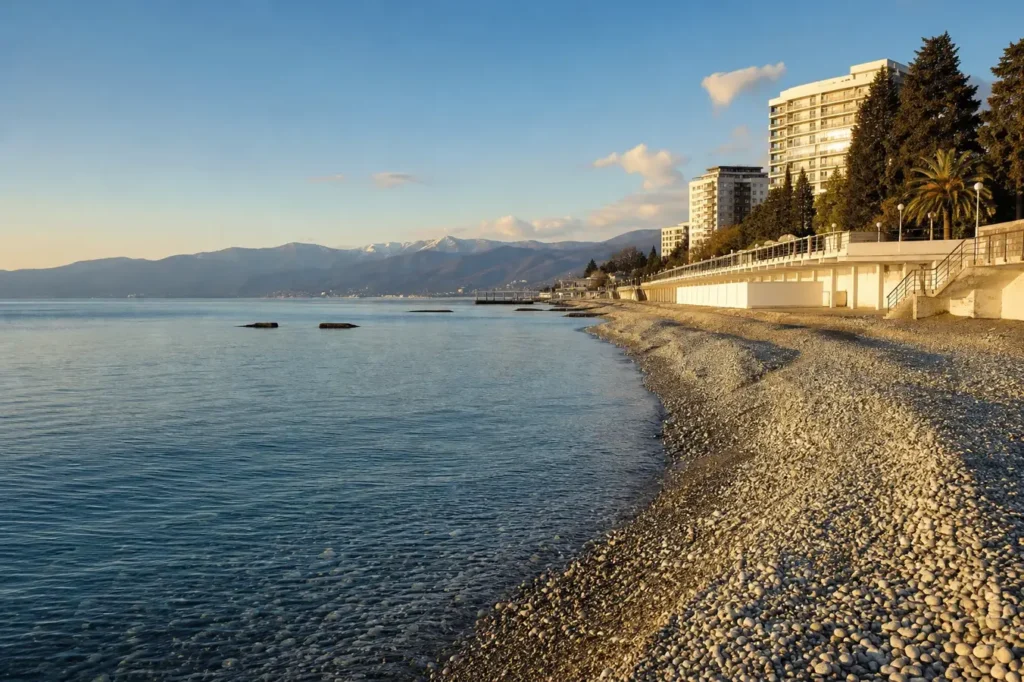
The Black Sea coast here is lined with pebble beaches accessible from the waterfront promenade. Soviet-era breakwaters divide the shoreline into short sections, creating a characteristic segmented appearance. The water is generally calm, attracting families and swimmers. A small municipal beach called Osvod operates on the right bank of the Khosta River; nearby, facilities and cafés cluster seasonally.
Tip: Beaches are cleanest in early June and September; July and August bring crowds and seasonal vendors. Bring water shoes for the pebbles.
Khosta Railway Station
Built between 1961 and 1963, this important transport hub sits on the Sochi–Adler coastal railway. Its three platforms, connected by a pedestrian subway tunnel, serve regional trains linking Sochi, Khosta and Adler, plus long-distance services. The station's architecture reflects Soviet modernism; its position at the district's heart makes it the natural arrival and orientation point for visitors without a car.
Tip: Suburban train tickets between Sochi, Khosta and Adler are inexpensive and frequent; preferable to the congested M27 Highway for car-free exploration of the coast.
Agura Waterfalls
A series of three cascades formed by the Agura River in a ravine 3.8 kilometres northeast of the microdistrict centre. The highest falls reach approximately 27 metres. A hiking trail follows the ravine upstream through mixed forest; the walk typically takes 1.5 to 2 hours round-trip from the trailhead. The site is part of Sochi National Park and offers a more rugged outing than beach or garden visits.
Tip: Start early to avoid afternoon crowds; the water is cool year-round. The trail can be muddy after rain; wear appropriate footwear.
Atmosphere
Khosta microdistrict feels more provincial than central Sochi: the pebble beaches are quieter, the streets less trafficked, the sanatorium-era buildings more weathered. The railway station is a central social hub, where locals board trains and tour groups gather. During summer high season, the waterfront promenade fills with families and vendors; outside summer, it is nearly empty. The yew-boxwood grove is perpetually hushed and cool, moss covering forest paths and muffling footsteps. Mount Akhun’s observation platform can be windswept and exposed, a stark contrast to the wooded ravines below. The overall character is restful and timeless rather than vibrant—a place where time moves to the rhythm of trains and tides.
History of Khosta, Sochi
Khosta’s history extends back to antiquity. In the Middle Ages, the Republic of Genoa established a colony called Costa at the location of modern Khosta, taking advantage of the protected coastal settlement. Genoan dominance faded with Ottoman expansion in the 16th century.
The modern history of Khosta begins in the 19th century, when Russian expansion into the Caucasus opened the region to settlement and resource development. What is now the Khostinsky District developed as a collection of independent settlements. In 1899, Khosta was granted town status; by 1914, it had a population of 1,500, a brick factory, and wine production—modest economic drivers for a growing resort.
The Soviet era brought dramatic change. In 1951, the Khostinsky City District was officially established as an administrative division of Sochi. The 1950s and 1960s saw large-scale construction: sanatorium complexes, the railway station (completed 1963), and residential blocks rose rapidly to accommodate the expanding health resort industry. Little remains from before 1930; most of today’s district was built during this post-war development boom.
Today, Khosta represents a quieter corner of Soviet-era seaside urbanism, less transformed than central Sochi by post-1990s commercialism, yet still a functioning resort with hotels, restaurants and transport links serving the broader Sochi tourism economy.
Legends and Myths about Khosta, Sochi
Mount Akhun as Sacred Peak
Disputed by historians. The Ubykh people, indigenous to the North Caucasus, traditionally regarded Mount Akhun as a sacred place before Russian colonial expansion displaced them in the 19th century. Local stories speak of the mountain as a site of spiritual significance to the Ubykh; the 1911 stone tower at its peak was built later by Russian owners, overlaying but not erasing these older associations.
Yew and Boxwood Grove as Ancient Refuge
Legend – historically unreliable. Legend holds that the Khostinsky Tisosamshitovaya Grove represents a remnant of subtropical forests that once blanketed the southern Caucasus before climate change and human settlement fragmented them into isolated pockets. The grove, preserved as a living museum, is said to harbor plant species unchanged since Tertiary times, making it a 'fossil forest' of extraordinary age.
Tickets and Booking for Khosta, Sochi
| Ticket | Price | Includes |
|---|---|---|
| Sochi Dendrarium – Adult | ₽ | Entrance to arboretum grounds, access to both upper and lower sections; does not include cable car. |
| Sochi Dendrarium – Child | ₽ | Entrance for ages typically up to 12; discounted rate. |
| Sochi Dendrarium – Cable Car (add-on) | ₽ | Round-trip cable car from lower to upper arboretum and back; extends visit duration by 20–30 minutes. |
| Mount Akhun Tower | ₽ | Access to observation tower at peak; small fee typically payable on-site or at informal kiosk. Rates unverified; check locally. |
₽ budget · ₽₽ moderate · ₽₽₽ upscale · ₽₽₽₽ splurge. Price levels are estimates compared with typical prices for visitors.
The Sochi Dendrarium’s official website is dendrarium.ru; tickets are generally sold at the main entrance at 74 Kurortny Prospekt, though online advance booking is possible. The site accepts international visitors and does not require advance purchase. Same-day tickets are normally available unless an event or seasonal closure occurs. Rates for Russian citizens and concessions (students, seniors) differ from international visitor rates; see the official ticket page for all categories.
Mount Akhun tower and Khostinsky Tisosamshitovaya Grove charge no or minimal fees; local guides and excursion operators can arrange combined visits to multiple sites. The railway station sells local transport passes; buses and minibuses serving the district are pay-per-ride.
Check the official Sochi National Park website and dendrarium.ru for current opening hours, any seasonal access restrictions, and up-to-date pricing before visiting.
Suggested itineraries Khosta, Sochi
Morning (2–3 hours)
Arrive by train or bus at Khosta station. Walk the compact waterfront promenade and municipal beach for 45 minutes. Climb or take a taxi uphill to the Sochi Dendrarium main entrance; explore the lower sections and lower park for 1–1.5 hours, then ride the cable car to the upper park for views and a brief walk.
Full day (5–6 hours)
Start at Khosta railway station. Spend 1–2 hours at the Sochi Dendrarium, including cable car. Take a bus or taxi to the Khostinsky Tisosamshitovaya Grove (15 minutes); walk the small or large circuit (45 minutes to 1.5 hours). Return to the microdistrict for lunch at a waterfront café, then walk the beaches and promenade in the afternoon.
Day trip including Mount Akhun
Hire a taxi or take a guided excursion from the microdistrict to Mount Akhun (30 minutes each way). Hike or drive to the observation tower (45 minutes climb or short drive). Enjoy the panorama and descend. Visit Agura Waterfalls (3–5 kilometres away; another 30-minute taxi ride); hike the ravine (1.5–2 hours). Return to Khosta for late lunch and evening beach walk.
How to Get to Khosta, Sochi
By train: Khosta railway station sits on the Sochi–Adler coastal line. Suburban trains run frequently from central Sochi (journey time 15–20 minutes) and Adler (10 minutes). The station is the natural entry point; platforms connect via pedestrian subway tunnel. Exit to the main concourse and walk downhill 5 minutes to the waterfront and beach.
By bus or minibus: Buses and minibuses serve Khosta from central Sochi (30–45 minutes) and Adler (15–20 minutes); stops are near the railway station. The M27 Highway crosses the district but is congested; buses avoid the worst traffic.
By taxi or ride-hailing: Taxis and ride services (Yandex, Uber where available) serve the microdistrict. From central Sochi, expect 30–40 minutes and moderate fares; from the airport, 20–30 minutes. The station is a well-known landmark for drivers.
On foot: The microdistrict is compact; the waterfront, shops, restaurants and most facilities lie within a 10-minute walk of the railway station. Beach access points are clearly signed.
Accessibility
The Sochi Dendrarium offers wheelchair access on lower terraces and cable car loading is accessible; upper terraces are on slopes and may challenge mobility. The waterfront promenade is generally paved and level. Railway station platforms are accessible via ramps and lifts. The Khostinsky Grove forest paths are earthen and uneven, unsuitable for wheelchairs. Mount Akhun is accessible by road; the tower climb involves stone steps and is steep. Public beaches have entry points at ramps in some areas. Most cafés and shops are single-level. Ask staff at the Dendrarium or station for specific assistance.
Food Nearby
The microdistrict's waterfront promenade and central streets offer cafés and informal restaurants, most active in summer. Expect simple Russian and Caucasian fare, shashlik (kebabs), and fresh fish. A few named establishments include Udacha Café and smaller dining kiosks near the beach. Outside high season, many close. Supermarkets (Lenta, Pyaterochka chains) and small shops cluster near the railway station, stocking groceries for self-catering. Larger shopping and dining options are in Adler (20 minutes by train) or central Sochi (20–30 minutes).
What to Bring
Bring sunscreen, sunglasses and a hat year-round; summer UV is intense. Swimwear and water shoes for pebble beaches; the shore is rocky. Comfortable walking shoes for forest trails (Khostinsky Grove, Mount Akhun paths) and arboretum terraces. Light layers for spring and autumn; waterproof jacket for winter rains. A camera or phone for panoramic views from Mount Akhun and the Dendrarium cable car. Bags must comply with standard security rules at public sites; no restrictions are unusually strict.
Best Views and Photo Spots of Khosta, Sochi
Mount Akhun Observation Tower Platform
The 360-degree panorama from the tower base encompasses the Black Sea coastline from Adler to central Sochi, the Caucasus Mountains inland, and the pebble beaches far below. The afternoon light casts the mountains in sharp relief; the sea reflects golden light in late afternoon. This is the single most photographed vista in the district.
Best time: Late afternoon (4–6 pm) for warm light and mountain definition; avoid midday glare. Early morning can be hazy in summer.
Sochi Dendrarium Cable Car View
The cable car ascends above subtropical gardens and terraces toward the upper park, offering descending views of sea, forest and coastal settlements. The ride itself frames scenic layers of landscape. Lower angle shots capture the cable car structure against the sea.
Best time: Morning light is soft; afternoon can create lens flare. Clear days after rain offer the sharpest visibility.
Khostinsky Grove Forest Path
Moss-covered yew and boxwood trees create a deep-green atmosphere; filtered light through dense canopy is moody and intimate. The texture of ancient bark and soft undergrowth suggests primordial forest. Wide-angle shots work well here.
Best time: Overcast days and after rain; avoid harsh midday shadows. Spring (May) and autumn (September–October) have richer green tones.
Khosta Microdistrict Waterfront at Sunset
The pebble beach, breakwaters and waterfront buildings frame the Black Sea at dusk. Soviet-era architecture along the shore creates an atmospheric silhouette. The sea reflects warm sunset tones.
Best time: One hour before sunset through twilight (May–August, 7–9 pm); September–October earlier (5–7 pm). Clear skies are essential.
Photography Rules
The Sochi Dendrarium permits personal photography on grounds; tripods and commercial shooting require permission from park administration. Mount Akhun observation tower is open air and ideal for panoramic photography; no restrictions. Drone flights are prohibited over Sochi National Park territory without permits. Flash photography is not restricted outdoors. The Khostinsky Grove permits personal photography but not commercial filming.
Family Suitability
Khosta is very family-friendly for young children. Beaches are calm and pebbled (water shoes recommended). The Sochi Dendrarium is stroller-accessible on lower terraces and the cable car adds novelty for children; upper sections are steep. The Khostinsky Grove is suitable for older children comfortable with forest walking but not buggies. Mount Akhun requires moderate fitness; the observation tower involves stone steps unsuitable for very young toddlers. Waterfront cafés and ice-cream kiosks cater to families. Few amusement park attractions exist locally (the district is quieter than central Sochi); entertainment is nature-focused.
Russia Vibes Tips
- Avoid the false Dendrarium entrance: the main entrance is at 74 Kurortny Prospekt (marked by a distinctive rotunda); a secondary entrance farther down the avenue is less convenient. Minibuses 105, 105s, 125s and 125p from Khosta station reach the main entrance stop 'Sanatorium Yana Fabritsiusa' in 10 minutes.
- The Dendrarium cable car operates split hours (morning and afternoon sessions with a midday break); plan your visit to catch both cable car sessions if desired, as queues can form in late afternoon.
- Do not expect entertainment or nightlife in the microdistrict; restaurants and bars are modest and seasonal. Book taxi or bus transport to Adler or central Sochi for evening dining or nightlife.
- Mount Akhun is best visited by taxi or car; public transport to the trailhead is minimal. Hire a driver for a few hours to combine multiple mountain sites (Mount Akhun, Agura Waterfalls, remote sanatoriums).
- The Khostinsky Grove entrance is poorly signed; ask locals for 'Tisosamshitovaya Grove' or 'Yew and Boxwood Grove'; a guide or printed map is useful to orient the two walking circuits and avoid getting lost.
- Coastal fog is common in early summer (May–June); mountain views from Mount Akhun can be obscured. September and October offer clearer panoramas.
Explore Nearby Khosta, Sochi
Browse more: More in Khostinsky City District · All Hidden Russia · All Neighborhoods · All Neighborhoods in Sochi · All Sochi
FAQ: Khosta, Sochi
Is Khosta a separate town or part of Sochi?
Khosta is a microdistrict (a small urban sub-area) within the Khostinsky City District of Sochi. It has its own railway station and administrative centre but is not independent; it is legally part of the city of Sochi, which was a unified municipality in 1951.
Can I visit the Sochi Dendrarium without a car?
Yes. From Khosta railway station, take minibuses 105, 105s, 125s or 125p (5–10 minutes); they stop near the main entrance. The Dendrarium is the easiest major attraction to reach without a car.
Is Mount Akhun accessible without hiking?
Yes. A road switchbacks up the mountain; visitors can hire a taxi to drive to the observation tower (45 minutes from the microdistrict). The hike takes 45 minutes to an hour from the lower trailhead; either option works.
Are beaches in Khosta different from central Sochi beaches?
Khosta beaches are quieter and less developed than central Sochi. They are lined with pebbles (bring water shoes) and divided by old Soviet breakwaters. Water is typically calm. Amenities (rentals, cafés) exist seasonally on the promenade but are fewer than in central Sochi.
Can I combine Khosta, Mount Akhun, and Agura Waterfalls in one day?
Yes. A taxi or hired car can connect all three in 5–6 hours: visit the Dendrarium or microdistrict in the morning, Mount Akhun at midday, and Agura Waterfalls in the afternoon. An excursion operator from the microdistrict can arrange this.
Is the Khostinsky Grove free to visit?
Yes. There is no entrance fee for the Khostinsky Tisosamshitovaya Grove. It is open during daylight and maintained by Sochi National Park; visitors walk freely on marked trails.
What is the best time to visit Khosta?
Late May to early June and September to early October offer warm sea temperatures and fewer crowds than July–August. Summer is hottest but crowded; winter is mild but rainy and quiet. Weekdays are always less busy than weekends.
How long should I spend in Khosta?
A half-day visit to the microdistrict and Dendrarium is possible; a full day allows exploration of multiple sites (Dendrarium, grove, beaches). Two days enable visits to Mount Akhun, Agura Waterfalls and relaxation on the beach.
Russia Vibes is a one-person project. A coffee keeps it going
How we research and update our guides
About this guide: AI assistance and accuracy
This guide is created with the help of AI and is based on official sources where available. Mistakes can still happen. Opening hours, prices, rules and other details are given to the best of our knowledge as of the date shown and can change without notice. It offers general recommendations only, not professional, legal or travel advice. Please confirm important details with the official source before you travel; you are responsible for your own plans and decisions.

Take this guide with you
Get a free PDF of this guide to print or read offline: key facts, tips and a map link on a few clean pages.
Report an issue on this page
Paying for your trip: please read
International sanctions affect payments between Russia and many other countries. In practice, cards issued in the EU, the UK, the US and several other countries often do not work in Russia, Russian cards usually do not work abroad, and some booking platforms, airlines and payment providers limit or suspend their services for Russia. The situation changes frequently.
We do not give legal or financial advice, and this site does not encourage anyone to break or circumvent sanctions. Whatever you plan, you are responsible for following the laws and regulations that apply to you, including those of your country of residence and citizenship.
Many travelers still organise their stay lawfully. It is worth asking your bank or payment provider what is currently permitted, contacting hotels, tour operators and carriers directly about the payment methods they accept, and checking which services are open to customers from your country. Clarify payment, cancellation and refund terms before you commit to a booking, and keep your plans flexible.
Partner links on this site may not be available in every country, and prices, availability and rules in our guides can differ from what you see when you book.