
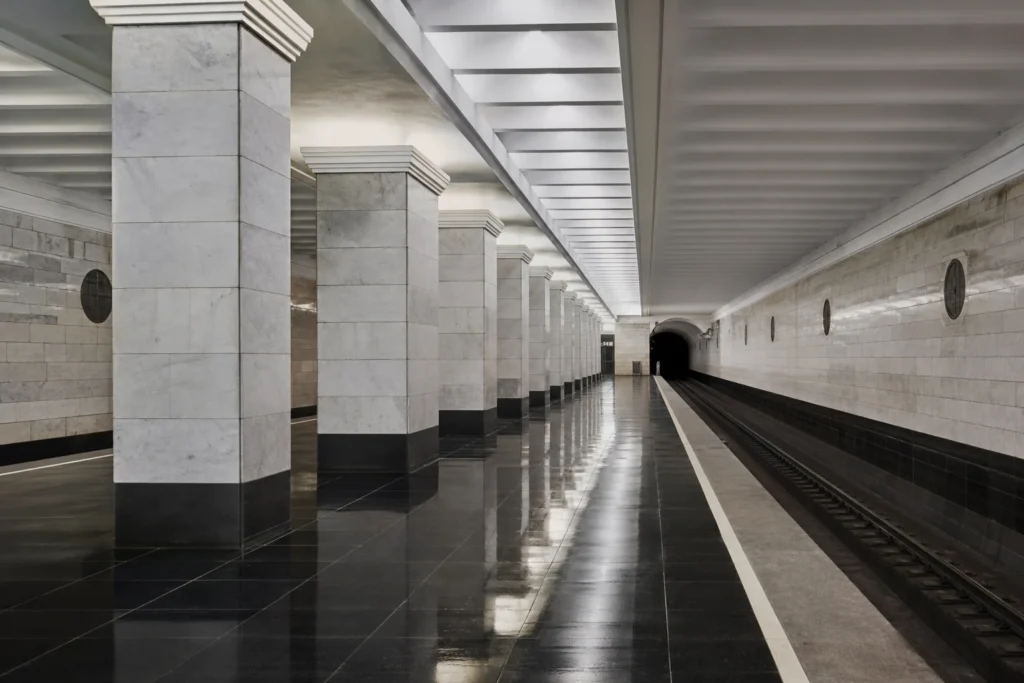
Mashinostroiteley metro station in Yekaterinburg opened on 27 April 1991 as one of the three inaugural stations of the Yekaterinburg Metro, which was the last metro system to open in the Soviet Union. The station’s name—”Machinery Builders”—reflects the historical role of the surrounding Uralmash industrial district, where heavy machinery factories once dominated the landscape.
Located between Uralmash and Uralskaya stations on Line 1, Mashinostroiteley exemplifies the pragmatic design philosophy of the early 1990s Soviet system. Built just 4.5 metres underground, it is a shallow station designed to serve industrial workers commuting between manufacturing plants and the city centre.
Quick Facts
| Russian name | Машиностроителей |
|---|---|
| Built / opened | 1991 |
| Address | Mashinostroiteley Street, Yekaterinburg OpenStreetMap · Google Maps |
| District | Yekaterinburg |
| Interchanges | Mashinostroiteley (Line 1, Main lobby on Mashinostroiteley Street) |
| Best time to visit | Mashinostroiteley is primarily a working station serving commuters, so it is busiest during weekday mornings (07:00–09:30) and evenings (17:00–19:00). Weekend and mid-day visits offer a quieter, more contemplative experience of the station's architecture. There is no seasonal variation in usage patterns. |
Why Visit Mashinostroiteley, Yekaterinburg?
Mashinostroiteley merits a stop for anyone interested in understanding the DNA of the Yekaterinburg Metro. Unlike the monumental metro systems of Moscow or Saint Petersburg, this station embodies the functional industrial aesthetic of late Soviet design. The contrast between its modest depth and refined materials—black flooring and marble details—reveals the tension between economic constraints and design aspiration at the end of the USSR.
The station also provides direct access to the Uralmash district’s workers’ housing and historical workshops. For visitors studying Russian industrial heritage or Soviet-era transit infrastructure, the station is a tangible record of how regional cities solved rapid-transit problems with different solutions than the metropolises.
Highlights of Mashinostroiteley, Yekaterinburg
Island platform with 24 columns
The station features a single island platform flanked by 24 supporting columns. This column-heavy design is necessary at shallow depth to distribute the weight of the street above while maintaining a wide platform for passenger flow. The columns are finished in polished materials that contrast with the black floor, creating the station's signature visual identity.
Tip: Walk the full length of the platform to appreciate the rhythm and scale of the colonnade.
Original 1991 materials and finishes
The station retains its original late Soviet finishes: polished stone, marble details, and utilitarian lighting. These materials were chosen for durability and ease of maintenance rather than luxury, reflecting the practical priorities of early 1990s Moscow-era planning during the economic crisis that followed the Soviet collapse.
Tip: Notice the consistency of materials—there are no major renovations or modern additions, which preserves the authentic design intent.
Connection to the Uralmash industrial legacy
The station serves the historic Uralmash manufacturing plant, one of the Soviet Union's largest heavy machinery producers. Although industrial production has declined, the district's layout and workers' housing blocks remain visible from street level near the station exits, offering a window into the urban form created by Soviet manufacturing.
Tip: Exit at Mashinostroiteley Street to see the dense workers' housing blocks and the street's scale as a main axis through the industrial district.
Part of the inaugural 1991 section
Mashinostroiteley was one of three stations that opened the Yekaterinburg Metro on 27 April 1991. The first section ran from Prospekt Kosmonavtov to Mashinostroiteley, a symbolic moment: it was the last new metro opened in the Soviet Union, just months before the country's dissolution. The political and economic significance of the system's opening makes each original station a historical artifact.
Tip: Prospekt Kosmonavtov and Uralmash stations opened on the same day; compare all three original stations to see the consistency of design language.
Atmosphere
Mashinostroiteley feels like a working station in a real residential and industrial district rather than a tourist landmark. During weekday mornings and evenings, it fills with commuters moving between factories and homes. The scale is human rather than grand; passengers move efficiently through a well-lit but unpretentious space.
The station is quieter than central metros, with less advertising and fewer vendors. The colour palette of black floor, grey walls, and reflected light from polished surfaces creates a clean, industrial mood that suits its original purpose. In off-peak hours, the station’s emptiness emphasises the functionalism of the design—every element serves a purpose without ornamentation.
History of Mashinostroiteley, Yekaterinburg
Planning and construction (1980–1991): The Yekaterinburg Metro was conceived in the late 1970s to connect the northern industrial districts with the city centre and railway station. In January 1981, movement of engineering and transport networks began in the area of the station, including the transfer of Yekaterinburg tram tracks at the intersection of Kosmonavtov Avenue and Mashinostroiteley street. In August 1982, construction of tunnels began on the longest stretch of the launch site between Mashinostroiteley and Uralskaya stations. In July 1983, excavation of a pit for the station was started by Trust Stroymekhanizatsiya No. 2. The decision to build Mashinostroiteley as a shallow station reflected both the challenging topography of Yekaterinburg—situated on the boundary between European and Asian Russia with uneven terrain—and economic constraints that made deep-level construction prohibitively expensive.
Tunnelling challenges and breakthroughs (1983–1990): The construction faced technical difficulties typical of that era. In April 1985, the first linking of the metro line tunnels took place (the line to the Uralmash station). Progress accelerated through the mid-to-late 1980s as crews completed the two running tunnels and the middle station tunnel. By 1990, the physical structure was largely complete, and work shifted to interior finishes and systems installation.
Opening as the last Soviet metro (1991): Mashinostroiteley was opened on 27 April 1991, as part of the first launch section of the Yekaterinburg Metro. The Yekaterinburg Metro was the 13th and last metro to open in the USSR. The economic crisis of the early 1990s rocked the Metro very hard and the first stage comprised only three stations. However, then-president Boris Yeltsin diverted state funds to complete its construction and by 1995 the Metro was doubled in length. The opening of Mashinostroiteley marked the culmination of a decade of planning and construction in the twilight of the Soviet system.
Expansion phase (1992 onwards): After the initial opening, the network expanded gradually southward. The station Uralskaya, the next stop south of Mashinostroiteley, was opened on December 23, 1992, as part of the second launch section of the Yekaterinburg metro. Subsequent expansions occurred in the late 1990s and 2000s, but Mashinostroiteley has remained functionally unchanged since 1991, preserving its original character as a snapshot of late Soviet transit design.
Tickets and Booking for Mashinostroiteley, Yekaterinburg
Using the Yekaterinburg Metro: The Yekaterinburg Metro has an official website at metro-ektb.ru, where you can find current fares and card options. Foreign visitors can purchase single-ride magnetic cards (also called tokens) at ticket windows or automated kiosks. Multi-ride travel cards (e.g. for 5 or 10 journeys) and unlimited day passes are also available and typically offer better value for day-trippers. Check the official website for current pricing.
Cash is accepted at ticket windows. Some visitors prefer to purchase multi-ride cards at major stations or airports for convenience during their stay. All payment methods work equally at Mashinostroiteley. During peak hours (approximately 07:00–09:30 and 17:00–19:00 on weekdays), expect crowded trains and platforms.
Plan and Book
How to Get to Mashinostroiteley, Yekaterinburg
By air: From Yekaterinburg International Airport, take a taxi or the airport bus to the city centre. The airport is approximately 20 km south of Mashinostroiteley station.
By train: From Yekaterinburg Railway Station, take the metro southbound one stop to Uralskaya, then continue one stop north to Mashinostroiteley.
By street: The main entrance is located at the intersection of Mashinostroiteley Street and Kosmonavtov Avenue in the northern industrial district. Look for the metro entrance sign at street level. The station serves Uralmash and workers’ residential blocks to the west and north.
Food Nearby
The surrounding Uralmash district is primarily residential and industrial, with limited restaurant and café options immediately adjacent to the station. The nearest commercial areas are along Kosmonavtov Avenue. Plan to eat before or after visiting the station if exploring this district, or travel to the central city on the metro for more varied dining options.
What to Bring
The station is covered and climate-controlled. In winter (November–March), the walk from the metro exit to street level is sheltered by the entrance vestibule. In summer, bring water and sun protection if exploring the surrounding industrial district on foot. Small bags are permitted; there are no special security restrictions.
Best Views and Photo Spots of Mashinostroiteley, Yekaterinburg
Central platform facing the columns
Stand near the centre of the island platform and frame the colonnade stretching toward the tunnel. The rhythm of the 24 columns creates a strong linear perspective, and the polished surfaces reflect the overhead lights. This composition shows both the technical and aesthetic qualities of the station's design.
Best time: Mid-day or evening when fewer passengers are present; the lighting is consistent throughout the day due to artificial illumination.
Platform edge looking down the tunnel
From a safe position on the platform edge, photograph the curve of the tunnel and the lights receding into darkness. This angle emphasises the station's functional purpose and the scale of the underground infrastructure.
Best time: When a train is not in the station and the platform is clear. Avoid flash that might disturb other passengers.
Photography Rules
Photography is permitted in the station hall and on the platform. Tripods and commercial filming require permission from the metro authority (contact through metro-ektb.ru). Flash is permitted but may be distracting during peak hours. No drone photography is allowed in or around the station.
Family Suitability
Mashinostroiteley is suitable for visitors of all ages. Strollers can be managed on the platform, though the escalator exit requires parents to fold strollers. The station's modest scale and clear layout make it easy for children to navigate. There are no special attractions or interactive elements—it is primarily of interest to those studying Soviet architecture or industrial history.
Russia Vibes Tips
- Visit outside peak commute hours (07:00–09:30 and 17:00–19:00 on weekdays) for a quieter experience and better photography conditions.
- Compare Mashinostroiteley with nearby Uralmash and Prospekt Kosmonavtov stations—all three opened in 1991 and share design language, yet each has subtle differences in scale and detail.
- The station's shallow depth (4.5 metres) is visible from the short escalator ride; this is a key difference from the deep, monumental stations of Moscow's system.
- Do not expect shops, restaurants or tourist services inside the station—it is a purely functional transit point serving the Uralmash residential and industrial district.
Explore Nearby Mashinostroiteley, Yekaterinburg
Related guides
 Geologicheskaya: Yekaterinburg Metro Station Guide
Main image: AI-generated illustration. It may not show the place exactly as it looks.
 Koltsovo International Airport: Getting to Yekaterinburg
Main image: AI-generated illustration. It may not show the place exactly as it looks.
 Stenograffia Festival: Russia’s Largest Street Art Event in Yekaterinburg
Main image: AI-generated illustration. It may not show the place exactly as it looks.
 Mekhanika Festival: Electronic Music and Light Shows in Yekaterinburg
Main image: AI-generated illustration. It may not show the place exactly as it looks.
 Old New Rock Festival: Yekaterinburg’s January 13 Rock Tradition
Main image: AI-generated illustration. It may not show the place exactly as it looks.
Browse more: More in Yekaterinburg · All Metro Stations · All Metro Stations in Yekaterinburg · All Other Hubs · All Yekaterinburg
FAQ: Mashinostroiteley, Yekaterinburg
Can I use my foreign credit card to buy a metro ticket?
Not directly. Ticket machines and windows at Mashinostroiteley accept cash only. You can purchase cards or tokens with cash at the ticket window, then use the card to enter. If you need cash, use an ATM in the city centre before coming to this station, as the surrounding district has limited banking services.
Is Mashinostroiteley the same as Uralmash station?
No. These are two separate stations on Line 1, located adjacent to each other on the Yekaterinburg Metro. Uralmash is the station to the north, and Mashinostroiteley is between Uralmash and Uralskaya to the south. Both opened in 1991 but serve different parts of the Uralmash district.
What is the station used for?
Mashinostroiteley is a commuter station serving workers and residents in the Uralmash industrial district and surrounding workers' housing. It connects this northern area to the city centre and railway station. It is not a tourist destination, though visitors interested in Soviet-era infrastructure may find it historically significant.
How long does it take to reach the city centre from here?
From Mashinostroiteley, it takes approximately 5–10 minutes by metro to reach central stations such as Uralskaya or Dinamo, depending on train frequency and connections. The metro operates on Line 1 with a single line, so navigation is straightforward.
Are there hotels or restaurants near Mashinostroiteley?
The surrounding Uralmash district is primarily residential and industrial, with limited commercial options. Hotels and restaurants are concentrated in the city centre and along Kosmonavtov Avenue. For dining and accommodation, travel south on the metro to central districts or stay in advance.
Can I access the station with a wheelchair?
The station has escalators but no elevator. Wheelchair users should check with the station staff at the ticket window about available assistance or alternative access routes. Contact the metro authority through metro-ektb.ru for specific accessibility questions.
Is the station open 24 hours?
The Yekaterinburg Metro operates on a daily schedule with first trains around 06:00 and last trains around midnight. Check the official website (metro-ektb.ru) for exact operating hours, as schedules may vary seasonally.
Why is it called Mashinostroiteley?
The name means "Machinery Builders" in Russian, reflecting the historical role of the surrounding Uralmash industrial district, which housed heavy machinery manufacturing plants during the Soviet period. The station was designed to serve factory workers commuting to and from these plants.
Russia Vibes is a one-person project. A coffee keeps it going
How we research and update our guides
About this guide: AI assistance and accuracy
This guide is created with the help of AI and is based on official sources where available. Mistakes can still happen. Opening hours, prices, rules and other details are given to the best of our knowledge as of the date shown and can change without notice. It offers general recommendations only, not professional, legal or travel advice. Please confirm important details with the official source before you travel; you are responsible for your own plans and decisions.

Take this guide with you
Get a free PDF of this guide to print or read offline: key facts, tips and a map link on a few clean pages.
Report an issue on this page
Paying for your trip: please read
International sanctions affect payments between Russia and many other countries. In practice, cards issued in the EU, the UK, the US and several other countries often do not work in Russia, Russian cards usually do not work abroad, and some booking platforms, airlines and payment providers limit or suspend their services for Russia. The situation changes frequently.
We do not give legal or financial advice, and this site does not encourage anyone to break or circumvent sanctions. Whatever you plan, you are responsible for following the laws and regulations that apply to you, including those of your country of residence and citizenship.
Many travelers still organise their stay lawfully. It is worth asking your bank or payment provider what is currently permitted, contacting hotels, tour operators and carriers directly about the payment methods they accept, and checking which services are open to customers from your country. Clarify payment, cancellation and refund terms before you commit to a booking, and keep your plans flexible.
Partner links on this site may not be available in every country, and prices, availability and rules in our guides can differ from what you see when you book.