
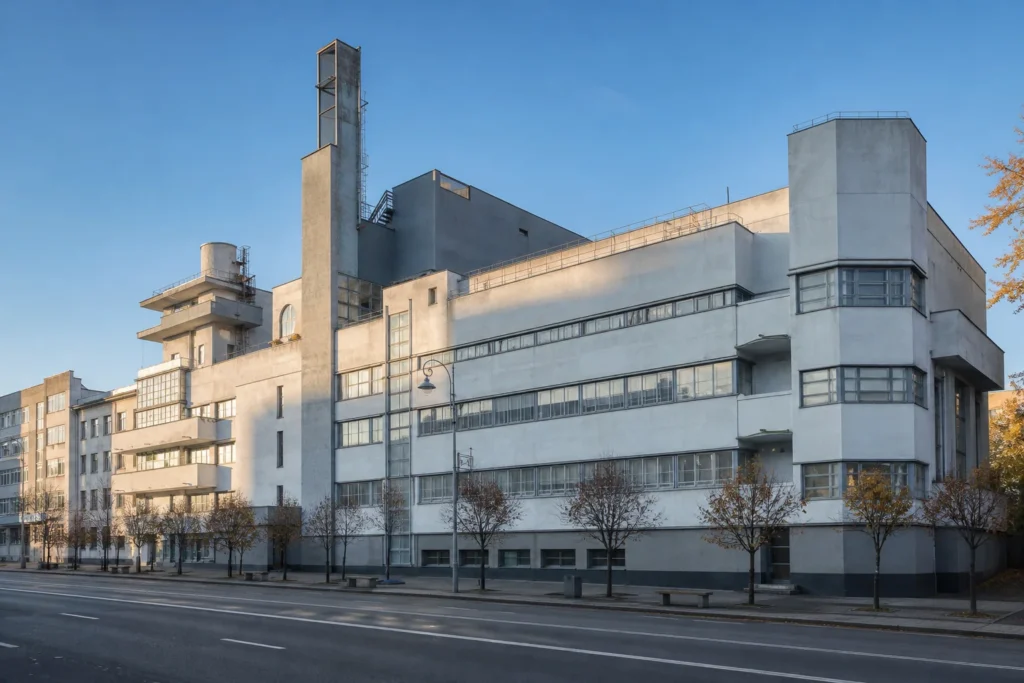
This itinerary is for architecture enthusiasts and anyone drawn to early Soviet design. It assumes a comfortable walking pace over two to three days, exploring the city center before venturing to the northern Uralmash district. You’ll see over 140 Constructivist buildings—more than anywhere else in the world—and understand the radical urban vision that transformed Yekaterinburg from a provincial town into a living laboratory of avant-garde architecture.
The route follows the two main clusters where the style is most visible: the downtown streets transformed by the ‘Big Sverdlovsk’ Plan at the end of the 1920s, and the planned workers’ district of Uralmash. Expect buildings with bold geometric forms, ribbon windows, asymmetrical balconies, and sculptural towers—functional art that blended the machine aesthetic with radical social ideals.
At a glance: Day 1: Walk Lenin Avenue and the central Constructivist ensemble, including Chekists' Village and Dynamo Sports Complex. Day 2: Explore Uralmash district and the White Tower water tower, once Yekaterinburg's only Constructivist cultural venue. Day 3: Extend the route to secondary buildings and practice spotting the distinctive geometric vocabulary of the style.
Day 1: Lenin Avenue and Chekists' Village
Start on the main thoroughfare where most central Constructivist sights cluster. Walk the length of Lenin Avenue (Prospekt Lenina) to see the range of the style: communal housing, office blocks, and public buildings. Stop at Chekists' Village to see the iconic Hotel Iset and natural history museum housed in the former Dzerzhinsky Club. Aim for the riverside to understand the urban layout.
- Prospekt Lenina (Lenin Avenue) – the main Constructivist corridor, lined with geometric office and residential blocks built 1924–1934 (1–2 hours of walking)
- Hotel Iset – circular ten-storey tower shaped like a sickle, originally communal housing, now a hotel with a ground-floor Soviet-style restaurant (30 minutes)
- Dzerzhinsky Club (Natural History Museum) – shaped like a hammer, now housing a museum; visitors can enter to see the curved 'red star' staircase (45 minutes)
- Workers' Club for Builders' Union (no. 50 Lenin Avenue) – one of the purest modernist buildings, part of the Builders' Village (20 minutes exterior)
- Dynamo Sports Complex – white rendered concrete stadium and sports clubs on a peninsula jutting into the City Pond, with art deco curves and prow-like corners (30 minutes)
Tip: Start early to avoid the afternoon crowds on Lenin Avenue. The best light for photography is morning; afternoon light reflects off modern buildings. Download a map offline and note metro stops, as you'll cover several kilometers on foot. The Buildings retain original plaques in Russian near their entrances if you want to photograph them.
Day 2: Uralmash District and the White Tower
Travel north to Uralmash, the planned industrial workers' district, where Constructivism took its boldest form. Here factories, communal housing, and cultural centers express the radical ideals of collective living. The White Tower, a 1929 water tower built in pure concrete, anchors the district. Allow time for the metro journey and exploring the vast open spaces that define this ensemble.
- Uralmash House of Culture – monumental Constructivist building and central square featuring geometric forms and functional design (45 minutes)
- White Tower (Ural Heavy Machinery Factory Water Tower) – 1929 concrete structure, 98 feet tall, originally surrounded by pine forests, reopened as cultural venue after restoration in 2013 (1 hour interior and exterior)
- Palace of Culture (former Factory Kitchen) – designed by German architect Béla Scheffler for the Uralmash Factory complex, decorated with Ural mineral samples (30 minutes exterior)
- Uralmash residential blocks – geometric concrete apartment buildings defining the workers' settlement (20 minutes walking)
- Uralmash District Park – provides contrast and scale to the Constructivist buildings (20 minutes)
Tip: Take the metro directly to Uralmash station. The district is spread across a wide area, so wear comfortable shoes and plan the route: start at the House of Culture, move to the White Tower, then loop back through residential blocks. The park offers a good spot to rest and observe building details from a distance. Check the White Tower's current hours before visiting, as it hosts rotating cultural events.
Day 3: Secondary Sights and Geometric Vocabulary
Return to the city center to explore secondary Constructivist buildings and consolidate your understanding of the style's vocabulary. Look for the recurring elements: boxes nested within boxes, rounded corners, ribbon windows, and sculptural towers. Visit the House of Printing and streets radiating from Lenin Avenue to see how the style appeared in office buildings, shops, and residential zones.
- House of Printing – glass-panelled Constructivist landmark near Yakov Sverdlov statue, hosts the Ural Industrial Biennale of Contemporary Art (30 minutes)
- Ulitsa Vainera – pedestrian street showing Constructivist retail and residential buildings; observe how the style adapted to commerce (45 minutes walking)
- Ulitsa 8 Marta – side street near the center with densely packed Constructivist residences (30 minutes walking)
- Central Post Office – one of the most prominent Constructivist buildings on Lenin Avenue, featuring asymmetrical balconies and ribbon windows (20 minutes exterior)
- Secondary office blocks – between Lenina and Vainera, showing the three-dimensional spatial planning using enclosed overhead walkways and staggered facades (45 minutes walking and observing)
Tip: Use this day to photograph architectural details: corner treatments, window patterns, and the interplay of shadow and geometric form. Many Constructivist buildings have been renovated for retail or offices; observe how modern uses have altered or preserved the original interiors. Note that only about one-third of Constructivist buildings are officially listed as monuments, so condition varies. Bring a notebook to sketch geometric patterns you observe.
Russia Vibes Tips
- The 'Big Sverdlovsk' Plan transformation occurred at the end of the 1920s. Most central buildings date from 1924–1934; after this period, Stalin's cultural shift discouraged the style, so Yekaterinburg avoided the ornamental cladding and modification that destroyed Constructivism elsewhere. This preservation is what makes the city unique.
- Constructivist architecture uses distinctive geometry: look for boxes within boxes, rounded corners, rectangular towers, ribbon windows running horizontally, bay windows protruding from flat facades, and circular or spinning elements meeting linear shapes. Once you spot these features, you'll see them everywhere in the center.
- Visit the White Tower early in your stay if you want to access its interior; it functions as a cultural venue and hours vary. The exterior alone is striking, but climbing to the top offers panoramic views of the district and shows how the tower was designed to be seen from all sides—characteristic of radical Constructivist spatial thinking.
- Many guides recommend viewing the city center from the Vysotsky skyscraper for a bird's-eye perspective before walking at street level. This helps you understand how the Constructivist buildings relate to the whole urban plan and the geography of the Iset River.
- The Natural History Museum, housed in the former Dzerzhinsky Club (shaped like a hammer), welcomes visitors to see the interior curved 'red star' staircase—one of the few preserved Constructivist interiors. The staff expect visitors interested in the architecture, not just natural history.
- October through April offers clear light and fewer tourists, but winter temperatures drop well below freezing. Spring (May–June) and autumn (September–October) provide the best combination of weather and light for both walking and photography.
Explore Nearby City Center Architecture & Constructivism, Yekaterinburg
Browse more: All Itineraries · All Itineraries in Yekaterinburg · All Themed Routes · All Yekaterinburg
FAQ
What is Constructivism and why is Yekaterinburg famous for it?
Constructivism was a radical Soviet artistic and architectural movement founded in Moscow in 1921. It embraced geometric forms, machine aesthetics, and collective social ideals. Yekaterinburg has the world's largest concentration of surviving Constructivist buildings—approximately 140—most built between 1924 and 1934 when the city (then Sverdlovsk) was the administrative center of the Ural region. Unlike other Soviet cities, Yekaterinburg's buildings mostly escaped being covered in ornamental cladding, so they retain their original radical appearance.
How long do I need to see the main Constructivist sites?
A focused architectural tour of the city center takes about half a day (3–4 hours). Adding the Uralmash district and its White Tower requires a full second day. A complete exploration, including secondary streets and careful observation of architectural details, takes 2–3 days. Most visitors spend one to two days on this theme alone.
Can I visit the interiors of Constructivist buildings?
Some are open to the public: the Natural History Museum (in the former Dzerzhinsky Club) welcomes visitors to see the interior staircase; the Hotel Iset's ground-floor restaurant operates in its original curved space; and the White Tower hosts cultural events. Most other buildings are private residences, offices, or retail spaces. You can often see ground-floor spaces by looking through windows or visiting shops inside.
Is there a Constructivist museum in Yekaterinburg?
No dedicated Constructivist museum exists yet, though one was planned. The House of Printing hosts the biennial Ural Industrial Biennale of Contemporary Art (held in different landmark buildings each time), which celebrates Soviet architecture. The White Tower reopened after restoration in 2013 as a cultural space hosting rotating exhibitions and events related to the city's architectural heritage.
Are Constructivist buildings being preserved or demolished?
Preservation is inconsistent. Only about one-third of Yekaterinburg's Constructivist buildings are officially listed as architectural monuments, leaving the rest vulnerable. Many have been renovated for modern commercial use, which sometimes alters interiors. Some buildings deteriorate. Local activists and young architects (like the group Podelniki) have taken on restoration and advocacy projects, including the White Tower's revival.
What are the distinctive visual features of Constructivist architecture I should look for?
Key features include: geometric forms (boxes, rectangles, circles, oblongs), rounded corners, ribbon windows running horizontally along facades, asymmetrical balconies, bay window shafts protruding from flat facades, rectangular towers or turrets, and sculptural elements with circular shapes meeting linear ones. The style avoids ornament; all visual interest comes from geometry and volume. Once you recognize these patterns, you'll spot Constructivist buildings instantly.
Should I hire a guide for the Constructivist architecture route?
A guide is not required but can be valuable if you want detailed historical context or access to building interiors. Self-guided walking tours are available through multiple sources, and the geometric clarity of Constructivism makes it visually readable without expert explanation. If you're seriously interested in interior details and restoration history, a local architecture specialist can deepen your understanding.
What's the best time of year to visit for Constructivist architecture?
Any season works visually, but October–April offers clearer light and fewer tourists. Winter (December–February) brings snow that highlights geometric forms but freezing temperatures. Spring (May–June) and autumn (September–October) provide comfortable walking weather and good photography light. Summer is warm but crowds increase.
Russia Vibes is a one-person project. A coffee keeps it going
How we research and update our guides
About this guide: AI assistance and accuracy
This guide is created with the help of AI and is based on official sources where available. Mistakes can still happen. Opening hours, prices, rules and other details are given to the best of our knowledge as of the date shown and can change without notice. It offers general recommendations only, not professional, legal or travel advice. Please confirm important details with the official source before you travel; you are responsible for your own plans and decisions.

Take this guide with you
Get a free PDF of this guide to print or read offline: key facts, tips and a map link on a few clean pages.
Report an issue on this page
Paying for your trip: please read
International sanctions affect payments between Russia and many other countries. In practice, cards issued in the EU, the UK, the US and several other countries often do not work in Russia, Russian cards usually do not work abroad, and some booking platforms, airlines and payment providers limit or suspend their services for Russia. The situation changes frequently.
We do not give legal or financial advice, and this site does not encourage anyone to break or circumvent sanctions. Whatever you plan, you are responsible for following the laws and regulations that apply to you, including those of your country of residence and citizenship.
Many travelers still organise their stay lawfully. It is worth asking your bank or payment provider what is currently permitted, contacting hotels, tour operators and carriers directly about the payment methods they accept, and checking which services are open to customers from your country. Clarify payment, cancellation and refund terms before you commit to a booking, and keep your plans flexible.
Partner links on this site may not be available in every country, and prices, availability and rules in our guides can differ from what you see when you book.