
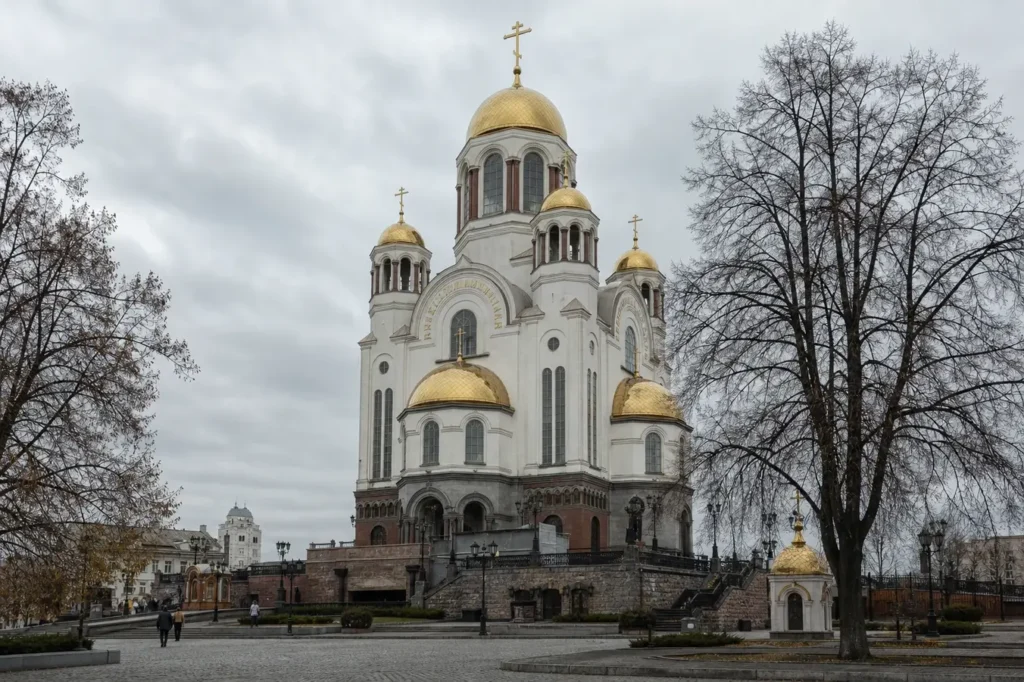
The Romanov Family Trail is designed for history buffs and anyone wanting to understand the final chapter of imperial Russia. This self-guided route traces the story of Tsar Nicholas II and his family during their imprisonment and execution in July 1918, connecting the city’s most significant memorial sites.
Over two to three days, you’ll move through a somber but essential narrative: from the Church on the Blood at the city center, where the family was executed in the basement of the Ipatiev House, to the Ganina Yama monastery complex 20 kilometers northeast, where their remains were hidden in an abandoned mine. The trail requires respectful engagement with tragic history and a willingness to sit with difficult stories.
At a glance: Day 1 focuses on the Church on the Blood and its museum, exploring the central Romanov execution site and Byzantine architecture. Day 2 ventures to Ganina Yama monastery, a forested pilgrimage site where the family's remains were disposed of, with several wooden churches and a holy pool. Day 3 (optional) covers the city center's broader history and nearby attractions.
Day 1: The Execution Site and Church on the Blood
Begin at the heart of the Romanov story. The Church on the Blood sits on the exact location where Tsar Nicholas II, his wife Alexandra, their five children, and four servants were executed in the basement of the Ipatiev House on the night of July 16–17, 1918. The modern Byzantine church, completed in 2003, incorporates a lower level designed to mirror the old basement room. Spend the morning exploring the upper church's golden domes and intricate mosaics, then descend to the solemn lower chamber.
- Church on the Blood – Byzantine-style memorial church with museum; upper sanctuary and lower basement chamber (2 hours)
- City Pond area – Pleasant green space adjacent to the church; good for orientation and reflection (30 minutes)
- Romanov Memorial exhibits – Information on the family's imprisonment and final days (included in church visit)
Tip: The church is both a place of worship and a museum. Dress respectfully (covered shoulders and knees). The lower chamber can feel emotionally heavy—allow quiet time. Arrive early to avoid crowds and to have space to absorb the atmosphere.
Day 2: Ganina Yama Monastery and the Hidden Grave
Travel 20 kilometers northeast to Ganina Yama, a forest monastery complex dedicated to the Holy Martyrs. After the execution, Bolshevik guards attempted to hide the Romanov family's remains in an abandoned mine shaft at this remote location. The monastery, built decades later, is now a Russian Orthodox pilgrimage site featuring seven wooden churches, icons dedicated to the family (canonized as martyrs in 2000), and a holy pool. The atmosphere shifts from the urban solemnity of Day 1 to a peaceful, forested memorial landscape.
- Ganina Yama Monastery complex – Seven wooden churches and pilgrimage site in forest setting; marks location of body disposal (2.5 hours)
- Holy pool (Svyatoy pool) – Sacred bathing site; entry requires prior blessing from monastery staff (30 minutes)
- Forest trails and wooden chapels – Quiet paths among the churches; for contemplation and photography (1 hour)
- Monastery shop – Local handicrafts and religious items (20 minutes)
Tip: Ganina Yama is best reached by private car or organized tour from the city center (allow 40 minutes each way). The site is working monastery—respectful behavior and modest dress are essential. The holy pool requires advance permission; check with monastery staff on arrival. Bring water and comfortable walking shoes for forest paths.
Day 3: City Context and Broader History (Optional)
If time allows, explore Yekaterinburg's broader relationship to the Romanov story and the city's role in the revolution. The city was founded in 1723 to exploit Ural mineral riches but became known worldwide only after 1918. Walk the historic center to see constructivist architecture and understand how Yekaterinburg transformed from an imperial outpost to a Soviet industrial hub. Visit museums or walk along the Iset River, which runs through the city.
- 1905 Square – Central plaza with historic buildings; reflects city's Soviet era transformation (45 minutes)
- Iset River embankment – Tree-lined waterfront for walking and reflection (1 hour)
- Yekaterinburg History Museum or similar – Broader context of city and regional history (1.5 hours)
- Local cafés in city center – Rest and informal gathering spaces (1 hour)
Tip: This day is flexible and can be condensed or skipped if you need to leave. Use it to process the emotional weight of Days 1 and 2 through a slower pace. Many visitors find this helpful for reflection.
Russia Vibes Tips
- The Church on the Blood opens for worship and tourism at different times. Check the official website (hram-na-krovi.cerkov.ru) before visiting for current hours, as they vary by season and religious observances. Modest dress is required: covered shoulders, knees, and respectful appearance.
- Ganina Yama can be visited independently only by car or taxi. Organized tours from Yekaterinburg typically last 4–5 hours and include transport. Many travelers prefer guided tours for historical context and to ensure they understand the significance of each church and location. Book in advance if possible.
- July 16–17 each year marks the anniversary of the execution. The Church on the Blood and Ganina Yama hold memorial services and special observances. If visiting during this time, expect larger crowds and altered visiting hours. Plan accordingly or visit adjacent dates for a quieter experience.
- The trail intersects difficult Russian history. Many visitors underestimate the emotional and psychological weight of standing in spaces connected to mass execution. Take breaks, spend time in the forested setting at Ganina Yama, and consider reading basic history before arriving to prepare yourself.
- Yekaterinburg's metro and marshrutka (shared van) system can reach the city center, but Ganina Yama requires private transport. Taxis and ride-share apps (Yandex Taxi, Uber where available) are reliable. Alternatively, book a private tour that includes translation and historical expertise.
- The Church on the Blood has two distinct levels: the upper sanctuary (bright, large, decorated in gold and mosaics) and the lower chamber (dim, reconstructed basement room mirroring the Ipatiev House). Do not miss the lower level—it is the core of the memorial and requires descending stairs. Allow sufficient time and bring comfortable walking shoes.
Explore Nearby Romanov Family Trail, Yekaterinburg
Browse more: All Itineraries · All Itineraries in Yekaterinburg · All Themed Routes · All Yekaterinburg
FAQ
Is the Church on the Blood the actual Ipatiev House where the execution happened?
No. The original Ipatiev House was demolished in 1977 to prevent it from becoming an unofficial pilgrimage site. The Church on the Blood, built 2000–2003 on the same site, incorporates a reconstructed lower chamber designed to resemble the basement room where the execution occurred. The upper church is a modern Russian Orthodox structure; the lower level is the memorial site.
Where were the Romanov family's remains found?
Their bodies were hidden in an abandoned mine shaft at Ganina Yama, about 20 kilometers northeast of Yekaterinburg, on the night of July 17, 1918. A monastery was later built on the site to honor the family, who were canonized as martyrs by the Russian Orthodox Church in 2000.
Who was executed with Tsar Nicholas II?
Tsar Nicholas II; his wife, Tsarina Alexandra; their five children (Olga, Tatiana, Maria, Anastasia, and Alexei); and four loyal servants (including the family physician and three attendants) were executed. In total, eleven people were killed in the basement on the night of July 16–17, 1918.
Why were they executed in Yekaterinburg?
The family was moved from Tobolsk to Yekaterinburg in April 1918 as Bolshevik security during the Russian Civil War. Anti-Bolshevik forces were advancing toward the city, and local Soviet authorities feared the family could be rescued and used as a rallying point against them. They were executed before the White Army arrived.
How long does it take to visit all Romanov sites?
The Church on the Blood takes 1.5–2 hours. Ganina Yama, including transport and time in the forest, requires a full morning or afternoon (4–5 hours from the city). Many visitors spend 2–3 days on the full trail, allowing time for reflection and a broader view of Yekaterinburg's history.
Can I visit without a guide?
Yes. The Church on the Blood is freely accessible to visitors during public hours and has basic information placards. Ganina Yama can be reached by private car. However, organized tours provide historical context and translation, which many visitors find essential for understanding the significance of each site.
Is dress code enforced at the Church on the Blood?
The Church on the Blood is an active Russian Orthodox place of worship. Respectful dress is expected: covered shoulders, knees, and a calm demeanor. Women may want to bring a scarf to cover their hair as a sign of respect, though enforcement varies. Modesty is more important than strict rules.
Can I bring children to the Romanov sites?
Children can visit, but the trail involves heavy history and tragic events. Many sites are emotionally somber. Older children (teenagers) with an interest in history may find it meaningful; younger children may not understand the significance. Consider your child's maturity and interest before bringing them. The forested setting at Ganina Yama is peaceful and less emotionally intense.
Russia Vibes is a one-person project. A coffee keeps it going
How we research and update our guides
About this guide: AI assistance and accuracy
This guide is created with the help of AI and is based on official sources where available. Mistakes can still happen. Opening hours, prices, rules and other details are given to the best of our knowledge as of the date shown and can change without notice. It offers general recommendations only, not professional, legal or travel advice. Please confirm important details with the official source before you travel; you are responsible for your own plans and decisions.

Take this guide with you
Get a free PDF of this guide to print or read offline: key facts, tips and a map link on a few clean pages.
Report an issue on this page
Paying for your trip: please read
International sanctions affect payments between Russia and many other countries. In practice, cards issued in the EU, the UK, the US and several other countries often do not work in Russia, Russian cards usually do not work abroad, and some booking platforms, airlines and payment providers limit or suspend their services for Russia. The situation changes frequently.
We do not give legal or financial advice, and this site does not encourage anyone to break or circumvent sanctions. Whatever you plan, you are responsible for following the laws and regulations that apply to you, including those of your country of residence and citizenship.
Many travelers still organise their stay lawfully. It is worth asking your bank or payment provider what is currently permitted, contacting hotels, tour operators and carriers directly about the payment methods they accept, and checking which services are open to customers from your country. Clarify payment, cancellation and refund terms before you commit to a booking, and keep your plans flexible.
Partner links on this site may not be available in every country, and prices, availability and rules in our guides can differ from what you see when you book.