
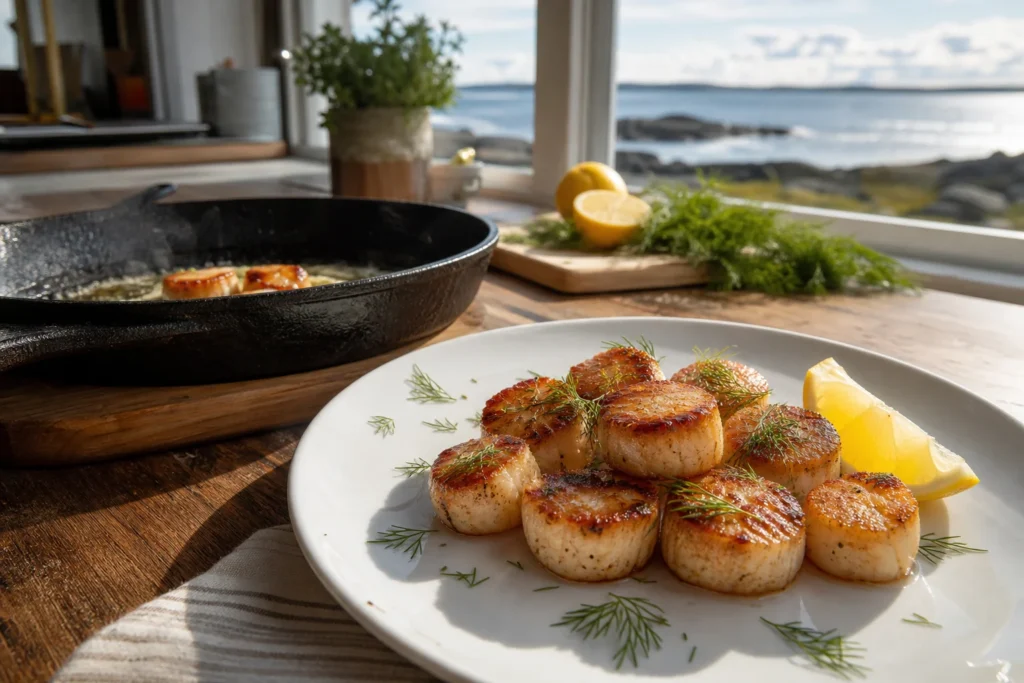
Scallops are one of the most beloved seafood in Vladivostok, prized locally for their naturally sweet taste and tender texture. This guide teaches you how to pan-sear scallops simply and quickly—a classic preparation that highlights their delicate flavour. You will achieve restaurant-quality results at home in less than 15 minutes.
The recommended option: pan-seared scallops with lemon and butter, served immediately while still warm. This method takes 10–15 minutes total, costs ₽₽, and requires only a few fresh ingredients and a hot skillet.
Quick answer: Remove the side muscle from fresh scallops, pat them dry, season with salt and pepper, then sear them quickly in hot butter or oil—about 2 minutes per side. Serve with lemon juice, fleur de sel and fresh dill. Total time: 10–15 minutes. Cost: ₽₽.
At a Glance
| Type | Dishes |
|---|---|
| Local name | Морской гребешок с маслом и лимоном |
| Origin | Vladivostok and the Russian Far East |
| Servings | 2–4 servings |
| Total time | 10–15 minutes |
| Difficulty | Easy |
History and Story of Scallop, Vladivostok
Scallops have been harvested in the coastal waters of the Russian Far East for centuries. The yesso scallop (Mizuhopecten yessoensis) is the species most commonly caught and farmed in the Sea of Japan near Vladivostok. Today, both wild-caught and farm-raised scallops from local waters appear on restaurant menus and in home kitchens throughout the city, enjoyed raw with soy sauce and lemon, fried, baked, or simply pan-seared.
Ingredients
- 600–800 g fresh scallops (for 2–4 servings)
- 30 g butter or neutral oil
- 1 lemon
- Salt and white pepper
- Fresh dill (optional)
- Fleur de sel or sea salt
How Scallop, Vladivostok Is Made
Step 1: Prepare the scallops
Place each scallop on a cutting board and locate the small tough muscle on the side of the shell. Pull or cut this muscle away—it is the only part that needs removing. Rinse the scallops briefly under cold water and pat them completely dry with paper towels. Moisture will prevent them from developing a golden crust when cooked.
Tip: Dry scallops are essential; wet ones will steam rather than sear.
Step 2: Heat the pan
Place a heavy-bottomed skillet (stainless steel works best) over medium-high heat. Wait until it is hot enough that a drop of water sizzles and evaporates immediately—this usually takes 2–3 minutes. Add the butter or oil and swirl to coat the bottom evenly.
Tip: Do not use a nonstick pan; it will not get hot enough to create a proper crust.
Step 3: Season and sear
Season the scallops lightly with salt and white pepper on both sides. Carefully place them in the hot pan, flat side down, in a single layer without crowding. Do not move them. Let them cook undisturbed for 1.5–2 minutes until golden underneath.
Tip: Space them apart; overcrowding lowers the pan temperature and causes them to release moisture.
Step 4: Flip and finish
Flip each scallop over carefully and cook for another 1.5–2 minutes on the second side until opaque throughout and just firm to the touch. The interior should be tender, not rubbery. Remove the pan from the heat immediately.
Tip: Scallops cook very quickly; overcooked ones become tough and fibrous.
Step 5: Serve
Arrange the scallops on warm plates. Squeeze fresh lemon juice over them, sprinkle with fleur de sel or sea salt, and scatter a few dill fronds on top if using. Serve at once while still hot.
Tip: Serve with steamed vegetables, boiled new potatoes or crusty bread to soak up the butter.
Variants
- Raw scallop with lemon and soy sauce—a traditional local preparation that showcases the natural sweetness
- Scallop khinkali—Georgian dumplings filled with diced scallop meat instead of meat, offered in many Vladivostok restaurants
- Baked scallops with butter and herbs—placed in the shell and baked until just cooked through
- Grilled scallops on skewers—brushed with oil and herb butter, cooked over charcoal or gas
- Seafood casserole with scallops, shrimp and halibut—a baked mixture of mixed shellfish and white fish
- Scallop tartare—finely diced raw scallops combined with cucumber, apple, yogurt and dill
Common Mistakes to Avoid
- Cooking wet scallops: Moisture on the surface prevents browning and causes them to release liquid and steam instead of searing. Always pat them dry thoroughly.
- Moving them in the pan: Resist the urge to stir or shake the scallops. Let them sit undisturbed so they develop a golden crust underneath.
- Overcrowding the skillet: Too many scallops at once lower the pan temperature and cause steaming. Cook in batches if needed.
- Overcoking: Scallops go from tender to rubbery in seconds. Watch the clock carefully and remove them as soon as they turn opaque.
- Using a nonstick pan: These pans cannot reach the high heat needed to sear scallops properly. A cast iron or stainless steel skillet works best.
- Skipping the side muscle: This tough, chewy part is inedible and must be removed before cooking.
- Using old or frozen-thawed scallops that have absorbed water: Buy the freshest scallops available and ask the fishmonger whether they have been frozen.
How to Order and Eat It
Use a fork to cut off small pieces and eat immediately while hot. The flesh should be tender and yield easily. Squeeze a little more lemon juice on each bite if desired. Scallops are delicate, so avoid heavy sauces that would mask their natural flavour. If the scallop flesh feels gritty when bitten, it may contain sand; discard it and try another.
To order: Прошу, морской гребешок с лимоном и маслом [Prosh-yu, morskoy grebeshchok s limonom i maslom]
Diet and Allergens
- gluten-free
Russia Vibes Tips
- Buy scallops the same day you plan to cook them. Ask the fishmonger at a market like Sportivnaya whether the scallops are fresh or have been frozen; truly fresh ones are worth seeking out. If frozen, thaw them slowly in the refrigerator, never at room temperature.
- In Vladivostok, some restaurants serve live scallops still in the shell; they move visibly and seem to breathe. These are the absolute freshest option. If you order them live and want to clean them yourself, the restaurant may charge less than for pre-cleaned scallops.
- Scallops pair beautifully with white wine, especially dry varieties from cool climates. A simple squeeze of fresh lemon is all the acid you need; do not oversauce them or their delicate flavour disappears.
- If your skillet is small or you have many scallops to cook, work in two batches rather than crowding them. A crowded pan steams them instead of searing, and they lose their golden crust and tender texture.
- The side muscle must be removed before cooking; if left on, it will remain tough and chewy. Gently pull it away or cut it off with a small sharp knife. It looks like a small white tab attached to the side edge of each scallop.
Explore Nearby Scallop, Vladivostok
Browse more: All Food & Drink · All Food & Drink in Vladivostok · All Other · All Vladivostok
FAQ
Can I use frozen scallops?
Yes, but quality suffers. Frozen scallops release more liquid during cooking, making them harder to sear properly. If you must use frozen scallops, thaw them slowly in the refrigerator (never at room temperature), then pat them very dry before cooking. Fresh scallops taste noticeably sweeter and more tender.
What is the small muscle I see on the side?
That is the attachment muscle the scallop used to hold its shell closed. It is tough and chewy and must be removed before cooking. Look for a small white or beige tab on the side edge of each scallop and pull or cut it away.
Why did my scallops turn out rubbery?
Overcooking is the most common cause. Scallops cook very quickly—usually 3–4 minutes total. They are done as soon as the flesh turns opaque and feels barely firm to the touch. Remove them immediately; even 30 seconds too long makes them tough.
Can I cook scallops without a hot pan?
Not successfully. A hot pan is essential to develop the golden crust and keep the flesh tender inside. A cold or warm pan causes them to release moisture and steam instead. Use high heat and wait until the pan is smoking slightly before adding the scallops.
Why do some scallops taste gritty?
Some scallops contain sand or grit from the sea bottom. This is rare but happens occasionally. Discard any that taste gritty. Some cooks briefly soak raw scallops in lightly salted water to help rinse out hidden sand, though fresh scallops from a good fishmonger rarely need this.
Is it true scallops have a sweet taste?
Yes. Scallops have a naturally mild, sweet flavour quite different from other seafood. This is especially true of the yesso scallop from the Sea of Japan. The sweetness is one of the reasons locals love them and why simple preparation—just lemon and butter—is best.
Can I eat raw scallops?
Yes, and it is a traditional local way to eat them in Vladivostok. Always use the freshest scallops available, preferably bought the same day from a reliable fishmonger. Serve them with a squeeze of lemon or a few drops of soy sauce. If in doubt about freshness, cook them instead.
What side dishes go well with scallops?
Scallops are delicate and pair well with simple sides: steamed asparagus or broccoli, boiled new potatoes tossed with butter and dill, or crusty bread to soak up the pan juices. Avoid heavy sauces that mask the natural flavour.
Russia Vibes is a one-person project. A coffee keeps it going
How we research and update our guides
About this guide: AI assistance and accuracy
This guide is created with the help of AI and is based on official sources where available. Mistakes can still happen. Opening hours, prices, rules and other details are given to the best of our knowledge as of the date shown and can change without notice. It offers general recommendations only, not professional, legal or travel advice. Please confirm important details with the official source before you travel; you are responsible for your own plans and decisions.

Take this guide with you
Get a free PDF of this guide to print or read offline: key facts, tips and a map link on a few clean pages.
Report an issue on this page
Paying for your trip: please read
International sanctions affect payments between Russia and many other countries. In practice, cards issued in the EU, the UK, the US and several other countries often do not work in Russia, Russian cards usually do not work abroad, and some booking platforms, airlines and payment providers limit or suspend their services for Russia. The situation changes frequently.
We do not give legal or financial advice, and this site does not encourage anyone to break or circumvent sanctions. Whatever you plan, you are responsible for following the laws and regulations that apply to you, including those of your country of residence and citizenship.
Many travelers still organise their stay lawfully. It is worth asking your bank or payment provider what is currently permitted, contacting hotels, tour operators and carriers directly about the payment methods they accept, and checking which services are open to customers from your country. Clarify payment, cancellation and refund terms before you commit to a booking, and keep your plans flexible.
Partner links on this site may not be available in every country, and prices, availability and rules in our guides can differ from what you see when you book.