
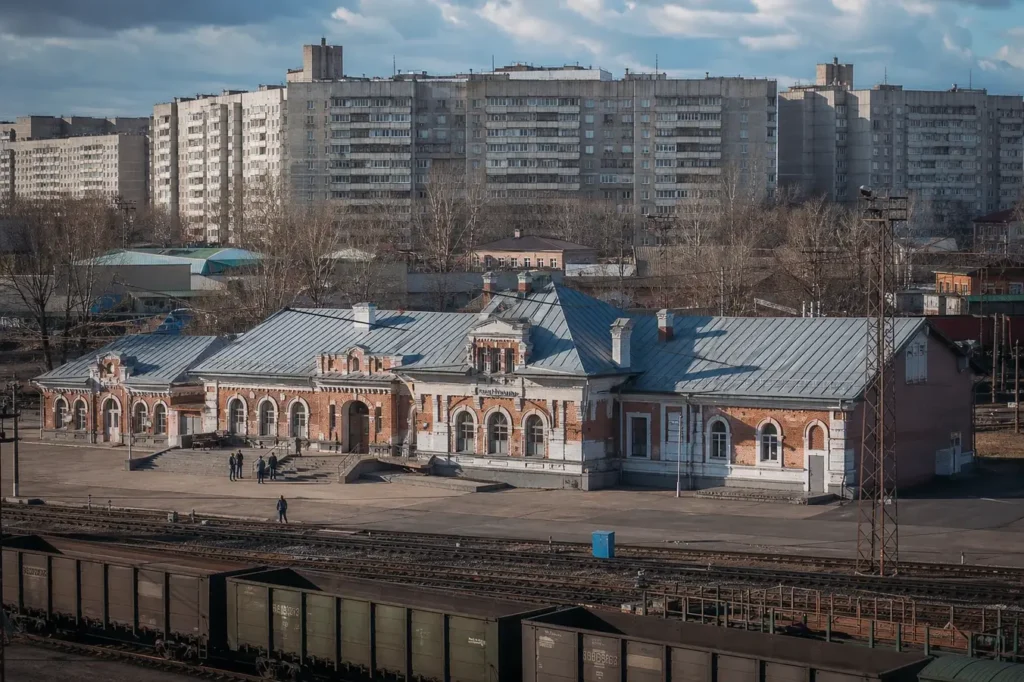
Pervaya Rechka, or “First River,” sits just beyond Vladivostok‘s busy downtown, a neighborhood that reflects the city’s dual identity as both a Pacific port and a major rail junction. The area takes its character from a historic railway station opened in 1893, which once anchored the entire region’s development during Russia’s expansion eastward. Unlike the restored facades and heavy tourist traffic of the city center, Pervaya Rechka remains a place where locals live, work and move through their day—quieter, less polished, and revealing how Vladivostok actually functions.
The neighborhood is chiefly useful to travelers as a base for those seeking accommodation away from downtown crowds, or as a brief stop to observe a piece of the Trans-Siberian Railway’s working infrastructure.
Quick Facts
| Russian name | Первая Речка |
|---|---|
| Address | Вокзальная улица, Владивосток OpenStreetMap · Google Maps |
| District | Pervorechensky |
| Best time to visit | Late spring through early autumn (May–September) offers stable, mild weather and longer daylight for walking and photography. Summer is the warmest season but can bring rain. The neighborhood is open year-round, though winters are cold (reaching below freezing), and many cafes and shops may have reduced hours. |
| Recommended duration | 1–2 hours |
What Is (and Isn't) Part of a Visit to Pervaya Rechka, Vladivostok?
| Part | Status | Notes |
|---|---|---|
| Pervaya Rechka railway station | Included in the standard ticket | Historic station (1893) visible from outside; still in active use but not open for interior tours. |
| Railway Workers' Club building | Outside / not part of it | Historic but not a visitor attraction and not open to the public; visible as part of the streetscape. |
| Stalin Tunnel (railway infrastructure) | Outside / not part of it | Located on the railway corridor between other stations; not in Pervaya Rechka proper and not open to public access. |
| Local shops and cafes | Included in the standard ticket | Genuine neighborhood establishments serving residents; not curated for tourists but open to visitors. |
| Hostels and guesthouses | Included in the standard ticket | Budget accommodation options operate in the neighborhood; these are separate commercial venues. |
Why Visit Pervaya Rechka, Vladivostok?
Pervaya Rechka draws visitors who value authenticity over stage-managed sights. The railway station itself stands as a regional architectural landmark, its 19th-century engineering a visible link to the city’s role as the Pacific terminus of the Trans-Siberian line. The neighborhood offers budget accommodation options and local restaurants without the markup and filtering of the tourist quarter.
For those interested in Soviet and early-20th-century industrial history, the area—where a Railway Workers’ Club was constructed during the 1920s–1930s housing boom—shows how the communist state built community spaces for its workforce. The urban texture here reflects that era’s planning choices.
Highlights of Pervaya Rechka, Vladivostok
Pervaya Rechka Railway Station
The station opened in 1893 as a working junction on the Trans-Siberian Railway, serving as a regional architectural landmark. Its structure reflects the engineering ambitions of late Imperial Russia, and it remains in active use today. Visitors can observe the station building and the rail yards from outside; the locomotive shop at the station is also noted as an industrial heritage site. The station anchors the neighborhood's geography and explains why development clusters here.
Tip: Visit during daylight to see the station's architectural details and track activity. The building is a regional cultural heritage site but is not typically open for interior tourism—view it from the platform and surrounding area.
Railway Workers' Club
Built during the 1920s–1930s housing expansion in Vladivostok, this structure served as a social hub for rail employees and their families. It exemplifies Soviet-era planning and the state's investment in workers' facilities during the early communist period. The building survives as a remnant of that ideological commitment and urban design philosophy.
Tip: The club is not a tourist attraction and is not typically open to visitors. It is identifiable by its architectural style and signage in the Pervaya Rechka area and provides context for understanding the neighborhood's historical role.
Stalin Tunnel
A tunnel constructed between the railway stations Lugovaya and Tretya Rabochaya during the Soviet era represents the scale of infrastructure works that supported Vladivostok's strategic importance. Though not located directly in Pervaya Rechka, it is part of the same railway corridor and illustrates the engineering efforts of the period. It remains a working part of the rail network.
Tip: The tunnel is visible from certain vantage points along the railway corridor but is not open to public access. Its existence is remarkable chiefly as industrial archaeology and symbol of Cold War-era Soviet construction.
Atmosphere
Pervaya Rechka carries a workaday feel quite different from downtown Vladivostok. Streets are less uniformly renovated; Soviet-era apartment blocks stand alongside smaller houses and light industrial structures. The railway station and yard bring a constant low hum of activity—the sound of trains, occasional loudspeaker announcements, and the movement of freight and passengers.
The neighborhood is less polished and less crowded than the city center, with locals in the majority. Local shops and modest cafes serve residents rather than tourists. The pace feels deliberate and local rather than rushed. It is a place to observe Vladivostok functioning as a working city rather than as a curated destination.
History of Pervaya Rechka, Vladivostok
Pervaya Rechka’s history is inseparable from the railway. The station was opened in 1893 as part of the Trans-Siberian Railway expansion, making it one of Vladivostok’s oldest surviving structures. The station served as a major junction and worker hub, reflecting Russia’s strategic commitment to the Far East and its Pacific gateway.
During the 1920s and 1930s, housing construction intensified across the city. Authorities built workers’ housing, shops, and community facilities—including the Railway Workers’ Club—in Pervaya Rechka and adjacent neighborhoods. This construction reflected Soviet central planning and the state’s investment in infrastructure for its Far East operations. The club embodied the communist ideology of providing collective spaces for workers and their families.
Throughout the Soviet period, Pervaya Rechka remained primarily a residential and railway-service neighborhood. It did not attract the administrative functions or cultural investments focused on the city center. When Vladivostok was closed to foreigners during the Cold War (1958–1992), this area was simply a place where people worked and lived, unremarkable to outsiders and thus undocumented in Western travel accounts.
After 1992, when the city reopened to international visitors, downtown Vladivostok was gradually restored and commodified as a tourist product. Pervaya Rechka, by contrast, remained relatively unchanged—a working neighborhood without self-conscious heritage management. For that reason, it preserves an authentic texture of Soviet and post-Soviet urban life that the renovated center no longer offers.
Tickets and Booking for Pervaya Rechka, Vladivostok
Pervaya Rechka is a residential neighborhood with no admission fees or centralized ticketing. It is freely accessible to walk through. Accommodation (hostels and guesthouses) and cafes operate with their own booking and payment systems; check their individual websites or apps for reservations and hours.
Suggested itineraries Pervaya Rechka, Vladivostok
1 hour
Walk from the city center to Pervaya Rechka railway station (approximately 15–20 minutes). Observe the station building and architecture from outside. Walk through the immediate neighborhood to note the streetscape, apartment blocks, and local businesses. Return to downtown.
2 hours
Arrive by bus or taxi from downtown. Start at the railway station, study its exterior and the surrounding railway infrastructure. Walk the neighborhood streets, noting building styles and Soviet-era urban planning. Visit a local cafe for tea or a light meal. Observe the residential and light-industrial character of the area before departing.
How to Get to Pervaya Rechka, Vladivostok
From downtown Vladivostok: bus lines run from the city center toward Pervaya Rechka; check local transit maps or ask hotel staff for current routes, as services change seasonally. Travel time is typically 15–25 minutes depending on traffic and starting point. Alternatively, taxi or ride-hailing apps are available and reliable; the distance from central attractions is 2–3 kilometers.
By train: if you are arriving at Vladivostok railway station and wish to explore Pervaya Rechka en route, the station is roughly 2 kilometers south and is reachable on foot (25–30 minutes) or by local transport.
Accessibility
The neighborhood consists of standard streets and sidewalks. Terrain is relatively flat in the immediate station area but can be uneven in parts; Soviet-era buildings lack modern accessibility features. Local buses may or may not have wheelchair lifts; check with your accommodation or the local transport authority. The railway station building itself is not accessible to wheelchair users.
Food Nearby
Local cafes and small restaurants operate throughout the neighborhood, serving Russian and Asian dishes at budget prices. Options range from basic stolovaya (canteen-style) restaurants to modest sit-down cafes. Most are open for lunch and dinner but few serve breakfast. Avoid assuming tourist-level English or English menus; they primarily serve locals. Supermarkets and convenience stores are scattered throughout, offering prepared foods and basic supplies.
What to Bring
Comfortable walking shoes suited to uneven or wet pavement. In summer, sunscreen and a light hat; in winter, warm layers, waterproof coat, and thermal boots. A phrasebook or translation app is useful, as English is rarely spoken in local businesses. Cash in rubles is safer than cards for small purchases.
Best Views and Photo Spots of Pervaya Rechka, Vladivostok
Pervaya Rechka railway station building facade
The 1893 station building presents late-19th-century Russian railway architecture with visible wear and weathering that documents its age. The facade records a century of rail use and Soviet-era stewardship. Photographed in daylight, it conveys the scale and historical layering of the Trans-Siberian line.
Best time: Morning light (7–10 a.m.) offers clear definition of the facade; afternoon light can flatten details. Avoid peak train-movement times if seeking a clear view without crowds.
Railway yard and tracks from station platform
The working rail yard—with locomotives, freight cars, and the physical layout of the junction—illustrates the operational reality of the Trans-Siberian Railway. The scale of the yard and the layering of tracks convey the infrastructure's importance and working character.
Best time: Early morning (6–8 a.m.) shows activity and natural light without excessive glare. Midday backlighting can obscure details; evening light (after 5 p.m.) is softer but shadows lengthen quickly.
Neighborhood streetscape on Lokomotivnaya Street or near the station approach
Soviet-era apartment blocks, modest single-family houses, small shops, and the day-to-day texture of a working neighborhood provide context for urban life beyond the tourist center. Signs, vehicles, and pedestrian activity reveal Vladivostok as a functioning city.
Best time: Midmorning (9–11 a.m.) captures good light and local activity without crowds. Cloudy days render detail well. Early evening (5–7 p.m.) shows residents returning home and neighborhood life at its fullest.
Photography Rules
Photography is unrestricted in public spaces. The railway station and surrounding infrastructure are freely photographable from outside. Do not photograph rail workers or enter restricted railway areas. Drones and tripods are not advised in this working neighborhood and may draw attention from security.
Family Suitability
Pervaya Rechka is suitable for families seeking to experience authentic city life rather than supervised tourist attractions. The neighborhood is safe and open for walking. Young children may find the railway station and yard visually interesting; older children can appreciate the historical context. Strollers are usable on main streets but sidewalks in parts of the neighborhood can be uneven. No playgrounds or dedicated children's facilities are notable. The pace is slow and the atmosphere calm, which suits families who value observation and walking over structured activities.
Russia Vibes Tips
- Visit Pervaya Rechka as a base or stopover rather than a primary destination. Use it to escape downtown crowds and to see how Vladivostok actually functions—not how it markets itself. A one- to two-hour walk here offers more authentic contact with the city than any renovated museum.
- Eat where locals eat. Stolovaya and small neighborhood cafes serve generous, inexpensive meals and reveal real daily life. Point to dishes in display cases if language is a barrier; this method works reliably. Avoid chain restaurants; this neighborhood's value lies in its local texture.
- The railway station is visually interesting but remains a working facility, not a heritage museum or viewing platform. Do not enter restricted areas or attempt to photograph workers. View the building and yard from public spaces; this is sufficient for understanding its historical and functional role.
- Daylight matters for photography and for safety. Winter darkness falls around 4–5 p.m.; plan your visit accordingly. Early morning and midday light are best for capturing the neighborhood's character. Avoid late evening exploration.
- Have a translation app ready on your phone. Unlike downtown, where tourist services have adapted to English, local businesses here operate in Russian. A few key phrases or a working app makes ordering food and asking directions much easier and more enjoyable.
- Do not assume that every hostel or guesthouse advertised online is still operating. Check reviews and contact information before booking, and confirm a few days before arrival. Smaller establishments in neighborhoods like this change hands or close seasonally.
Explore Nearby Pervaya Rechka, Vladivostok
Browse more: More in Pervorechensky · All Hidden Russia · All Neighborhoods · All Neighborhoods in Vladivostok · All Vladivostok
FAQ: Pervaya Rechka, Vladivostok
Is Pervaya Rechka a tourist destination or just a neighborhood?
It is primarily a working residential and railway neighborhood, not a tourist destination. It lacks museums, galleries, or monuments designed for visitors. Its value lies in offering an authentic view of Vladivostok beyond the restored downtown—useful for travelers seeking real urban context rather than curated sights.
Can I tour the railway station or see inside?
The station building is not open for interior tours. It is a working railway facility, and public access is limited to platform areas during train times. You can observe and photograph the exterior and the surrounding rail yard from public spaces.
What transport should I use to reach Pervaya Rechka from downtown?
Local buses serve the area; ask your accommodation for current route numbers and schedules, as these change seasonally. Taxi or ride-hailing apps (Yandex Taxi, for example) are reliable and cost moderately. The walk from downtown is possible (25–35 minutes, depending on starting point) but not typically recommended.
Are there restaurants and shops in Pervaya Rechka?
Yes. Local cafes, stolovaya (canteen-style restaurants), small shops, and markets operate throughout the neighborhood, serving residents. These are not tourist-focused; English menus are unlikely. Prices are budget to moderate, significantly lower than downtown tourist venues.
Is the neighborhood safe to walk around in?
Yes. Pervaya Rechka is a normal residential neighborhood where locals live and work. It is as safe as most established city areas. Standard urban precautions (avoid isolated areas after dark, secure valuables) apply. Daytime exploration is straightforward and low-risk.
Why would I visit a residential neighborhood instead of downtown Vladivostok?
To experience how the city functions for residents rather than tourists, to eat genuine local food, and to see Soviet-era architecture and urban planning in its unrestored state. It is useful for anyone seeking authentic urban context, photography of real city life, or budget accommodation away from central crowds.
Can I visit Pervaya Rechka in winter?
Yes, but plan for cold weather (below freezing typical in December–February), shorter daylight (4–5 p.m. sunset), and reduced opening hours at some local businesses. The neighborhood is accessible year-round, but winter visits require more preparation and offer fewer daylight hours for exploration.
Is there a specific route or map for exploring Pervaya Rechka?
No official tourist route exists. The neighborhood is best explored by walking, starting from the railway station and moving through the streets in the immediate area. Google Maps and Yandex Maps work well for orientation. Allow 1–2 hours for a casual walk; there is no prescribed itinerary.
Russia Vibes is a one-person project. A coffee keeps it going
How we research and update our guides
About this guide: AI assistance and accuracy
This guide is created with the help of AI and is based on official sources where available. Mistakes can still happen. Opening hours, prices, rules and other details are given to the best of our knowledge as of the date shown and can change without notice. It offers general recommendations only, not professional, legal or travel advice. Please confirm important details with the official source before you travel; you are responsible for your own plans and decisions.

Take this guide with you
Get a free PDF of this guide to print or read offline: key facts, tips and a map link on a few clean pages.
Report an issue on this page
Paying for your trip: please read
International sanctions affect payments between Russia and many other countries. In practice, cards issued in the EU, the UK, the US and several other countries often do not work in Russia, Russian cards usually do not work abroad, and some booking platforms, airlines and payment providers limit or suspend their services for Russia. The situation changes frequently.
We do not give legal or financial advice, and this site does not encourage anyone to break or circumvent sanctions. Whatever you plan, you are responsible for following the laws and regulations that apply to you, including those of your country of residence and citizenship.
Many travelers still organise their stay lawfully. It is worth asking your bank or payment provider what is currently permitted, contacting hotels, tour operators and carriers directly about the payment methods they accept, and checking which services are open to customers from your country. Clarify payment, cancellation and refund terms before you commit to a booking, and keep your plans flexible.
Partner links on this site may not be available in every country, and prices, availability and rules in our guides can differ from what you see when you book.