
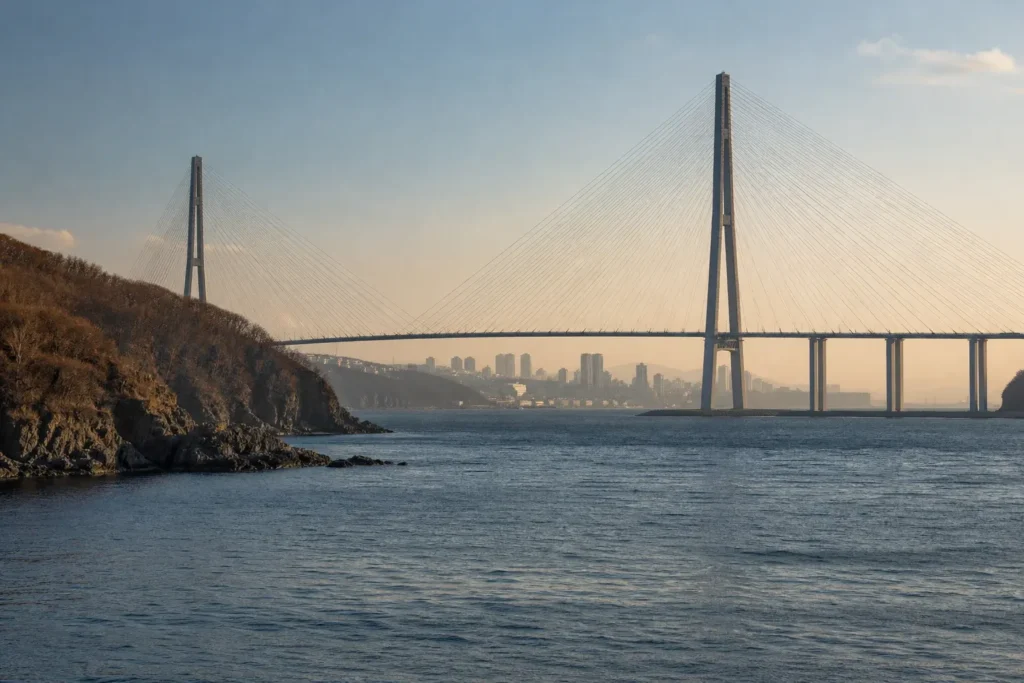
Russky Island lies just offshore from Vladivostok, separated from the mainland by the Eastern Bosphorus strait. Until 2012, the island was isolated and heavily militarized. The opening of the Russky Bridge—the world’s second-longest cable-stayed bridge—transformed access and marked the beginning of the island’s transformation into a major academic and tourist destination.
Today, the island is dominated by the sprawling Far Eastern Federal University campus, built for the 2012 Asia-Pacific Economic Cooperation summit. Beyond the university grounds lie some of Vladivostok’s best natural assets: empty beaches, rugged sea cliffs, forested slopes and waterfront trails offering sweeping coastal views. For many visitors, a day trip to Russky Island combines the iconic bridge crossing, a walk through the modern FEFU campus, and time exploring the island’s quiet natural side away from the city.
Quick Facts
| Russian name | Остров Русский |
|---|---|
| Distance from the nearest major city | 9,334 km |
| Travel time from the nearest major city | 10–12 hours by plane |
| Built / opened | 2012 |
| Address | Russky Island, Vladivostok, Primorsky Krai, Russia OpenStreetMap · Google Maps |
| Admission | free |
| Best time to visit | Season: Late spring through early autumn (May to September) offer the warmest, most stable weather. Summer (June to August) brings longer daylight, warmer swimming temperatures at beaches, and busier crowds. August is generally the warmest month. Spring (May) and autumn (September) are quieter with still-pleasant conditions for walking and photography.
Winter (November to March): Vladivostok and Russky Island experience harsh winters with temperatures dropping to −25°C or lower, frequent snowfall and strong winds. The island is less welcoming, though winter light can be striking for photography. Many casual visitors avoid this season. Day of the Week & Time of Day: Weekdays outside school holidays are quieter than weekends. Early morning and late afternoon offer the best light for photography and the fewest crowds. Midday bus travel can be crowded during rush hours (7–9 AM, 4–6 PM). The waterfront promenade and coastal trails are pleasantly empty before 10 AM and after 4 PM. |
| Recommended duration | 4–6 hours |
| Website | dvfu.ru/en |
What Is (and Isn't) Part of a Visit to Russky Island, Vladivostok?
| Part | Status | Notes |
|---|---|---|
| Russky Bridge | Included in the standard ticket | Crossing the bridge is free for passengers on buses or taxis; you cannot walk the bridge. |
| Far Eastern Federal University Campus – Public Areas | Included in the standard ticket | The waterfront promenade, campus grounds visible from roads, forested park areas and public paths are accessible without charge. Student buildings and academic facilities are generally not open for tours. |
| Beaches and Coastal Trails | Included in the standard ticket | All natural beaches and coastal paths including Cape Tobizin are freely accessible. |
| Historical Military Sites and Batteries | Separate ticket or institution | Some preserved military installations and battery museums require separate tickets and are typically visited as part of guided tours; independent access is limited. |
| Primorsky Aquarium / Oceanarium | Separate ticket or institution | A dedicated aquarium facility exists on the island and requires separate admission; confirm current operating status before visiting. |
| FEFU Campus Student Facilities and Guided Tours | Separate ticket or institution | Formal campus tours and entry to educational buildings require special arrangements and are not part of free public access. |
| Guided Off-Road Tours | Separate ticket or institution | Organized excursions to interior peaks, remote beaches and military heritage sites require separate booking and payment with tour operators; these are not included in basic day-trip access. |
How to Get from the nearest major city to Russky Island, Vladivostok
| Option | Duration | Price | Notes |
|---|---|---|---|
| Bus from central Vladivostok | 1.5–2 hours each way | ₽ | Bus 15 departs from the Izumrud stop (near the Green Glass Shopping Center on Okeansky Prospect, 300 m uphill from central square) every 15 minutes and takes approximately 1 hour 20 minutes. The same route also passes through or connects to the FEFU campus. Bus 29 serves different parts of the island. Pay in cash at the front as you exit. This is the most affordable and regular option but requires navigating Vladivostok's bus system and tolerating crowds during rush hours. Last buses typically depart the island in early evening. |
| Taxi from central Vladivostok | 30–45 minutes each way | ₽₽ | A direct taxi or ride from the city center to the FEFU campus or to southern beaches typically costs moderate rates. Yandex Taxi app is widely used and reliable. Faster and more direct than public buses, allowing flexibility to explore different parts of the island. Useful if traveling in a group (splitting costs) or if time is limited. Last return taxis are available until late evening, but confirm availability. |
| Ferry from Vladivostok port | varies | ₽ | Before the bridge opened, ferries were the primary transport. Today, ferries still operate seasonally from the waterfront terminal (Vokzal Pribrezhnykh Morskikh Soobscheniya) near the train station, reaching multiple points on the island's perimeter. Ferry schedules are less frequent and more seasonal than buses; confirm schedules in advance. This option offers scenic views of the Russky Bridge from the water—an alternative perspective unavailable by land. Travel time and return schedules vary considerably. |
₽ budget · ₽₽ moderate · ₽₽₽ upscale · ₽₽₽₽ splurge. Price levels are estimates compared with typical prices for visitors.
Why Visit Russky Island, Vladivostok?
Russky Island draws visitors for several reasons. The Russky Bridge itself is a marvel of engineering and an instantly recognizable landmark (it appears on the 2,000-rouble banknote). Crossing the bridge by bus or taxi is an experience in itself, offering views of the Eastern Bosphorus and Vladivostok’s skyline.
The Far Eastern Federal University campus is architecturally significant—built to international standards with forested parks, a waterfront promenade, a beach and modern facilities designed to handle the harsh Vladivostok winters. Part of the campus is open to public viewing.
Most importantly, the island offers natural escape. The eastern and southern coasts have quiet coves, sandy beaches, rocky cliffs and hiking trails largely free from Vladivostok’s crowds, making it ideal for walking, photography and simply experiencing the Pacific coast.
Highlights of Russky Island, Vladivostok
Russky Bridge
The iconic cable-stayed bridge, completed in July 2012, spans 3,100 metres across the Eastern Bosphorus. The central span measures 1,104 metres, making it the world's second-longest cable-stayed bridge. At 319 metres tall, it dominates the skyline and is visible from across Vladivostok. Visitors cannot walk the bridge itself; you cross it by bus or taxi. The structure appears on Russia's 2,000-rouble banknote, underscoring its symbolic importance.
Tip: Ask the bus driver to take the window seat on the bridge's eastern side for the best view of Vladivostok and the bay as you cross.
Tip: Sit on the eastern side of the bus when crossing for unobstructed views of the city and Golden Horn Bay.
Far Eastern Federal University Campus
The sprawling FEFU campus, completed in 2012 to host the Asia-Pacific Economic Cooperation summit, is one of Russia's most modern university complexes. Set on Ajax Bay, it houses approximately 25,000 students across multiple faculties. The campus is architecturally distinctive: buildings are arranged on concentric roads that follow the sloping terrain, connected by glass and steel bridges designed to protect from Vladivostok's six-month winters when temperatures drop to −25°C.
Parts of the campus—the waterfront promenade, public areas and the forested park—are accessible to visitors. The gym and pool occasionally host regional and international events.
Tip: Visit the waterfront promenade during early morning or late afternoon for the best light and fewer crowds of students.
Tip: The campus has cafés and facilities open to visitors; the waterfront promenade offers the best views of the bridge at angles unavailable from the road.
Cape Tobizin Coastal Trail
Cape Tobizin is the island's most accessible and scenic natural attraction. A boardwalk trail, suitable for most walkers including children, runs along the southern headland offering continuous views of rocky coves, cliff faces and the open Pacific. The walk takes 1 to 1.5 hours and is most rewarding in clear weather. To reach it, take bus 29 from the central emerald shopping center area toward the southern part of the island and get off at the "Mini-TETs Kommunalnaya" stop.
The coves below the cliffs are inaccessible from above but visible from the trail. Bring a camera for coastal photography.
Tip: Start your walk early in the afternoon to catch the best light on the western-facing cliffs.
Tip: The trail is well-marked but somewhat exposed; bring a windbreaker even in summer, as sea breezes can be strong.
Eastern Beaches and Coves
The eastern and southeastern shores of Russky Island have a number of small coves and sandy beaches, mostly quiet and much less crowded than city beaches. These spots are best reached by car or taxi rather than by public bus, which explains why they remain peaceful. Bring a picnic, swimming clothes and a towel. Even in August, these beaches are rarely packed. The eastern side also offers distant views of foreign shipping traffic in the Eastern Bosphorus, a reminder of Vladivostok's role as a major Pacific port.
Tip: Visit in the afternoon for the best light. Bring sea-glass and shell-hunting supplies if interested in beachcombing.
Tip: Eastern beaches are best reached by taxi; they remain largely empty even in peak season, making them ideal for a quiet swim or picnic.
Waterfront Promenade at FEFU Campus
The university's waterfront promenade, accessed from the main campus grounds, offers unobstructed views of the Russky Bridge at angles unavailable from the roadway. The promenade includes a working waterfall and access to a small beach. This is a popular spot for students and visitors to walk, photograph the bridge from different perspectives and rest. The walk is sheltered from Vladivostok's wind by the campus buildings and offers a sense of the university's relationship to the sea.
Tip: The promenade is peaceful in the early morning and late afternoon; mid-day may see more student traffic.
Tip: Photograph the bridge at golden hour from the promenade for the best lighting and fewest crowds.
Russky Mountain Viewpoint
Russky Mountain is the highest point on Russky Island and one of the largest peaks visible from Vladivostok. Full-day tour operators with off-road vehicles access this spot as part of guided excursions, but day-trip visitors on public transport may find it challenging to reach independently. The viewpoint rewards the journey with panoramic views across the island, the Eastern Bosphorus and Vladivostok beyond.
Tip: Consider booking a guided off-road tour if accessing remote viewpoints is a priority; public buses serve the more accessible coastal areas.
Tip: Guided off-road tours (available through local operators) are often the practical way to reach this peak and explore interior trails.
Atmosphere
Russky Island has a split personality. The FEFU campus, especially during the academic year, buzzes with student activity—people crossing the glass bridges, gathering at cafés and working in groups. The campus feels contemporary, international and alive. The promenade areas are relatively peaceful, with students and a few tourists enjoying the water views.
Away from the campus, the island becomes noticeably quieter. The southern and eastern coasts are windswept and contemplative, especially in off-season. In summer, locals venture to the eastern beaches, but even then they remain far less crowded than mainland beaches. The sea breeze is constant and can be strong; the light is clear and bright, especially in morning and late afternoon.
There is little sense of Soviet-era military infrastructure, though remnants exist for historically minded visitors. The dominant feeling is one of modernization meeting untamed coastline—a newly accessible island caught between its academic present and its natural landscape.
History of Russky Island, Vladivostok
Military Zone (mid-1800s to 2012): Russky Island served as a heavily militarized fortress and garrison for over 150 years, protecting Russia’s Pacific approaches. The island was closed to civilians and inaccessible to outsiders throughout the Soviet period. Various military batteries, forts and naval installations were built across the island, remnants of which visitors occasionally encounter. The strategic location at the mouth of Vladivostok’s Golden Horn Bay made it one of Russia’s most restricted military zones.
2012 Transformation: In preparation for hosting the 2012 Asia-Pacific Economic Cooperation (APEC) summit, the Russian government invested approximately $6 billion in major infrastructure development across Vladivostok and Russky Island. The Russky Bridge was completed in July 2012 and officially named in September 2012. Simultaneously, the Far Eastern Federal University—a merger of four existing institutions founded in 1899—relocated to a new purpose-built campus on Russky Island designed to international standards. The campus was engineered to withstand Vladivostok’s extreme winters, with interconnected buildings and glass bridges.
Post-2012 Development: After the APEC summit, the island transitioned from a restricted military zone to an open academic and tourism destination. The university campus remains the island’s dominant feature, housing approximately 25,000 students. Infrastructure continued to improve, including coastal paths, facilities for visitors and amenities at settlements like Rynda. Part of the military heritage has been preserved in museums and battery sites accessible to interested visitors, though the island’s character is now firmly that of a modern university district and natural sanctuary rather than a military stronghold.
Tickets and Booking for Russky Island, Vladivostok
Entry to Russky Island itself is free. You pay only for transport (bus, taxi or ferry) to reach the island. Public buses from Vladivostok require cash payment when you exit at the front door. Bus cards (Podorozhnik) are not typically used for this route; bring cash in small denominations.
For specific attractions—military heritage sites, museum batteries or the Primorsky Aquarium—separate tickets are required. These are not included in day-trip transport. Confirm opening hours and current status on the official university website (dvfu.ru) before visiting, as campus access policies and facility hours may change. Most beaches and coastal trails are freely accessible year-round. Guided tours can be booked through local tour operators in Vladivostok; these typically include transport, a guide and entry to restricted areas.
Plan and Book
Suggested itineraries Russky Island, Vladivostok
4 hours on-island
Morning: Arrive by bus 15 at the FEFU campus. Walk the waterfront promenade and take photos of the Russky Bridge from multiple angles. Explore the campus grounds and forested park area. Lunch at a campus café. Afternoon: Head south to Cape Tobizin via local minibus or taxi and walk the boardwalk trail for 1–1.5 hours. Return to the campus area and depart by evening bus. This plan prioritizes architecture and accessible coastal scenery.
6 hours on-island
Morning: Cross the Russky Bridge by bus, arriving mid-morning. Spend 2 hours exploring the FEFU campus, promenade and surroundings. Lunch. Afternoon: Take bus 29 south to Cape Tobizin for the coastal trail walk (1.5 hours). If energy remains, explore a quiet eastern beach cove by taxi. Late afternoon: Return to the campus area or proceed directly back to Vladivostok. This plan balances campus exploration with more substantial nature time.
Full day (8–10 hours including return)
Depart Vladivostok early morning. Spend the day at multiple locations: morning at the FEFU waterfront; mid-morning to early afternoon at Cape Tobizin trail; afternoon exploring eastern beaches by taxi or minibus; final hour at a coastal viewpoint or café with bridge views. Allow time for lunch at a campus or local settlement café. This maximizes exposure to varied landscapes and natural features. Evening return to Vladivostok by bus or taxi. Best for those interested in photography, hiking and coastal exploration.
How to Get to Russky Island, Vladivostok
By Bus (Most Frequent, Budget-Friendly)
- Route: Bus 15 from central Vladivostok departing every 15 minutes
- Stop: Izumrud (Emerald) shopping center area on Okeansky Prospect, 300 metres uphill from Central Square
- Journey time: Approximately 1 hour 20 minutes across the Russky Bridge to the FEFU campus
- Payment: Cash at the exit (front door); small denominations helpful
- Schedule: Daytime frequency every 15 minutes; evening service reduces after 21:00
By Taxi
- Apps: Yandex Taxi (reliable, English-language interface)
- Journey time: 30–45 minutes from city center to campus or southern beaches
- Cost: Moderate; split costs in a group for better value
- Advantages: Direct route, no transfers, flexible timing
By Ferry (Seasonal)
- Terminal: Vokzal Pribrezhnykh Morskikh Soobscheniya (waterfront terminal) near Vladivostok railway station
- Note: Less frequent than bus; schedules are seasonal. Confirm in advance. Offers scenic water views of the Russky Bridge.
Accessibility
The FEFU campus features modern, well-maintained pathways and the waterfront promenade is relatively flat and accessible. Wheelchair access to campus public areas is generally available, though some areas with stairs exist. The coastal boardwalk trail at Cape Tobizin is raised but has some uneven sections; it is passable for wheelchair users or those with limited mobility with care.
Public buses in Vladivostok have variable wheelchair accessibility; newer vehicles have ramps, but older minibuses do not. Confirm bus accessibility when boarding. Taxis are a more reliable accessible option and allow direct door-to-door service.
Beaches and eastern coves may have uneven rocky or sandy access; facilities for swimmers with disabilities are limited. Bring assistance if needed. The island lacks comprehensive accessible amenities, though the core campus and promenade areas are reasonably navigable.
Food Nearby
The FEFU campus has several cafés and dining facilities open to visitors, offering Russian meals, snacks, hot drinks and light lunch options at budget to moderate prices. Campus food is suitable for quick meals between exploring.
The main island settlement of Rynda and smaller populated areas have local cafés and shops, though selection is more limited than in Vladivostok. Seafood restaurants exist on the island, particularly near the waterfront, though these are primarily oriented toward weekend visitors and special occasions.
Recommendation: Bring a packed picnic (sandwiches, fruit, drinks) if you plan to spend time on beaches or the Cape Tobizin trail; this gives maximum flexibility and avoids reliance on limited food options in remote areas. Campus cafés are reliable for hot tea and pastries at any time of day.
What to Bring
Vladivostok and Russky Island are windy; bring a windbreaker or fleece layer even in summer. In spring and autumn, warmer layers are essential. Sturdy walking shoes are needed for coastal trails and rocky beaches. For beach visits, bring swimsuit, towel and sunscreen. For the Cape Tobizin trail, allow 1–2 hours and bring water. A camera is essential for capturing the bridge and coastal scenery, especially during golden hour (early morning or late afternoon).
Cash in small denominations is needed for bus fares and street-level purchases; credit cards are not widely accepted on public transport. A map or offline navigation app (Google Maps or Yandex Maps) helps navigate bus routes and island areas. Bag security rules are standard for public buses (no restrictions).
Best Views and Photo Spots of Russky Island, Vladivostok
FEFU Waterfront Promenade
Unobstructed side-on views of the Russky Bridge with the Eastern Bosphorus and Vladivostok's skyline in the background. This is the single best vantage point for bridge photography available to day-trippers. The promenade also captures the bridge's reflection in the water at dusk.
Best time: Early morning or late afternoon for golden light; late afternoon for sunset reflections with the bridge illuminated.
Russky Bridge from Moving Bus
The bridge approaches and passes reveal its scale and engineering drama. The view from the eastern side of the bus shows the bridge, Vladivostok skyline and the strait. Fleeting but visually striking.
Best time: Afternoon crossing (4–5 PM) for side-lit illumination; ask the driver to slow if possible, or take multiple bus trips.
Cape Tobizin Coastal Trail
Rocky coves, cliff formations and open sea views along the southern headland. Varied rock colors and light create rich compositions. The trail includes several natural overlooks framing the landscape.
Best time: Late afternoon light from the west hits the cliff faces; clearer days offer the longest sightlines.
Eastern Beach Coves
Small sandy beaches nestled in rocky coves with open water views and occasional distant ship traffic. Quieter, less dramatic than the southern cliffs but intimate and peaceful.
Best time: Afternoon light; late afternoon to capture the sun over the water; summer for warmest light and colors.
FEFU Campus Forested Park
Modern architecture integrated with mature trees and landscaping. The glass and steel bridges connecting buildings create dynamic compositions, especially with overcast skies or winter conditions.
Best time: Overcast days minimize glare and flattening light; early morning when few students are present.
Photography Rules
Russky Island is highly photogenic. The Russky Bridge is the star subject, best photographed from the waterfront promenade (east-facing light early morning, west-facing light late afternoon) or from moving buses and taxis. The bridge can also be photographed from the water if taking a ferry.
Coastal cliffs at Cape Tobizin offer dramatic rock formations and sea views. Golden hour (first hour after sunrise, last 2 hours before sunset) is ideal for warm, directional light on the cliffs. Drones are not permitted on campus or in restricted military areas. Tripods can be used on public trails and beaches but may draw attention on campus. No restrictions on photography in public outdoor areas, though respect student privacy on the campus. Interior photography at campus buildings or museums (if visited) may have specific restrictions—ask locally.
Family Suitability
Russky Island is suitable for families with children of school age and older. The Russky Bridge crossing is exciting for all ages, and the FEFU campus waterfront promenade is a pleasant stroller-friendly walk. Cape Tobizin's boardwalk trail is appropriate for children aged 5+ with supervision; the trail is elevated and safe but somewhat windswept.
Quieter eastern beaches are ideal for families seeking a calm swimming and picnic experience. The island is generally safe, with low crime and good visibility. Toilets and water fountains exist on campus but are limited in remote areas; plan accordingly. The campus cafés accommodate families at meal times. Younger children (under 5) may find the walking distances and wind challenging; consider a taxi to specific destinations rather than relying on buses and long walks.
Russia Vibes Tips
- Book your day trip to Russky Island for a clear day if possible. Overcast or foggy conditions reduce visibility of the bridge, distant views and photography potential. In autumn and winter, clear days are rarer and more valuable.
- The FEFU campus can feel maze-like to first-time visitors. Download an offline map of the campus before arrival (available on the official FEFU website) or take a photo of the campus map posted at the main entrance. The three parallel ring roads and connecting glass bridges are the main navigation aids.
- Do not plan to walk the Russky Bridge itself—pedestrians are not permitted. However, you can view the bridge structure in detail from the waterfront promenade and many spots around the island. The view from a moving bus crossing the bridge is the unique perspective most visitors experience.
- Eastern beaches are accessed more easily by taxi than by public bus; the bus routes serve the northern and central parts of the island. If beaches are your primary goal, budget for a taxi ride to maximize time actually on the beach.
- Bring sufficient water and snacks when hiking the Cape Tobizin trail. There are no facilities midway along the boardwalk. The 1–1.5 hour walk is not strenuous but is fully exposed to sea wind, making hydration important.
- Ask locals or the FEFU information desk (if open) about current access to military heritage sites and batteries. Some locations change accessibility seasonally or as university policies evolve. What was open last season may be restricted this season.
Explore Nearby Russky Island, Vladivostok
Browse more: All Day Trips · All Day Trips in Vladivostok · All Parks · All Vladivostok
FAQ: Russky Island, Vladivostok
Can I walk across the Russky Bridge?
No. The bridge is a four-lane highway and pedestrians are not permitted. You cross the bridge by bus, taxi or (rarely) by ferry. Most day-trippers experience the bridge view from a bus window. The waterfront promenade at the FEFU campus offers the best stationary views for photography and detailed observation.
Is the Far Eastern Federal University campus open to visitors?
Parts of the campus are accessible to visitors free of charge, including the waterfront promenade, public pathways, forested park areas and the beach. Student buildings and academic facilities are not open for casual tours. If you wish to explore the campus formally, email the university in advance or visit the information desk at the main entrance to inquire about official campus tours.
What is the most affordable way to reach Russky Island from Vladivostok?
Public bus 15 from the Izumrud stop is the cheapest option, requiring only cash for a single fare (roughly budget-level cost). Buses depart every 15 minutes and take approximately 1 hour 20 minutes. This is ideal if you do not mind public transport crowds and have flexibility with timing. A taxi is faster but costs more; splitting taxi costs in a group can approach bus prices.
What is there to do on Russky Island besides seeing the bridge?
The island offers the modern FEFU campus (free public access to certain areas), coastal trails and beaches, quiet coves with sandy beaches (especially on the eastern shore), and historical military sites (some requiring guided tours). The Cape Tobizin boardwalk is the island's most accessible scenic walk. Hiking, beach picnics, photography and observing student campus life are all viable day-trip activities.
Are there places to eat on Russky Island?
The FEFU campus has cafés open to the public offering Russian meals, snacks and hot drinks at budget to moderate prices. Small settlements on the island have local cafés. Bring a packed picnic if exploring remote beaches or hiking, as food options in those areas are limited. Campus cafés provide hot tea and pastries throughout the day.
How long does a day trip to Russky Island typically take?
A minimal visit (bridge crossing plus 1–2 hours on the island) takes 4 hours total including return transport. A fuller day exploring the campus, coastal trails and beaches typically requires 6–8 hours. Full-day immersive tours with guided elements and off-road exploration can extend to 10+ hours. Most casual visitors allocate 4–6 hours on-island.
Can I visit Russky Island in winter?
Yes, though conditions are harsh. Winter temperatures drop to −25°C or lower, with snow and strong winds. The island is open year-round and visitors do come in winter for dramatic light and photography, but fewer facilities are active, beach swimming is not practical, and the experience is quite austere. Spring through early autumn (May–September) are far more pleasant for a day trip.
Is swimming possible on Russky Island?
Yes. The eastern and southern beaches are accessible and have sandy coves suitable for swimming in summer months (roughly June–August). The water is cold even in summer. The FEFU campus also has a small beach area. Bring swimwear and a towel. Avoid swimming in winter and shoulder seasons unless very hardy; water temperatures remain cold most of the year.
Russia Vibes is a one-person project. A coffee keeps it going
How we research and update our guides
About this guide: AI assistance and accuracy
This guide is created with the help of AI and is based on official sources where available. Mistakes can still happen. Opening hours, prices, rules and other details are given to the best of our knowledge as of the date shown and can change without notice. It offers general recommendations only, not professional, legal or travel advice. Please confirm important details with the official source before you travel; you are responsible for your own plans and decisions.

Take this guide with you
Get a free PDF of this guide to print or read offline: key facts, tips and a map link on a few clean pages.
Report an issue on this page
Paying for your trip: please read
International sanctions affect payments between Russia and many other countries. In practice, cards issued in the EU, the UK, the US and several other countries often do not work in Russia, Russian cards usually do not work abroad, and some booking platforms, airlines and payment providers limit or suspend their services for Russia. The situation changes frequently.
We do not give legal or financial advice, and this site does not encourage anyone to break or circumvent sanctions. Whatever you plan, you are responsible for following the laws and regulations that apply to you, including those of your country of residence and citizenship.
Many travelers still organise their stay lawfully. It is worth asking your bank or payment provider what is currently permitted, contacting hotels, tour operators and carriers directly about the payment methods they accept, and checking which services are open to customers from your country. Clarify payment, cancellation and refund terms before you commit to a booking, and keep your plans flexible.
Partner links on this site may not be available in every country, and prices, availability and rules in our guides can differ from what you see when you book.