
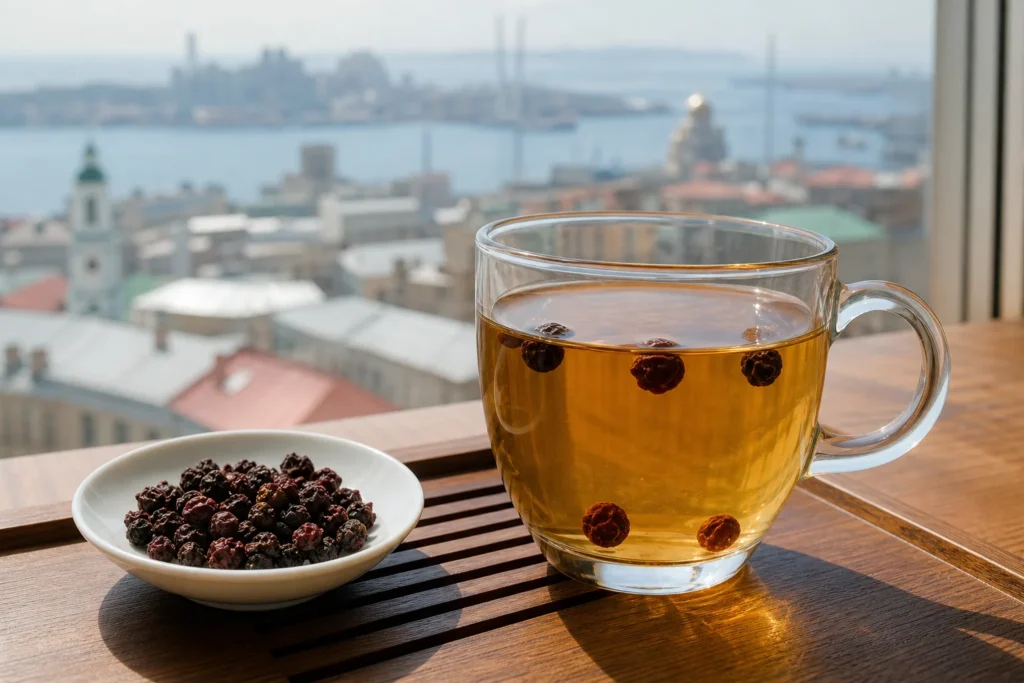
Magnolia Vine Tea—made from the berries of Schisandra chinensis—is a traditional Russian Far East drink with roots in Chinese herbal medicine. Vladivostok sits in the Primorsky region where the magnolia vine grows wild and is cultivated commercially. This guide shows you how to prepare Magnolia Vine Tea from dried berries, the most common method.
You will learn the simple brewing process, the authentic flavor profile, and how to adjust steeping time to suit your taste. The recommended option is a gentle hot-water infusion that takes just minutes.
Quick answer: Steep dried magnolia vine berries in hot water for 1–2 minutes for a light infusion, or 3–5 minutes for a stronger brew. Total time: 5–10 minutes including water heating. Cost: budget-friendly.
At a Glance
| Type | Drinks |
|---|---|
| Local name | чай из лимонника |
| Origin | Eastern Russia and China; commonly prepared in the Primorsky region around Vladivostok |
| Servings | 1 cup |
| Total time | 5–10 minutes |
| Difficulty | Easy |
History and Story of Magnolia Vine Tea, Vladivostok
Magnolia vine, botanically Schisandra chinensis, has been used in Traditional Chinese Medicine for over 2,000 years. Called wǔwèizǐ (‘five flavor fruit’) in Chinese, the berries are valued for their distinctive balance of all five basic tastes. The plant grows wild across the forests of China, Korea, and Eastern Russia, including the Primorsky region. In Russia’s Far East, magnolia vine has become a regional specialty, cultivated commercially and widely consumed as a local tonic tea.
Ingredients
- 1–2 teaspoons dried magnolia vine berries (Schisandra chinensis)
- 250 ml (1 cup) hot water
- A teapot or mug
- A fine strainer or tea infuser
- Optional: honey or rock sugar for sweetness
How Magnolia Vine Tea, Vladivostok Is Made
Step 1: Measure the dried berries
Place 1–2 teaspoons of dried magnolia vine berries into a teapot, mug, or infuser basket. If using loose berries, use a fine strainer to prevent particles from entering your cup. The berries should be whole, dried, and dark in color. Avoid using crushed or powdered berries, which brew too quickly and become cloudy.
Tip: You can find dried magnolia vine berries in specialty tea shops in Vladivostok and throughout the Primorsky region.
Step 2: Heat water to just below boiling
Fill a kettle with fresh, cold water and bring it to a boil, then let it cool for 1–2 minutes. The ideal temperature is around 80–90°C (176–194°F). Water that is too hot will extract bitter compounds; water that is too cool will not release enough flavor.
Tip: If you do not have a thermometer, wait about 30 seconds after the kettle stops boiling before pouring.
Step 3: Pour water over the berries
Pour the hot water slowly over the berries in your teapot or infuser. Fill until the berries are completely submerged. Cover the pot or mug with a lid or saucer to keep the heat in and prevent the delicate aroma from escaping.
Tip: Use about 250 ml (8 fluid ounces) of water per serving.
Step 4: Steep for 1–5 minutes
For a light, refreshing infusion, steep for 1–2 minutes. For a more robust flavor and stronger medicinal effect, steep for 3–5 minutes. The longer you steep, the more pronounced the five flavors—sweet, sour, salty, bitter, and pungent—will become. Do not steep longer than 5 minutes, as the tea will become overly astringent.
Tip: Set a timer on your phone so you do not forget the tea steeping.
Step 5: Strain and serve
Pour the brewed tea through a fine strainer into a cup, leaving the berries behind in the pot. If you used a strainer basket, simply lift it out. The tea should be a warm amber or golden color. Drink while warm.
Tip: Do not discard the berries after the first infusion—they can be steeped again two or three times. Subsequent brews may be slightly weaker but will retain the distinctive five-flavor character.
Step 6: Sweeten if desired
Magnolia vine tea is naturally tart and complex. If you prefer it sweeter, add a small amount of honey or rock sugar (crystal sugar). Stir to dissolve and taste. Some locals add a thin slice of fresh ginger for warmth or a squeeze of lemon for brightness, though the tea is excellent on its own.
Tip: Traditional preparation in China and Korea typically uses no added sweetener, allowing the five natural flavors to stand alone.
Variants
- Cold infusion: Steep dried berries in cold water overnight or for 6–8 hours, then strain and drink chilled with ice—popular in summer.
- Boiled decoction: Place 2–3 teaspoons of berries in a pot with 500 ml of cold water, bring to a simmer, and cook gently for 2–3 minutes for a deeper, more concentrated flavor.
- Blended with other herbs: Mix magnolia vine berries with dried ginger, chrysanthemum flowers, or goji berries for a custom tea blend.
- Berry and leaf blend: Use equal parts dried berries, leaves, and shoots (all three parts of the plant can be dried and stored) for a fuller herbal profile.
Common Mistakes to Avoid
- Using water that is boiling hot: Boiling water will extract harsh tannins that make the tea bitter and unpleasantly astringent. Always let the water cool for 30 seconds to 1 minute before pouring.
- Steeping too long: More than 5 minutes creates an over-extracted, overly bitter drink. Set a timer and do not exceed this time.
- Confusing magnolia vine with magnolia flowers: Magnolia Vine Tea comes from Schisandra chinensis berries, not from magnolia tree flowers. Flower-based teas are a completely different drink.
- Discarding berries after one use: Magnolia vine berries can be steeped 2–3 times. The subsequent infusions are lighter but still flavorful and worth preparing.
- Using powdered or crushed berries: Whole dried berries brew cleanly. Powdered berries create a cloudy, gritty cup and are difficult to strain.
- Not covering the pot while steeping: An uncovered pot allows the aromatic compounds to escape with steam. Always cover while steeping.
How to Order and Eat It
Magnolia Vine Tea is served hot in a small cup or mug, typically without milk or cream. Sip slowly to appreciate the layered five-flavor character—the sweetness emerges first, followed by sour and pungent notes, with a lingering salty and bitter finish on the back of the palate. In Vladivostok and throughout the Primorsky region, locals drink it as a daily tonic, often in the afternoon or early evening. It is not sweetened in traditional preparation, though modern drinkers sometimes add honey. The tea is consumed on its own, not with food.
To order: чай из лимонника [chai iz limonnika]
Russia Vibes Tips
- Buy berries at local markets in Vladivostok and the Primorsky region during autumn, when fresh berries are being dried. Local specialty shops and herbal medicine stores often carry high-quality dried berries year-round.
- The five-flavor profile is subtle on the first sip. Let the tea cool slightly and taste again—the flavors develop as it cools, and the pungent finish becomes clearer.
- Do not waste the berries after steeping. Magnolia vine berries can withstand 3–4 infusions total. The second and third steepings are lighter but still aromatic and worth the time.
- Magnolia vine berries may be rehydrated and eaten after steeping if you prefer a less wasteful approach. They are completely non-toxic and have a pleasant tart-sweet flavor.
- Store dried berries in a cool, dark, dry place in an airtight glass jar. They will keep for 1–2 years without losing potency. Avoid plastic containers, which can absorb odors.
- In Vladivostok, locals also prepare magnolia vine compotes (a sweet, concentrated berry drink served hot or cold) and juices alongside tea—all from the same plant.
Explore Nearby Magnolia Vine Tea, Vladivostok
Browse more: All Food & Drink · All Food & Drink in Vladivostok · All Other · All Vladivostok
FAQ
Is Magnolia Vine Tea the same as magnolia flower tea?
No. Magnolia Vine Tea is made from dried berries of Schisandra chinensis. Magnolia flower tea is made from the petals or bark of true magnolia trees, which are botanically unrelated. The two drinks taste and brew very differently.
Why is it called 'five-flavor' tea?
The berries contain all five basic flavors in Chinese medicine: sweet, sour, salty, bitter, and pungent (spicy). The balance of these five flavors is what makes the tea distinctive and is why it is prized in traditional medicine.
Can I reuse the berries?
Yes. Magnolia vine berries can be steeped 2–4 times total. Add 30 seconds to the steeping time with each subsequent infusion. The second and third infusions will be lighter in flavor but still pleasant.
Is magnolia vine tea caffeine-free?
Yes, magnolia vine tea is naturally caffeine-free, making it safe to drink at any time of day or evening without disrupting sleep.
How do I store dried berries?
Store in an airtight glass jar in a cool, dark, dry place away from direct sunlight and strong odors. Properly stored berries will keep for 1–2 years without significant loss of flavor or potency.
What does magnolia vine tea taste like?
The flavor is tart and complex, with subtle sweetness, sourness, bitterness, saltiness, and a warming pungent finish. It is not floral or fruity like some herbal teas, but rather bracing and herbaceous. The taste develops and becomes more pronounced as the tea cools.
Can I sweeten magnolia vine tea?
Yes, though traditionally it is served without sweetener. If you prefer it sweeter, add a small amount of honey or rock sugar. Ginger or lemon can also enhance the flavor without overpowering the delicate five-flavor profile.
Where can I buy dried magnolia vine berries in Vladivostok?
Local tea shops, herbal medicine stores, and traditional medicine pharmacies throughout Vladivostok carry dried magnolia vine berries year-round. Local markets and farmers' markets often have them in autumn during the harvest season.
Russia Vibes is a one-person project. A coffee keeps it going
How we research and update our guides
About this guide: AI assistance and accuracy
This guide is created with the help of AI and is based on official sources where available. Mistakes can still happen. Opening hours, prices, rules and other details are given to the best of our knowledge as of the date shown and can change without notice. It offers general recommendations only, not professional, legal or travel advice. Please confirm important details with the official source before you travel; you are responsible for your own plans and decisions.

Take this guide with you
Get a free PDF of this guide to print or read offline: key facts, tips and a map link on a few clean pages.
Report an issue on this page
Paying for your trip: please read
International sanctions affect payments between Russia and many other countries. In practice, cards issued in the EU, the UK, the US and several other countries often do not work in Russia, Russian cards usually do not work abroad, and some booking platforms, airlines and payment providers limit or suspend their services for Russia. The situation changes frequently.
We do not give legal or financial advice, and this site does not encourage anyone to break or circumvent sanctions. Whatever you plan, you are responsible for following the laws and regulations that apply to you, including those of your country of residence and citizenship.
Many travelers still organise their stay lawfully. It is worth asking your bank or payment provider what is currently permitted, contacting hotels, tour operators and carriers directly about the payment methods they accept, and checking which services are open to customers from your country. Clarify payment, cancellation and refund terms before you commit to a booking, and keep your plans flexible.
Partner links on this site may not be available in every country, and prices, availability and rules in our guides can differ from what you see when you book.