
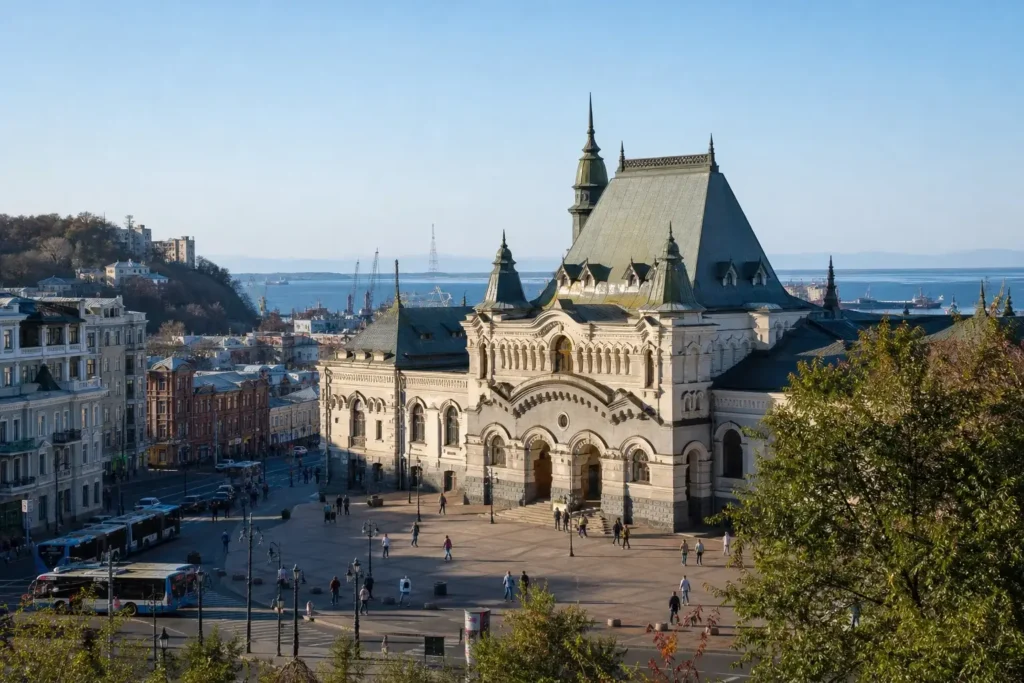
Pervomaysky is one of Vladivostok‘s five administrative districts, established in 1936 and historically named after Kliment Voroshilov, the Soviet military commander. Covering parts of the central and eastern city, the district encompasses a mix of residential neighborhoods, commercial areas, and several landmarks tied to Vladivostok’s role as the eastern terminus of the Trans-Siberian Railway.
Unlike some of Vladivostok’s newer developments, Pervomaysky retains pockets of late 19th and early 20th century architecture alongside Soviet-era buildings and contemporary construction. The district is accessible by local buses and trams, which remain the primary public transport in this port city on the Sea of Japan.
Quick Facts
| Russian name | Первомайский |
|---|---|
| Address | Pervomaysky District, Vladivostok Google MapsApple MapsYandex Maps2GISOpenStreetMap |
| District | Vladivostok |
| Best time to visit | Late spring (May–June) and early autumn (September–October) offer the most pleasant weather for walking and exploring. Summers are warm but sometimes humid and rainy. Winters are cold and can be harsh, with heavy snow; Vladivostok's location on the Pacific means unpredictable winter weather. Avoid mid-summer tourist season if seeking a quieter neighborhood experience. Weekday mornings tend to be less crowded than evenings and weekends. |
| Recommended duration | 2–4 hours |
What Is (and Isn't) Part of a Visit to Pervomaysky, Vladivostok?
| Part | Status | Notes |
|---|---|---|
| Vladivostok Railway Station | Included in the standard ticket | Located within Pervomaysky; visitors can enter the station building and surrounding plaza. |
| Mariinsky Theatre, Primorskaya Stage | Included in the standard ticket | Cultural venue within the district; performances require separate tickets. |
| Historic architecture near the station | Included in the standard ticket | Late 19th and early 20th-century buildings on public streets; viewable from outside, some privately owned. |
| Local parks | Included in the standard ticket | Small public parks and green spaces throughout; free access, no formal facilities. |
| Svetlanskaya Street commercial zone | Included in the standard ticket | Main street with shops and cafes; freely accessible to walk and window-shop. |
| Soviet-era monuments and plaques | Included in the standard ticket | Scattered throughout the district on building facades; visible from public areas. |
| Leninsky and Pervorechensky Districts | Outside / not part of it | Separate administrative districts of Vladivostok; not part of Pervomaysky. |
Why Visit Pervomaysky, Vladivostok?
Visitors exploring Vladivostok discover Pervomaysky as a practical base for understanding the city’s layered history. The railway station and adjacent historic quarter show the city’s origins as a strategic Pacific port, while the district’s mix of neighborhoods reveals how Vladivostok has evolved from a remote frontier outpost to a modern regional hub.
The district is central enough to reach major attractions on foot or by local transport, yet quiet enough to experience everyday life away from tourism circuits. For travelers arriving by the Trans-Siberian Railway or those interested in Soviet urban planning and Russian Far Eastern culture, Pervomaysky offers authentic context for the city.
How Pervomaysky, Vladivostok Is Laid Out
Pervomaysky stretches across Vladivostok’s central and eastern zones, with the railway station and its surrounding historic quarter marking the district’s western anchor. From there, residential and commercial areas spread eastward toward the hills that define Vladivostok’s geography. The main transport spine is Svetlanskaya Street, which cuts through the district and connects key neighborhoods.
The district can be mentally divided into zones: the railway quarter near the station, the central commercial area around Svetlanskaya, residential neighborhoods climbing toward higher ground, and pockets of green space including small parks. Buses and trams connect these areas, though many neighborhoods are walkable for short distances.
Highlights of Pervomaysky, Vladivostok
Vladivostok Railway Station
The iconic terminus of the Trans-Siberian Railway, opened in 1893 with its distinctive Russian 17th-century architectural style. Architect P.E. Bazilevsky designed the stone building, which was consecrated on November 2, 1893, marking the opening of the rail link between Vladivostok and Ussuriysk. The station remains a working transport hub and one of Vladivostok's most recognizable landmarks, symbolizing the city's historical importance as a Pacific gateway.
Tip: Visit early morning to see the ornate facade clearly lit; the station is still an active railway hub, so observe current security protocols.
Mariinsky Theatre, Primorskaya Stage
Located within Pervomaysky, the Primorskaya Stage of Vladivostok's premier theater offers performances of ballet, opera, and drama. The venue represents Vladivostok's cultural ambitions and serves as a gathering point for the city's arts community. Check the performance schedule before visiting, as this is an active cultural institution rather than a museum.
Tip: Book tickets in advance during tourist season; programs are often available in Russian and may include translated summaries.
Historic Quarter near the Station
The streets radiating from the railway station contain late 19th and early 20th century commercial and residential buildings, some restored and others weathered. These structures recall Vladivostok's origins as a trading post and military garrison, with period details visible in facades, windows, and street layouts. The quarter is walkable and offers a visual sense of how the city developed from its inception.
Tip: Walk these streets in daylight to photograph details; many buildings are privately owned residences, so respect privacy and do not photograph private interiors.
Local Parks and Viewpoints
Pervomaysky contains several small parks and elevated areas offering views over Golden Horn Bay and the city's harbor. These spots are popular with residents for relaxation and are less crowded than central tourist zones. The views toward the bay and surrounding hills provide context for understanding Vladivostok's geography and strategic position on the Pacific.
Tip: Visit parks early in the morning or late afternoon for best light and fewer crowds; bring water, as facilities are limited.
Svetlanskaya Street
The main commercial and transport artery running through Pervomaysky, lined with shops, cafes, and bus stops. This street has evolved over more than a century and shows the layers of Vladivostok's development, from pre-Soviet storefronts to Soviet-era structures to modern businesses. Walking Svetlanskaya gives a practical sense of how the district functions in daily life.
Tip: Walk the street in short sections; it is long and hilly. Stop at local cafes to rest and observe local life.
Soviet-Era Architecture
Scattered throughout Pervomaysky are apartment blocks, public buildings, and monuments from the Soviet period (1920s–1990s). These structures reflect the standardized architectural approach of Soviet urban planning and often feature socialist realist decorative elements, commemorative plaques and architectural details associated with their construction period. They contrast sharply with both older pre-revolutionary buildings and newer post-Soviet development.
Tip: Look up at building facades to notice details; ground-level graffiti and wear is common, but upper-floor architectural features remain interesting.
Atmosphere
Pervomaysky feels like a working district rather than a tourist enclave. Buses rumble down Svetlanskaya carrying commuters; small shops and cafes serve locals rather than visitors. The air carries the salt and industrial tang of a port city, especially near the railway quarter. Early morning brings quietness; afternoons fill with activity as offices and schools close.
The district’s character shifts by location: near the station, the architecture and pace feel historic and transitional; further east, residential neighborhoods grow quieter and more domestic, with locals walking dogs and tending small gardens. Soviet-era apartment blocks dominate many blocks, their scale and repetition creating a distinctly post-war feel. Compared to central Vladivostok tourist zones, Pervomaysky is understated and genuine, where visitors encounter real neighborhood life rather than curated experiences.
History of Pervomaysky, Vladivostok
Pervomaysky District was formally established on January 4, 1936, as one of Vladivostok’s original administrative divisions. It was named after Kliment Voroshilov, the Soviet military commander and Commissar of Defense, reflecting the Soviet Union‘s practice of naming urban zones after political and military figures.
The district encompasses territory that had been developed since Vladivostok’s founding as a military port in the 1860s. The railway station, opened in 1893 as the terminus of the Trans-Siberian Railway, became the anchor of this zone. The station’s construction and operation transformed Vladivostok from a remote garrison into a significant commercial hub, and the district that grew around it absorbed waves of development tied to this shift.
During the Soviet era, Pervomaysky underwent systematic urban planning. Stalin-era apartment blocks were constructed to house workers and military personnel; these structures defined much of the district’s residential character from the 1930s onward. The district remained a core administrative and economic zone throughout the Soviet period.
After the Soviet Union’s collapse in 1991, Pervomaysky, like the rest of Vladivostok, experienced economic and physical decline as Russia’s Far Eastern connections weakened. However, since the 2000s, renewed interest in the Trans-Siberian Railway as a tourist route and Vladivostok’s role in Russian Far Eastern policy have brought some restoration of historic buildings and incremental modernization. The district today shows this layered history: pre-revolutionary stone structures, Soviet apartment blocks, and newer commercial development coexist, creating a palimpsest of the city’s changing fortunes.
Tickets and Booking for Pervomaysky, Vladivostok
Pervomaysky is a public neighborhood with no admission fee. Visitors move freely through streets, parks, and public areas. To visit specific venues such as the Mariinsky Theatre, check the theater’s official website for performance schedules and ticket purchase options. The railway station can be entered freely during daylight hours; departing passengers should check train schedules and ticket services with Russian Railways.
Plan and Book
Advertisement: these are partner links. If you book or buy through them, we may earn a commission at no extra cost to you.
Suggested itineraries Pervomaysky, Vladivostok
2 hours
Walk from the railway station through the historic quarter, observing pre-revolutionary and Soviet-era architecture. Continue along Svetlanskaya Street toward the commercial center, stopping at a local cafe. End at a viewpoint toward Golden Horn Bay. Focus on street-level details and building facades rather than entering multiple venues.
4 hours
Start at the railway station; explore the historic quarter systematically, photographing details. Visit a local park for rest. Walk Svetlanskaya Street, browsing shops and cafes. Visit the Mariinsky Theatre exterior (or a performance if available). Conclude at an elevated viewpoint. Include time for lunch at a local cafe or casual restaurant.
Half day
Begin with the railway station and historic quarter as above. Spend time in residential neighborhoods away from main streets to observe Soviet-era urban planning. Visit 2–3 local parks. Have lunch at a neighborhood cafe or small restaurant. Explore side streets branching from Svetlanskaya. End at a harbor viewpoint or cultural venue if interested.
How to Get to Pervomaysky, Vladivostok
By local bus: Most routes serving Vladivostok pass through or near Pervomaysky. Buses converge around the railway station and along Svetlanskaya Street. Use local transit maps or ask at your accommodation for routes to specific neighborhoods.
By tram: A single tram line operates in Vladivostok with limited service. Check current schedules, as service has been sporadic.
By taxi or ride-hailing: Taxis and ride-hailing apps operate throughout Vladivostok. Journey times depend on starting point and traffic; fares are moderate.
On foot: Much of Pervomaysky is walkable once you are in the district. Expect hilly terrain, especially toward higher elevations. Streets can be steep and uneven in places.
From Vladivostok International Airport: The airport is outside the city. Use the Express Primorya train or buses to reach the railway station or central Vladivostok, then local transport to Pervomaysky.
Accessibility
Vladivostok's terrain is hilly, and Pervomaysky includes steep streets and uneven sidewalks, making wheelchair access challenging in many areas. The railway station has designated accessible entrances and facilities. Sidewalks vary in condition; some are well-maintained while others are broken or narrow. Public restrooms are limited. Information on accessible venues within the district is not widely published; check with your accommodation or local tourism offices for current details.
Food Nearby
Svetlanskaya Street and the area near the railway station contain numerous cafes, small restaurants, and shops. Local options range from casual Soviet-style stolovayas (cafeterias) serving traditional Russian dishes to modern cafes and international restaurants. Bakeries and convenience stores are scattered throughout residential neighborhoods. Seafood is common due to the coastal location. Prices are moderate. Most venues cater to locals rather than tourists, so English menus are rare; pictures or point-and-order works well.
What to Bring
Wear sturdy walking shoes suited for uneven sidewalks and hills. In cooler months (October–April), bring warm layers and a windproof jacket; Vladivostok can be windy. In summer, sunscreen and a hat are recommended. Bring a reusable water bottle, as public fountains are rare. A local transit map or phone app helps navigate bus routes. Small change is useful for local cafes and shops, though card payment is increasingly available.
Best Views and Photo Spots of Pervomaysky, Vladivostok
Vladivostok Railway Station facade
The ornate stone building with its Russian 17th-century architectural style is most striking from the plaza in front. Early morning or late afternoon light illuminates the details. The surrounding area is busy but the facade photographs well from multiple angles.
Best time: Early morning or late afternoon for side lighting; avoid midday harsh shadows.
Historic street quarter near the station
Pre-revolutionary buildings line narrow streets with period details visible in facades, windows, and street paving. These streets feel frozen in time compared to modern Vladivostok and offer atmospheric photography of architectural layers.
Best time: Early morning before crowds; overcast days reduce harsh shadows on building facades.
Golden Horn Bay viewpoint from elevated areas
Several points in Pervomaysky offer views toward the bay and harbor, framed by the city's buildings and hills. The water and port activity provide context for Vladivostok's geography and strategic importance.
Best time: Late afternoon for backlighting and color; morning fog often obscures the bay.
Soviet-era apartment blocks and street scenes
Blocks of Stalin-era and post-Stalin construction dominate many neighborhoods. Photographed with proper context (street life, residents, trees), they document Soviet urban planning and the district's character.
Best time: Daytime for clear detail; respect privacy and do not photograph through residential windows.
Svetlanskaya Street commercial zone
The main street shows layers of commercial development, shops, cafes, and local life. Photographs capture everyday urban energy and the district's functional character.
Best time: Afternoon when shops are open and people are active; evening light is warm.
Photography Rules
General photography is allowed on public streets and in parks. Avoid photographing government buildings, military installations, or private residences without permission. The railway station may have restrictions on commercial photography; check with station staff. Drones are prohibited without special authorization. The historic quarter and viewpoints toward the harbor offer good photo opportunities, especially at golden hour light.
Family Suitability
Pervomaysky is a working neighborhood suitable for families with children. The hilly terrain and uneven sidewalks make stroller navigation challenging in some areas, though main streets like Svetlanskaya are more accessible. Small parks provide space for children to play, though facilities (restrooms, playgrounds) are limited. Cafes and restaurants are family-friendly but often lack high chairs or children's menus. The railway station offers a visual spectacle for children interested in trains. Traffic can be heavy on main streets, so supervise children carefully. The neighborhood has no major museums or attractions specifically for children, making it best suited for families interested in observing urban life and architecture.
Russia Vibes Tips
- Arrive at the railway station early in the day. The building and surrounding area are most pleasant in the morning, and afternoon crowds and traffic increase. The station is an active transport hub, so arriving early gives you time to observe the space without feeling rushed.
- Vladivostok has no metro system; rely on buses and trams. Download a local transit app or grab a paper map before exploring. Buses are frequent on main routes, but service on smaller streets is limited, so plan walking routes accordingly.
- Avoid walking at night in unfamiliar areas. Pervomaysky is generally safe during daylight, but street lighting in residential neighborhoods is inconsistent. Return to well-lit main streets or your accommodation before dark.
- Many small shops and cafes do not accept card payments; carry cash in Russian rubles. Supermarkets and some restaurants accept cards, but local eateries often operate cash-only.
- Do not expect English speakers in casual venues or smaller shops. Learning a few Russian phrases or carrying a translation app helps with ordering food and asking directions.
- The historic quarter near the station is compact and best explored on foot in one visit. Do not spend excessive time looking for individual buildings; the atmosphere of the entire zone matters more than specific addresses.
Explore Nearby Pervomaysky, Vladivostok
Related guides
 Rock’s Cocktail Bar: Live Music, Cocktails and Nightlife in Vladivostok
 Cat & Clover, Vladivostok: Rock, Beer, and Live Music
 Holy Hop: Craft Beer Bar and Pub in Vladivostok’s City Centre
 Zabriskie Point: Rock Club on Vladivostok’s Waterfront
 Apteka25.rf: Pharmacy Locations, Hours and How to Buy Medications
Browse more: More in Vladivostok · All Neighborhoods · All Neighborhoods · All Neighborhoods in Vladivostok · All Vladivostok
FAQ: Pervomaysky, Vladivostok
Is there a metro system in Vladivostok?
No. Vladivostok has no metro system. Public transport consists of buses and a single limited tram line. Visitors rely on buses and taxis to move around the city. Walking is practical for exploring neighborhoods like Pervomaysky, though the hilly terrain requires good shoes.
What is the best way to get around Perpaysky District?
Walking is the most enjoyable way to explore Pervomaysky for several hours. For longer distances, use local buses. Buses on Svetlanskaya Street connect major areas. Taxis are available but more expensive than buses. Wear comfortable walking shoes suited for hills and uneven sidewalks.
Is Pervomaysky safe for tourists?
Pervomaysky is generally safe during daylight hours. Exercise normal precautions: avoid walking alone at night in unfamiliar areas, keep valuables secure, and stay aware of surroundings. The district is a working neighborhood with local residents, not a dedicated tourist zone, but is welcoming to visitors.
Are there museums or attractions with admission fees in Pervomaysky?
The main paid attraction is the Mariinsky Theatre, Primorskaya Stage, which requires tickets for performances. Most sites (railway station exteriors, historic buildings, parks) are freely accessible. Check locally for any temporary exhibitions or cultural events.
Can I visit the railway station interior?
The railway station building can be entered during the day. Passengers and visitors move through the main concourse freely. Departing passengers access trains through ticketed areas. Photography is generally allowed in public areas; check with staff if uncertain.
How long should I spend in Pervomaysky?
For a walking overview of the historic quarter and main streets, 2–3 hours suffices. For a more relaxed exploration of neighborhoods and cafes, plan half a day. Overnight stays in the district are possible but not necessary unless using the railway station.
What season is best to visit Pervomaysky?
Late spring (May–June) and early autumn (September–October) offer the most pleasant weather for walking. Summers are warm but sometimes humid and rainy. Winters are cold and snowy, with unpredictable weather due to Vladivostok's Pacific coast location.
Do I need a guide to explore Pervomaysky?
No formal guide is necessary. The district is navigable on foot with a map or transit app. A guide becomes useful if you want detailed historical context for buildings or specialized knowledge about Soviet-era urban planning. Most venues are self-explanatory for independent exploration.
Russia Vibes is a one-person project. A coffee keeps it going
How we research and update our guides
About this guide: AI assistance and accuracy
This guide is created with the help of AI and is based on official sources where available. Mistakes can still happen. Opening hours, prices, rules and other details are given to the best of our knowledge as of the date shown and can change without notice. It offers general recommendations only, not professional, legal or travel advice. Please confirm important details with the official source before you travel; you are responsible for your own plans and decisions.

Take this guide with you
Get a free PDF of this guide to print or read offline: key facts, tips and a map link on a few clean pages.
Report an issue on this page
Paying for your trip: please read
International sanctions affect payments between Russia and many other countries. In practice, cards issued in the EU, the UK, the US and several other countries often do not work in Russia, Russian cards usually do not work abroad, and some booking platforms, airlines and payment providers limit or suspend their services for Russia. The situation changes frequently.
We do not give legal or financial advice, and this site does not encourage anyone to break or circumvent sanctions. Whatever you plan, you are responsible for following the laws and regulations that apply to you, including those of your country of residence and citizenship.
Many travelers still organise their stay lawfully. It is worth asking your bank or payment provider what is currently permitted, contacting hotels, tour operators and carriers directly about the payment methods they accept, and checking which services are open to customers from your country. Clarify payment, cancellation and refund terms before you commit to a booking, and keep your plans flexible.
Partner links on this site may not be available in every country, and prices, availability and rules in our guides can differ from what you see when you book.