
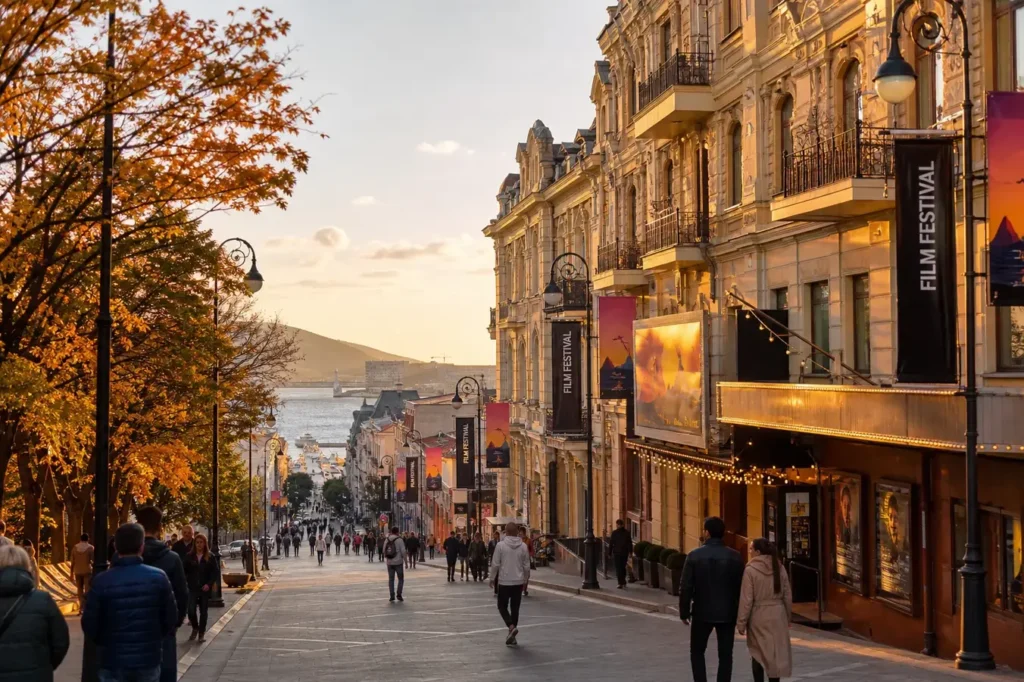
The Pacific Meridian Film Festival is the largest showcase of Asian-Pacific cinema in Russia. Established in 2003, this annual event transforms Vladivostok into a gathering place for filmmakers, critics, and cinema enthusiasts from around the world each early autumn.
The festival screens approximately 200 films across multiple venues, from feature competitions to documentaries, shorts, animations, and retrospectives. It attracts international guests, industry professionals, and local audiences, making it a major cultural event in Russia’s Far East. For visitors interested in contemporary cinema or looking to explore Vladivostok during its liveliest cultural season, the festival offers a window into cutting-edge filmmaking across the Pacific Rim.
Quick Facts
| Russian name | Международный кинофестиваль стран Азиатско-Тихоокеанского региона «Меридианы Тихого» |
|---|---|
| Type | Recurring event |
| When | Every year in early September |
| Typical duration | 7 days |
| Address | 49 Svetlanskaya Street, Vladivostok 690091 OpenStreetMap · Google Maps |
| District | Vladivostok |
| Best time to visit | Early September, during the festival week itself. The city experiences crisp autumn weather with comfortable daytime temperatures and clear evenings ideal for evening screenings. September offers fewer crowds than peak summer tourism season while delivering the festival's full programming, international atmosphere, and cultural energy. Plan to arrive several days before festival opening to explore Vladivostok and acclimate. |
| Website | pacificmeridianfest.ru |
Dates, programs and prices change from year to year. Always check the official website for the current edition.
Why Visit Pacific Meridian Film Festival, Vladivostok?
The Pacific Meridian offers a unique perspective on contemporary cinema you won’t see at Western film festivals. Its focus on Asian-Pacific filmmaking—from established directors to emerging talent through the Screentest program for first-time filmmakers—provides access to stories and voices often underrepresented elsewhere.
The festival brings acclaimed films from countries across Southeast Asia, North and South America, and the Pacific region. Beyond screenings, it hosts master classes, workshops, and meetings between international filmmakers and audiences. Attending during the festival transforms Vladivostok into a vibrant cultural hub, offering a rarer experience than typical tourist seasons while introducing you to a significant film festival that operates independently of the major European and American circuits.
What to Expect at Pacific Meridian Film Festival, Vladivostok
The festival unfolds across multiple venues throughout Vladivostok, with screenings from morning to late evening. Screenings take place at dedicated cinema venues, creating a festival atmosphere across the city center. The opening and closing ceremonies draw significant crowds, and major competition films command full houses.
Each day brings new programmes: international competition films, panorama selections showcasing the year’s best cinema worldwide, dedicated Russian film programs, documentaries, and animated works. Master classes and seminars bring directors and producers into conversation with audiences. The festival culminates in award ceremonies honouring the best films, including the annual Yul Brynner Award for promising young acting talent—a tribute to the actor who was born in Vladivostok.
Highlights of Pacific Meridian Film Festival, Vladivostok
Main Competition Programme
The core event features feature-length films and shorts from Asian-Pacific countries competing for festival awards. Films are judged by an international jury, and the competition represents the festival's founding mission to champion cinema from the region. This is where critically acclaimed and world-premiere films receive their debut screenings, often going on to recognition at other major festivals.
Tip: Competition films draw large audiences; book tickets in advance for popular screenings, particularly opening and closing selections.
Panorama Programme
This non-competition section presents outstanding films and filmmakers from major international festivals worldwide, including works from Cannes, Berlin, and Busan that may not have premiered in Russia. The Panorama reflects the festival's commitment to showing contemporary world cinema at its highest level, offering context for how Asian-Pacific films sit within global cinema.
Tip: Panorama screenings are less crowded than competition films but equally rewarding; check the daily schedule for selections that interest you.
Russian Cinema Programme
A dedicated section showcasing contemporary Russian films, many making their Far East premieres. This programme highlights Russian filmmakers and the state of national cinema to both local and international audiences, emphasizing cultural exchange and dialogue between Russian and Asian-Pacific cinema.
Tip: These screenings often include filmmakers present for Q&A sessions; look for announcements of director appearances.
Screentest Programme
Running since 2006, this programme is specifically designed for first-time filmmakers and emerging voices. It provides a platform for directorial debuts, shorts, and experimental work that might not fit traditional competition categories. The programme has become a talent incubator within the festival structure.
Tip: Screentest films offer discoveries and fresh perspectives; these screenings are often quieter than major competition slots, creating a more intimate viewing experience.
Documentary and Animation Sections
The festival allocates significant space to documentary and animated works across multiple programmes. These reflect both regional and international filmmaking in these genres, with particular emphasis on Asian-Pacific storytellers. Documentaries often explore cultural, environmental, and social themes across the region.
Tip: Documentary and animation screenings typically run throughout the festival day; check venue schedules for dedicated time blocks.
Master Classes and Seminars
International filmmakers, directors, producers, and critics conduct workshops and seminars throughout the festival. These sessions provide professional development opportunities and allow audiences direct access to working cinematographers and industry figures, creating dialogue between creators and cinema enthusiasts.
Tip: Master class seating fills quickly; arrive early or check registration requirements in advance through the festival website.
Opening and Closing Ceremonies
The festival opens with a ceremonial screening of a major film, typically in the largest venue, attracting audiences from across Vladivostok and the region. The closing ceremony presents awards and often includes performances or special presentations. These events set the festival's tone and cultural significance.
Tip: Opening ceremony tickets are highly sought; purchase them as soon as sales open online through the official site.
Yul Brynner Award
Each year the festival presents the Yul Brynner Award for the most promising young actor or actress, honouring the legendary actor who was born in Vladivostok in 1920. The award is formally presented at a ceremony during the festival and carries prestige within the industry.
Tip: The Yul Brynner award ceremony is a festival highlight; check the schedule to know when this moment occurs.
What It Means for Your Visit
During the Pacific Meridian festival week in early September, Vladivostok experiences significant cultural activation. Multiple cinema venues across the city operate extended hours, with screenings typically running from 10 a.m. to 11 p.m. This concentration of programming transforms entertainment patterns—cinemas become the focal point of evening activity, and daytime slots fill with seminars and master classes.
Hotels and restaurants see increased bookings as filmmakers, critics, industry delegates, and festival attendees from other Russian regions converge on the city. Transport remains normal; the festival does not trigger road closures or major traffic disruptions. Cultural venues beyond cinemas may host peripheral events or exhibitions related to the festival.
For visitors attending the festival, plan accommodation well in advance—September occupies a shoulder season when rooms fill more than in winter but availability is tighter than summer. The festival atmosphere attracts cinema enthusiasts and cultural tourists alongside regular visitors. Check the official festival website for the current year’s specific dates, venue locations, ticket sales opening, and programme details, as these vary annually.
Atmosphere
The festival creates an electric cultural atmosphere in Vladivostok for one week. Cinephiles, filmmakers, and curious locals fill cinema lobbies between screenings. Conversations about films spill onto streets; international visitors mix with Russian audiences and festival staff wearing credentials. The energy builds through the week, peaking at evening screenings and opening/closing events.
By day, the city feels like a working film festival—venues opening at 10 a.m., screenings running until late evening, master classes and seminars filling midday hours. Evening brings crowds to major screenings; smaller documentaries or early morning slots attract dedicated fans. The atmosphere blends professional seriousness (international juries, competition tension) with genuine enthusiasm (audiences discovering new cinema, volunteers coordinating events). Vladivostok itself feels prouder during festival season, the city’s role as a Pacific gateway emphasized by this annual convergence of Asian and world cinema.
History of Pacific Meridian Film Festival, Vladivostok
Founded in 2003, the Pacific Meridian emerged as a deliberate project to establish Russia’s first film festival dedicated exclusively to Asian-Pacific cinema. The Primorsky Regional Academic Drama Theater (named after Maxim Gorky) served as the original organiser and inspiration, with support from the Government of Primorsky Krai and Russia’s Ministry of Culture. The first edition took place at the Ocean cinema in Vladivostok, a venue choice rooted in the city’s identity as a Pacific port.
This founding reflected Vladivostok’s geopolitical position and cultural identity. After decades as a closed military city during Soviet times, the city was reopening to the world in the early 2000s. Creating a festival focused on the Pacific region—rather than European or American cinema—positioned Vladivostok as a cultural bridge between Russia and Asia. The choice to premiere Asian-Pacific films in the Russian Far East rather than Moscow or Saint Petersburg was deliberate and distinctive.
The festival grew rapidly. By 2016, its 14th edition, it had established itself as a respected international event attracting filmmakers from over 100 countries and screening more than 1,200 submissions annually. The festival screened approximately 2,500 films total by its 17th year, reaching over a million viewers cumulatively. This growth reflected both the festival’s credibility within international film circuits and genuine interest in Asian-Pacific cinema among Russian audiences.
Key programming milestones include the introduction of the Screentest programme in 2006, dedicated to first-time filmmakers and emerging voices. This initiative positioned the Pacific Meridian not merely as a showcase but as a development platform for new talent. The Cinema Train project brought the festival’s spirit beyond Vladivostok, screening films across the region and emphasizing cultural exchange.
Today, the Pacific Meridian holds status as Russia’s most significant cultural event focused on a single geographic region’s cinema. It remains one of only a handful of international festivals with this Asian-Pacific specialization, making it distinctive within the global festival circuit. The festival continues to attract international juries, industry professionals, and audiences numbering over 50,000 annually, screening around 200 films from approximately 60 countries each September.
Tickets and Booking for Pacific Meridian Film Festival, Vladivostok
Festival tickets are sold through the official website pacificmeridianfest.ru and at venue box offices. Ticket sales typically open several months before the festival, with online sales beginning in advance of the September event. Specific films and screening times are announced progressively as the festival approaches; check the official site for the current year’s programme and scheduling.
Entry fees vary by programme section (competition, panorama, documentaries, shorts, special screenings) and venue. Passes for full festival access and single-film tickets are available. Russian citizens and certain concession categories (students, pensioners) may receive different rates. The official festival website lists all current ticket prices, pass options, and terms of sale. Festival attendance is open to the general public; no special registration or accreditation is required for standard ticket purchases.
Get Tickets for Pacific Meridian Film Festival, Vladivostok
How to Get to Pacific Meridian Film Festival, Vladivostok
Vladivostok has no metro system. Most festival venues are located in the city center along or near Svetlanskaya Street, the main north-south thoroughfare. From Vladivostok International Airport (Knevichi), located approximately 40 km from the city center, travel by taxi, ride-hailing app (Yandex Taxi, Uber), or airport shuttle bus to reach central venues; journey time is approximately 50–60 minutes depending on traffic.
From the city center or accommodation, reach festival venues by taxi, bus, or on foot if staying nearby. Major screening venues cluster along Svetlanskaya and adjacent central streets, making the festival accessible on foot within the city core. Local bus and marshrutka (minibus) routes connect the wider city; single journey tickets are inexpensive. A Podorozhnik transport card (purchased at metro-style kiosks or convenience stores) works on all public transport and simplifies multiple journeys.
Accessibility
Check the official festival website and individual venue information for accessibility details, as facilities vary by screening location. Major cinema venues typically offer standard wheelchair access and designated seating; some smaller or alternative venues may have limited accessibility. Contact the festival office in advance for specific venue accessibility information and any required accommodations. The festival team can provide guidance on venue selection based on individual accessibility needs.
Food Nearby
Vladivostok's city center, where festival venues concentrate, has abundant restaurant and cafe options. Restaurants serving Russian, Asian (Korean, Japanese, Chinese), and international cuisine are within walking distance of major screening venues. The waterfront area near the Pacific coast offers cafes and dining with views. Convenience stores and small eateries provide quick meals between screenings. Festival venues may have on-site concessions, though these typically offer limited options; exploring nearby restaurants is more rewarding.
What to Bring
Comfortable walking shoes (the city center has hills and uneven terrain). Early September weather is mild; bring a light jacket for cool evenings. A portable phone charger is useful for navigating between venues and purchasing tickets online. Bring a pen to note film times and recommendations. Russian rubles are essential (most venues do not accept international payment cards; ATMs are available throughout the city center). Download a map or translation app if you do not speak Russian; most festival staff speak limited English.
Best Views and Photo Spots of Pacific Meridian Film Festival, Vladivostok
Svetlanskaya Street, city center
The main pedestrian corridor lined with early 20th-century architecture, restaurants, and cultural institutions. During festival season, this street bustles with crowds moving between venues, creating an atmospheric street scene that captures the festival's energy and Vladivostok's architectural character.
Best time: Evening hours (6–8 p.m.) when venues open and crowds congregate before screenings; golden hour light enhances the historic facades.
Vladivostok waterfront (Nab. Riviera, near Sportivnaya)
The Pacific coastline with views across the bay, Russky Island bridge in the distance, and waterfront promenades. The landscape defines Vladivostok's identity as a Pacific city and provides context for why the festival celebrates Pacific-region cinema.
Best time: Morning light (7–9 a.m.) or late afternoon (5–7 p.m.) for clear views and photographer-friendly light; September offers crisp, clear skies.
Primorsky Regional Academic Drama Theater exterior (Svetlanskaya 49)
The festival's institutional home, a significant cultural building with architectural presence reflecting pre-revolutionary and Soviet-era construction. The theatre entrance often displays festival banners and serves as a focal point during the event.
Best time: Day or evening; festival banners and decorations appear a week before the event begins, creating visual festival markers.
Eagle's Nest viewpoint (Orylinoe Gnezdo, accessible by cable car or hiking)
Panoramic vistas across Vladivostok, the Sea of Japan, and surrounding geography. This viewpoint defines the city's Pacific location and offers perspective on Vladivostok's scale and topography, contextualizing why Pacific-oriented cinema matters culturally.
Best time: Late afternoon or early evening (4–6 p.m.) when light is warm and haze clears; September typically offers clearer skies than other seasons.
Photography Rules
Standard photography and video recording policies apply at festival venues; check individual cinema rules before filming. Commercial or professional recording typically requires special permission from the festival organizer. Tripods and professional photography equipment are generally not permitted in screening venues without prior arrangement. Photography in foyer areas and during outdoor festival events is typically permitted. Respect filmmakers' intellectual property and avoid recording screened films.
Family Suitability
The festival's suitability for families depends on film selection. Competition and panorama programmes include works with adult themes; many documentaries and animations are family-friendly, while others address mature subjects. Screentest and shorts programmes may include age-appropriate content, but individual films require pre-screening consultation. Children under 12 are welcome at most venues but should not attend screenings with parental guidance restrictions. Master classes and seminars may appeal to older children and teenagers interested in filmmaking. Check individual film ratings and descriptions on the festival website before booking tickets for family viewing.
Russia Vibes Tips
- The festival's detailed programme is released progressively; bookmark the official website and check back multiple times before September to see complete scheduling, film descriptions, and ratings. This helps you plan which screenings to prioritize and when to purchase tickets.
- Buy tickets for major competition screenings and opening/closing ceremonies as soon as online sales open; these events fill completely and sell out before festival week begins. Single-film tickets for lesser-known or documentary screenings are often available on the day of screening.
- Arrive in Vladivostok 2–3 days before festival opening to explore the city, find venues, and adjust to local time and rhythm. This makes navigating festival logistics during the busy week less stressful and gives you time to discover restaurants and facilities in advance.
- Attend at least one master class or seminar in addition to films. These provide rare direct access to international filmmakers and offer insights into the filmmaking process that enhance appreciation of what you see on screen.
- Do not assume that festival venues are obvious or well-signed; print or download a map showing screening locations beforehand and note opening times. Vladivostok's topography and street layout can be disorienting for first-time visitors, particularly when navigating between distant venues.
- Carry cash (Russian rubles) at all times. While ATMs are plentiful in the city center, some smaller venues and the cinema box offices may not accept international credit cards. This prevents delays when purchasing tickets on-site.
Explore Nearby Pacific Meridian Film Festival, Vladivostok
Related guides
 Primorsky Monsoon Festival: Vladivostok’s Waterfront Cultural Celebration
Main image: AI-generated illustration. It may not show the place exactly as it looks.
 Peter the Great Gulf Cup: Russia’s Premier Offshore Sailing Regatta
Main image: AI-generated illustration. It may not show the place exactly as it looks.
 International King Crab Festival, Vladivostok: Fresh Crab and Harvest Celebration
Main image: AI-generated illustration. It may not show the place exactly as it looks.
 Eastern Economic Forum: Vladivostok’s International Business Summit
Main image: AI-generated illustration. It may not show the place exactly as it looks.
 Tiger Day, Vladivostok: Celebrate the Endangered Amur Tiger
Main image: AI-generated illustration. It may not show the place exactly as it looks.
Browse more: More in Vladivostok · All Entertainment · All Events & Holidays · All Events & Holidays in Vladivostok · All Vladivostok
FAQ: Pacific Meridian Film Festival, Vladivostok
When does the Pacific Meridian Film Festival take place?
The festival is held annually in early September, typically running for one week (usually 6–7 days). Check the official website for the exact dates of the current year's edition, as the specific start and end dates vary slightly annually.
What films are screened at the festival?
The festival screens approximately 200 films across multiple programmes: international competition films from Asian-Pacific countries, a panorama of world cinema from major festivals, Russian cinema, documentaries, animations, shorts, and retrospectives. Most films are subtitled or in their original language; some Russian films may have international subtitles.
Do I need to speak Russian to attend?
English is helpful but not essential. Many festival staff speak some English, particularly at the main office and larger venues. Festival materials are available in English on the website. Most screened films have Russian or English subtitles. Download a translation app for reference, and do not hesitate to ask for help; the festival is accustomed to international visitors.
How far in advance should I book tickets?
For major competition screenings, opening, and closing ceremonies, purchase tickets at least several weeks in advance. Single-film tickets for less-publicized documentaries, shorts, or afternoon screenings are often available closer to the festival or on the day. Check the website for ticket availability by date and film.
Are there free screenings at the festival?
Most screenings require a ticket purchase. Some outdoor events, seminars, or special public screenings may occasionally be free; check the festival programme for details. The official website lists which events require payment and which are open access.
Can I attend the festival without having seen previous editions or knowing much about Asian-Pacific cinema?
Yes, absolutely. The festival welcomes all cinema enthusiasts regardless of prior experience. Programme curators intentionally select films from across genres, styles, and difficulty levels. Festival materials provide context for films and filmmakers. Attending seminars and master classes enhances understanding for newcomers. The festival is designed to introduce audiences to Asian-Pacific cinema, not assume existing expertise.
What is the Yul Brynner Award?
The Yul Brynner Award is presented annually to the most promising young actor or actress in films screened at the festival. The award honours the legendary actor who was born in Vladivostok in 1920. The award ceremony is a festival highlight, and the winning performance often attracts international recognition.
Will I be able to find accommodation in Vladivostok during the festival?
Accommodation fills during festival week; book your hotel, hostel, or Airbnb at least 2–3 months in advance. September is a shoulder season with moderate demand, so options exist, but popular mid-range and budget properties book quickly. The festival website may list official partner hotels; check there first for convenience and potential discounts.
Russia Vibes is a one-person project. A coffee keeps it going
How we research and update our guides
About this guide: AI assistance and accuracy
This guide is created with the help of AI and is based on official sources where available. Mistakes can still happen. Opening hours, prices, rules and other details are given to the best of our knowledge as of the date shown and can change without notice. It offers general recommendations only, not professional, legal or travel advice. Please confirm important details with the official source before you travel; you are responsible for your own plans and decisions.

Take this guide with you
Get a free PDF of this guide to print or read offline: key facts, tips and a map link on a few clean pages.
Report an issue on this page
Paying for your trip: please read
International sanctions affect payments between Russia and many other countries. In practice, cards issued in the EU, the UK, the US and several other countries often do not work in Russia, Russian cards usually do not work abroad, and some booking platforms, airlines and payment providers limit or suspend their services for Russia. The situation changes frequently.
We do not give legal or financial advice, and this site does not encourage anyone to break or circumvent sanctions. Whatever you plan, you are responsible for following the laws and regulations that apply to you, including those of your country of residence and citizenship.
Many travelers still organise their stay lawfully. It is worth asking your bank or payment provider what is currently permitted, contacting hotels, tour operators and carriers directly about the payment methods they accept, and checking which services are open to customers from your country. Clarify payment, cancellation and refund terms before you commit to a booking, and keep your plans flexible.
Partner links on this site may not be available in every country, and prices, availability and rules in our guides can differ from what you see when you book.