
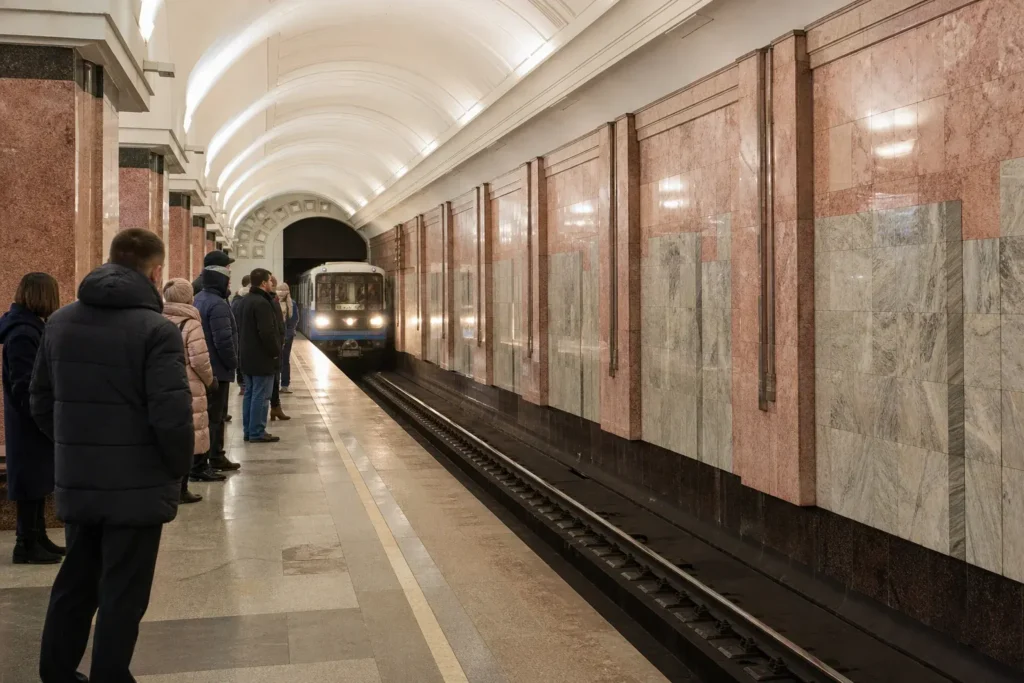
Yekaterinburg offers a straightforward public transport network for visitors—useful to know if you plan to move beyond the central walking zone or want to reach the airport, train station, or outlying attractions. This guide covers how to use public transport in Yekaterinburg, from the metro through surface transport.
The metro is the fastest option for north–south travel, while trams cover the wider city. Both accept contactless cards or cash. Most visitors can master the system in a single journey.
Quick answer: Buy an EKARTA card or use a contactless bank card at ticket machines. Tap to enter the metro or board a tram. Single journeys cost a flat rate regardless of distance. The system runs from 06:00 to midnight daily.
At a Glance
| Total time | 5–10 minutes on the metro; 15–30 minutes on surface transport depending on route |
|---|---|
| Typical cost | ₽ |
What You Need Before You Start
- EKARTA card (from station ticket offices or top-up points) or contactless bank card
- Cash if paying conductors on trams or buses
- Yandex Transport or 2GIS app for route planning
- Luggage: small bags are allowed; large luggage may incur questions
- Russian or English language basics (staff speak limited English)
Compare Your Options
| Option | Duration | Price | Notes |
|---|---|---|---|
| Metro (recommended for most visitors) | 5–10 minutes per journey | ₽ | Single line, 9 stations, runs 06:00–midnight. Fast and direct. Does not reach airport directly but stops at Botanicheskaya; bus 01 from there serves Koltsovo Airport. |
| Tram network | 15–40 minutes depending on distance | ₽ | 29 lines cover most of the city. Most extensive network. Slower than metro but reaches neighbourhoods the metro does not. Buses and trolleybuses operate alongside trams. |
| Bus from airport | 40–60 minutes to city centre | ₽ | Buses 1 or 01 connect Koltsovo Airport to Uralskaya (railway station) and city centre. Bus 01 continues south; metro or trams needed for final leg to many hotels. |
| Marshrutka (minibus) | 15–45 minutes depending on route | ₽ | Privately operated shared vans. Frequent and cover outskirts. Less predictable than trams or metro. Cash only. Less reliable route adherence than official transport. |
| Sightseeing tram | 60–90 minutes | ₽₽ | Special heritage tram with commentary on city history and landmarks. Operates around city centre. More expensive than regular tram. Useful for an introductory tour if you prefer not to navigate independently. |
| Taxi or ride-app | 10–30 minutes depending on distance | ₽₽ | Available but not necessary in central areas. Russian apps (Yandex Taxi) more reliable than Western apps. Meter-based or app-quoted. No significant time advantage in traffic. |
₽ budget · ₽₽ moderate · ₽₽₽ upscale · ₽₽₽₽ splurge. Price levels are estimates compared with typical prices for visitors.
Step-by-Step Instructions
Step 1: Choose your payment method
At any metro station or designated top-up point, purchase an EKARTA card (rechargeable transport card) or use a contactless NFC bank card if yours supports it. EKARTA works on metro, tram, bus and trolleybus. If you have cash, you can pay conductors on trams and buses directly, but keep your receipt to show inspectors. Do not assume a card will work; verify it beforehand.
Tip: EKARTA is most practical for stays longer than 2–3 days. Single-ride tickets from machines are also available at metro stations.
Step 2: Plan your route using the metro or surface transport
Open Yandex Transport or 2GIS app and enter your start and destination. The app shows which metro station, tram or bus to use. The metro runs north–south on a single line with 9 stations. Trams cover wider areas with 29 lines. The metro is fastest for long distances; trams are useful for shorter hops and exploring neighborhoods.
Tip: Metro stations are colour-coded and signed in Cyrillic; learn the name of your destination in Russian (written on your hotel card or app) so you can recognize the stop.
Step 3: Enter the metro station
Look for the distinctive 'M' sign with a red diamond. Descend to the ticket level (escalators available at most stations). Queue at the machine or ticket office. Tap your card or bank card on the validator, or insert cash into the machine. Listen for the beep and green light confirming entry. Push through the turnstile.
Tip: Station names are announced in Russian at each stop. Follow other passengers if unsure. Do not rush the escalators; stand on the right, walk on the left (local custom).
Step 4: Board the train
Wait on the platform until the train arrives. Doors open and close quickly (usually 20–30 seconds). Step aboard, hold the overhead rail or pole. Trains run every 4–5 minutes during rush hour (07:00–09:00, 17:00–19:00) and every 6–8 minutes at other times. The line runs from Prospekt Kosmonavtov in the north to Botanicheskaya in the south.
Tip: Crowds peak 07:00–09:00 and 17:00–19:00. If you see crowds, wait for the next train.
Step 5: Exit the metro at your stop
When your destination station is announced, move towards the doors before they open. Step onto the platform. Follow signs to the exit ('Выход'). Some stations have multiple exits serving different parts of the city; check the station map or app before exiting. Exit via stairs or escalator.
Tip: Uralskaya is adjacent to the railway station and Northern Bus Station. Chkalovskaya connects to the Southern Bus Station. Geologicheskaya is near the Circus (central landmark).
Step 6: Use trams for surface travel
Wait at a tram stop marked with a red T or lamp post sign. Board from the front or middle doors. If paying cash, the conductor (usually an older woman in a coloured vest) will board shortly after departure. Say the number of rides or show your card. Keep your ticket or receipt; inspectors check randomly. Tap EKARTA cards on the validator. Alight by pulling the cord or pressing a button near the doors.
Tip: Conductors do not speak English; have your destination written down or tap your card without speaking. Do not validate twice on the same tram.
Step 7: Understand bus and trolleybus boarding
Buses and trolleybuses (electric buses running on overhead wires) follow the same system as trams: board, pay the conductor in cash or tap your card, keep the receipt if paying cash. The conductor sits in a small booth inside the vehicle. Trolleybuses are quieter and emit no exhaust, making them pleasant for short journeys. Marshrutkas (minibuses) accept cash only and are common for reaching outlying areas.
Tip: Avoid buses and trams during rush hour (07:00–09:00, 17:00–19:00) if possible; they become extremely crowded and pickpocketing has been reported.
Common Mistakes to Avoid
- Assuming a Western bank card (Visa, Mastercard) will work. Since 2022, these cards do not function in Russia. A contactless MIR card or EKARTA card is needed. Check before arrival if your Russian bank offers a card or purchase EKARTA on arrival.
- Not keeping the ticket receipt when paying cash to a conductor. Ticket inspectors board randomly and fine passengers without valid receipts. The conductor will hand you a receipt or validate your card; keep visible proof.
- Boarding during rush hour (07:00–09:00, 17:00–19:00). Trams and buses become dangerously crowded and pickpocketing increases. Wait for a quieter service if possible.
- Confusing the metro's single line as less useful than it is. The line runs north–south through most major attractions (railway station, central square, circus). Plan surface transport before or after the metro, not instead of it.
- Assuming all stops have signs in English. Most metro stations display names only in Russian. Use your app to confirm your stop by listening for station announcements (in Russian) or counting stops.
- Using marshrutkas for long distances without knowing the route. Minibuses do not always announce stops. Ask other passengers in Russian or have your destination written down to show the driver.
Tickets, Payment and Booking
EKARTA Card (recommended for most visitors): Purchase at metro ticket offices, designated top-up kiosks throughout the city, or the EKARTA app. Top up as needed. Works on metro, tram, bus, trolleybus and some marshrutkas. Most practical for stays of 3 days or longer.
Single-ride tickets: Buy from automated ticket machines at metro stations or directly from conductors on trams and buses. Machines accept cards and cash. Conductors on surface transport accept exact cash; give them the number of tickets needed.
Contactless bank cards: Cards with NFC (Visa PayWave, Mastercard Contactless, or Russian MIR) work at metro validators and on surface transport tap machines. Verify your card is enabled before boarding. Foreign cards (Visa, Mastercard issued outside Russia) do not work as of 2022; MIR cards do work.
Payment methods: EKARTA card (cashless, reloadable), contactless bank card (NFC-enabled), cash (conductors, some machines), QR ticket (for metro). Do not purchase tickets from unofficial sellers; use only official machines or conductors.
Russia Vibes Tips
- Download the Yandex Transport app offline. Metro stations lack reliable mobile signal below ground. Plan your full journey before descending to the platform.
- The metro station Uralskaya is adjacent to the railway station (look for the 'Zh.D. Vokzal' stop outside). If arriving by train, take the metro from there to reach central attractions like the Circus or 1905 Square.
- Chkalovskaya station (opened 2012) is the deepest and newest metro station, decorated distinctively. It connects to the Southern Bus Station. The oldest stations (Prospekt Kosmonavtov, Uralmash) are less crowded but serve residential areas.
- Contactless payment validators on trams sometimes malfunction. If your card is rejected, ask the conductor to process cash instead. Carry at least some cash as backup.
- The metro closes at midnight. Plan evening outings to end by 23:30. Taxis and marshrutkas operate after midnight if needed.
- Winter (November–March) can make waiting at outdoor tram stops uncomfortable in severe cold. Use trams and buses for short hops; the metro is warmer for longer journeys.
Explore Nearby Use public transport in Yekaterinburg
Browse more: All How-To · All How-To in Yekaterinburg · All Metro and Trains · All Yekaterinburg
FAQ
Does the metro reach the airport?
No. Botanicheskaya is the closest metro station, serving the southern edge of the city. From there, take bus 01 to Koltsovo Airport (40–60 minutes). Alternatively, bus 01 runs directly from the airport to Uralskaya (railway station). The airport is 30 km away.
Can I use my credit card from home?
Western Visa and Mastercard have not worked in Russia since 2022. Only MIR cards (Russian bank cards) work contactless at validators. If your card is not MIR or NFC-enabled, buy an EKARTA card upon arrival or pay cash to conductors.
How much does a single metro ride cost?
One ride costs a flat rate (₽) regardless of distance or number of stations. Trams, buses, trolleybuses and minibuses charge the same. Multi-day and monthly passes are available on the EKARTA card.
What time does the metro close?
The metro runs from 06:00 to midnight (00:00) daily. Trams and buses run longer but less frequently after 23:00. Marshrutkas and taxis operate 24 hours.
Do I need to validate my EKARTA card or contactless card every time?
Yes. Tap or insert your card on the validator at the metro entrance/exit and on surface transport. Failure to tap results in a fine if an inspector checks. Conductors will validate cards for you if you pass them aboard.
Is cash accepted everywhere?
Conductors on trams and buses accept cash; metro machines accept both cards and cash. Marshrutkas accept cash only. Exact change helps but change is given. For the metro, cash-fed machines are available at most stations.
Are trams and buses dangerous or heavily pickpocketed?
Generally safe but crowded during rush hours (07:00–09:00, 17:00–19:00). Pickpocketing has been reported on crowded vehicles. Keep bags zipped, phone secured, and avoid standing near doors. Avoid peak hours if possible. The metro is less problematic.
Can I travel with luggage?
Small day bags and backpacks are standard. Suitcases may attract attention on trams but are not forbidden. Oversized luggage (such as arriving with large cases) is best left at your hotel or transferred by taxi. Station staff may ask about very large items.
Russia Vibes is a one-person project. A coffee keeps it going
How we research and update our guides
About this guide: AI assistance and accuracy
This guide is created with the help of AI and is based on official sources where available. Mistakes can still happen. Opening hours, prices, rules and other details are given to the best of our knowledge as of the date shown and can change without notice. It offers general recommendations only, not professional, legal or travel advice. Please confirm important details with the official source before you travel; you are responsible for your own plans and decisions.

Take this guide with you
Get a free PDF of this guide to print or read offline: key facts, tips and a map link on a few clean pages.
Report an issue on this page
Paying for your trip: please read
International sanctions affect payments between Russia and many other countries. In practice, cards issued in the EU, the UK, the US and several other countries often do not work in Russia, Russian cards usually do not work abroad, and some booking platforms, airlines and payment providers limit or suspend their services for Russia. The situation changes frequently.
We do not give legal or financial advice, and this site does not encourage anyone to break or circumvent sanctions. Whatever you plan, you are responsible for following the laws and regulations that apply to you, including those of your country of residence and citizenship.
Many travelers still organise their stay lawfully. It is worth asking your bank or payment provider what is currently permitted, contacting hotels, tour operators and carriers directly about the payment methods they accept, and checking which services are open to customers from your country. Clarify payment, cancellation and refund terms before you commit to a booking, and keep your plans flexible.
Partner links on this site may not be available in every country, and prices, availability and rules in our guides can differ from what you see when you book.