
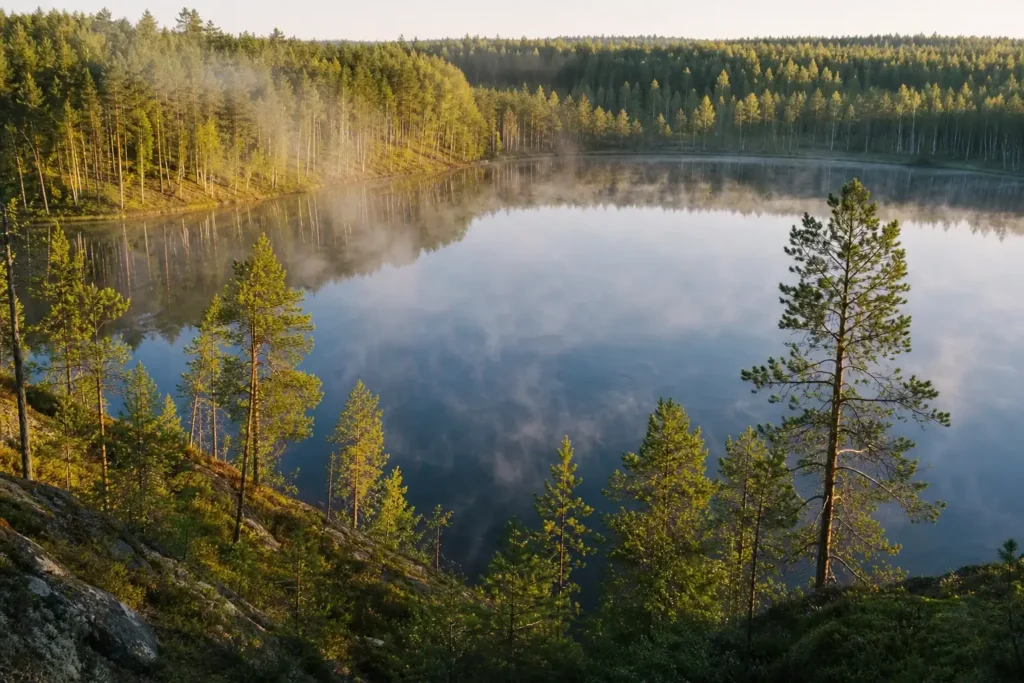
Lake Svetloyar lies in the remote forests of Voskresensky District, 130 kilometres north of Nizhny Novgorod. This small but extraordinarily deep lake—at 33.4 metres, one of the deepest in the region—sits in a near-perfect oval basin, its water crystalline and cool year-round.
The lake is inseparable from the legend of Kitezh, a mythical medieval city that supposedly vanished beneath its waters to escape Mongol invaders in the 13th century. Whether you come to contemplate folklore or simply walk the forested shore, Svetloyar rewards the journey with the rare sense of a place that feels genuinely removed from the modern world.
Quick Facts
| Russian name | Озеро Светлоя́р |
|---|---|
| Distance from the nearest major city | approximately 500 km |
| Travel time from the nearest major city | 8–10 hours by car; 6–7 hours by train to Nizhny Novgorod, then 3–4 hours by car |
| Address | Vladimirskoe village, Voskresensky District, Nizhny Novgorod Oblast OpenStreetMap · Google Maps |
| Admission | free |
| Best time to visit | Late spring (May to early June) and early autumn (September to early October) offer the best combination of comfortable weather, fewer insects, and clear light. In late May, birch trees are in fresh leaf and the forest smells of new growth. Days are long; sunset is after 21:00.Summer (July to August) is warm and draws the most pilgrims, especially around Orthodox festivals in July. Daylight persists until 22:00. However, mosquitoes are abundant near wetland margins; bring strong insect repellent. Tourist numbers remain modest.Winter (November to March) is stark and beautiful but challenging. The lake freezes solid; ice depths vary. Travel is slow due to snow; roads are rough. The forest is silent and grey. Temperature drops to −10°C or lower. Winter visits require experience and proper preparation.Autumn colours are vivid from September through mid-October. Rainfall increases from late autumn; paths become muddy. |
| Recommended duration | 3–4 hours |
What Is (and Isn't) Part of a Visit to Lake Svetloyar, Nizhny Novgorod?
| Part | Status | Notes |
|---|---|---|
| Lake Svetloyar—water, shoreline, forest | Included in the standard ticket | Free access to the shore and walking paths around the lake within Voskresenskoe Povetluzhye Nature Park. |
| Chapel of Our Lady of Kazan | Included in the standard ticket | Small Orthodox chapel near the lake; open to visitors. No entry fee. Respect as sacred space. |
| Stone with Virgin's Footprint | Included in the standard ticket | Located near the chapel; accessible during daylight. Part of informal pilgrimage route. |
| Holy Spring of Kibelek | Included in the standard ticket | Approximately 2 km from the lake across forest terrain. No marked trail; ask locals for directions. Spring water is free. |
| Grave of Three Saints | Included in the standard ticket | Approximately 2 km from the lake. Part of extended pilgrimage route. Respectful visitation only. |
| Voskresenskoe Povetluzhye Nature Park museum or visitor centre | Not open to visitors | No staffed visitor facilities exist at the lake. Park administration is in distant Voskresenskoye (50+ km). |
| Svyatogor Hotel (accommodation near lake) | Separate ticket or institution | Not part of the lake site itself; run independently in Vladimirskoe village. Offers overnight lodging and meals if staying longer than a day trip. |
| Museum of Epochs, Voskresenskoye | Outside / not part of it | Located in Voskresenskoye village, 50+ km south. Separate site with regional history exhibits. Not walkable from the lake. |
How to Get from the nearest major city to Lake Svetloyar, Nizhny Novgorod
| Option | Duration | Price | Notes |
|---|---|---|---|
| Private car from Nizhny Novgorod | 3–4 hours each way (270 km round trip) | ₽₽ | Most flexible and direct option. Drive north from Nizhny Novgorod towards Voskresensky District. Last petrol stations are in Voskresenskoye; fuel up before the final 30 km to Vladimirskoe. Road is paved but narrow in places; poor conditions in winter. Parking at village. |
| Organised tour from Nizhny Novgorod | 8–10 hours including transport | ₽₽ | Travel agencies offer day excursions with guide, typically departing early morning from central Nizhny Novgorod. Includes transport, guide commentary, and sometimes a stop at a nearby village or natural spring. No advance booking usually required, but book at least one day ahead during summer. |
| Minibus or marshrutka from Nizhny Novgorod | 4–5 hours each way | ₽ | Shared minibuses run sporadically from Nizhny Novgorod to Voskresenskoye. Journey requires transfer in Voskresenskoye to a local taxi or local minibus to Vladimirskoe (additional 30 km). Schedules are irregular; enquire at central station the evening before. Not reliable for same-day returns. |
₽ budget · ₽₽ moderate · ₽₽₽ upscale · ₽₽₽₽ splurge. Price levels are estimates compared with typical prices for visitors.
Why Visit Lake Svetloyar, Nizhny Novgorod?
Svetloyar draws pilgrims, historians and nature seekers drawn to its layered mysteries. The geological puzzle—scientists still debate whether it was formed by meteorite impact, ancient glaciers or karst collapse—makes it a destination for the curious. But the real draw is atmosphere: the cold, transparent water; the birch and pine forest descending to the shore; and the pervasive sense that you are standing above a story. Summer day-trippers from Nizhny Novgorod come to walk the water’s edge and feel something inexplicable.
Highlights of Lake Svetloyar, Nizhny Novgorod
The Lake Itself
An oval body of water measuring 470 by 350 metres, with depths reaching 33.4 metres in the south. The water remains unusually transparent and cold—fed by underground springs—and maintains exceptional clarity even in summer. The southern shoreline is characterised by elevated banks and steep ravines (7–8 metres deep) rising behind the water's edge. Look for the gently sloping northern shore as a walking approach.
Tip: Wade or swim only in designated areas; the bottom deepens sharply and water temperatures remain cold even in July.
Chapel of Our Lady of Kazan
A small Orthodox chapel stands near the lake, built to honour the spiritual significance of the place. It serves pilgrims and visitors seeking quiet prayer and reflection. The chapel marks a focal point for the Orthodox pilgrimage tradition that has endured since the 19th century.
Tip: Respect the sacred space; remove hats and speak softly. Photography inside is usually restricted.
Birch and Pine Shoreline
The lake is encircled by dense conifer forest—predominantly pine and birch—which creates a temperate microclimate and frames the water's edge. The forest creates natural viewing points and shaded walking paths where locals and pilgrims traditionally walk the perimeter. The Batu Trail, an informal pilgrim path, traces a route around the water.
Tip: Wear insect repellent in summer; the forest shelters mosquitoes near boggy margins. Best visited in late spring or early autumn when insects are fewer and the light is clearest.
Stone with Virgin's Footprint
Near the chapel, a stone bearing what locals interpret as a footprint—resembling a child's impression—sits as a votive point. Pilgrims and believers touch or leave offerings as an act of devotion. Whether genuine or naturally formed, the stone anchors oral tradition and folklore that defines Svetloyar's spiritual identity.
Tip: Ask local guides or pilgrims for precise location; the stone's position can shift slightly with seasons and foot traffic.
Voskresenskoe Povetluzhye Nature Park
The lake sits within this protected natural park, established in 2008 and covering the surrounding forest and river valleys. The park preserves the ecological integrity of the area, with strict rules: no tents, no fires, no tree-felling, no litter, no fishing. It is a legal monument of federal natural significance, reflecting its scientific and cultural importance.
Tip: Bring all supplies—water, food, sunscreen—from Nizhny Novgorod; no facilities exist at the lake itself.
Holy Spring of Kibelek
Two kilometres from the lake, across forested terrain, pilgrims visit a natural spring considered holy. The spring feeds a small stream; locals and believers collect water for drinking and bathing, attributing healing or purifying properties to it. The walk to the spring is part of the traditional pilgrimage circuit.
Tip: The trail is unmarked; go with a local guide or ask at Vladimirskoe village for directions. Wear sturdy footwear and bring water.
Burial of Three Saints
Also two kilometres away, a grave site honours three defenders of Kitezh, identified in tradition as saints who fell during the city's mythical destruction. The site acts as a waypoint on the pilgrimage route and remains a place where local believers leave flowers and candles.
Tip: Visit respectfully; leave no litter and observe any Orthodox customs you witness.
Atmosphere
The lake has a solemn, meditative quality, especially in early morning or late afternoon when mist sometimes rises from the water. In summer, the place is quiet even on weekends—a rarity so close to Russia’s major cities. The water’s chill, the forest’s quiet, and the almost ceremonial silence of pilgrims walking the shore create an air of reverence without cheerfulness.
The light changes dramatically with season. In spring and autumn, slanting rays through the birch trunks create a dreamlike quality. Winter brings stark beauty—ice locks the lake solid, and the forest becomes a stark monochrome. Summer attracts more visitors, but never crowds; families come for the walking, pilgrims for prayer, photographers for the elusive play of light.
History of Lake Svetloyar, Nizhny Novgorod
The geological history of Svetloyar remains hotly debated. Scientific field studies conducted in 2009 lent weight to the meteorite-impact hypothesis—that the lake basin formed roughly 3,000 years ago from a cosmic collision. Other theories invoke glacial action, karst collapse (dissolution of underground limestone), or neotectonic activity. The unusual depth (33.4 metres relative to surrounding terrain), the perfect oval shape, and the persistent clarity of the water all feed speculation.
The legendary history, by contrast, is firmly rooted in folklore and Orthodox Christian mysticism. The Legend of Kitezh first appears in written form in the late 18th century, in an anonymous text called the Kitezh Chronicle, believed to have originated among the Old Believers—a sect of Russian Orthodox Christians who rejected 17th-century church reforms. The legend distinguishes between two cities: Maly Kitezh (Little Kitezh, identified with the real medieval town now called Krasny Kholm), and Bolshoy Kitezh (Big Kitezh), the mythical grand city said to lie hidden beneath Svetloyar’s waters.
According to the legend, Grand Duke Georgy Vsevolodovich of Vladimir built Kitezh-Grad in the early 13th century on the Lyunda River, as a spiritual centre with white-stone churches and golden domes. In 1238, when Mongol forces led by Batu Khan invaded northeastern Russia and approached the city, the inhabitants prayed for divine salvation. The city, the legend says, was miraculously submerged beneath the earth and water, transforming into a lake while the water rose slowly before the invaders’ eyes. Only a gleaming cathedral dome with a cross vanished last into the depths.
From the 19th century onwards, Svetloyar became a pilgrimage site for Orthodox believers and spiritual seekers. The tradition intensified during the Soviet era when official atheism drove believers to sacred landscapes. Since the 1990s, pilgrimage has revived openly. The lake was formally recognised as a cultural heritage object of local significance in 2015.
Tickets and Booking for Lake Svetloyar, Nizhny Novgorod
Entry is free. Lake Svetloyar lies within a protected nature park; no tickets or permits are required for day visits to the shore. The site operates year-round and is accessible during daylight hours. No booking or reservation system exists for the lake itself.
Visitors are expected to respect nature park rules: no tents, no fires, no tree-cutting, no litter, no fishing. Swimming is permitted in designated areas (ask locals or guides). Respect the chapel and sacred sites as you would any place of worship.
For organised tours with a guide, book through travel agencies in central Nizhny Novgorod (generally one day in advance). Prices typically range from budget to moderate for a full-day excursion. Bring all supplies (food, water, sunscreen, insect repellent) from Nizhny Novgorod; no shops or facilities exist at the lake.
Plan and Book
Suggested itineraries Lake Svetloyar, Nizhny Novgorod
Half day (4 hours at the lake)
Depart Nizhny Novgorod early morning by car or tour bus. Arrive Vladimirskoe around midday. Walk the northern (shallower, easier) shore for 1–1.5 hours to scout the lake and reach the Chapel of Our Lady of Kazan. Rest and have a packed lunch on a shaded bank. Visit the stone with the Virgin's Footprint. Depart by mid-afternoon; return to Nizhny Novgorod by early evening.
Full day (6–7 hours at the lake)
Early departure from Nizhny Novgorod. Walk the entire perimeter on the informal Batu Trail (approximately 1.5–2 km, 1.5–2 hours). Visit the Chapel and stone shrine. Picnic on the southern elevated banks with views of the northern shore. In the afternoon, hire a local guide or taxi to reach the Holy Spring of Kibelek and the Grave of Three Saints (2 km, 30–45 minutes on foot each way). Return to the lake for sunset reflection. Depart for Nizhny Novgorod.
Overnight or longer
Book accommodation at Svyatogor Hotel in Vladimirskoe the evening before. Spend the first day as a full-day itinerary above. On day two, join a morning pilgrimage walk if visiting during a festival or pilgrimage season. Explore side trails into the surrounding Povetluzhye forest. Return to hotel for evening meal. Day three allows for a second visit to the lake or further exploration of Voskresenskoye District villages and the Museum of Epochs if interested in regional history.
How to Get to Lake Svetloyar, Nizhny Novgorod
From Nizhny Novgorod city (130 km north): There is no public metro or local rail service to the lake. The only practical options are by car, organised tour, or minibus.
- By private car: Head north from Nizhny Novgorod city centre on the A119 highway towards Voskresenskoye. Continue north for approximately 130 km. Stop in Voskresenskoye to refuel (last petrol station before the lake). Turn east towards Vladimirskoe village (approximately 30 km). Park in or near Vladimirskoe and walk to the lake shore (5–10 minutes on foot). Road is paved but narrow; winter conditions can be difficult.
- By organised tour: Depart from central Nizhny Novgorod (hotels or central station). Tours typically last 8–10 hours including all transport and a guide. Book one day in advance at travel agencies or hotel concierge.
- By minibus (marshrutka): Sporadic shared minibuses depart from Nizhny Novgorod’s central stations for Voskresenskoye. Journey takes 4–5 hours. From Voskresenskoye, hire a local taxi or wait for a connecting minibus to Vladimirskoe (30 km, 1–1.5 hours). Return journeys are unpredictable; confirm schedules the evening before.
Accessibility
The lake shore is accessible on foot via relatively easy, mostly flat forest paths. The northern shore has gentle slopes and sandy patches, making approach straightforward. The southern shore features elevated banks and ravines behind the water, creating more dramatic topography.There are no paved walkways, disabled facilities, or wheelchair access. The Chapel of Our Lady of Kazan is a small, open-air structure without barriers; it is accessible to ambulatory visitors on foot. The stone with the Virgin's Footprint sits on open ground near the chapel.The walk to the Holy Spring of Kibelek (2 km) and the Grave of Three Saints involves forest terrain with no marked trail and requires moderate fitness and orientation skills; go with a guide. Visitors with reduced mobility should limit their visit to the lake shore itself and the chapel area.
Food Nearby
No restaurants, cafes or food vendors exist at Lake Svetloyar itself. The nearest village, Vladimirskoe, has basic supplies in small local shops (bread, canned goods, beverages), but selection is limited. Larger shops and cafes are in Voskresenskoye, approximately 50 km south.Bring all food and water from Nizhny Novgorod: packed lunch, snacks, bottled water (at least 2 litres per person). Organised tours often include a simple meal or stop at a roadside cafe during the journey. Svyatogor Hotel in Vladimirskoe serves meals if you stay overnight; book ahead.
What to Bring
Sturdy hiking shoes or waterproof boots (paths are damp in spring and autumn, boggy near the shore in summer). Insect repellent (essential in summer and early autumn for mosquitoes). Sun protection: sunscreen, hat, sunglasses (little shade on exposed shore). Lightweight rain jacket (weather changes rapidly in forest). Bring all drinking water and food from Nizhny Novgorod. In winter: heavy winter coat, thermal layers, waterproof boots, hat, gloves. Bag policy: day packs are fine; larger bags should be checked for forest rules (advised, not prohibited). Flash photography and tripods are not restricted, but respect sacred spaces and do not photograph pilgrims without permission.
Best Views and Photo Spots of Lake Svetloyar, Nizhny Novgorod
Northern shore, early morning
Mist often rises from the cold water in early morning, creating a dreamlike veil over the lake. The birch and pine forest rises sharply on the far shore, creating layers of depth. Light is soft and golden, reflecting off the water's glassy surface.
Best time: 05:30–07:30 on clear mornings in spring or autumn. Bring a tripod for low-light shots.
Southern elevated bank at sunset
Looking north from the high southern bank, the lake stretches away in a perfect oval. The setting sun catches the water at a low angle, turning it copper and gold. Pine trees frame the edges. The elevated position creates dramatic perspective.
Best time: 30 minutes before sunset, June to August (21:00 onwards). September to October (18:30–19:30). Avoid backlit silhouettes unless deliberately composing them.
Chapel of Our Lady of Kazan with water reflection
Frame the small chapel against the forest backdrop with the lake's waters in foreground, creating layered composition. Morning light from the east illuminates the chapel structure. The surrounding birches add vertical lines.
Best time: 09:00–11:00 on clear mornings. Wet ground after rain creates mirror reflections of trees and sky.
Birch grove shoreline (western shore)
A natural grove of mature birch trees lines the western shore, their white trunks creating strong graphical contrast against dark pine behind. The forest descends to the lake's edge, creating a wild, timeless quality.
Best time: Late afternoon (16:00–18:00) when slanting light illuminates white bark. Best in May (new leaf) and September–October (autumn gold).
Eastern shore at twilight (blue hour)
The transition from sunset to night creates deep blue tones in the water while the sky holds fading orange light. Forest becomes silhouetted. The water is calm and reflective, doubling the colour gradient.
Best time: 20 minutes after sunset through 40 minutes after sunset in May–August (approximately 21:30–22:00). September–October (approximately 18:45–19:15).
Photography Rules
Photography is generally unrestricted in the lake area and surrounding forest. Natural light is best in early morning and late afternoon. Avoid photographing pilgrims during worship or processions without permission. Inside the Chapel of Our Lady of Kazan, ask before photographing; many Orthodox visitors consider this sacred space and may object. Drones are not explicitly banned but should be avoided out of respect for the site's spiritual significance and to avoid disturbing wildlife. Tripods for landscape work are acceptable on open shores.
Family Suitability
Lake Svetloyar is suitable for families with school-age children (7+) in good physical condition. Young children (under 7) find the walk less engaging unless deeply interested in nature or local legend. The shore has no lifeguards; swimming requires adult supervision at all times due to rapid depth increase and cold water.The informal pilgrim paths are generally safe but unmarked; keep children within sight. The 2 km walk to the Holy Spring requires moderate fitness; younger children may struggle with the forest terrain. Stroller access is not feasible—paths are uneven and muddy. Older teens enjoy hiking and photography. Summer crowds are minimal, reducing safety concerns around strangers.Pilgrimage atmosphere is peaceful; children are welcomed, though expect quiet dignity rather than entertainment.
Russia Vibes Tips
- Plan your timing around daylight in off-season. In winter (November–February), darkness falls by 17:00, cutting exploration time short. In summer (May–August), light persists until 22:00, allowing evening visits. Spring and autumn (March–April, September–October) offer 12–14 hours of daylight.
- Visit on a weekday if you want solitude; weekends attract more day-trippers and pilgrims, especially Saturdays and Sundays in summer. If seeking the meditative atmosphere the lake is known for, arrive early (before 10:00) or stay late (after 18:00).
- Respect Orthodox customs if present. During summer pilgrimage festivals (typically July), barefoot processions walk the shore at dawn. Join in if welcome, but stand aside silently if you're not a participant. Photography of processions requires explicit permission from organisers.
- Bring more water than you think necessary. The lake water is cold and not suitable for drinking untreated. No shops or sources exist on-site. Dehydration is a real risk in summer, especially when hiking to the Holy Spring.
- The lake is at its most visually dramatic in fog or mist (common in spring and autumn mornings) or at twilight. Clear sunny days are pleasant but less atmospheric. Plan your photography and experience accordingly.
- Do not attempt to reach the lake in poor road conditions without local knowledge or a guide experienced in winter driving. January–March roads are hazardous. If visiting in winter, go with an organised tour or local driver.
Explore Nearby Lake Svetloyar, Nizhny Novgorod
Browse more: All Day Trips · All Day Trips in Nizhny Novgorod · All Nizhny Novgorod · All Viewpoints
FAQ: Lake Svetloyar, Nizhny Novgorod
Is Lake Svetloyar really 130 km from Nizhny Novgorod?
Yes, approximately 130 kilometres north. Travel time by car is 3–4 hours each way depending on road and traffic conditions. Public transport is limited; private car or organised tour is most practical.
Can I see the sunken city of Kitezh underwater?
No. Kitezh is a legend, not a verified historical city. The lake basin has no visible ruins or submerged structures confirmed by archaeologists. Pilgrims and mystics report spiritual visions or hearing bells in certain conditions, but these are folklore, not scientific fact.
Is it safe to swim in the lake?
Swimming is permitted but requires caution. The water is cold year-round (fed by underground springs), and the bottom deepens sharply, especially in the southern basin. Swim only in designated shallow areas on the northern shore and never alone. No lifeguards are present.
Can I camp or stay overnight at the lake?
No camping is allowed—it is a protected nature park with strict rules. However, Svyatogor Hotel in nearby Vladimirskoe village offers overnight accommodation with meals. Book in advance.
What's the best season to visit?
Late spring (May–early June) and early autumn (September–early October) offer the best weather, fewest insects, and clearest light. Summer is warm but has heavy mosquitoes; winter is beautiful but travel is difficult and daylight is limited.
Do I need a guide?
No guide is required for the lake shore itself; paths are straightforward. However, a guide is highly recommended if you wish to visit the Holy Spring of Kibelek or the Grave of Three Saints 2 km away—trails are unmarked and easy to lose. Organised tours include a guide.
How much does it cost?
Entry to the lake is free. Organised day tours from Nizhny Novgorod cost a moderate amount. Private car travel costs fuel and parking (minimal). Overnight hotel accommodation at Svyatogor is moderate. Food and supplies should be purchased in Nizhny Novgorod.
Is the lake worth a day trip from Nizhny Novgorod?
Yes, if you value natural beauty, folklore, solitude and spiritual atmosphere. The lake itself is modest in size but extraordinary in character. The long drive (6–8 hours total) is justified by the uniqueness of the place and its reputation. Less suitable if you expect hiking, adventure sports or family entertainment.
Russia Vibes is a one-person project. A coffee keeps it going
How we research and update our guides
About this guide: AI assistance and accuracy
This guide is created with the help of AI and is based on official sources where available. Mistakes can still happen. Opening hours, prices, rules and other details are given to the best of our knowledge as of the date shown and can change without notice. It offers general recommendations only, not professional, legal or travel advice. Please confirm important details with the official source before you travel; you are responsible for your own plans and decisions.

Take this guide with you
Get a free PDF of this guide to print or read offline: key facts, tips and a map link on a few clean pages.
Report an issue on this page
Paying for your trip: please read
International sanctions affect payments between Russia and many other countries. In practice, cards issued in the EU, the UK, the US and several other countries often do not work in Russia, Russian cards usually do not work abroad, and some booking platforms, airlines and payment providers limit or suspend their services for Russia. The situation changes frequently.
We do not give legal or financial advice, and this site does not encourage anyone to break or circumvent sanctions. Whatever you plan, you are responsible for following the laws and regulations that apply to you, including those of your country of residence and citizenship.
Many travelers still organise their stay lawfully. It is worth asking your bank or payment provider what is currently permitted, contacting hotels, tour operators and carriers directly about the payment methods they accept, and checking which services are open to customers from your country. Clarify payment, cancellation and refund terms before you commit to a booking, and keep your plans flexible.
Partner links on this site may not be available in every country, and prices, availability and rules in our guides can differ from what you see when you book.