
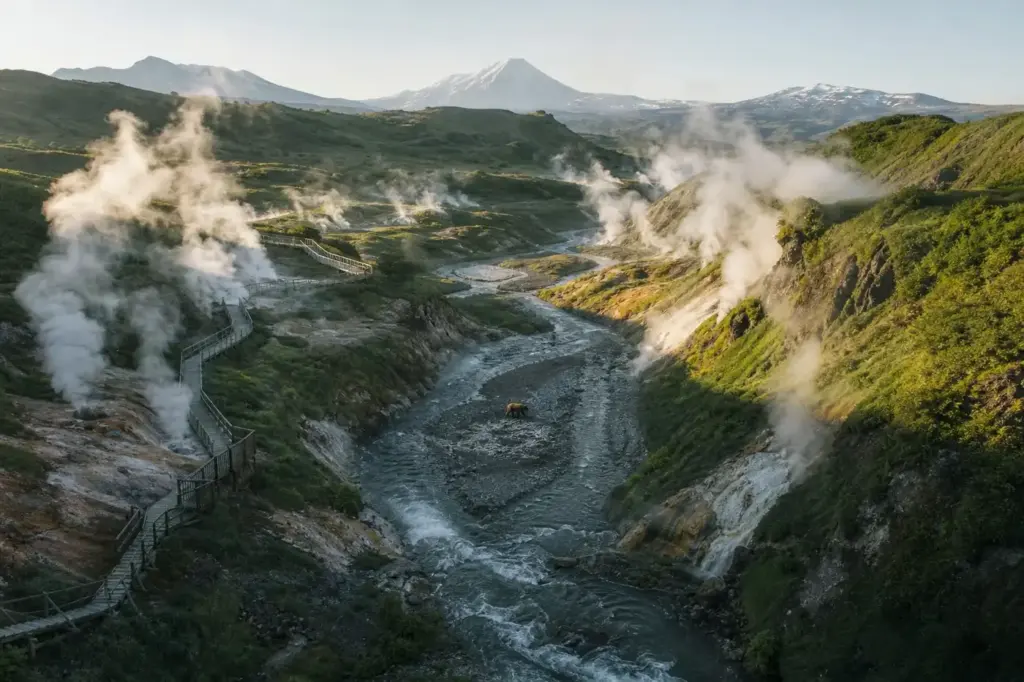
Kronotsky Nature Reserve is one of the best-known protected areas in Russia, covering a huge stretch of Kamchatka‘s east coast. The Kronotsky Nature Reserve contains the Valley of Geysers, the Uzon Caldera, Lake Kronotskoye and a chain of active volcanoes, and its wildlife includes brown bears, sea eagles and sables. It is part of the UNESCO-listed Volcanoes of Kamchatka.
Access is strictly controlled. There are no public roads into the heart of the reserve, so visitors normally fly by helicopter on a day trip or a multi-day programme arranged through the reserve or a licensed operator. Permits are required, group sizes are small and weather decides whether flights go. In return you see landscapes that few people reach. Book far ahead, keep spare days and bring cash, because cards issued outside Russia do not work.
Quick Facts
| Russian name | Кроноцкий государственный природный биосферный заповедник |
|---|---|
| District | Yelizovsky |
| Admission | Visits need a permit and are arranged through the reserve or licensed operators; guided trips are priced at ₽₽₽₽ |
| Best time to visit | Summer, from about July to September, is the main season, with the best chances of flights and the most active wildlife. Early summer has snow in places, and autumn brings colour and cold. Weather changes quickly in every month, so plan spare days. Winter programmes are limited and not for ordinary visitors. |
| Recommended duration | 1 to 3 days |
What Is (and Isn't) Part of a Visit to Kronotsky Nature Reserve, Kamchatka Peninsula?
| Part | Status | Notes |
|---|---|---|
| Valley of Geysers | Separate ticket or institution | Reached by helicopter with a ranger on a boardwalk route; booked as a programme. |
| Uzon Caldera | Separate ticket or institution | A separate area inside the reserve, usually part of a longer programme; see its own article. |
| Lake Kronotskoye | Separate ticket or institution | Included in some programmes only, depending on weather and landing rules. |
| Helicopter flight | Separate ticket or institution | The usual access route, priced as part of the programme and dependent on weather. |
| Independent walking | Not open to visitors | Not allowed without permission and a ranger; the reserve is a strictly protected area. |
| Camping and overnight stays | Not open to visitors | Not open to ordinary visitors except in organised programmes with set accommodation. |
Why Visit Kronotsky Nature Reserve, Kamchatka Peninsula?
Kronotsky is the closest thing Kamchatka has to a wilderness showcase. In one protected area you can see steaming geyser basins, a vast volcanic caldera, a deep mountain lake, wild coastlines and bears fishing in rivers. The scale is hard to grasp until you fly over it.
It is also a place where rules protect the experience. Visits are guided, boardwalks keep feet off fragile ground and numbers are limited, so the landscape feels quiet even in summer. If you can accept the cost, the planning and the chance of a cancelled flight, it is the most complete nature trip on the peninsula.
How Kronotsky Nature Reserve, Kamchatka Peninsula Is Laid Out
Kronotsky is a huge reserve with several distinct areas rather than a single site, and most visitors only see the parts included in their programme.
- Valley of Geysers: a steaming river canyon with geysers, hot springs and mud pots, reached by helicopter and a boardwalk route.
- Uzon Caldera: a large volcanic basin with hot springs and mud pots, described in its own article on this site.
- Lake Kronotskoye: a large mountain lake surrounded by volcanoes and forest.
- Volcanic ridges and coast: active volcanoes, lava fields and a wild Pacific shore, usually seen from the air.
- Visitor centre in Yelizovo: the reserve’s office and information point near the airport.
Programmes differ widely, so ask the operator which areas your trip actually includes and how long you spend on the ground. Do not assume that every trip reaches every area: weather, group size and ranger decisions on the day decide where the helicopter lands and how long you can stay there.
Highlights of Kronotsky Nature Reserve, Kamchatka Peninsula
Valley of Geysers
The best-known sight of the reserve is a steaming river canyon where geysers, hot springs and mud pots break through the valley walls. Visitors walk on boardwalks with a ranger, stopping at lookout points as columns of steam rise and fall. The valley has changed over the years because of natural events, and the guide explains what you see on the day. Time on the ground is limited and strictly guided, so use it to look, not to rush through.
Tip: Bring a rain layer; steam and drizzle often mix in the canyon.
Helicopter flight
Almost every visit starts with a helicopter flight over mountains, forest, rivers and lava fields. The flight is a highlight of its own, crossing country that has no road and few trails. Seats are limited, and flights depend on weather, so delays and cancellations are part of the plan. Operators usually allow spare days. Seating is assigned, and window seats are not guaranteed, so ask in advance if photography matters.
Tip: Dress warmly; the cabin can be cold, and landing sites are windy.
Uzon Caldera
This huge volcanic basin lies within the reserve and is known for hot springs, mud pots and colourful thermal areas. It is reached by helicopter and usually needs a longer programme with a ranger. The terrain is fragile and very hot in places, so visitors stay on marked routes. It deserves its own article on this site, but many visitors combine it with the geysers on one trip, so ask your operator how long you will stay.
Tip: Check whether your programme includes Uzon or only the geyser valley.
Lake Kronotskoye
The largest mountain lake in the region sits in a landscape of forest, volcanic cones and open slopes. On a calm day, the surface mirrors the peaks. Trips may include a landing, a short walk or a stop for lunch, depending on weather and rules. The lake is a rare example of a wild lake with little human presence, so the silence is part of the experience. Weather can change quickly on the water.
Tip: Pack binoculars; eagles and other birds often patrol the shore.
Bears and wildlife
Kronotsky is a home of brown bears, and sightings are common on river valleys and shores during the warm months. Sables, foxes, sea eagles and many other animals also live here. Rangers keep a safe distance and follow strict rules, so you watch from set points or the boardwalk. Binoculars help a lot. Wildlife is never guaranteed, but the density of bears is one of the main reasons the reserve is famous.
Tip: Keep quiet, stay with your ranger and never approach an animal.
The wild Pacific coast
The reserve stretches to the east coast, where black sand beaches, cliffs and surf meet an empty horizon. Most visitors see the coast from the air, and a few programmes include landings. The shore is exposed and weather changes quickly. The scene explains why the area has stayed wild: it is far from towns, with no roads and few safe landing points. A flight along the shore is one of the quietly memorable parts of a visit.
Tip: Ask your pilot or ranger about coastal stops that fit the weather.
Atmosphere
Kronotsky feels remote from the moment the helicopter lifts off. Below you, rivers braid across wide valleys, steam rises from hidden hollows and the horizon is full of cones. On the ground, the air smells of sulphur, wet earth and cold water, and the loudest sounds are wind and boiling springs.
The mood is respectful. Rangers lead small groups along the boardwalks, speak quietly and point out signs of bears and birds. In clear weather the reserve looks spacious and bright; in cloud it becomes close and mysterious, with steam and mist blending together. Everyone tends to speak softly, and even the pilots seem to lower their voices once the engines are off.
History of Kronotsky Nature Reserve, Kamchatka Peninsula
The history of the Kronotsky Reserve begins with the wish to protect Kamchatka’s sable. In the 1930s, hunting had reduced the animal’s numbers, and the reserve was created in 1934 as a place where sables and their habitat could recover. Over the following decades its mission widened to include the whole volcanic landscape of the east coast, including forests, rivers, lakes and thermal areas.
Much of the reserve remained unexplored for years. In 1941, geologist Tatyana Ustinova and local guide Anisifor Krupenin found the valley of geysers while working in the area, a discovery that surprised scientists because it ranked among the major geyser fields of the world. The valley became the best-known part of the reserve, and Ustinova’s name is still closely tied to it.
During the Soviet period, the reserve was closed to ordinary visitors, and research stations and rangers worked in remote conditions. Scientists studied volcanoes, bears, birds and the unusual thermal ecosystems, and the reserve gradually gained a reputation as a natural laboratory. Later its status was raised, and it became a biosphere reserve and part of the UNESCO-listed Volcanoes of Kamchatka.
Tourism developed carefully. As interest in Kamchatka grew, the reserve began to organise controlled visits, mainly by helicopter, with rangers, boardwalks and strict limits on group size. The aim was to share the landscape without damaging it, and the model is still used: permits, set routes, small groups and no independent wandering.
The landscape itself is a record of long volcanic activity. Lava flows, ash layers and crater lakes show how repeated eruptions have built the east coast, while rivers cut through soft deposits and carry salmon to spawning grounds each summer. Those fish feed bears, eagles and many smaller animals, which is why wildlife and volcanoes are protected together here, as one system rather than two separate attractions.
Nature has also changed the reserve. Floods, landslides and mudflows have reshaped the geyser valley more than once, and a major landslide in the early 21st century altered parts of the canyon and flooded some geysers. Rangers and scientists continue to monitor the changes, and the valley today looks different from the one found in the 1940s.
Today the reserve is both a protected area and a research site. It guards brown bears, sea eagles, sables, salmon rivers and active volcanoes, and it invites visitors under rules that protect all of them. Visitors who understand that history tend to see the boardwalks and permits not as obstacles but as part of the reason the place still looks wild. The reserve exists to protect nature first, and visitors are guests who leave nothing behind and take only photographs, which is exactly why its landscapes remain so intact.
Tickets and Booking for Kronotsky Nature Reserve, Kamchatka Peninsula
| Ticket | Price | Includes |
|---|---|---|
| Helicopter day programme | ₽₽₽₽ | Flight, ranger, permit arrangements and time at the main sights; check meals. |
| Multi-day programme | ₽₽₽₽ | Several days with set accommodation, flights and rangers. |
| Permit only | ₽₽ | Needed for any visit; normally arranged by the reserve or the operator. |
₽ budget · ₽₽ moderate · ₽₽₽ upscale · ₽₽₽₽ splurge. Price levels are estimates compared with typical prices for visitors.
Visits are organised through the reserve or licensed operators, which handle permits, flights and rangers. There is no walk-in ticket. Contact an operator well in advance, give your dates and group size and ask for a written programme that states what is included and what happens if weather cancels the flight.
- Where: the reserve’s own page and office, or licensed operators in Petropavlovsk-Kamchatsky.
- Payment: cards issued outside Russia do not work, so ask which methods are accepted and plan cash.
- Season: summer fills first, so book far ahead.
- Warnings: avoid sellers who cannot show a permit or name the pilot or ranger.
Rules and permits change, so confirm them before you pay.
Suggested itineraries Kronotsky Nature Reserve, Kamchatka Peninsula
One day
Take a helicopter day programme from the Yelizovo area to the Valley of Geysers, walk the boardwalk with a ranger, enjoy a packed lunch and fly back. Weather can delay flights, so keep a spare day before any onward travel. Keep a spare day in case weather changes the plan.
Two days
Fly in with an operator, spend the first day at the geysers and Uzon or the lake, and stay overnight in set accommodation for a second day of walks and wildlife viewing. Confirm accommodation and meals in writing. Check the weather the evening before and again at breakfast.
Three days
Combine the reserve with a spare day for weather, an extra excursion near Petropavlovsk-Kamchatsky or the Mutnovsky Volcano. This works well for visitors who want both wilderness and flexibility. Allow extra time, because transfers and weather can move the schedule. Keep a spare day in case weather changes the plan.
How to Get to Kronotsky Nature Reserve, Kamchatka Peninsula
The reserve’s office is in Yelizovo, close to the airport, but the sights lie far inland and along the east coast with no public road. Visitors travel with a licensed operator or the reserve, usually by helicopter from the Yelizovo area.
- By helicopter: the standard route, arranged as part of a programme, weather permitting.
- By overland expedition: long, specialised trips exist but are not for ordinary visitors.
- Independently: not possible, because permits and rangers are required.
Allow spare days in your schedule, and ask the operator what happens if weather closes in.
Accessibility
The reserve involves helicopter flights, boardwalk routes with stairs and uneven ground, so it is demanding for wheelchair users and people with limited mobility. Ask the operator about the exact walking distances, steps and seating, and tell them about any health needs before you book.
Food Nearby
There are no cafes in the reserve. Programmes usually include a packed lunch, and overnight stays offer simple meals. Bring snacks and water, and tell the operator about dietary needs in advance. Food must be stored carefully because of bears. In Yelizovo you will find shops and cafes before and after the trip.
What to Bring
Bring warm layers, a waterproof jacket, sturdy boots, a hat and gloves, binoculars and a camera with a zoom lens. Pack insect repellent, sun protection, snacks and cash, since cards issued outside Russia do not work. Keep a dry bag for electronics, and carry your passport for the permit.
Best Views and Photo Spots of Kronotsky Nature Reserve, Kamchatka Peninsula
Geyser valley boardwalk
Steam columns, hot springs and the canyon walls make a layered scene from the lookout points. Stay on the boardwalk at all times. Bring a spare battery and a lens cloth.
Best time: Morning, when steam is densest.
Helicopter window
Aerial views of volcanoes, rivers and forest show the scale of the reserve. Keep the camera strap secure. Dress warmly, because wind makes it feel colder.
Best time: Clear mornings, if flights run.
Lake Kronotskoye shore
Calm water mirrors the surrounding peaks, giving a simple, quiet composition in good weather. Arrive early to find a good spot before others do. Bring a spare battery and a lens cloth.
Best time: Early morning.
River valley with bears
A long lens captures bears feeding at a distance, with grass and water behind them. Follow the ranger's rules. Bring a spare battery and a lens cloth.
Best time: Evening light in summer.
Photography Rules
Photography is allowed along the routes. Drones are not allowed in a reserve without special permission, so leave them at home. Use a zoom lens for bears and birds, keep a safe distance and never leave the boardwalk for a better angle.
Family Suitability
Children who can sit still on a flight and follow ranger instructions can enjoy the trip, but it is expensive and weather dependent. Minimum ages are set by operators, so ask in advance. Young children may find the long day and the rules tiring.
Russia Vibes Tips
- Book the reserve programme months ahead, since permits and flights are limited.
- Keep a spare day before any onward flight, because helicopters are weather dependent.
- Carry your passport, because permits are issued by name.
- Ask in advance whether your programme includes the geysers, Uzon or the lake.
- Pack layers; the canyon is steamy and the helicopter can be cold.
- Follow every instruction from your ranger, especially about distance and food.
Explore Nearby Kronotsky Nature Reserve, Kamchatka Peninsula
Related guides
 Kamchatka Peninsula: Volcanoes, Wildlife and Travel Guide
Main image: AI-generated illustration. It may not show the place exactly as it looks.
 Vilyuchinsky Volcano: Hiking, Waterfall and Winter Skiing
Main image: AI-generated illustration. It may not show the place exactly as it looks.
- Mutnovsky Volcano: Fumaroles, Glacier Crater and Off-Road Trip
- Uzon Caldera: Hot Springs, Mud Pots and Bears by Helicopter
- Avachinsky Volcano: Day Climb Above Petropavlovsk-Kamchatsky
Browse more: More in Yelizovsky · All Kamchatka Peninsula · All Parks · All Sightseeing · All Sightseeing in Kamchatka Peninsula
FAQ: Kronotsky Nature Reserve, Kamchatka Peninsula
What is Kronotsky Nature Reserve?
It is a federal protected area on Kamchatka's east coast, known for the Valley of Geysers, Uzon Caldera, Lake Kronotskoye, volcanoes and brown bears. It is part of the UNESCO-listed Volcanoes of Kamchatka. Details vary by season, so confirm them with the operator before you go.
Can I visit independently?
No. Access is controlled, and visits require a permit and a ranger or a licensed operator. There are no public roads to the main sights, so most visits are arranged as helicopter programmes. Ask your host or operator for the latest information before you set out.
How do I get to the Valley of Geysers?
By helicopter from the Yelizovo area as part of an organised programme. The flight and the walk on the boardwalk are guided, and weather can delay or cancel departures. Conditions change quickly here, so keep a spare day in your plan.
Is the Valley of Geysers still active?
Yes, steam, hot springs and geysers remain active, though the valley has changed over the years because of natural events. Your guide explains what is visible on the day. Local guides usually know the current situation better than any map. Details vary by season, so confirm them with the operator before you go.
When is the best time to go?
Summer, from about July to September, offers the best chance of flights and wildlife. Early summer has snow in places, and autumn is colourful but cold. Always plan a spare day. Details vary by season, so confirm them with the operator before you go.
Can I see bears?
Bears are common in the reserve, especially near rivers in summer. Sightings are never guaranteed, but rangers know where to look and keep a safe distance. Ask your host or operator for the latest information before you set out. Conditions change quickly here, so keep a spare day in your plan.
Are drones allowed?
No, not without special permission. Leave your drone at home, because a reserve protects wildlife from disturbance. Ask the operator or the reserve office for the rules. Conditions change quickly here, so keep a spare day in your plan. Local guides usually know the current situation better than any map.
How much does it cost?
Programmes are among the more expensive trips in Kamchatka because of helicopter flights and permits. Ask the operator for a written programme that shows what is included, and plan cash. Local guides usually know the current situation better than any map.
Russia Vibes is a one-person project. A coffee keeps it going

Take this guide with you
Get a free PDF of this guide to print or read offline: key facts, tips and a map link on a few clean pages.
Report an issue on this page
Paying for your trip: please read
Payments and bookings between Russia and many other countries are currently restricted. In practice, cards issued in the EU, the UK, the US and several other countries often cannot be used in Russia, Russian cards usually cannot be used abroad, and some booking platforms, airlines and payment providers limit or pause their services for Russia. The situation changes frequently.
We do not give legal or financial advice, and this site does not encourage anyone to break any rule that applies to them. Whatever you plan, you are responsible for following the laws and regulations that apply to you, including those of your country of residence and citizenship.
Many travelers still organise their stay without problems. It is worth asking your bank or payment provider what is currently possible, contacting hotels, tour operators and carriers directly about the payment methods they accept, and checking which services are open to customers from your country. Clarify payment, cancellation and refund terms before you commit to a booking, and keep your plans flexible.
Partner links on this site may not be available in every country, and prices, availability and rules in our guides can differ from what you see when you book.
How we research and update our guides
About this guide: AI assistance and accuracy
This guide is created with the help of AI and is based on official sources where available. Mistakes can still happen. Opening hours, prices, rules and other details are given to the best of our knowledge as of the date shown and can change without notice. It offers general recommendations only, not professional, legal or travel advice. Please confirm important details with the official source before you travel; you are responsible for your own plans and decisions.
* Affiliate link: as an Amazon Associate we earn from qualifying purchases at no extra cost to you.