
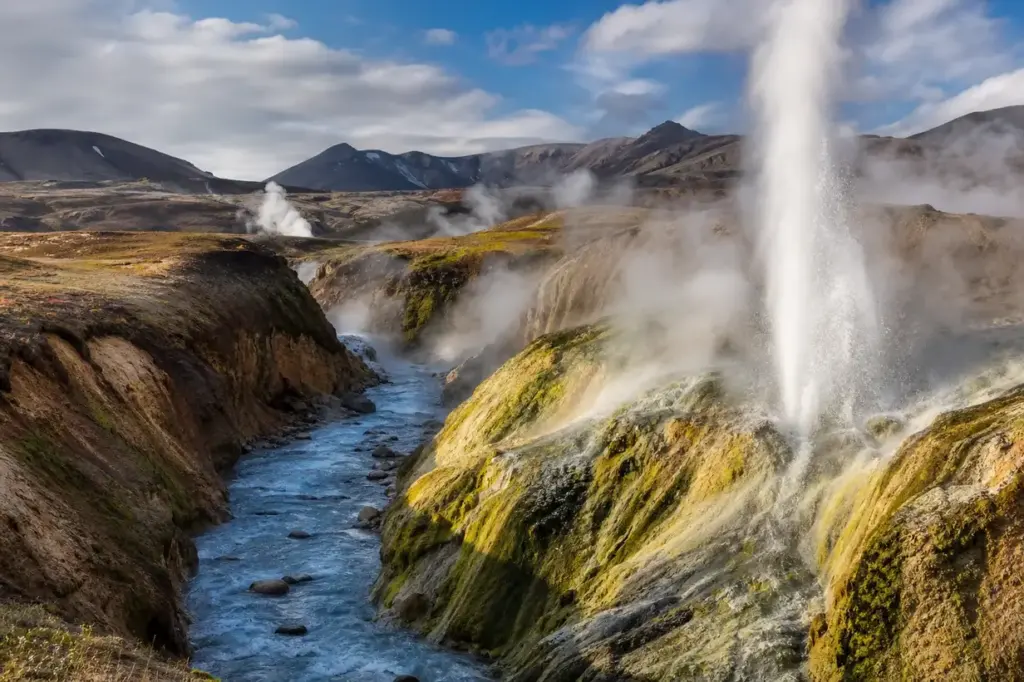
The Valley of Geysers on the Kamchatka Peninsula is one of Earth’s rarest geothermal phenomena. This six-kilometre-long basin contains approximately 90 active geysers and hundreds of hot springs—all concentrated in a steep canyon carved by the Geysernaya River. It is Eurasia’s only geyser field and the second-largest collection of geysers anywhere in the world, after Yellowstone.
The valley lies entirely within the Kronotsky Nature Reserve, a UNESCO World Heritage Site. Its extreme remoteness and fragile thermal ecosystems mean access is tightly restricted. Nearly all visitors arrive by helicopter from Petropavlovsk-Kamchatsky for guided day excursions, making it one of Russia’s most exclusive and challenging destinations to reach.
Quick Facts
| Russian name | Долина гейзеров |
|---|---|
| Built / opened | 1941 |
| Address | Kronotsky Nature Reserve, Kamchatka Peninsula, Russia Google MapsApple MapsYandex Maps2GIS |
| District | Kamchatka Krai |
| Admission | ₽₽₽₽ |
| Best time to visit | The Valley of Geysers is visited primarily from July through September, when weather in Kamchatka is most stable and helicopter flights are most frequently available. July and August offer the warmest conditions and longest daylight (nearly 24-hour daylight in mid-summer). September brings cooler temperatures and potential rain, but the landscape is scenic with autumn colours in the surrounding tundra.June and early October are transition months; helicopter flights operate but weather is unpredictable and visibility may be poor.Winter (November–April) and spring (May–June) see almost no tourist access due to extreme weather, poor visibility, and limited helicopter availability. The reserve prioritizes scientific research during these months.Crowds are small year-round because overall visitor numbers are capped at 3,000–4,100 annually. Avoid mid-July to mid-August if you prefer smaller groups, as this is peak Russian holiday season. |
| Recommended duration | 3–4 hours on-site; full day including helicopter travel |
| Website | kronoki.org/en |
What Is (and Isn't) Part of a Visit to Valley of Geysers, Kamchatka Peninsula?
| Part | Status | Notes |
|---|---|---|
| Valley of Geysers itself (main thermal area) | Included in the standard ticket | All geysers, hot springs, mineral terraces, and the Geysernaya River canyon are part of the core visit. |
| Helicopter transport from Petropavlovsk-Kamchatsky | Separate ticket or institution | Helicopter flight is arranged separately by tour operators and is not included in reserve entry fees alone; cost varies by operator. |
| Ranger-led guided tour at the valley | Included in the standard ticket | A professional guide is required and included as part of the admission ticket sold by Kronotsky Reserve. |
| Uzon Caldera aerial viewing | Separate ticket or institution | Some helicopter tours include aerial views of the Uzon Caldera; confirm with your operator whether this is included. |
| Kronotsky Lake and other reserve areas | Outside / not part of it | These are separate attractions within the reserve, accessible only by additional helicopter flights or overnight stays; not part of a standard Valley of Geysers day tour. |
| South Kamchatka Sanctuary attractions (Kuril Lake, salmon rivers) | Outside / not part of it | These are in a different protected area and require separate arrangements; often confused with Kronotsky Reserve. |
Why Visit Valley of Geysers, Kamchatka Peninsula?
Geysers exist naturally in only a handful of places on Earth: Iceland, New Zealand, Chile, the United States, and here in Kamchatka. The Valley of Geysers combines this rarity with dramatic volcanic landscape. You will see boiling water and steam erupting from rock, brilliantly coloured mineral terraces, and thermal pools at temperatures exceeding 95°C, all set against tundra and mountains. This is nature’s raw geothermal theatre, largely untouched and difficult to reach—which is precisely why it remains so intact and striking.
The valley was declared one of Russia’s Seven Natural Wonders in 2014, and for good reason: few visitors to Kamchatka miss it if they can arrange the helicopter journey and the cost.
How Valley of Geysers, Kamchatka Peninsula Is Laid Out
The Valley of Geysers is a narrow, steep canyon running north–south. Upon helicopter arrival, visitors land near the ranger station and then proceed on foot along marked trails beside the Geysernaya River. The main geysers and hot springs are concentrated along the riverbed and canyon walls. A 2007 mudflow buried roughly two-thirds of the valley, but most thermal features remain active and visible. Trails typically loop through both the more densely geothermal sections and areas recovering from the mudflow.
Highlights of Valley of Geysers, Kamchatka Peninsula
The Geysernaya River and Canyon
The valley's defining feature is the ever-deepening Geysernaya River, which flows through a canyon up to 400–500 metres deep. Geothermal waters feed into it from the volcanic system beneath. Walking beside this river, you move through a landscape of raw thermal activity: boiling water spurts from rock, steam vents hiss from the canyon walls, and the ground itself radiates heat.
Tip: Stay on marked trails; the ground near thermal features can be unstable and dangerously hot.
Velikan (the Giant Geyser)
Velikan is one of the largest named geysers in the valley, historically capable of sending water up to 40 metres into the air. Its eruptions are irregular but spectacular when they occur. The geyser remains active and is a highlight of most guided tours, though eruption times are unpredictable.
Tip: Ask your guide about recent activity; rangers track which geysers have erupted recently.
Mineral Terraces and Hot Springs
Colourful mineral deposits coat the rocks around many springs, creating layers of yellows, oranges and whites. These are formed by dissolved minerals in the boiling water. Many springs flow continuously at temperatures near boiling, creating a surreal landscape of colour and steam.
Tip: Photograph these in the morning or late afternoon light for the best colour saturation.
Geothermal Flora
Despite the extreme heat and acidic conditions, specialized plants and microorganisms have adapted to thrive in the thermal zones. You will see vibrant green algae mats in warm water and unique vegetation in the cooler margins—a striking demonstration of life's resilience.
Tip: The thermal streams create warm microclimates that are noticeably warmer than the surrounding tundra; some visitors rest beside them.
Lake Geysernoe (Geyser Lake)
This lake collects geothermal water and sits at the valley floor. It is a focal point where you can observe multiple geysers and springs simultaneously. The lake itself is fed by hot springs and represents the hydrological heart of the valley system.
Tip: The lake's water temperature and mineral content vary depending on inlet sources; stay back from the shoreline.
2007 Mudflow Scar
On 3 June 2007, a massive mudslide struck the valley, burying approximately two-thirds of it beneath debris. The scar is still visible: a wall of new rock face 480 feet high and a depth of sludge averaging 50 feet was deposited. Despite this catastrophe, most geysers either survived or have become active again, demonstrating the resilience of Kamchatka's thermal system.
Tip: Your guide will show you the before-and-after landscape; it is an important story in understanding the valley's current state.
The Uzon Caldera Connection
Beneath and adjacent to the Valley of Geysers lies the Uzon Caldera, formed approximately 40,000 years ago when a volcanic cone collapsed. This underground reservoir of magma still heats groundwater to approximately 250°C at depth, driving all the thermal activity above. The caldera's heat source is what makes the geysers possible.
Tip: Some tours include a separate helicopter excursion to view Uzon Caldera from above; ask if this is included in your package.
Vodopadny Creek and Waterfalls
Beyond the main geyser field, Vodopadny Creek cuts through the valley and creates waterfalls fed by thermal springs. These combine cold stream water with hot spring outflow, creating unusual warm-water falls. The creek was significantly affected by the 2007 mudflow.
Tip: Ask your guide which creeks are accessible on the day of your visit; some areas may be restricted depending on conditions.
Atmosphere
The Valley of Geysers is dominated by the constant interplay of heat and motion. Steam rises continuously from dozens of vents; the ground beneath your feet is warm. The air carries the smell of minerals and sulphur. In the silence of the remote tundra, the hiss and roar of erupting geysers are startling and primordial.
Visitors typically arrive mid-morning after a helicopter flight and spend 2–3 hours walking the valley with a professional guide. Groups are small (usually under 20 people) and controlled to protect the ecosystem. The landscape is otherworldly: coloured mineral deposits, boiling pools, patches of green thermal algae, and the constant threat and promise of a geyser eruption. It feels like standing on the threshold between Earth’s crust and the life on its surface.
History of Valley of Geysers, Kamchatka Peninsula
Discovery and Early Exploration
The Valley of Geysers was discovered on 25 July 1941 by Tatyana Ustinova, a geologist at the Kronotsky Reserve, and Anisifor Krupenin, an Itelmen guide. Their discovery was partly accidental. Ustinova and Krupenin were attempting to explore a tributary of the Geysernaya River to reach the outflow from the Uzon caldera when they stumbled upon the geyser field. At the time, geysers were known to exist in only three places on Earth: Iceland, the United States (Yellowstone), and New Zealand. The discovery of an active geyser field on the Asian continent was unprecedented.
Publishing and Limited Exploration (1941–1972)
Ustinova published her findings fourteen years later, in 1955. However, scientific interest remained limited during the Soviet era, partly due to strict military restrictions on civilian access to Kamchatka. The region was a sensitive frontier zone, and outside exploration was tightly controlled. Few scientists or explorers visited the valley for decades after its discovery.
Scientific Study and Tourism Opening (1972–1991)
Systematic scientific study began in the mid-1970s. An automatic monitoring system was introduced in 1990 to track geyser activity and thermal changes. From the 1980s onward, the Soviet authorities began promoting the valley as a tourist attraction within Kamchatka for domestic visitors. However, foreign access remained restricted until 1991, after the fall of the Soviet Union and the opening of Kamchatka to international tourism.
UNESCO Recognition and the 2007 Mudflow
In 1996, the Volcanoes of Kamchatka—including the Valley of Geysers and Kronotsky Nature Reserve—were designated a UNESCO World Heritage Site. The valley was further honoured in 2014 when it was declared one of Russia’s Seven Natural Wonders.
On 3 June 2007, a catastrophic mudflow struck the valley, triggered by heavy rains and the collapse of a crater wall. The mudslide buried approximately two-thirds of the valley, destroying or burying numerous geysers, hot springs, and waterfalls. Thermal features were entombed under debris averaging 50 feet deep across roughly a mile of valley floor. Visitors and reserve personnel had to be evacuated by helicopter. Many feared the valley’s unique ecosystem had been permanently destroyed.
Recovery and Modern Status
Contrary to initial fears, most thermal features survived or became active again following the mudflow. The valley’s resilience reflects the power and permanence of the underlying geothermal system. Today, geysers continue to erupt, and new thermal features have emerged. The mudflow scarred landscape is now part of the valley’s story and is visible to modern visitors.
Access remains tightly controlled by the Kronotsky Nature Reserve administration. Approximately 3,000 to 4,100 tourists visit annually, making it one of Russia’s most exclusive destinations. All visits are conducted by helicopter, preserving the valley’s isolation and ecological integrity.
Legends and Myths about Valley of Geysers, Kamchatka Peninsula
The Spirit of the Mountain
Legend – historically unreliable. Local indigenous peoples of Kamchatka, including the Itelmen, have long understood the valley as a place where the underworld's heat and power emerge. Geothermal phenomena were interpreted as signs of spiritual or divine forces beneath the earth. The regular eruptions of geysers were seen as the mountain's breath or heartbeat. While not a single legend, this belief system shaped how the valley was understood before modern science.
The 2007 Mudflow as Nature's Reset
Disputed by historians. After the devastating 2007 mudflow, local observers and some scientists spoke of the event as nature 'renewing' itself or the valley 'healing.' The recovery of thermal features and emergence of new geysers in previously mudburied areas was interpreted by some as the valley reasserting its power. While rooted in observable geological recovery, the narrative took on a semi-mystical quality in local retellings.
Tickets and Booking for Valley of Geysers, Kamchatka Peninsula
| Ticket | Price | Includes |
|---|---|---|
| Valley of Geysers day tour (one person, full price summer season) | ₽₽₽₽ | Entrance to the valley, ranger-led guided tour of 2–3 hours, hot lunch at the ranger station |
| Valley of Geysers off-season tour | ₽₽₽ | Entrance, ranger tour (reduced visitor numbers in autumn/winter); helicopter availability may be limited |
| Helicopter flight from Petropavlovsk-Kamchatsky to Valley of Geysers and return | ₽₽₽₽ | Helicopter transport for up to 22 passengers, scenic aerial views en route, typically includes 1-hour flight each way |
₽ budget · ₽₽ moderate · ₽₽₽ upscale · ₽₽₽₽ splurge. Price levels are estimates compared with typical prices for visitors.
Access to the Valley of Geysers is exclusively through organized tours booked with licensed operators or directly with the Kronotsky Reserve. The reserve’s official website is kronoki.org. Tours operate primarily in the summer and autumn seasons (July through September) when weather permits helicopter flights. Tours must be booked weeks or months in advance, as availability is strictly limited.
To book:
- Contact tour operators licensed to operate helicopter flights from Petropavlovsk-Kamchatsky (Kamchatka’s capital, 200 km away). Major operators include Kamchatkaland Tours and Kray Tours.
- Provide dates and the number of participants. Minimum group sizes (often 10–18 people) may apply.
- Confirm whether the helicopter flight is included or must be paid separately from the reserve entrance fee.
- Pay in rubles. Some operators accept international payments or euros.
A full day trip typically includes helicopter travel from the airport (3–4 hours round trip), the guided valley tour (2–3 hours), lunch, and entrance. Rates for Russian citizens and concessional visitors (children, students, pensioners) differ from international rates; consult the official Kronotsky Reserve website for the current price structure.
Suggested itineraries Valley of Geysers, Kamchatka Peninsula
Full day
Depart Petropavlovsk-Kamchatsky early morning by helicopter (1–1.5 hours each way). Upon arrival, begin the ranger-guided tour, starting from the ranger station near the main geyser field. Walk the trails along the Geysernaya River canyon, visiting Velikan and other major geysers, mineral terraces, Lake Geysernoe, and recovering mudflow zones. Return to helicopter and fly back to the airport by late afternoon or early evening.
2–3 days (overnight at ranger station)
Arrive by helicopter. Stay overnight at the basic ranger station (requires special permit). First day covers main geysers and hot springs. Second day explores peripheral thermal features and the Vodopadny Creek waterfalls. Additional time allows deeper exploration and better chance of witnessing multiple geyser eruptions. Return by helicopter on final day.
Aerial scenic helicopter tour with landing
Helicopter departs Petropavlovsk-Kamchatsky, circles over the Uzon Caldera and surrounding volcanic peaks (20–30 minutes of sightseeing), then lands at the Valley of Geysers for 1–2 hours of guided exploration. Return by helicopter. Suitable for those with limited time who still want to see the valley firsthand.
How to Get to Valley of Geysers, Kamchatka Peninsula
By Air: All visitors must arrange a helicopter flight from Petropavlovsk-Kamchatsky Airport (PK Airport, also called Elizovo Airport), located approximately 25 km south of the city centre. Daily commercial flights connect Petropavlovsk-Kamchatsky to Moscow and other Russian cities.
From the airport to the city: Taxi, shuttle or hotel transfer to central Petropavlovsk-Kamchatsky (20–30 minutes).
Helicopter logistics: Tour operators coordinate helicopter pickup from a designated helipad near Petropavlovsk-Kamchatsky. Flight time to the Valley of Geysers is approximately 1–1.5 hours depending on weather and exact landing site. The helicopter pilot will circle the valley on approach, offering aerial views before landing near the ranger station.
On foot at the valley: No vehicle access exists. All movement is on foot along marked trails guided by a ranger. Trails are unpaved and may be muddy or snow-covered depending on season.
Return journey: Helicopter extraction is pre-scheduled for a specific time; tardiness will delay the entire group and incur additional charges.
Accessibility
The Valley of Geysers is not accessible to visitors with mobility limitations. The terrain is steep canyon-side trails with uneven ground, thermal hazards, and no infrastructure for wheelchairs or those with difficulty walking. The helicopter itself presents additional challenges for those with mobility issues or certain health conditions. Overnight stays require carrying personal gear over rough terrain. Consult the reserve and your tour operator about your specific needs before committing to a trip; exceptions may be considered on a case-by-case basis, but facilities and modifications are minimal.
Food Nearby
There are no commercial food vendors or restaurants within the Valley of Geysers. All tours include a packed lunch (typically vegetarian options available) provided at the ranger station. Bring water; the reserve may provide it, but confirm with your tour operator. Once back in Petropavlovsk-Kamchatsky, the city offers restaurants serving Russian and Asian cuisine, cafes, and shops. Dining options are limited compared to larger Russian cities; book ahead if seeking specific cuisines.
What to Bring
Wear waterproof hiking boots with good grip; terrain is slippery and thermal features can produce unexpected steam and spray. Bring a waterproof jacket and windproof layer; weather can change rapidly. Thermal springs make some areas warm and steamy; bring lighter clothing too. Sun protection (sunscreen, hat, sunglasses) is essential despite cloud. Bring a full water bottle and high-energy snacks. A good camera and telephoto lens are ideal for photographing erupting geysers. Wear gloves and hat even in summer; the region is cool. Pack a small first-aid kit and any personal medications. The thermal zones are extremely hot; do not attempt to touch boiling water or get closer than your guide advises. Leave all bag contents clear with your operator in advance.
Best Views and Photo Spots of Valley of Geysers, Kamchatka Peninsula
Velikan (Giant Geyser) eruption viewpoint
When active, Velikan produces a powerful jet of boiling water up to 40 metres high against the canyon wall backdrop. The spray catches light and creates dramatic backlit and rainbow effects. Stand to the side to capture the full eruption plume.
Best time: Early morning or late afternoon for side-angle light and minimal haze; eruptions are unpredictable, so ask your guide about recent activity.
Mineral terrace wide view from upper trail
Step back on the trail to capture the layered, colourful mineral deposits (yellows, oranges, whites, greens) with multiple geysers and steam vents visible in one frame. The stratified effect is visually striking.
Best time: Midday when colours are saturated and shadows are minimal; afternoon light adds warmth to the mineral tones.
Lake Geysernoe shoreline perspective
Standing at a safe distance from the lake shore, you can capture multiple geysers and hot springs reflected in the water, with the canyon wall rising behind. The composition captures the scale and density of thermal activity.
Best time: Calm water conditions (less wind) create clearer reflections; early morning is typically calmest.
Mudflow scar and recovery landscape
Photograph the 480-foot rock wall and adjacent terrain buried by the 2007 mudflow, contrasting with the active geysers emerging from the rubble. This captures the valley's history and resilience.
Best time: Afternoon light emphasizes the rock face texture and the dramatic scale of the scar.
Steam and haze landscape near Vodopadny Creek
Multiple vents create a misty, ethereal landscape where boiling springs feed waterfalls. The atmospheric haze and steam create a dreamy quality.
Best time: Early morning when thermal contrast is greatest and mist is thick; afternoon heat dissipates some of the dramatic effect.
Ranger station area and full valley overview
From the ranger station, the full canyon and dispersed geyser field are visible, providing context and scale. Include the Geysernaya River for geographic reference.
Best time: Late afternoon for warm, angled light across the canyon; wind direction may clear or add mist.
Photography Rules
Photography is permitted throughout the valley and is encouraged. Erupting geysers are the prime subject, so bring a camera with fast shutter speed to freeze the spray. Tripods are allowed on trails but may be impractical on narrow canyon paths; check with your guide. Drones are strictly prohibited (reserve regulation). Flash photography is not restricted but is unnecessary outdoors. Respect other visitors when photographing; do not block trails during eruptions. The colour and clarity of photos are best in morning and late afternoon light.
Family Suitability
The Valley of Geysers is suitable for older children and teens (ages 12+) who are comfortable with strenuous hiking, can follow safety instructions closely, and are genuinely interested in geology. The 2–3 hour walk involves uneven terrain, steep sections, and constant thermal hazards. Young children are not advised; strollers are impossible. The helicopter journey may be challenging for very young or anxious children. The cost (upward of ₽₽₽₽ per person) is substantial for a family. Before planning a family trip, consult the tour operator about the fitness level required, group composition, and whether the reserve offers any family discounts or accommodations.
Russia Vibes Tips
- Book your helicopter tour 2–3 months in advance, not weeks. Summer slots fill quickly, and weather cancellations sometimes bump reservations to later dates. Early booking gives you the best chance of securing your preferred dates.
- Geysers erupt unpredictably. Velikan might erupt three times during your visit or not at all. Do not plan your entire trip around witnessing a specific eruption. The journey is worthwhile for the landscape and thermal phenomena even if major geysers remain quiet.
- Bring much more water than you think you need. The thermal environment is dehydrating, and the exertion of hiking in a remote place burns energy. Dehydration leads to fatigue and poor decision-making on steep terrain.
- Listen carefully to your guide's safety instructions. The ground near geysers can collapse without warning. Boiling springs kill instantly. The ranger's job is to keep you safe while maximizing your experience; follow their guidance exactly.
- Arrive in Petropavlovsk-Kamchatsky at least one day before your scheduled helicopter tour. Flight weather conditions are assessed early on tour day, and if the weather is unsuitable, your tour may be rescheduled or cancelled with short notice. Arriving early allows for rescheduling without stress.
- Take photos and videos, but also spend time simply observing and listening. The sound of boiling water and escaping steam, the smell of minerals, and the heat on your skin are irreplaceable sensory experiences that are lost if you spend the entire visit behind a camera.
Explore Nearby Valley of Geysers, Kamchatka Peninsula
Related guides
 Kamchatka Peninsula: Volcanoes, Wildlife and Travel Guide
Main image: AI-generated illustration. It may not show the place exactly as it looks.
Browse more: More in Kamchatka Krai · All Kamchatka Peninsula · All Parks · All Sightseeing · All Sightseeing in Kamchatka Peninsula
FAQ: Valley of Geysers, Kamchatka Peninsula
Is the Valley of Geysers part of the Kronotsky Nature Reserve?
Yes, entirely. The Valley of Geysers lies within the Kronotsky Nature Reserve, which is itself part of the UNESCO World Heritage Site 'Volcanoes of Kamchatka.' All visits are managed by the reserve's administration.
Can I visit the Valley of Geysers without a helicopter?
No. There are no roads, no public transport, and no hiking trails to the valley from accessible settlements. Helicopter is the only feasible means of access for tourists. A few researchers live at the ranger station year-round, but civilian overnight stays require special permits and helicopter transport.
What is included in the admission price?
The admission ticket includes entry to the valley, a mandatory ranger-led guided tour (2–3 hours), hot lunch at the ranger station, and use of trails and facilities. Helicopter transport is typically booked and paid separately from the reserve entrance fee, though some tour operators bundle them.
How many visitors go to the Valley of Geysers each year?
Approximately 3,000 to 4,100 tourists visit annually. This tight cap is intentional, designed to protect the fragile thermal ecosystem and preserve the remoteness of the experience.
Is the Valley of Geysers still active after the 2007 mudflow?
Yes. Despite the mudflow burying about two-thirds of the valley, most geysers survived or became active again. The underlying geothermal system remains powerful. The mudflow scar is still visible but does not diminish the valley's activity or appeal.
What is the best time of year to visit?
July, August, and early September are ideal. These months offer the most stable weather for helicopter flights, longest daylight, and warmest conditions. June and October are possible but less reliable. Winter and spring are not practical for tourist visits.
How long is the helicopter flight from Petropavlovsk-Kamchatsky?
Approximately 1–1.5 hours each way, depending on exact landing location and weather. Total round-trip travel time (including ground transfers, checkins, and waiting) is typically 4–6 hours for a full day tour.
Can I stay overnight at the Valley of Geysers?
Overnight stays are theoretically possible but extremely rare for tourists. The ranger station has minimal accommodation, and reservations require special permits through the reserve administration. Most visitors do day tours via helicopter. Inquire directly with Kronotsky Reserve if interested in an overnight stay.
Russia Vibes is a one-person project. A coffee keeps it going

Take this guide with you
Get a free PDF of this guide to print or read offline: key facts, tips and a map link on a few clean pages.
Report an issue on this page
Paying for your trip: please read
Payments and bookings between Russia and many other countries are currently restricted. In practice, cards issued in the EU, the UK, the US and several other countries often cannot be used in Russia, Russian cards usually cannot be used abroad, and some booking platforms, airlines and payment providers limit or pause their services for Russia. The situation changes frequently.
We do not give legal or financial advice, and this site does not encourage anyone to break any rule that applies to them. Whatever you plan, you are responsible for following the laws and regulations that apply to you, including those of your country of residence and citizenship.
Many travelers still organise their stay without problems. It is worth asking your bank or payment provider what is currently possible, contacting hotels, tour operators and carriers directly about the payment methods they accept, and checking which services are open to customers from your country. Clarify payment, cancellation and refund terms before you commit to a booking, and keep your plans flexible.
Partner links on this site may not be available in every country, and prices, availability and rules in our guides can differ from what you see when you book.
How we research and update our guides
About this guide: AI assistance and accuracy
This guide is created with the help of AI and is based on official sources where available. Mistakes can still happen. Opening hours, prices, rules and other details are given to the best of our knowledge as of the date shown and can change without notice. It offers general recommendations only, not professional, legal or travel advice. Please confirm important details with the official source before you travel; you are responsible for your own plans and decisions.
* Affiliate link: as an Amazon Associate we earn from qualifying purchases at no extra cost to you.