
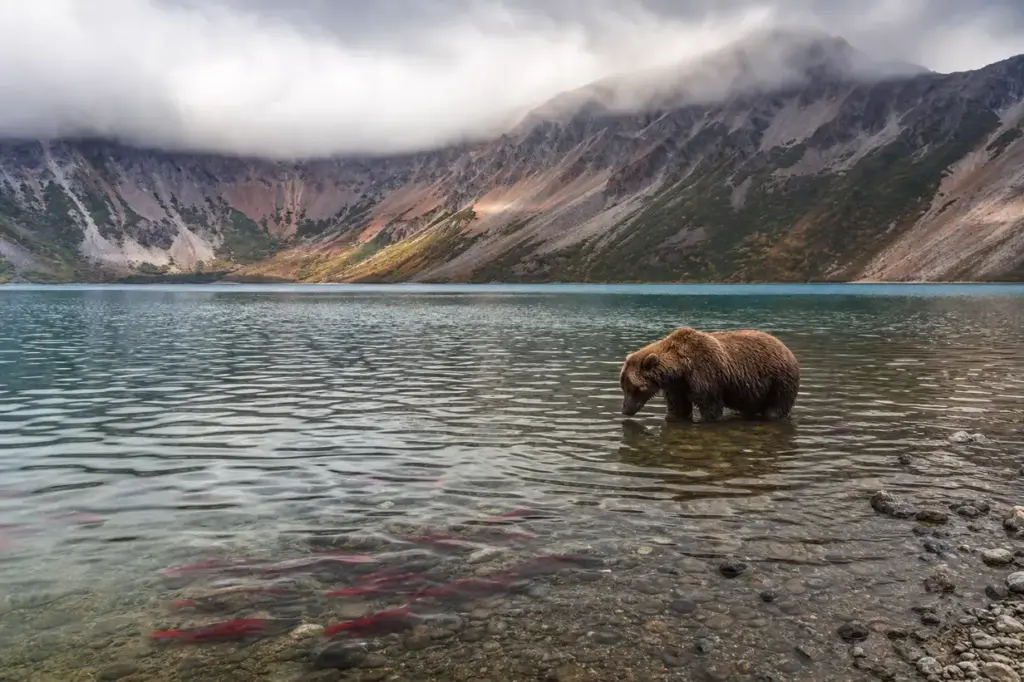
The South Kamchatka Wildlife Sanctuary is a federal protected area in the far south of the peninsula, best known for Kurile Lake and the brown bears that gather there to feed on salmon. It covers more than 3,000 square kilometres and is part of the Volcanoes of Kamchatka UNESCO World Heritage site.
It is not the same as the Southern Kamchatka Nature Park, which covers the Mutnovsky and Gorely volcanoes, so check the name when you book. It is remote: travel usually means a helicopter or a long off-road journey, a permit is required, and weather often decides the schedule. In return you get one of the best chances in Russia to watch bears in a natural setting.
Quick Facts
| Russian name | Южно-Камчатский федеральный заказник |
|---|---|
| Address | Kurile Lake, South Kamchatka Federal Sanctuary, Kamchatka Krai |
| Admission | Permit required; guided trips with helicopter or off-road transfer are ₽₽₽₽. |
| Best time to visit | Bear watching is best when salmon are spawning, from mid-summer through autumn, with August often given as the peak. Spawning continues into winter, and some bears stay active then. Weather is the main uncertainty at any time. |
| Recommended duration | Full day (1.5-2.5 hours on the sanctuary territory) |
| Website | kronoki.org |
What Is (and Isn't) Part of a Visit to South Kamchatka Wildlife Sanctuary, Kamchatka Peninsula?
| Part | Status | Notes |
|---|---|---|
| Kurile Lake observation area | Included in the standard ticket | The main visitor area with a guide and electric fence. |
| Permit and licensed operator | Separate ticket or institution | All visitors need a permit; trips are arranged through operators. |
| Helicopter or off-road transfer | Separate ticket or institution | Not part of the sanctuary visit; arranged by the operator. |
| Southern Kamchatka Nature Park (Mutnovsky, Gorely) | Outside / not part of it | A different protected area with different permits and routes. |
| Independent walking around the lake | Not open to visitors | Leaving the protected visitor area alone is prohibited because of the bears. |
Why Visit South Kamchatka Wildlife Sanctuary, Kamchatka Peninsula?
This is one of the world’s best-known places to watch brown bears fish.
- Kurile Lake, the second largest freshwater lake in Kamchatka and a major salmon spawning ground.
- A long salmon season, from mid-summer into late autumn, with some bears active into winter.
- A volcanic landscape of crater lake, active volcanoes and thermal springs.
- Guided visits with an electric fence and rangers for bear safety.
How South Kamchatka Wildlife Sanctuary, Kamchatka Peninsula Is Laid Out
The sanctuary lies on the southern tip of the peninsula. Its centre is Kurile Lake, a crater lake flanked by volcanoes. Visitors usually arrive by helicopter or off-road transport and spend time at a designated area on the shore with a guide, separated from the bears by an electric fence.
Other features include thermal springs, rookeries of seals and sea otters on Utashud Island in Vestnik Bay, and breeding grounds at Cape Lopatka. These are far from the lake and are normally visited on separate expeditions. For most visitors, the day trip to Kurile Lake is the main option.
Highlights of South Kamchatka Wildlife Sanctuary, Kamchatka Peninsula
Kurile Lake
The living heart of the sanctuary is a crater lake surrounded by volcanoes. It is the second largest freshwater lake in Kamchatka and very deep, with a maximum depth reported at 316 metres. Its size and the setting make it a dramatic place even without bears.
Tip: Bring warm clothing; wind off the lake makes the shore cold even in summer.
Brown bears fishing for salmon
The sanctuary holds the largest protected population of brown bears on the peninsula, and the lake basin has a very high density of bears. In peak season, many bears gather on the shore to catch sockeye salmon, and visitors may see up to dozens at once.
Tip: Follow the ranger's instructions exactly; the bears are wild.
The salmon run
Kurile Lake is the largest spawning ground for sockeye salmon in Eurasia, with spawning from mid-summer to late autumn and some into winter. The water in the lake and its rivers can look red and crowded with fish.
Tip: August is the usual peak for bear watching.
Guided observation area
Visits take place in a fenced area on the shore where guides explain the ecosystem, the sanctuary and the lake's history. Time on the territory is usually about an hour and a half to two and a half hours. Leaving the area alone is prohibited.
Tip: Do not step outside the fenced area without a ranger.
Volcanic scenery
Active volcanoes such as Ilyinsky and Koshelevsky stand in the landscape, with the Dikiy Greben ridge and thermal features such as the Koshelevsky springs. The scenery changes with weather and cloud.
Tip: Ask your operator whether a thermal spring stop is part of the day.
Coast and islands
On the coast, seals and sea otters use rookeries such as Utashud Island, and birds breed at Cape Lopatka. These areas are far from the lake and are normally visited on specialist expeditions.
Tip: These are separate trips from the standard bear-watching day.
Atmosphere
The landscape is wide and quiet. Volcanoes rise behind a large cold lake, and wind carries the smell of water and fish. Along the shore, the sound is mostly water, birds and the click of cameras.
Visitors are in small groups with rangers and a guide, and rules are strict. Bears move calmly along the water, paying little attention to people behind the fence. Weather can change the mood quickly, from bright sun to low cloud.
History of South Kamchatka Wildlife Sanctuary, Kamchatka Peninsula
The sanctuary was set up in the early 1980s as a federal protected area in the south of the peninsula and is named after the naturalist Tikhon Shpilenok. In 1996 the sanctuary was included in the Volcanoes of Kamchatka UNESCO World Heritage site.
It is known for the salmon runs of Kurile Lake and for the largest guarded group of brown bears in Kamchatka. Its staff and partner institutions monitor bears and salmon in the lake basin.
Visitor programmes are organised so that people can learn about the lake ecosystem while protecting the animals, including controlled access and an electric fence in the observation area.
Tickets and Booking for South Kamchatka Wildlife Sanctuary, Kamchatka Peninsula
| Ticket | Price | Includes |
|---|---|---|
| Guided day trip to Kurile Lake | ₽₽₽₽ | Transfer by helicopter or off-road vehicle, guided visit of about two hours and permit handling; contents vary by operator. |
₽ budget · ₽₽ moderate · ₽₽₽ upscale · ₽₽₽₽ splurge. Price levels are estimates compared with typical prices for visitors.
All visitors must obtain a permit to enter the sanctuary, and trips are normally arranged by a licensed operator who handles it. Book well ahead, especially for the bear season, and keep a spare day because weather affects flights and roads.
- Confirm the exact protected area; do not confuse it with the Southern Kamchatka Nature Park.
- Ask what is included in the price, such as transfer, guide and meal.
- Bring cash: cards issued outside Russia do not work in Russia.
Rates for Russian citizens and concessions differ, so check all categories with the operator and on the sanctuary’s website, kronoki.org.
Suggested itineraries South Kamchatka Wildlife Sanctuary, Kamchatka Peninsula
Day trip
Fly or drive from Yelizovo to Kurile Lake, spend about two hours with a guide in the observation area, then return. Weather can delay both legs.
2 days
Spend a night near the lake or the area to allow more time for bears and scenery, and keep a spare day in your plan.
Kamchatka week
Combine the sanctuary with the Avacha Bay boat trip and a hot spring or volcano day, scheduling the sanctuary early so weather delays can be absorbed.
How to Get to South Kamchatka Wildlife Sanctuary, Kamchatka Peninsula
The sanctuary lies in the far south of the peninsula and is reached by helicopter or by a long off-road journey with a licensed operator. Most trips start from Yelizovo or Petropavlovsk-Kamchatsky.
- Operators arrange the permit, transfers and guide.
- Weather often delays flights; keep a spare day.
- There is no public transport to the lake.
Food Nearby
There are no restaurants on the shore. Operators normally provide a packed lunch or meal; ask when you book and carry water.
What to Bring
Warm layers, a waterproof jacket, sturdy shoes, a hat, binoculars, a camera with a long lens and insect repellent. Bring cash for extras.
Best Views and Photo Spots of South Kamchatka Wildlife Sanctuary, Kamchatka Peninsula
Lake shore at the observation area
Bears fishing in shallow water with the lake and volcanoes behind, a classic Kamchatka image.
Best time: Peak salmon season, morning light
Kurile Lake from the air
A crater lake with volcano slopes around it, easy to see on helicopter flights.
Best time: Clear day
Salmon in the shallows
Water filled with spawning fish in red colours, with bears nearby.
Best time: August to September
Volcano backdrop
Active volcanoes rising behind the lake when cloud clears.
Best time: Calm, clear morning
Photography Rules
Photography is allowed in the visitor area. Keep to the fenced zone, never approach animals, avoid flash and do not use drones in the protected area.
Family Suitability
Possible for older children who can follow strict safety rules, but trips are expensive, weather-dependent and involve a helicopter or long off-road drive. Check age limits with the operator. Strollers are not practical.
Russia Vibes Tips
- Check the exact protected area when you book; the South Kamchatka Sanctuary and the Southern Kamchatka Nature Park are two different places.
- Schedule this early in your Kamchatka itinerary so weather delays do not wipe out the trip.
- Ask the operator how long you will actually spend on the shore; it is often only a couple of hours.
- Bring a long lens; bears are at a distance beyond the fence.
- Dress for the lake wind, not for the city weather.
Explore Nearby South Kamchatka Wildlife Sanctuary, Kamchatka Peninsula
Browse more: All Kamchatka Peninsula · All Parks · All Sightseeing · All Sightseeing in Kamchatka Peninsula
FAQ: South Kamchatka Wildlife Sanctuary, Kamchatka Peninsula
What is the South Kamchatka Wildlife Sanctuary?
A federal protected area in the south of Kamchatka, known for Kurile Lake, salmon runs and brown bears.
Is it the same as Southern Kamchatka Nature Park?
No. The nature park covers Mutnovsky and Gorely volcanoes and is a separate area with its own rules.
Do I need a permit?
Yes. All visitors need a permit to enter the sanctuary, usually arranged by the operator.
How do you get there?
Usually by helicopter or a long off-road journey with a licensed operator from the Petropavlovsk-Kamchatsky area.
When can I see bears?
During the salmon run from mid-summer into autumn, with August often the peak. Some bears remain active into early winter.
Can I walk around the lake alone?
No. Leaving the protected visitor area alone is prohibited because of the bears.
How long do visitors spend on site?
A typical guided day trip allows about one and a half to two and a half hours on the territory.
Is it a World Heritage site?
Yes, it is part of the Volcanoes of Kamchatka UNESCO World Heritage site.
Russia Vibes is a one-person project. A coffee keeps it going

Take this guide with you
Get a free PDF of this guide to print or read offline: key facts, tips and a map link on a few clean pages.
Report an issue on this page
Paying for your trip: please read
Payments and bookings between Russia and many other countries are currently restricted. In practice, cards issued in the EU, the UK, the US and several other countries often cannot be used in Russia, Russian cards usually cannot be used abroad, and some booking platforms, airlines and payment providers limit or pause their services for Russia. The situation changes frequently.
We do not give legal or financial advice, and this site does not encourage anyone to break any rule that applies to them. Whatever you plan, you are responsible for following the laws and regulations that apply to you, including those of your country of residence and citizenship.
Many travelers still organise their stay without problems. It is worth asking your bank or payment provider what is currently possible, contacting hotels, tour operators and carriers directly about the payment methods they accept, and checking which services are open to customers from your country. Clarify payment, cancellation and refund terms before you commit to a booking, and keep your plans flexible.
Partner links on this site may not be available in every country, and prices, availability and rules in our guides can differ from what you see when you book.
How we research and update our guides
About this guide: AI assistance and accuracy
This guide is created with the help of AI and is based on official sources where available. Mistakes can still happen. Opening hours, prices, rules and other details are given to the best of our knowledge as of the date shown and can change without notice. It offers general recommendations only, not professional, legal or travel advice. Please confirm important details with the official source before you travel; you are responsible for your own plans and decisions.
* Affiliate link: as an Amazon Associate we earn from qualifying purchases at no extra cost to you.