
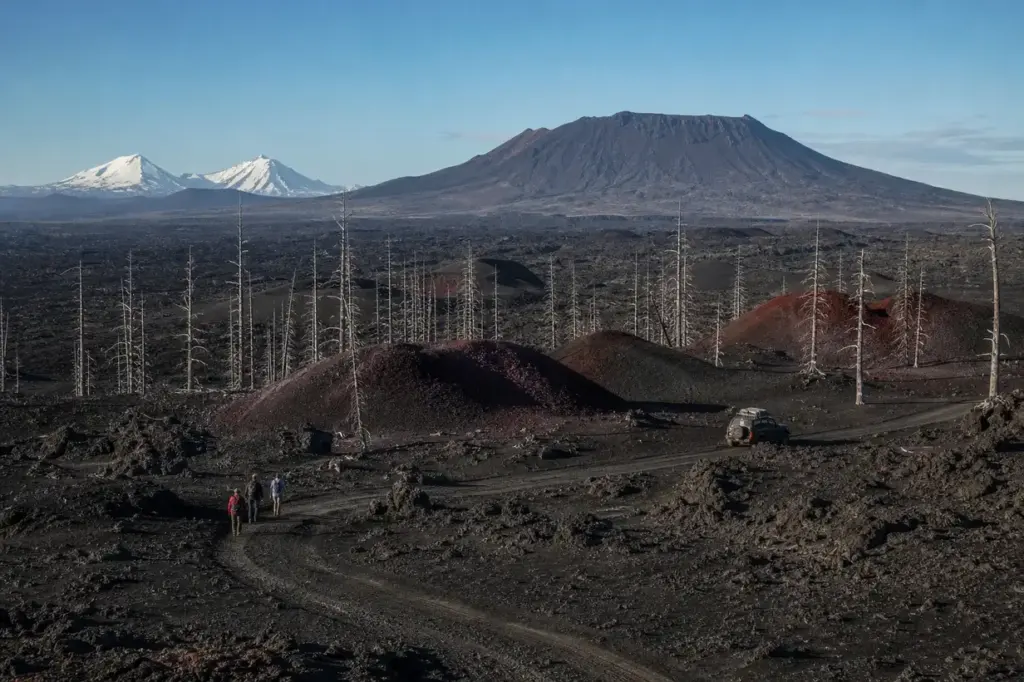
The Tolbachik volcano is one of the most striking volcanic zones in northern Kamchatka, a landscape of black cinder cones, wide lava fields and ghostly dead trees. Tolbachik is really a group of volcanoes and fissures, and two major eruptions in the last century have reshaped the area, which is why a visit feels like walking through a story that is still being written.
Trips normally start in the village of Klyuchi and use off-road vehicles on rough tracks, often over two or more days, with a guide who knows the current conditions. Hikers can walk on cooled lava and look into old craters, while the main summit demands experience and settled weather. Plan spare days, book a licensed operator and bring cash, because cards issued outside Russia do not work.
Quick Facts
| Russian name | вулкан Толбачик |
|---|---|
| District | Ust-Kamchatsky |
| Admission | Access is arranged through operators; guided trips are priced at ₽₽₽ to ₽₽₽₽ |
| Best time to visit | Summer, from about July to September, is the main season, with the best access and the most stable weather. Early summer has snow on higher ground, and autumn brings cold nights and colour. Weather changes fast at every time of year, so keep spare days. Winter trips exist for experienced travellers only. |
| Recommended duration | 2 to 4 days |
What Is (and Isn't) Part of a Visit to Tolbachik Volcano, Kamchatka Peninsula?
| Part | Status | Notes |
|---|---|---|
| Lava fields and cones | Included in the standard ticket | The usual focus of a trip, crossed on foot with a guide on safe lines. |
| Dead Forest | Included in the standard ticket | A well-known area of bare trunks, normally part of the standard route. |
| Off-road transfer from Klyuchi | Separate ticket or institution | Arranged as part of a guided trip; the vehicle and driver are booked through an operator. |
| Climbing Plosky Tolbachik | Outside / not part of it | A serious hike needing fitness, equipment, settled weather and a licensed guide. |
| Active eruption zones | Not open to visitors | Closed or restricted when volcanic activity makes them unsafe. |
| Klyuchevskoy Nature Park | Separate ticket or institution | A neighbouring protected area; see its own article. |
Why Visit Tolbachik Volcano, Kamchatka Peninsula?
Tolbachik is the easiest place on the peninsula to understand how a volcano builds and destroys a landscape. Within a short drive you move from green forest into a black desert of cinders and lava, with cones in red and purple and trees standing bare where ash once buried them. It looks like another planet.
It is also a hands-on experience. You can walk across cooled lava, look into collapsed lava tubes and feel warmth rising from the ground in places. For travellers who like long days outdoors, rough roads and big skies, Tolbachik is among the most rewarding trips in Kamchatka, as long as you accept that weather sets the schedule.
How Tolbachik Volcano, Kamchatka Peninsula Is Laid Out
Tolbachik is a zone, not a single mountain, and trips are planned around several distinct areas that guides link by off-road vehicle.
- Plosky Tolbachik: the broad, flat-topped volcano with a large summit caldera, the main goal for climbers.
- Ostry Tolbachik: the neighbouring pointed cone, usually seen from a distance.
- Lava fields: black fields from the eruption of 1975–1976 and a later fissure eruption, crossed on foot with a guide.
- Dead Forest: an area of bare tree trunks left standing after ash buried the forest in the 1970s.
- Klyuchi village: the usual base, with guesthouses, shops and operator offices.
Which areas you visit depends on weather, road conditions and volcanic activity, so ask your operator about the plan. Do not expect to see every area in one trip: distances are long, tracks are rough and a focused plan with spare days works better than a rushed one. Choose the places that matter most to you and let the guide fill in the rest.
Highlights of Tolbachik Volcano, Kamchatka Peninsula
Black lava fields
The fields left by the great eruption of 1975–1976 and by a later fissure eruption form a vast black plain of cinders, bombs and frozen lava. Guides lead groups along safe lines across the cooled rock, past cones in red, purple and ochre. The surface is sharp and uneven, and wind can raise fine dust. Walking here gives a clear sense of how quickly volcanic landscapes are made and how slowly they recover.
Tip: Wear stiff boots and gloves; the lava edges cut skin and shoes.
The Dead Forest
In the 1970s, falling ash and gases killed a stretch of forest, and the bare trunks still stand among the cinders. The scene is strange and quiet, with grey wood against black ground and sometimes clouds drifting through. It is one of the best-known images of Tolbachik and a good place to talk with your guide about how the eruption unfolded. Photographs work best in low light, when the grey wood stands out against the dark ground and cloud adds depth to the scene.
Tip: Come early or late for the softest light on the bare trunks.
Plosky Tolbachik
The broad, flat-topped volcano dominates the zone, with a large caldera at its summit. Climbing it is a serious hike that takes most of a day or more and needs good fitness, proper equipment, settled weather and a licensed guide. Conditions on the upper slopes can change quickly. Many visitors enjoy the volcano from below, where its size and the surrounding lava fields are already impressive, and where a long day on foot is not required to feel the scale of the place.
Tip: Ask the guide honestly whether your fitness and gear fit the climb.
Lava tubes and cones
Hollow lava tubes and rows of small cinder cones are among the quieter highlights. Guides can show tubes where molten rock once flowed and cooled into a tunnel, and cones that mark old vents. Some are easy to enter, but others are unstable, so only go where your guide allows. The colours of the rock, from rust to deep purple, change with the light and the weather. Take time to look closely, since the textures of the lava are as interesting as the large views.
Tip: Bring a headlamp for the tubes your guide marks as safe.
Warm ground and steam
In places on the lava fields the ground is warm, and gentle steam rises from cracks after rain. These patches show that the volcanic system is still active, even when no eruption is visible. Guides know where it is safe to stand and where to keep away. The sight is subtle but memorable, particularly on cold mornings when the vapour is easy to see. Touching the ground is not allowed unless the guide says it is safe, and the group stays together at all times.
Tip: Keep to your guide's path; warm ground can hide hot spots.
The off-road journey
The ride to Tolbachik is part of the experience. Large off-road trucks or vehicles cross rivers, forest tracks and cinder plains, with views of the Klyuchevskaya cones on clear days. It is bumpy, dusty and slow, and breakdowns or delays are possible, so operators allow spare time. Seats are shared, and the vehicle also serves as shelter in bad weather. Pack for long rides, bring a cushion if you are sensitive to bumps and keep water within reach.
Tip: Bring motion-sickness remedies and keep your camera in a bag.
Atmosphere
Tolbachik is stark and quiet. The ground is black or deep red, the horizon is full of cones and the wind carries a faint metallic smell. Where trees stood, grey trunks rise from the cinders like a ghost forest, and in the distance the Klyuchevskaya volcanoes catch the light.
The mood is expansive and a little humbling. On clear days the colours are sharp and the sky feels huge. In cloud the world shrinks to a few metres of dark rock, and the dead trees emerge from the mist. Evenings in camp or a guesthouse are calm, with talk of what the volcanoes may do next.
History of Tolbachik Volcano, Kamchatka Peninsula
Tolbachik is a volcanic zone built over a very long time by repeated eruptions, but it entered the world’s attention in the 20th century. In July 1975, a fissure opened on the slopes of the main volcano and began the Great Tolbachik Fissure Eruption, one of the largest basaltic eruptions recorded in Russia in modern times. Within hours, huge columns of ash and gas rose into the sky.
The eruption continued for many months and formed two main centres of activity, often called the northern and southern breakthroughs. New cones grew rapidly, and lava flows spread across the nearby plain, covering forest, rivers and old terrain. Ash fell over a wide area, and the trees nearest the vents were killed by heat, ash and gas, leaving the bare trunks of what is now called the Dead Forest.
Volcanologists from across the country came to study the eruption, and it became a famous case for research on basaltic volcanism. The eruption ended in 1976, but it left a landscape of black lava fields, cinder cones and craters that has changed slowly since. Plants, mosses and lichens began to return to the lava, while ash deposits remained. Researchers still return to the fields to measure how fast plants, soil and insects settle on bare lava, which makes the zone useful far beyond tourism.
The zone then entered a long quiet period. Scientists continued to monitor the volcanoes with instruments and field trips, and the lava fields became a popular goal for hikers and photographers. As tourism to Kamchatka grew, guides began to take small groups to Tolbachik by off-road vehicle, and the area became a classic multi-day trip from the village of Klyuchi.
In late 2012 the zone erupted again, almost four decades after the first great eruption. A new fissure opened on the southern flank, and lava flows spread across the older fields, burying parts of the earlier landscape and creating new cones. The eruption continued for many months and attracted researchers and visitors, though access to the active area was restricted for safety reasons. It ended in 2013, leaving fresh black lava next to the older flows of the 1970s.
Today the zone is a living textbook. Visitors can see the older and the newer lava fields side by side, with the Dead Forest, cones and tubes in between. Guides explain the differences between them, and the pattern is clear: eruptions shape the land, and life slowly returns. Each trip shows a different stage of that cycle. It is also a reminder that the zone is not a museum: the volcanoes are monitored, closures happen and the routes that guides use today may differ from those of a few years ago, which is why local knowledge matters so much.
Tickets and Booking for Tolbachik Volcano, Kamchatka Peninsula
| Ticket | Price | Includes |
|---|---|---|
| Guided trip from Klyuchi | ₽₽₽ | Off-road transport, guide and basic camp or lodging arrangements; check meals. |
| Multi-day trip with climb | ₽₽₽₽ | Several days with equipment and a licensed guide for the summit hike. |
| Permit | ₽ | Needed in protected areas; normally arranged by the operator. |
₽ budget · ₽₽ moderate · ₽₽₽ upscale · ₽₽₽₽ splurge. Price levels are estimates compared with typical prices for visitors.
There is no ticket office for Tolbachik. Visits are organised through licensed operators in Klyuchi and Petropavlovsk-Kamchatsky, which arrange vehicles, guides and permits. Contact an operator in advance, say what you want to do and ask for a written programme that states what is included and what happens if weather cancels a day.
- Where: operator websites, guesthouses in Klyuchi or agencies in the regional capital.
- Payment: cards issued outside Russia do not work, so ask which methods the operator accepts and plan cash.
- Season: summer fills first, so book weeks ahead.
- Warnings: avoid sellers who cannot name the guide or show a permit.
Rules and conditions change, so confirm them before you pay.
Suggested itineraries Tolbachik Volcano, Kamchatka Peninsula
Two days
Join a guided trip from Klyuchi by off-road vehicle: lava fields and the Dead Forest on the first day, an overnight in a simple camp or hut, and a morning walk before the return. Weather sets the schedule, so keep a spare day.
Three days
Spend three days with a longer route that adds lava tubes, cones and a high viewpoint, with an overnight stay. This suits keen photographers and hikers who want time to move slowly across the fields. Check the weather the evening before and again at breakfast.
Four days
Include a climb of Plosky Tolbachik with a licensed guide, a rest day and a spare day for weather. This is a serious trip for fit hikers, and it should be planned with the operator well in advance. Allow extra time, because transfers and weather can move the schedule.
How to Get to Tolbachik Volcano, Kamchatka Peninsula
Tolbachik lies in northern Kamchatka, reached from the village of Klyuchi, which is a long road journey from Petropavlovsk-Kamchatsky. Yelizovo Airport is the usual arrival point, and a transfer to Klyuchi takes most of a day.
- By organised transfer: the simplest option, arranged with an operator or a guesthouse.
- By off-road vehicle from Klyuchi: the only practical way to reach the lava fields, with a guide and driver.
- By helicopter: offered by some operators, weather permitting.
Allow spare days for road, river and weather problems.
Accessibility
The trip involves rough tracks, long days in off-road vehicles and walking on uneven lava, so it is not suitable for wheelchair users and difficult for people with limited mobility. Ask the operator about walking distances, vehicle access and rest points, and tell them about any health needs before booking.
Food Nearby
There are no cafes at Tolbachik. Operators provide simple meals on trips, often cooked at camp, and Klyuchi has small shops and a few places to eat. Bring snacks and water, and tell the operator about dietary needs in advance. Food must be stored carefully because of bears.
What to Bring
Bring waterproof hiking boots with stiff soles, layers, a windproof jacket, hat, gloves and sun protection. Pack gloves for lava, a headlamp, insect repellent, snacks, a power bank and cash, since cards issued outside Russia do not work. Keep a dry bag for electronics and a spare layer for cold evenings.
Best Views and Photo Spots of Tolbachik Volcano, Kamchatka Peninsula
Dead Forest
Grey trunks against black ground and drifting cloud make a strong, moody image. Keep to the marked route. Bring a spare battery and a lens cloth.
Best time: Low light, early or late.
Lava field with cones
Dark rock in the foreground and red and purple cones behind show the scale of the eruption. Use a wide lens and a low angle. Dress warmly, because wind makes it feel colder.
Best time: Late afternoon for side light.
Lava tube entrance
The contrast between rust-coloured rock and the dark opening is dramatic. Only enter where the guide allows. Arrive early to find a good spot before others do.
Best time: Midday, when light reaches inside.
Distant Klyuchevskaya cones
On clear days the snow-capped volcanoes frame the black plain. A long lens compresses the view. Bring a spare battery and a lens cloth. Dress warmly, because wind makes it feel colder.
Best time: Early morning before cloud builds.
Photography Rules
Photography is allowed. Drones are often restricted near volcanoes and in protected areas, so ask the operator before flying one. Keep dust out of the camera with a bag or cover, use a wide lens for the lava fields and never leave the route for a better angle.
Family Suitability
Older children who enjoy long vehicle rides and short walks can manage the standard trip, but the rough roads, dust and weather make it demanding for small children. Climbing is not suitable for families. Ask operators about minimum ages and shorter options.
Russia Vibes Tips
- Plan two spare days; weather and rivers can change a route.
- Choose a guide who knows the current conditions on the lava fields.
- Carry cash, because cards issued outside Russia do not work.
- Wear gloves and sturdy boots; fresh lava is sharp.
- Take dust protection for your camera and phone.
- Ask which areas are closed or restricted before you pay for a route.
Explore Nearby Tolbachik Volcano, Kamchatka Peninsula
Related guides
 Kamchatka Peninsula: Volcanoes, Wildlife and Travel Guide
Main image: AI-generated illustration. It may not show the place exactly as it looks.
 Klyuchevskoy Nature Park: Volcano Group, Lava Fields and Klyuchi
Main image: AI-generated illustration. It may not show the place exactly as it looks.
Browse more: More in Ust-Kamchatsky · All Kamchatka Peninsula · All Parks · All Sightseeing · All Sightseeing in Kamchatka Peninsula
FAQ: Tolbachik Volcano, Kamchatka Peninsula
What is Tolbachik?
It is a volcanic zone in northern Kamchatka with two main volcanoes, Plosky and Ostry Tolbachik, and wide lava fields from eruptions in the 1970s and in 2012–2013. Details vary by season, so confirm them with the operator before you go.
How do I get to Tolbachik?
Most visitors travel from Petropavlovsk-Kamchatsky to the village of Klyuchi, then continue by off-road vehicle with a guide. Some operators also offer helicopter options. Ask your host or operator for the latest information before you set out. Conditions change quickly here, so keep a spare day in your plan.
Can I climb Plosky Tolbachik?
Yes, with fitness, proper equipment, settled weather and a licensed guide. The climb takes most of a day or more, and conditions on the upper slopes can change quickly. Conditions change quickly here, so keep a spare day in your plan.
What is the Dead Forest?
It is an area where trees were killed by ash and gas during the eruption of 1975–1976. The bare trunks still stand among the cinders, making one of the best-known scenes in the zone. Local guides usually know the current situation better than any map.
Do I need a guide?
Yes. The tracks are rough, the weather changes quickly, rivers can be high and conditions on the lava fields are unpredictable. A guide also arranges permits and vehicles. Details vary by season, so confirm them with the operator before you go.
When is the best time to go?
Summer, from about July to September, offers the best access and weather. Early summer has snow on higher ground, and autumn is colourful but cold. Ask your host or operator for the latest information before you set out. Conditions change quickly here, so keep a spare day in your plan.
Is it the same as Klyuchevskoy Nature Park?
No. They are neighbouring volcanic areas near Klyuchi. Many trips visit both, but each has its own landscape and its own article on this site. Conditions change quickly here, so keep a spare day in your plan. Local guides usually know the current situation better than any map.
Is it dangerous?
Trips are run with guides who know safe routes, but volcanic areas can change. Active zones may be closed, lava is sharp and the weather turns quickly. Follow your guide's instructions at all times. Local guides usually know the current situation better than any map.
Russia Vibes is a one-person project. A coffee keeps it going

Take this guide with you
Get a free PDF of this guide to print or read offline: key facts, tips and a map link on a few clean pages.
Report an issue on this page
Paying for your trip: please read
Payments and bookings between Russia and many other countries are currently restricted. In practice, cards issued in the EU, the UK, the US and several other countries often cannot be used in Russia, Russian cards usually cannot be used abroad, and some booking platforms, airlines and payment providers limit or pause their services for Russia. The situation changes frequently.
We do not give legal or financial advice, and this site does not encourage anyone to break any rule that applies to them. Whatever you plan, you are responsible for following the laws and regulations that apply to you, including those of your country of residence and citizenship.
Many travelers still organise their stay without problems. It is worth asking your bank or payment provider what is currently possible, contacting hotels, tour operators and carriers directly about the payment methods they accept, and checking which services are open to customers from your country. Clarify payment, cancellation and refund terms before you commit to a booking, and keep your plans flexible.
Partner links on this site may not be available in every country, and prices, availability and rules in our guides can differ from what you see when you book.
How we research and update our guides
About this guide: AI assistance and accuracy
This guide is created with the help of AI and is based on official sources where available. Mistakes can still happen. Opening hours, prices, rules and other details are given to the best of our knowledge as of the date shown and can change without notice. It offers general recommendations only, not professional, legal or travel advice. Please confirm important details with the official source before you travel; you are responsible for your own plans and decisions.
* Affiliate link: as an Amazon Associate we earn from qualifying purchases at no extra cost to you.