
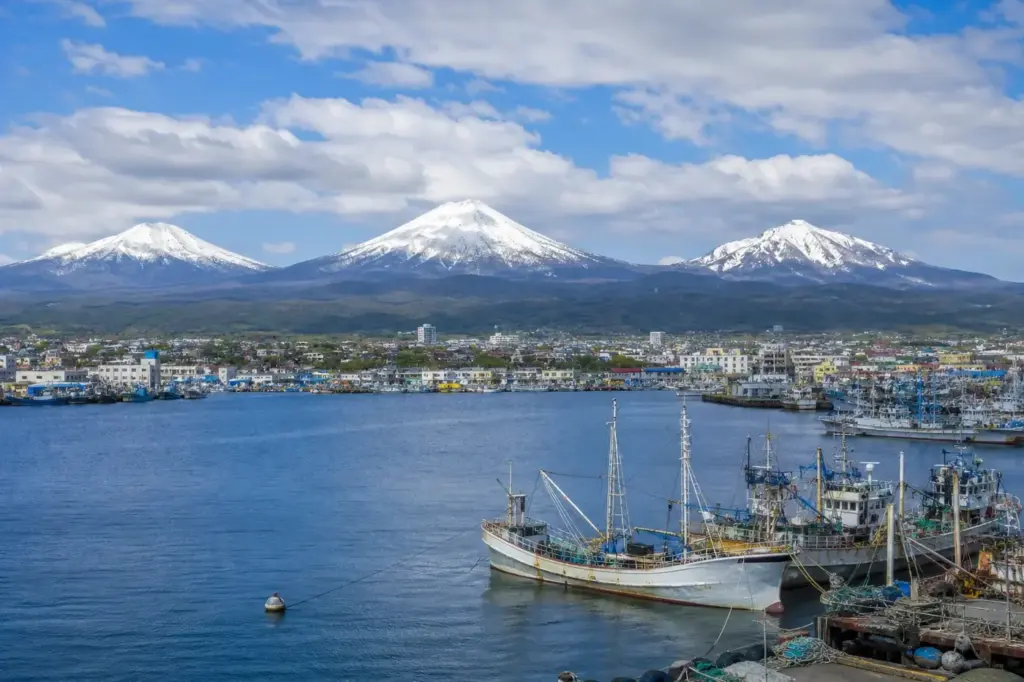
Founded in 1740 during Vitus Bering’s second Kamchatka expedition, Petropavlovsk-Kamchatsky sits on one of the Pacific’s most dramatic coastlines. The city lies along the landlocked Avacha Bay, where fishing vessels still dominate the harbor and three volcanoes frame the skyline. This is Russia’s gateway to the remotest corner of its territory—a place where nature sets the tone.
Visitors arrive mainly for the volcanoes, geysers and brown bears that live inland, but the city itself offers museums, Soviet-era monuments and the everyday rhythm of a Russian Far East port. Winters are long and cool; summer weeks are bright and surprisingly mild. Most tourism infrastructure clusters in the small downtown, while day trips reach hot springs, geysers and hiking trails within an hour or two.
Quick Facts
| Russian name | Петропавловск-Камчатский |
|---|---|
| Built / opened | 1740 |
| Address | Google MapsApple MapsYandex Maps2GIS |
| District | Kamchatka Krai |
| Best time to visit | Summer (June–September) offers the most stable weather, warmest temperatures (10–16°C), and the most tour availability. July and August are peak season for volcano and bear-viewing trips. Autumn (September–October) brings occasional clear skies and fewer crowds, but weather becomes unpredictable. Winter (November–March) is cold, snowy, and many outdoor attractions close; tourism is minimal. Spring (April–May) is transition season with lingering snow and muddy trails. Visit a museum or explore downtown in any season; reserve volcano and multi-day outdoor trips for summer months only. |
| Recommended duration | 2–3 days |
| Website | pkgo.ru |
What Is (and Isn't) Part of a Visit to Petropavlovsk-Kamchatsky, Kamchatka Peninsula?
| Part | Status | Notes |
|---|---|---|
| City downtown and harbor | Included in the standard ticket | Walking accessible; museums, churches and waterfront attractions are in the central area. |
| Avacha Bay boat tours | Separate ticket or institution | Organized tours depart from the harbor; book in advance through hotels or tour operators; typically cost ₽₽ to ₽₽₽. |
| Mishennaya Sopka and Nikolskaya Sopka hikes | Included in the standard ticket | Free to access; no permit required for day hikes on the hills themselves. |
| Khalaktyrsky Beach | Included in the standard ticket | Free public beach; accessible by taxi or local bus; about 15 minutes from downtown. |
| Volcanoes (Mutnovsky, Gorely, Avachinsky) | Separate ticket or institution | Day trips requiring guides, permits and transportation; arranged through tour operators; typically ₽₽₽ to ₽₽₽₽. |
| Valley of Geysers | Separate ticket or institution | Requires helicopter charter (most common) or multi-day trekking; extremely expensive, ₽₽₽₽; not part of the city. |
Why Visit Petropavlovsk-Kamchatsky, Kamchatka Peninsula?
Volcanoes have become the main attractions of the city and all of Kamchatka. Koryaksky and Avachinsky are active volcanoes near the city, and a chain of five volcanoes lies 25 km away with two active ones. From the city center you can see them across the bay, smoldering on clear days.
The city serves as the logistics hub for reaching Kamchatka’s remote wonders—the Valley of Geysers (a smaller mirror of Yellowstone), Mutnovsky and Gorely volcanoes, and brown bear viewing at river fishing sites. In 1854, during the Crimean War, an Anglo-French attack on Petropavlovsk was repulsed, leaving behind war monuments and historical layers. For travelers, it is the essential base: no other major settlements exist within hundreds of kilometers.
Highlights of Petropavlovsk-Kamchatsky, Kamchatka Peninsula
Avacha Bay
Avacha Bay is one of the most picturesque bays of the world, discovered in 1703 by Russian Cossacks. The bay curves around the city on three sides, and small boat tours depart from the harbor to view sea stacks, rock formations, sea lions and bird colonies. On calm days, the volcanic peaks mirror in the water. Take binoculars and a camera; tours typically last 2–3 hours and depart from the central embankment.
Tip: Go early in the day for the calmest water and best light; afternoon winds can make the bay choppy and tours may be cancelled.
Mishennaya Sopka and Nikolskaya Sopka Hills
The historical center is located between Mishennaya, Petrovskaya and Nikolskaya hills, with Lake Kultuchnoye separated from Avacha Bay by a narrow isthmus. Both hills offer hiking trails with panoramic views of the city, bay and volcanoes. Nikolskaya Sopka is a wooded hill with walking paths and war monuments and a chapel located on the hill. Most visitors hike Mishennaya for the best sunset views; both hikes take 1–2 hours round trip.
Tip: Start your hike mid-afternoon to reach the summit before sunset; trails are muddy in rain and snow blocks them November through April.
Holy Trinity Cathedral
The city's most visible landmark is the golden-domed Orthodox cathedral overlooking downtown. The cathedral is this golden-domed stunner, which sits on an outcrop from where it is visible from all over the city. The interior contains icons and religious art. Entry is free; respectful dress is expected (covered shoulders and knees).
Tip: Visit on a clear day to photograph the dome lit by afternoon sun; the cathedral is busiest on Sunday mornings for services, which are open to respectful visitors.
Kamchatka Regional United Museum
The Kamchatka Regional United Museum is a treasure trove for those eager to delve into the region's rich natural history and cultural heritage, showcasing an eclectic array of artifacts that narrate the story of Kamchatka's development and its diverse ethnography. Exhibits cover geology, indigenous peoples, natural history and fishing culture. Allow 2–3 hours to walk through the halls.
Tip: Most labels are in Russian; hiring a guide in advance (arrange through your hotel or the museum) greatly enriches the visit. Ask specifically about exhibits on the Second Kamchatka Expedition and the 1854 Crimean War defense.
Vulcanarium Museum
Vulcanarium is a private museum operating since 2017, offering an immersion in the atmosphere of Kamchatka, with exhibits on the life and traditions of indigenous peoples, showing different stages of regional development, with a special part devoted to volcanoes and their features, displaying lava flow models and rock samples. The museum is compact, filled with photographs and volcanic materials from eruptions near the city.
Tip: This museum works best for visitors with limited time in the city or those unable to hike to volcanoes; combine it with a walk through the adjacent downtown for a half-day cultural visit.
Khalaktyrsky Beach
Khalaktyrsky Beach is a large beach with black sand, located on the eastern outskirts of the city. The beach is dramatic, often windy, and backed by volcanic ridges. On clear days you can see Mount Vilyuchinsky across the bay. The black sand is distinctive and quite cold even in summer.
Tip: Visit in July or August for the warmest water (still cold by most standards); bring a windbreaker and waterproof jacket year-round, as ocean winds are constant.
Three Brothers Rocks
The Three Brothers Rocks are a trio of stark sea stacks guarding the entrance to Avacha Bay. These rock formations are a classic subject for photography and wildlife viewing (seabirds nest on them). Most visitors see them from boat tours in the bay rather than from shore.
Tip: Book a bay tour in advance during summer; Three Brothers are best photographed in afternoon light when shadows define their shapes. Bring a telephoto lens if photographing birds.
Downtown Monuments and Soviet Architecture
The city center preserves Soviet-era buildings and monuments to Vitus Bering, explorers, and the 1854 battle. Plaques commemorate the Second Kamchatka Expedition, Japanese traders and Russian administrators. Petropavlovsk-Kamchatsky is one of the oldest cities in the Russian Far East, with Cossacks arriving from the Russian kingdom in 1697 to build warehouses for furs, and in 1740, participants of the Second Kamchatka Expedition arrived here. A 30-minute walking tour covers the main sites.
Tip: Pick up a printed map from your hotel showing monument locations; many plaques are in Russian and Cyrillic only, so a translation app helps. Early morning or late afternoon light works best for photography.
Atmosphere
Petropavlovsk-Kamchatsky is a working port city with a frontier spirit. It is the largest city on the Kamchatka Peninsula and the fourth-largest city in the Russian Far East, yet outside the small downtown, wilderness begins almost immediately. The waterfront buzzes with fishing vessels and cargo ships; the harbor smells of salt and diesel. Streets are quiet compared to major cities; many local businesses close by 19:00. Summers bring hikers and volcano chasers, creating a cosmopolitan buzz; winters are subdued, with snow and short daylight. Most visitors are Russian or European adventurers seeking bears, volcanoes or geysers. The city feels very Russian in its Soviet monuments and administrative bearing, yet profoundly shaped by its isolation on the Pacific edge.
History of Petropavlovsk-Kamchatsky, Kamchatka Peninsula
The Cossacks were the first to arrive here from the Russian kingdom in 1697, building warehouses for storing yasak – furs, which were collected as a tax from the peoples of Siberia and the Far East.
The city was founded in 1740 during Vitus Bering’s second Kamchatka expedition. On October 17, 1740, the St. Peter and St. Paul packet boats of the Second Kamchatka Expedition entered the Niakina harbor. Vitus Bering named it as the harbor of St Apostles Peter and Paul, and the new settlement on its shores as Petropavlovsk harbor. This date is considered to be the city’s birthday. In 1779 first foreign vessels entered the bay under command of Charles Clarke, the assistant and deputy of the famous James Cook. In 1787 famous French seafarer Jean Francois La Perouse visited the harbor and found about 100 residents in the settlement.
In April 1812, Emperor Alexander I approved the regulation ‘On the transformation of the military and civilian life in Kamchatka’. According to it, Petropavlovsky harbor became the administrative center of Kamchatka. The settlement received the status of a town.
In 1854, during the Crimean War, an Anglo-French attack on Petropavlovsk was repulsed. This defense remains a source of pride and historical memory, commemorated by monuments and a chapel on Nikolskaya Sopka.
In 1924, the town was renamed Petropavlovsk-Kamchatsky to distinguish it from the city of Petropavlovsk located in Kazakhstan. In 1932, the Kamchatka Branch of the Pacific Research Institute of Fisheries and Oceanography was organized here. In 1933, the first professional theater was opened. In the 1930s, the borders of Petropavlovsk-Kamchatsky expanded significantly. In 1939, its population was 35,373 people. By 1956, the population increased to 58,000 people.
Legends and Myths about Petropavlovsk-Kamchatsky, Kamchatka Peninsula
Bering's Ships and the Naming of the Harbor
Legend – historically unreliable. On October 17, 1740, the St. Peter and St. Paul packet boats of the Second Kamchatka Expedition entered the harbor. Vitus Bering named it as the harbor of St Apostles Peter and Paul, and the new settlement on its shores as Petropavlovsk harbor. The two ships remain a symbol of the city, depicted on its coat of arms, and the date is celebrated annually as City Day.
The 1854 Defense Against Anglo-French Forces
Legend – historically unreliable. In 1854, during the Crimean War, an Anglo-French attack on Petropavlovsk was repulsed. Russian defenders held the harbor against naval bombardment, making it one of Russia's few successful defenses during the war. Monuments, memorials and a chapel on Nikolskaya Sopka honor those who died.
Tickets and Booking for Petropavlovsk-Kamchatsky, Kamchatka Peninsula
| Ticket | Price | Includes |
|---|---|---|
| Kamchatka Regional United Museum | ₽ | General admission to all permanent and temporary exhibitions. |
| Vulcanarium Museum | ₽ | General admission to volcanic and ethnographic exhibits. |
| Avacha Bay boat tour | ₽₽ | 2–3 hour guided boat tour viewing Three Brothers Rocks, sea lion colonies, and coastal formations. |
₽ budget · ₽₽ moderate · ₽₽₽ upscale · ₽₽₽₽ splurge. Price levels are estimates compared with typical prices for visitors.
Museums and attractions in downtown Petropavlovsk-Kamchatsky do not require advance booking for international visitors; walk-in visits are normal. Avacha Bay boat tours should be booked the evening before or morning of your visit through your hotel concierge or directly at the harbor. Tours operate daily May through September, weather permitting; winter tours are less frequent.
Day trips to volcanoes, hot springs, and the Valley of Geysers must be booked with licensed tour operators in advance (1–3 days ahead). Hotels can recommend operators or provide booking assistance. Bring your passport; copies are sometimes requested for tour manifests. The official city website (pkgo.ru) does not provide an English booking portal, so tour operators and hotels are the practical channels for visitors.
Suggested itineraries Petropavlovsk-Kamchatsky, Kamchatka Peninsula
Half day (afternoon/evening)
Walk downtown to the Holy Trinity Cathedral, explore surrounding monuments and plaques, then hike Mishennaya Sopka for sunset views. Return to the harbor for dinner. Total time: 4–5 hours.
Full day
Morning visit to the Kamchatka Regional United Museum (2 hours). Lunch at a downtown café. Afternoon Avacha Bay boat tour (2–3 hours). Evening walk along the embankment and visit Vulcanarium (1 hour). Dinner with bay views.
Two days
Day 1: Museums, cathedral and hill hikes as above. Day 2: Early departure for a volcano day trip (Mutnovsky or Gorely) or Paratunka hot springs (requires booking). Return to the city by early evening.
Three days
Day 1: Downtown cultural loop (museums, monuments, hikes). Day 2: Volcano or hot springs day trip. Day 3: Khalaktyrsky Beach in the morning, leisurely harbour walk, and evening departure—or a second day trip to a different volcano or the Valley of Geysers (helicopter).
How to Get to Petropavlovsk-Kamchatsky, Kamchatka Peninsula
Petropavlovsk-Kamchatsky has no train service and is not connected to mainland Russia by road. The nearest airport is Elizovo Airport (IATA: PKC), located about 30 km north of the city. Most travelers fly from Moscow (Sheremetyevo), Vladivostok, or Novosibirsk.
From Elizovo Airport to downtown: Arrange a transfer through your hotel in advance (₽₽ to ₽₽₽). Shared shuttle vans and taxis are available; journey time is 45 minutes to 1 hour depending on traffic. There is no public bus service from the airport.
Downtown orientation: The city center is compact and walkable. Most hotels, restaurants and museums lie within 1–2 km of the harbor. Local minibuses (marshrutki) connect neighborhoods; fares are low (₽). Taxis are abundant; negotiate the fare before entering or use a ride-share app if available.
For day trips: Tour operators provide transport. Bring your passport and confirm departure times the evening before.
Accessibility
Downtown museums and churches are accessible with mobility aids in most cases, though some older buildings lack elevators. Sidewalks can be icy or uneven, especially in winter. Mishennaya and Nikolskaya Sopka trails are steep and muddy; not recommended for wheelchair users. The Holy Trinity Cathedral has steps but no wheelchair access to the interior. Contact your hotel or tour operator in advance if you have specific accessibility needs; English-language accessibility information is limited, so bring written instructions in Russian if possible.
Food Nearby
Downtown restaurants and cafés serve Russian cuisine, seafood and international dishes. Look for restaurants along the harbor embankment and on Lenin Street (the main shopping street). Fresh fish is common and affordable (₽ to ₽₽). Supermarkets stock groceries and packaged goods. Street food such as pelmeni (dumplings) is sold from kiosks. Outside the downtown core, dining options are limited. Most hotels provide breakfast; dinner should be arranged before 19:00 closing time.
What to Bring
Waterproof jacket and windbreaker (essential year-round; coastal winds are constant). Sturdy hiking boots for hill trails (often muddy or wet). Binoculars for bay tours and bird viewing. Hat, gloves and warm layers in any season. Sunscreen and insect repellent for summer. Charger for electronic devices; bring adapters for European outlets (Type C or F). Cash in Russian rubles for small purchases and taxis; card acceptance in shops is improving but remains inconsistent. A lightweight translation app helps read Russian labels and menus. Small day pack for museums and walks.
Best Views and Photo Spots of Petropavlovsk-Kamchatsky, Kamchatka Peninsula
Mishennaya Sopka summit at sunset
The entire Avacha Bay, downtown harbor with fishing vessels, and the three volcanoes (Koryaksky, Avachinsky and Kozelsky) silhouetted against the setting sun. The view stretches across the Pacific horizon with the city lights beginning below.
Best time: June–August, 1 hour before sunset; clearest on windless evenings after rain.
Holy Trinity Cathedral from the harbor embankment
The golden dome framed by the bay and distant mountains. Approach from the waterfront looking northeast; the cathedral sits elevated above downtown with fishing boats and docked vessels in the foreground.
Best time: Morning (7–9 AM) for soft side light and clear water reflections; midday backlighting also works.
Three Brothers Rocks from Avacha Bay boat tour
Three dark rock stacks jutting from the sea with seabirds circling; the Pacific swells and coastal cliffs behind them. Best captured from the boat as the tour circles the rocks.
Best time: Afternoon, when sunlight defines their shapes; calm seas (July–August best).
Khalaktyrsky Beach with Mount Vilyuchinsky backdrop
Black sand beach in the foreground, waves rolling in, and a dramatic volcanic cone rising in the distance across the bay. Very wide-angle perspective for dramatic scale.
Best time: Late afternoon when the volcano is lit and shadows define the beach contours; also works in morning light.
Downtown harbor at dawn
Fishing boats and cargo vessels at anchor with the bay, mountains and volcanoes reflected in calm early-morning water. Few people, soft golden light, and working-port atmosphere.
Best time: 5–7 AM in summer months; dress warmly as coastal winds chill quickly.
Nikolskaya Sopka memorial complex
War monuments, a small chapel and stone monuments on a wooded hillside overlooking the bay. Historic plaques and views of the harbor from the ridge; blend of nature and Soviet-era stonework.
Best time: Late afternoon for the golden hour and long shadows; brings out details of the monuments and engravings.
Photography Rules
Photography is generally permitted in museums, though some exhibits prohibit flash or tripods; ask staff before photographing. Outdoor photography (bay tours, hikes, monuments) is unrestricted. Drones require permits from local aviation authorities; do not fly without checking current regulations. Tripods are fine for fixed landscapes. Golden hour (early morning and late afternoon) is ideal for the cathedral dome and volcanic backdrops.
Family Suitability
Petropavlovsk-Kamchatsky is moderately family-friendly. Downtown walking, museums and the cathedral are suitable for children of all ages. Avacha Bay boat tours are generally safe for children 5+; sea conditions can be rough, and motion sickness remedies are advisable. Hill hikes (Mishennaya, Nikolskaya Sopka) are manageable for children 6+ with good fitness; trails have no handrails and can be muddy. Khalaktyrsky Beach is accessible but very cold and often windy; older children enjoy exploring. Volcano and multi-day trips are demanding and typically suited to teenagers and adults. Strollers work on downtown streets but not on hiking trails. Limited dedicated children's attractions; most appeal lies in natural scenery and outdoor activity rather than typical theme parks or attractions.
Russia Vibes Tips
- Book all day trips (volcanoes, geysers, hot springs) the evening before through your hotel or a tour operator, not on the morning of departure. Popular trips can fill, and guides need roster confirmation overnight.
- Download offline maps and a translation app before arriving; internet connectivity is reliable in downtown but weak outside the city center, and English is rarely spoken outside tour companies.
- Don't miss the harbor embankment at dusk. Locals gather there to walk, and the light across the bay transforms the landscape; it's the best casual introduction to the city's character.
- The post office and some shops close by 17:00 or 18:00; plan shopping and administrative tasks for daytime hours. Most restaurants close by 21:00 or 22:00.
- Bring cash (rubles) for small purchases, museums and taxis. Card payments work in hotels and some cafés but are unreliable in smaller shops. ATMs are concentrated downtown near the harbor.
- If hiking Mishennaya or Nikolskaya Sopka in summer, start by 16:00 at the latest; the trails cross open hillside with no shade, and sun exposure is intense despite cool temperatures.
Explore Nearby Petropavlovsk-Kamchatsky, Kamchatka Peninsula
Browse more: More in Kamchatka Krai · All City · All Kamchatka Peninsula · All Sightseeing · All Sightseeing in Kamchatka Peninsula
FAQ: Petropavlovsk-Kamchatsky, Kamchatka Peninsula
Is Petropavlovsk-Kamchatsky connected to mainland Russia by road or train?
No. The city has no train service and no road connection to the rest of Russia. Access is by air only (flights from Moscow, Vladivostok or Novosibirsk) or by sea (cruise ships or chartered vessels). The distance and geography make it one of Russia's most remote cities.
How do I get to the volcanoes and geysers from the city?
All volcano and geysers trips are organized tours departing from downtown. Book through your hotel or licensed tour operators. Mutnovsky and Gorely volcanoes require full-day or multi-day guided hikes (₽₽₽ to ₽₽₽₽). The Valley of Geysers requires helicopter charter (₽₽₽₽). No independent travel is possible due to remoteness and permit requirements.
What is the best time to visit?
Summer (June–September) offers stable weather, warm days (10–16°C), and full availability of tours and activities. July and August are peak season. Winter is cold and snowy; most outdoor attractions close. Spring and autumn are transitions with unpredictable weather.
Do I need a visa to visit?
Visa requirements depend on your nationality and Russia's current entry rules. Most visitors require a Russian visa. Check with the Russian embassy or consulate in your country. As of October 2026, rules may change; verify current requirements before booking.
What language is spoken, and how much English is available?
Russian is the primary language. English is spoken in hotels, tour companies and some restaurants catering to visitors. Museums and street signs are primarily in Russian and Cyrillic. A translation app and small Russian phrasebook are helpful.
How many days do I need in Petropavlovsk-Kamchatsky?
Two to three days is sufficient to see downtown attractions, museums and the harbor, plus one day trip. To include volcanoes or geysers, add 1–2 more days. Most visitors stay 3–5 days total.
Are there restaurants and accommodation options?
Yes. Hotels range from budget to mid-range (₽ to ₽₽₽); luxury international chains are absent. Restaurants serve Russian, seafood and international cuisine (₽ to ₽₽). Booking in advance through international sites or Russian platforms is recommended.
Is the city safe for tourists?
Yes. Petropavlovsk-Kamchatsky is generally safe for tourists. Standard precautions apply: avoid isolated areas at night, keep valuables secure, and stay aware of your surroundings. The city center is walkable and well-lit in evening. Hiking and outdoor activities carry natural hazards; use licensed guides for volcano and geysers trips.
Russia Vibes is a one-person project. A coffee keeps it going

Take this guide with you
Get a free PDF of this guide to print or read offline: key facts, tips and a map link on a few clean pages.
Report an issue on this page
Paying for your trip: please read
Payments and bookings between Russia and many other countries are currently restricted. In practice, cards issued in the EU, the UK, the US and several other countries often cannot be used in Russia, Russian cards usually cannot be used abroad, and some booking platforms, airlines and payment providers limit or pause their services for Russia. The situation changes frequently.
We do not give legal or financial advice, and this site does not encourage anyone to break any rule that applies to them. Whatever you plan, you are responsible for following the laws and regulations that apply to you, including those of your country of residence and citizenship.
Many travelers still organise their stay without problems. It is worth asking your bank or payment provider what is currently possible, contacting hotels, tour operators and carriers directly about the payment methods they accept, and checking which services are open to customers from your country. Clarify payment, cancellation and refund terms before you commit to a booking, and keep your plans flexible.
Partner links on this site may not be available in every country, and prices, availability and rules in our guides can differ from what you see when you book.
How we research and update our guides
About this guide: AI assistance and accuracy
This guide is created with the help of AI and is based on official sources where available. Mistakes can still happen. Opening hours, prices, rules and other details are given to the best of our knowledge as of the date shown and can change without notice. It offers general recommendations only, not professional, legal or travel advice. Please confirm important details with the official source before you travel; you are responsible for your own plans and decisions.
* Affiliate link: as an Amazon Associate we earn from qualifying purchases at no extra cost to you.