
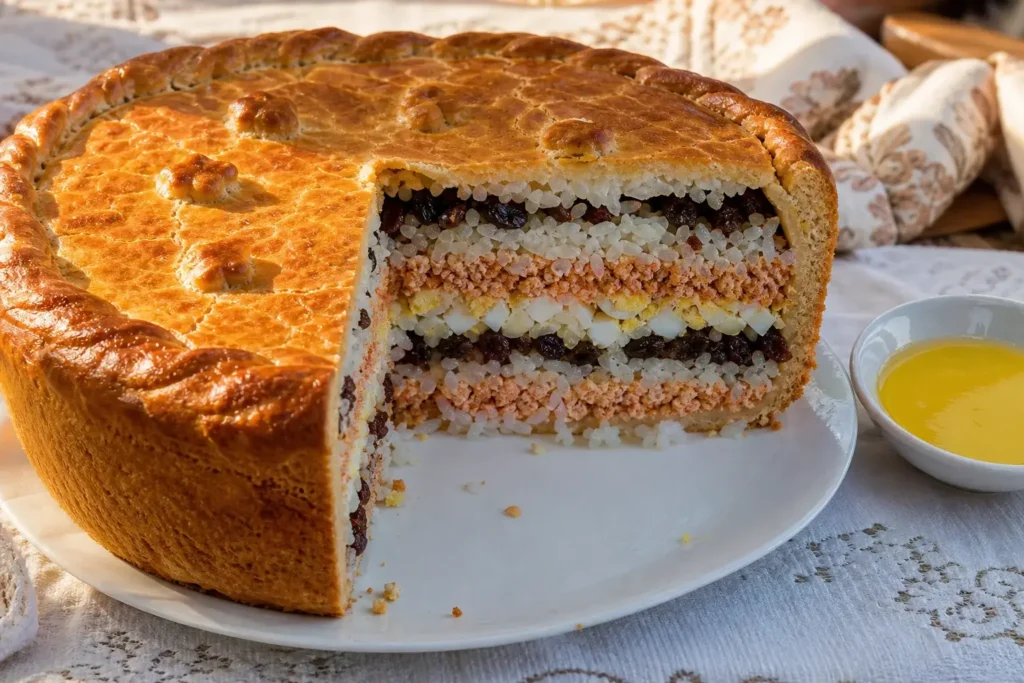
Gubadia is a traditional dish from Tatar and Bashkir cuisine in Russia. If you search for “Gubadia: how to make Tatar layered pie,” you’re looking to recreate one of the region’s most elaborate festive dishes at home. Gubadia is prepared on holidays, for weddings, when celebrating naming and meeting welcome guests.
This guide walks you through making the sweet version with dried curds and fruits—though meat variants exist. Gubadia is a complex, festive pie that differs from other pies where the filling is a mixture of several products; in profile it consists of several clearly seen layers of different products. The recommended option is a yeast dough version with alternating layers of rice, dried cottage cheese (kort), eggs, and dried fruits.
Quick answer: Gubadia with kort and raisins is a sweet version of the national Tatar holiday pie, served with tea, eaten from dessert or pie plates using a spoon. Bake the pie in an oven preheated to 170°C in the top-bottom mode without convection for 20–30 minutes. Total time including dough rising and cooling: approximately 3–4 hours.
At a Glance
| Type | Dishes |
|---|---|
| Local name | Губадия |
| Origin | Tatar and Bashkir national cuisine. Gubadia is primarily characteristic of the cuisine of the city Kazan Tatars. This round tall pie with a multi-layered filling is one of the must-have treats at gala receptions. |
| Servings | 6–8 servings |
| Total time | 3–4 hours (including dough rising and cooling) |
| Difficulty | Medium |
History and Story of Gubadia, Kazan
Gubadia is a wedding cake traditionally prepared by the bride. The number of layers in the filling matters—how many there are, the number of days the groom will stay in the bride’s house. Gubadia is prepared on holidays, for weddings, when celebrating naming and meeting welcome guests. It is traditionally served at weddings and the Sabantuy festival, the Tatar ploughing celebration.
Ingredients
- 250 ml milk
- 500 g flour
- 10 g dry yeast
- 150 g butter
- 2 eggs
- 250 g cooked rice
- 3–4 hard-boiled eggs
- 100 g dried cottage cheese (kort) or substitute
- 75 g seedless raisins
- 75 g dried apricots or prunes (optional)
- Salt and sugar to taste
How Gubadia, Kazan Is Made
Step 1: Prepare the yeast mixture
Pour yeast, sugar and half of the sifted flour into the warm milk. Stir, cover with a towel and leave it in a warm place for 1 hour.
Tip: Warm milk should be around 38°C (100°F) to activate the yeast properly.
Step 2: Knead the dough
Add butter, egg yolks, salt and the remaining flour to the mixture. Knead the dough on a floured surface until it stops sticking to your hands. Return to the bowl, cover and leave for 1 hour. Knead the dough 2 more times at intervals of 40–50 minutes.
Tip: The dough should be soft and buttery; adding extra butter is typical for gubadia.
Step 3: Cook filling components
Cook the rice until ready and let it cool. Finely chop the eggs. Ensure the rice is fluffy and each grain separate so it holds its shape in layers.
Tip: Use long-grain rice; overcooked sticky rice will blur the layers.
Step 4: Assemble the pie base
Roll out two thirds of the dough into a circle with a diameter 5 cm larger than the diameter of the oven mold. Put it in a greased mold; sprinkle oil liberally on top.
Tip: Greasing between layers prevents them from sticking and helps create distinct visual separation.
Step 5: Layer the filling
Put a third of the rice on the dough. Then the dried cottage cheese (kort). Then the other layer – the second third part of rice and a layer of eggs. Add the remaining rice and dried fruits. Melt the butter and pour generously over the filling of the pie so that the pie does not turn out dry.
Tip: Pour melted butter between layers and especially before the final topping to prevent drying.
Step 6: Seal the pie
Roll out the remaining dough into a circle and place it on top and pinch the edges. Pinch the edges of the cake, and on the top layer make small holes and sprinkle with pre-prepared crumbs.
Tip: Pricking holes with a fork allows steam to escape during baking.
Step 7: Bake
Bake the pie in an oven preheated to 170°C in the top-bottom mode without convection for 20–30 minutes. After the gubadia is baked, let it "rest" for about 10–15 minutes. But don't delay it – it should be served hot.
Tip: Watch for a golden crust; too dark indicates the oven is too hot.
Variants
- Gubadia can also be with meat filling and served as a second course.
- The sweet version works as dessert; the savoury meat version is a meal in itself.
- You may use either yeast or unleavened dough for gubadia, but the dough should contain a little more butter than usual.
Common Mistakes to Avoid
- Using wet, sticky rice instead of fluffy, firm rice: this will cause the layers to blur together and lose the distinctive visual separation that defines gubadia.
- Adding insufficient butter: gubadia requires generous butter throughout the layers and between them. Skipping or reducing this will make the pie dry and unappetizing.
- Mixing the filling instead of creating distinct layers: the essence of gubadia is visibly separated layers, not a mixed filling. Each component must stay in its own layer.
- Not letting the dough rise enough between kneadings: rushing this step results in dense, heavy dough that bakes unevenly.
- Baking at too high a temperature: this browns the crust too quickly before the inside cooks through, or burns the top before the layers warm.
- Cutting into the pie while it is still too hot: this causes the butter to run out and the structure to collapse. Allow at least 10–15 minutes of cooling.
How to Order and Eat It
These pastries are eaten from dessert or pie plates using a spoon. The dish must be served cold or warm, depending on preference. The ideal serving for such a cake is mint tea. In a traditional restaurant they bring it to the table in its clay pot, then open the dough lid right in front of you and the steam—carrying the scent of spices and meat—is released all at once.
To order: Губадия, пожалуйста [Gubadia, pozhaluysta]
Diet and Allergens
- Contains eggs
- Contains dairy (cottage cheese)
- Contains butter
- Typically contains gluten
Where to Try Gubadia, Kazan
Kazan
 Dom Chaya, Kazan Russian and Tatar
Main image: AI-generated illustration. It may not show the place exactly as it looks.
Russia Vibes Tips
- Find kort (dried cottage cheese) in Russian or Central Asian markets, or substitute with sweetened ricotta blended with caramelized sugar as a close approximation.
- Many Tatar restaurants bake gubadia to order, so call ahead—they don't keep stock on the shelf.
- Each layer should be visible in cross-section; if layers blur, your rice was overcooked or too wet.
- Use an odd number of filling layers (traditionally five, seven, or nine) for symbolic significance in Tatar tradition.
- It is better to pre-scald dried fruits with boiling water to make it easier to cut them before adding to the pie.
Explore Nearby Gubadia, Kazan
Related guides
 Local Food & Market Walk, Yekaterinburg: Central Market, Pelmeni and Street Eats
Main image: AI-generated illustration. It may not show the place exactly as it looks.
 Best Restaurants by Budget, Yekaterinburg: Where to Eat at Every Price Level
Main image: AI-generated illustration. It may not show the place exactly as it looks.
Browse more: All Food & Drink · All Food & Drink in Kazan · All Kazan · All Other
FAQ
Is gubadia sweet or savoury?
Gubadia comes in both a sweet version (with raisins) and a savoury version (with meat). Gubadia with meat is served hot as a second course. Gubadia as dessert is only twice as thin, with curd and fruit filling.
What is kort and can I substitute it?
The main ingredient is the court. This is a specific red Tatar cottage cheese. If there is no possibility to buy the finished one, you can make it yourself. It is difficult to imagine a recipe for Tatar gubadia without this product. Sweetened ricotta or cottage cheese caramelized with sugar offers a rough alternative.
How many people does one gubadia serve?
It's served in large portions, almost like a Tatar lasagne. One typical gubadia serves 6–8 people when cut into portions.
Can I make gubadia with unleavened dough?
You may use either yeast or unleavened dough for gubadia, but the dough should contain a little more butter than usual.
Why do the layers matter?
Gubadia in profile consists of several clearly seen layers of different products, which harmonize with each other both in taste and colour. The visual distinctness of the layers is essential to the dish's identity.
Should gubadia be served hot or cold?
The dish must be served cold, though some traditions allow warm serving. The ideal serving for such a cake is mint tea.
What occasions call for gubadia?
Gubadia is prepared on holidays, for weddings, when celebrating naming and meeting welcome guests.
How long does the recipe take?
Approximately 3–4 hours total, including dough rising (about 3 hours for multiple risings) and baking (20–30 minutes), plus cooling time.
Russia Vibes is a one-person project. A coffee keeps it going
How we research and update our guides
About this guide: AI assistance and accuracy
This guide is created with the help of AI and is based on official sources where available. Mistakes can still happen. Opening hours, prices, rules and other details are given to the best of our knowledge as of the date shown and can change without notice. It offers general recommendations only, not professional, legal or travel advice. Please confirm important details with the official source before you travel; you are responsible for your own plans and decisions.

Take this guide with you
Get a free PDF of this guide to print or read offline: key facts, tips and a map link on a few clean pages.
Report an issue on this page
Paying for your trip: please read
International sanctions affect payments between Russia and many other countries. In practice, cards issued in the EU, the UK, the US and several other countries often do not work in Russia, Russian cards usually do not work abroad, and some booking platforms, airlines and payment providers limit or suspend their services for Russia. The situation changes frequently.
We do not give legal or financial advice, and this site does not encourage anyone to break or circumvent sanctions. Whatever you plan, you are responsible for following the laws and regulations that apply to you, including those of your country of residence and citizenship.
Many travelers still organise their stay lawfully. It is worth asking your bank or payment provider what is currently permitted, contacting hotels, tour operators and carriers directly about the payment methods they accept, and checking which services are open to customers from your country. Clarify payment, cancellation and refund terms before you commit to a booking, and keep your plans flexible.
Partner links on this site may not be available in every country, and prices, availability and rules in our guides can differ from what you see when you book.