
If you’re visiting Kazan and want to taste authentic Tatar cuisine, kystybyi belongs at the top of your list. This article shows you how to make kystybyi from scratch—the traditional way—so you understand what makes this dish so central to the region’s food culture.
You’ll make an unleavened dough, prepare a creamy filling, and fold everything together into a warm, butter-dressed flatbread. The whole process takes about 90 minutes, and the recommended approach is to make the dough and filling separately, then assemble and cook them just before serving.
Quick answer: Mix an unleavened dough with flour, milk, egg and butter, let it rest 20–30 minutes, prepare mashed potatoes with caramelized onions, then roll out thin flatbreads, fry them on a dry griddle, top with filling, fold and serve hot with melted butter on top. Total time: 90 minutes.
At a Glance
| Type | Dishes |
|---|---|
| Local name | кыстыбый |
| Origin | Kystybyi is a traditional dish in Tatarstan, Bashkortostan and Chuvashia. The foundation of Tatar cooking traces to the Volga Bulgars, a Turkic state from roughly the 7th century onward, who shifted from nomadic herding toward settled agriculture based on grain and dairy. Kystybyi was traditionally prepared as a portable meal, easily carried by herders and workers, providing them with a hearty and satisfying dish that was easy to prepare and consume. |
| Servings | 2–4 servings (makes 10–12 flatbreads) |
| Total time | 90 minutes |
| Difficulty | Easy |
History and Story of Kystybyi, Kazan
Long ago, women in Tatarstan prepared kystybyi with love and care for special occasions, lavishing this delicious treat on their guests during festive events and holidays, and also serving it as an every-day, nourishing lunch for hard working husbands who toiled in the fields. It’s a quintessential winter dish — hearty and comforting, designed for the cold of the Volga.
Ingredients
- 280 g flour
- 100 ml warm milk
- 1 egg
- 50 g butter, melted
- 1 tablespoon sugar
- Salt to taste
- 500 g potatoes
- 1 medium onion
- 100 ml milk for filling
- 1.5 tablespoons butter for filling
How Kystybyi, Kazan Is Made
Step 1: Prepare the dough
In a deep bowl, combine warm milk, sugar, salt, one egg, and melted butter. Mix until smooth. In a separate bowl, sift the flour. Gradually add the sifted flour to the milk mixture, kneading until the dough no longer sticks to your hands. You may need around 250 g of flour total.
Tip: The dough should be soft but not sticky, similar to dumpling dough.
Step 2: Rest the dough
Place the kneaded dough on a lightly floured surface, shape it into a thick sausage, and cover it with a damp cloth or plastic wrap. Let it rest for 20–30 minutes at room temperature.
Tip: Resting allows the dough to relax and makes it easier to roll out.
Step 3: Cook and mash the potatoes
Peel and cut potatoes into large chunks. Boil them in salted water until tender, about 15–20 minutes. Drain the water and mash the potatoes until smooth. Add hot milk and butter, mix thoroughly, and season with salt to taste.
Tip: Use hot milk so the mash stays warm and creamy.
Step 4: Prepare the onion topping
Finely dice one medium onion. Heat a small amount of butter in a frying pan over low heat and fry the diced onion until it becomes transparent and lightly caramelized, about 5–7 minutes. Stir the cooked onion into the mashed potato filling.
Tip: Caramelized onion adds a delicate savory depth to the filling.
Step 5: Roll and fry the flatbreads
Divide the rested dough into 10–12 equal pieces. On a lightly floured surface, roll each piece into a thin, round flatbread about 6–8 inches across. Heat a dry griddle or frying pan over medium heat and fry each flatbread for 1–2 minutes per side until lightly browned but still pliable. Stack the finished flatbreads on a plate.
Tip: The flatbread should be thin enough to fold without cracking. Do not use oil—a dry griddle gives the best texture.
Step 6: Fill and fold
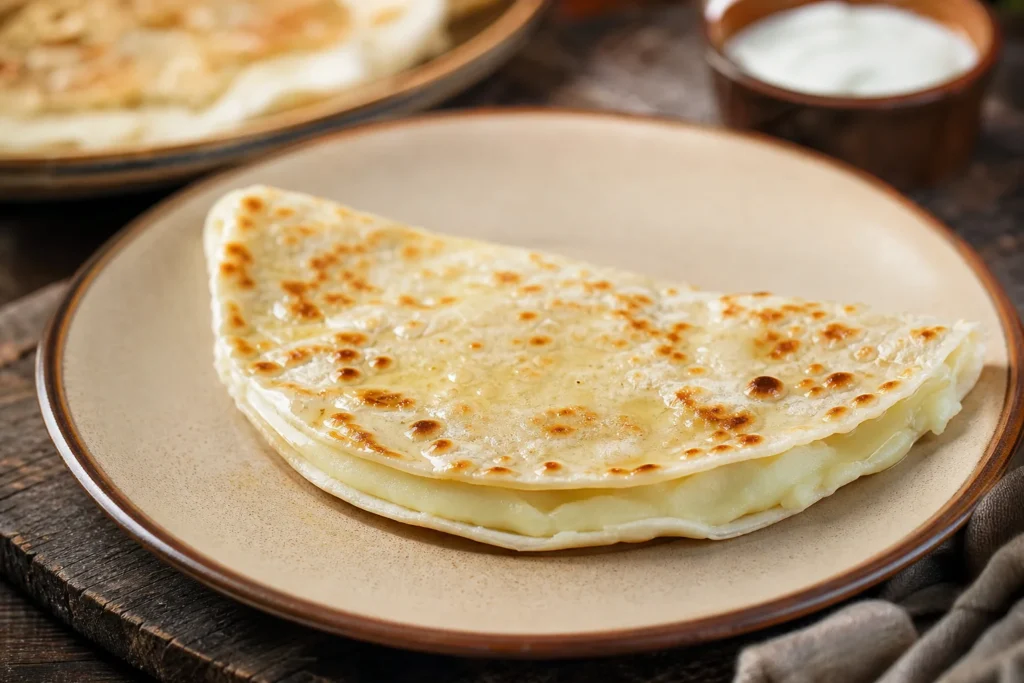
Place a generous tablespoon of warm mashed potato filling on one half of each warm flatbread. Fold the flatbread in half to cover the filling, creating a half-moon shape. The filling should still be slightly visible or just peeking out.
Tip: Work quickly while the flatbread is still warm so it folds without breaking.
Step 7: Finish with butter and serve
Place the folded kystybyi on a warm plate and brush generously with melted butter on both sides. Serve immediately while still warm.
Tip: The butter is essential—it seals the flatbread and adds richness. Kystybyi is best eaten right away, held in your hand or on a plate.
Variants
- The most common filling is mashed potato but it may also be ragout or millet.
- The stuffing is most often made from mashed potatoes or various cereals such as millet, from pumpkin with various additives, or sometimes sweet fillings.
- Some modern versions in Kazan add cheese, fresh herbs, or ground meat to the filling.
- Some restaurants and home cooks use millet porridge (the traditional filling before potatoes became common) instead of or mixed with mashed potatoes.
Common Mistakes to Avoid
- The texture of the flatbread makes all the difference: it has to be flexible but slightly crispy at the edges. If the dough breaks when folded, it's been done wrong. Avoid over-kneading the dough or rolling it too thin.
- Using oil in the pan instead of a dry griddle creates a greasy, heavy flatbread. The traditional method is to fry on an ungreased hot surface.
- Filling the flatbread when it is cold or cooled will cause it to crack when folded. Always work with warm flatbreads and warm filling.
- Skipping the onion or undercooked onion results in a bland filling. Take time to caramelize the onion—this step adds essential flavor.
- While some modern cooks use ready-made lavash (purchased flatbreads) to make the process quicker, a homemade kystybyi is preferable. Store-bought flatbreads lack the tender, slightly crispy texture of freshly made dough.
How to Order and Eat It
Picture an unleavened flatbread, thin and pan-fried, folded in half like a taco, with a generous filling of hot mashed potato and melted butter on top. Hold the kystybyi in your hand or place it on a plate and eat it warm. The soft flatbread folds easily, and the butter drips slightly—this is normal and intended. You can eat it as a main course with tea, or as a quick snack. In Kazan, there are restaurants like Kystyby Tatar-food that serve kystybyi with creative fillings and coloured dough.
To order: Кыстыбый [Kystybyi]
Russia Vibes Tips
- The best kystybyi is eaten within minutes of being filled and buttered—not hours later. Plan to eat it fresh or reheat gently on a griddle if needed.
- Visit a local market or traditional Tatar canteen (столовая) in Kazan if you want to taste the version made by older cooks who learned the dish from their grandmothers. The technique and filling can vary subtly between households.
- If you are cooking for guests, prepare the dough and filling ahead of time, but assemble and fry the flatbreads just before serving. This timing ensures the best texture.
- In winter, kystybyi pairs perfectly with hot strong tea or a bowl of clear broth. In summer, some people serve it at room temperature as a portable snack.
- The dough should never include yeast or baking powder—kystybyi is an unleavened flatbread. Using leavened dough changes the dish fundamentally.
Explore Nearby Kystybyi, Kazan
Related guides
 Local Food & Market Walk, Yekaterinburg: Central Market, Pelmeni and Street Eats
Main image: AI-generated illustration. It may not show the place exactly as it looks.
 Best Restaurants for Traditional Russian Cuisine, Nizhny Novgorod: Where to Eat Local
Main image: AI-generated illustration. It may not show the place exactly as it looks.
Browse more: All Food & Drink · All Food & Drink in Kazan · All Kazan · All Other
FAQ
Is kystybyi the same as lavash?
No. Lavash is a thin Armenian flatbread eaten plain or used as a wrapper. Kystybyi is a specifically Tatar dish made with an unleavened dough that is filled with potatoes or millet, then folded and topped with butter. Some cooks use ready-made lavash to speed up the process, but this is a modern shortcut, not the traditional method.
Can I make kystybyi without butter?
Technically yes, but it won't taste right. Butter is not a garnish—it is essential to the flavor and texture. The melted butter on top seals the flatbread and adds richness that defines the dish.
What is the difference between kystybyi and millet kystybyi?
The most common filling is mashed potato but it may also be ragout or millet. Both versions are authentic. Millet kystybyi is older and more traditional in Tatar cuisine, while potato kystybyi became popular after potatoes were widely adopted in the region.
How long can kystybyi keep?
Kystybyi is best eaten fresh, within 1–2 hours of cooking. It can be refrigerated and gently reheated on a griddle or pan, but the flatbread will lose its tender texture and become tough.
Is kystybyi halal?
Tatar cuisine is pork-free (Tatars have been Muslim since 922 AD). Traditional kystybyi contains no meat at all—only flour, dairy, potatoes and onions. It is halal by default.
Can I add meat to kystybyi?
While meat is not traditional in kystybyi itself, some modern restaurants in Kazan have created meat-filled versions. The classic dish is vegetarian, made with potatoes or millet.
Where in Kazan can I buy kystybyi?
There is a chain called Kystyby Tatar-food with a branch on Bauman Street that reimagines it as fast food, with creative fillings and coloured dough. You can also find it in traditional Tatar canteens, markets, and many restaurants across the city.
What milk should I use for the dough?
Use regular whole milk or milk with medium fat content. Warm it to around 35–40°C (lukewarm) before mixing into the dough. Do not use hot milk, which will cook the egg.
Russia Vibes is a one-person project. A coffee keeps it going
How we research and update our guides
About this guide: AI assistance and accuracy
This guide is created with the help of AI and is based on official sources where available. Mistakes can still happen. Opening hours, prices, rules and other details are given to the best of our knowledge as of the date shown and can change without notice. It offers general recommendations only, not professional, legal or travel advice. Please confirm important details with the official source before you travel; you are responsible for your own plans and decisions.

Take this guide with you
Get a free PDF of this guide to print or read offline: key facts, tips and a map link on a few clean pages.
Report an issue on this page
Paying for your trip: please read
International sanctions affect payments between Russia and many other countries. In practice, cards issued in the EU, the UK, the US and several other countries often do not work in Russia, Russian cards usually do not work abroad, and some booking platforms, airlines and payment providers limit or suspend their services for Russia. The situation changes frequently.
We do not give legal or financial advice, and this site does not encourage anyone to break or circumvent sanctions. Whatever you plan, you are responsible for following the laws and regulations that apply to you, including those of your country of residence and citizenship.
Many travelers still organise their stay lawfully. It is worth asking your bank or payment provider what is currently permitted, contacting hotels, tour operators and carriers directly about the payment methods they accept, and checking which services are open to customers from your country. Clarify payment, cancellation and refund terms before you commit to a booking, and keep your plans flexible.
Partner links on this site may not be available in every country, and prices, availability and rules in our guides can differ from what you see when you book.