
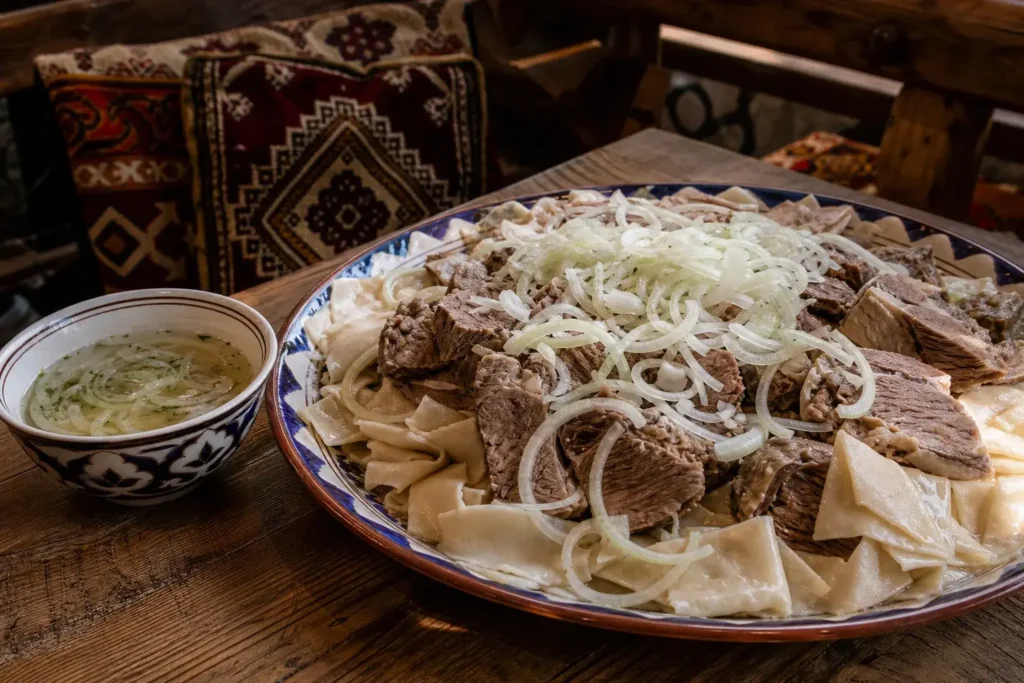
Beshbarmak is one of the oldest dishes in Central Asian nomadic cuisine, now a fixture on tables throughout Kazan and the wider region. Beshbarmak, Kazan: how to order and eat this iconic dish means understanding both its preparation and its place in Tatar food culture. The dish itself is straightforward: tender boiled meat layered over wide, flat hand-cut noodles and finished with an onion-rich broth.
In Tatarstan and Bashkortostan, locals call it qullama, though it is most widely known by the Kazakh name that literally means ‘five fingers’—a reference to how it was traditionally eaten without utensils. Most visitors encounter it in restaurants throughout Kazan, where it appears on nearly every Tatar menu.
Quick answer: The dish consists of boiled potatoes, meat, and noodles, eaten poured with broth and also separately as a main dish. Most restaurants serve it as a single large portion meant for sharing. Total preparation at home takes around 2 to 2.5 hours; at a restaurant, it arrives within 15–20 minutes.
At a Glance
| Type | Dishes |
|---|---|
| Local name | бешбармак |
| Origin | Beshbarmak is one of the oldest dishes in nomadic cuisine, where lamb was simmered for hours and cut into small pieces as a gesture of respect to the guest. The roots of Tatar cuisine go back around 1,500 years to the Volga Bulgars, nomads who eventually settled and turned to farming. That shift from herding to agriculture shaped Tatar food: sheep, cattle, and horses became the backbone of the diet and remain common today. Beshbarmak is the subject of constant dispute between Kazakhs and Kyrgyz over who created it. Tatarstan and Bashkiria also lay claim to the dish. |
| Servings | 2–4 servings |
| Total time | 2–2.5 hours |
| Difficulty | Medium |
History and Story of Beshbarmak, Kazan
In Kazakh, beshbarmak means ‘five fingers’ because people used to eat it with their fingers. The serving was very ritualistic. It was often prepared for special occasions when the guest of honor would be allowed to choose an animal from the herd for the meal. The entire sheep was cooked, including the head, which was slowly boiled until tender and became the focal point of the traditional dish. Beshbarmak was served in large communal serving dishes that everyone would sit around on the floor or low table. Pieces of the head were cut by the most respected member of the table. Different meats were served to different guests and family members, depending on their age, gender, and social rank. The best pieces of meat went to the oldest adult men, then the men, then women, younger adults, and finally the children, meant to encourage them to work hard to earn their status.
Ingredients
- 500–600 g all-purpose flour
- 2 eggs
- 600 g beef, lamb or mutton, bone-in
- 2 large onions
- 1 carrot
- 2 bay leaves
- 1 tsp salt
- ½ tsp black peppercorns
How Beshbarmak, Kazan Is Made
Step 1: Prepare and boil the meat
Rinse the meat and place it in a large pot with cold water, covering it completely. Bring to a boil over high heat, then skim off the foam that rises to the surface. Add one halved onion, the carrot, peppercorns, and a pinch of salt. Reduce to a low simmer, cover, and cook for 1.5–2 hours until the meat is fully tender and falling off the bone. When ready, remove the meat and keep the broth warm. Shred or cut the meat into bite-sized pieces, removing bones and fat.
Tip: Reserve the broth to serve alongside the finished dish.
Step 2: Make the noodle dough
Mix the flour, egg, a pinch of salt, and water gradually until you have a firm, smooth dough. Rest it for 20–30 minutes. The dough should be firm enough to handle but not dry; it will become smooth and elastic as it rests.
Tip: Work on a lightly floured surface to prevent sticking.
Step 3: Roll and cut the noodles
Roll out the dough very thinly, and cut into noodles. The pasta is usually cut into flat squares. Dust the cut noodles lightly with flour so they don't stick together. You want pieces roughly 5–8 cm wide.
Tip: Cut them just before boiling, or they may dry out.
Step 4: Cook the noodles
Bring the reserved broth back to a rolling boil. Add the cut noodle pieces and cook until tender, about 3–5 minutes depending on thickness. The noodles will soften as they cook in the broth. Stir occasionally to prevent clumping.
Tip: Do not overcrowd the pot; cook in batches if needed.
Step 5: Slice and prepare the second onion
While the noodles cook, slice the remaining onion into thin half-moons. Some cooks blanch this onion briefly in the hot broth, others serve it raw for crispness. Both are traditional.
Step 6: Assemble the dish
Arrange the cooked noodles on a large communal platter or individual bowls. Top with the warm meat pieces and the sliced onion. Beshbarmak is central to Kazakh hospitality and is often served on large shared platters at family feasts, weddings, and celebrations. The arrangement of meat traditionally reflects respect for guests and elders. Pour the hot broth over the top or serve it on the side in small bowls for dipping.
Tip: Serve immediately while the noodles and meat are hot.
Variants
- Horse meat, mutton, beef or chicken can be substituted depending on personal preference or availability.
- In Kazakhstan, the dough is usually cut into large rhombuses, and in Kyrgyzstan, into small oblong pieces.
- In the Bashkir and Tatar languages, one eats 'bishbarmak'.
- Potatoes are the most common addition to beshbarmak.
- Festive beshbarmak can be cooked together with qazı (horse sausage) and chuchuk (spiced sausage).
Common Mistakes to Avoid
- Beshbarmak is often sold by weight and meant for sharing, so do not each order one if dining as a group.
- Do not cook the noodles until just before serving, or they will become mushy and lose their tender texture.
- Avoid substituting commercial pasta for hand-cut noodles in the traditional version; the width and texture of home-made noodles matter to the dish's character.
- Do not drain all the broth from the noodles; it should be moist and flavourful, not dry.
- If ordering in a restaurant, mention whether you prefer beef, lamb or mutton when ordering, as different meats are used regionally and by preference.
How to Order and Eat It
The traditional way is to eat beshbarmak with your hands, directly from a communal platter—which is how it earned its name. However, modern restaurant service usually provides a fork and spoon. The broth is sipped from small bowls or spooned over individual portions. There is no rush; the meal is meant to be shared leisurely with others at the table. In formal settings, an eldest or honored guest may receive choice pieces of meat first.
To order: бешбармак, пожалуйста [beshbarmak, pozhaluysta]
Diet and Allergens
- Contains gluten
- Contains eggs
- Meat-based
Russia Vibes Tips
- In Kazan, you can taste some of the most typical dishes from Tatarstan at restaurants like Markhaba—including beshbarmak—all in a carefully decorated space with traditional Tatar touches.
- Beshbarmak is served at any traditional restaurant in Kazan, with prices typically in the moderate range (₽₽). Prices are evergreen averages; check the restaurant menu for current costs.
- Beshbarmak consists of boiled potatoes, meat, and noodles. It is eaten poured with broth, and also separately as a main dish. Usually, the main meat option is lamb. Some restaurants offer both beef and lamb versions; ask which is available.
- The dish is often heavier than it looks. If you are eating with others, order one large portion to share rather than individual servings.
- Restaurants typically serve beshbarmak during lunch and dinner hours. It is not a breakfast dish, so plan to eat it from midday onwards.
- If you order in a traditional Tatar family restaurant on Bauman Street or near Kolkhoznyy market, staff may offer it hotter and fresher than in hotel restaurants.
Explore Nearby Beshbarmak, Kazan
Related guides
 Old Tatar Quarter: Historic Streets and Tatar Heritage in Kazan
Main image: AI-generated illustration. It may not show the place exactly as it looks.
Browse more: All Food & Drink · All Food & Drink in Kazan · All Kazan · All Other
FAQ
What does 'beshbarmak' actually mean?
In Kazakh, it means 'five fingers' because people used to eat it with their fingers. The name reflects its nomadic origins, when the dish was eaten by hand directly from a shared platter.
Is beshbarmak the same as qullama?
Most people outside Tatarstan know this dish by its Kazakh name, beshbarmak. In Tatarstan and Bashkortostan, locals call it qullama instead. Either way, it's boiled meat tossed with wide pasta pieces. The names refer to the same basic dish, though recipes and presentations vary slightly by region.
What meat is traditionally used?
Traditionally, horse meat or mutton is used; however, beef or chicken can also be substituted depending on personal preference or availability. Usually, the main meat option for beshbarmak is lamb. In Kazan restaurants, beef and lamb are most common.
Can I eat beshbarmak with a fork and spoon?
Yes. While the traditional way is to eat it by hand from a communal platter, modern restaurant service includes cutlery. The broth is eaten with a spoon, and the meat and noodles can be eaten either with a fork or by hand, depending on your preference and the setting.
Is beshbarmak spicy?
No. Beshbarmak contains black pepper and onion for flavour, but it is not spicy in the sense of chilli heat. The flavour is savoury and warm, coming from the meat broth and the sweetness of slow-cooked onions.
How is beshbarmak different from pelmeni?
Pelmeni are small dumplings filled with meat and boiled in water, served in broth. Beshbarmak is boiled meat served over wide flat noodles, with broth poured over or served on the side. The noodles are unfilled, and the dish is meant to be shared from a communal platter.
Is beshbarmak made fresh to order in restaurants, or is it pre-made?
Most traditional restaurants make the broth and cook the meat fresh. The noodles are often hand-cut and cooked to order, which is why the dish may take 15–20 minutes to arrive. This ensures the noodles are tender and moist rather than dried out.
Can I order beshbarmak for one person?
Beshbarmak is often sold by weight and meant for sharing, so do not each order one if you are dining as a group. A single large portion typically serves 2–3 people comfortably, and sharing is part of the dining tradition.
Russia Vibes is a one-person project. A coffee keeps it going
How we research and update our guides
About this guide: AI assistance and accuracy
This guide is created with the help of AI and is based on official sources where available. Mistakes can still happen. Opening hours, prices, rules and other details are given to the best of our knowledge as of the date shown and can change without notice. It offers general recommendations only, not professional, legal or travel advice. Please confirm important details with the official source before you travel; you are responsible for your own plans and decisions.

Take this guide with you
Get a free PDF of this guide to print or read offline: key facts, tips and a map link on a few clean pages.
Report an issue on this page
Paying for your trip: please read
International sanctions affect payments between Russia and many other countries. In practice, cards issued in the EU, the UK, the US and several other countries often do not work in Russia, Russian cards usually do not work abroad, and some booking platforms, airlines and payment providers limit or suspend their services for Russia. The situation changes frequently.
We do not give legal or financial advice, and this site does not encourage anyone to break or circumvent sanctions. Whatever you plan, you are responsible for following the laws and regulations that apply to you, including those of your country of residence and citizenship.
Many travelers still organise their stay lawfully. It is worth asking your bank or payment provider what is currently permitted, contacting hotels, tour operators and carriers directly about the payment methods they accept, and checking which services are open to customers from your country. Clarify payment, cancellation and refund terms before you commit to a booking, and keep your plans flexible.
Partner links on this site may not be available in every country, and prices, availability and rules in our guides can differ from what you see when you book.