
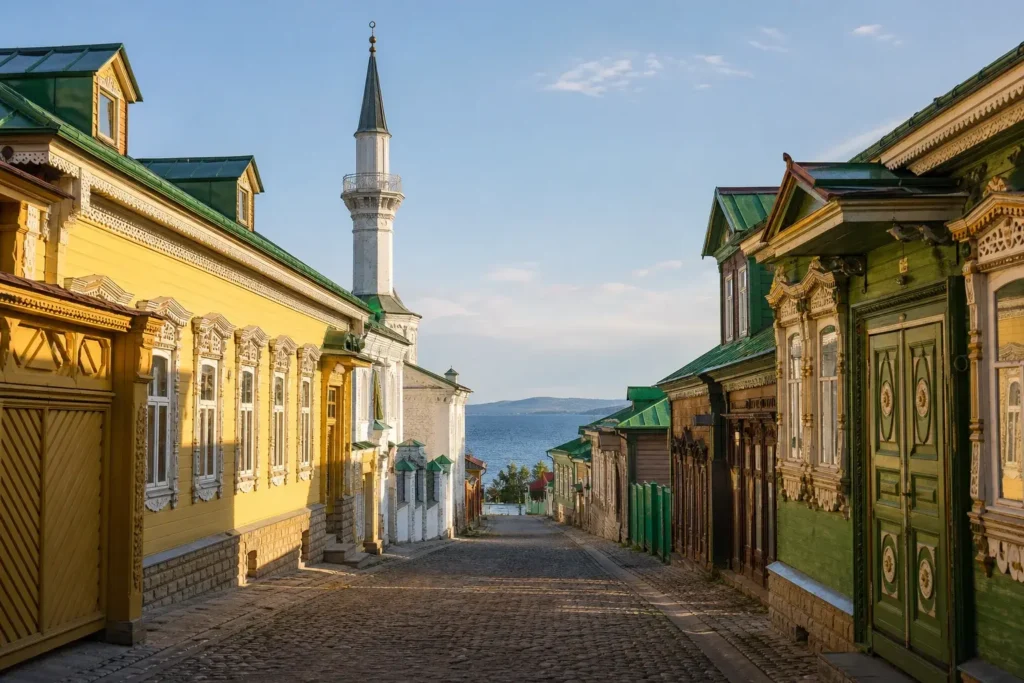
The Old Tatar Quarter is the historic heart of Kazan‘s Tatar community. Set on the banks of Lake Kaban, this neighborhood of narrow streets, traditional wooden houses, mosques and merchant mansions has preserved Tatar architecture and cultural life since the 16th century. Visitors walk through what feels like a preserved medieval settlement, separated from the rest of the city by water and history.
The quarter began after Ivan the Terrible conquered Kazan in 1552, when he resettled Tatar residents to the left bank of Lake Kaban. Over the following centuries, this area became one of the wealthiest and most culturally significant parts of the city, home to scholars, merchants, and artists who shaped Tatar intellectual life.
Quick Facts
| Russian name | Старо-Татарская слобода |
|---|---|
| Address | Улица Кайума Насыри, 38, Казань, Татарстан, 420021 OpenStreetMap · Google Maps |
| District | Vakhitovsky |
| Metro | Ploshchad Tukaya (Sokolniki Line, 5 min walk southeast) Kremlyovskaya (Krasnaya Line, 10 min walk west) |
| Opening hours | Daily 10:00-18:00 |
| Best time to visit | Spring (May–June) and early autumn (September–October) offer mild weather, clear skies, and manageable tourist crowds. Summer (July–August) brings warm but occasionally humid weather and peak tourism. Winter (December–February) is cold and gray, though snow can make the old wooden architecture picturesque.Weekdays are quieter than weekends. Mornings tend to be more atmospheric than afternoons. August typically sees higher tourist traffic before the school year begins. |
| Recommended duration | 2-3 hours |
| Website | visit-tatarstan.com/en/places/attractions/staro-tatarskaya_sloboda |
| Last updated | October 18, 2026 |
What Is (and Isn't) Part of a Visit to Old Tatar Quarter, Kazan?
| Part | Status | Notes |
|---|---|---|
| Open-air quarter with streets and public spaces | Included in the standard ticket | The entire neighborhood is open to walk through freely without admission. |
| Historic mosques (Al-Mardjani, Apanaeva, Äcem) | Included in the standard ticket | Exteriors are visible from streets; some allow interior viewing outside prayer times with modest dress. |
| House-museums (Shamardin/Tatar Sloboda Museum, Kayum Nasyri House-Museum) | Separate ticket or institution | These require separate admission tickets; they operate with specific hours. |
| Lake Kaban | Outside / not part of it | The lake itself is a separate natural feature; beaches and water access are not part of the historic quarter. |
| Kazan Kremlin | Outside / not part of it | The Kremlin is a separate fortress complex north and west of the Old Quarter; it requires its own visit and tickets. |
| Central Market (Tsentralny Rynok) | Outside / not part of it | The market is the northern boundary of the quarter but is a separate commercial institution. |
| Restaurants, tea houses, and shops | Included in the standard ticket | These are independently operated by residents and merchants; visiting them has no additional cost beyond purchase. |
| Gabdulla Tukay Literary Museum | Separate ticket or institution | A dedicated museum with separate admission in the central area. |
Why Visit Old Tatar Quarter, Kazan?
Authentic Tatar architecture: The quarter preserves traditional wooden and stone houses with colorful decorative details unchanged from the 18th and 19th centuries.
Historic mosques: See the Al-Mardjani Mosque, the first stone mosque permitted within Kazan city limits (1767), and several other historic prayer houses that anchor the community.
Living cultural center: Local shops, teahouses and restaurants serve traditional Tatar food and crafts alongside museums. The quarter is not frozen in time but remains actively used by residents.
Literary and scholarly heritage: Wander streets named after Tatar poets, philosophers and educators, or visit house-museums dedicated to cultural figures like Gabdulla Tukay.
How Old Tatar Quarter, Kazan Is Laid Out
The Old Tatar Quarter occupies a crescent-shaped zone bounded by Lake Kaban to the east and railway tracks to the west, spanning roughly 2 kilometers north to south. The district divides into three zones: a northern business quarter, a central cultural and residential core, and a southern industrial area.
The main axis runs along Tukay Street, which connects the northern areas to Yunusov Square, the historic center. Kayuma Nasyri Street, lined with historic merchant mansions, runs parallel and is the other major spine. The central area, near Ploshchad Tukaya metro station, holds the highest concentration of restored buildings and museums. Most visitors focus on the central and northern zones within walking distance of the metro, as the southern industrial area is less developed for tourism.
Highlights of Old Tatar Quarter, Kazan
Al-Mardjani Mosque
Built in 1767 at Kayuma Nasyri Street 17, this was the first stone mosque permitted inside Kazan city limits and served as the largest mosque in the city for two centuries. Its elegant minaret and traditional interior remain a symbol of the quarter's spiritual life. The mosque continues to function as a place of worship.
Tip: The courtyard around the mosque offers a quiet place to observe the building's proportions; modest dress is expected if visiting during prayer times.
Yunusov Square
This historic plaza at the heart of the quarter marks the cultural center where merchants, families and travelers have gathered for centuries. The square is surrounded by restored mansions and offers a sense of how the quarter once functioned as a living community. Today it hosts markets and local activity.
Tip: Visit early morning to see locals using the square and its surrounding shops; it provides the clearest sense of daily life in the quarter.
Kayuma Nasyri Street
Named after a 19th-century Tatar educator, this street forms the architectural spine of the Old Quarter. Mansions of wealthy merchants, scholars and cultural figures line both sides, their wooden facades showing original decorative details. Many houses now host small museums, tea rooms and shops.
Tip: Walk slowly along this street to read plaques identifying the former occupants and their contributions to Tatar history.
Lake Kaban Embankment
The eastern boundary of the quarter opens to Lake Kaban, providing views across water to other parts of Kazan. Traditionally, the wealthiest residents lived on the first line of the lake shore. The embankment offers breathing room from the crowded streets and a perspective on how the quarter developed as a distinct settlement.
Tip: The embankment is particularly pleasant in early morning or late afternoon when light reflects off the water.
Shamardin House and Tatar Sloboda Museum
Located at Kayuma Nasyri Street 38, this restored manor house functions as an exhibition space showing Tatar domestic life, crafts, and cultural traditions. The museum offers insight into the everyday world of the quarter's residents through period furnishings, textiles and household objects.
Tip: Ask staff for guidance on other nearby house-museums; many are small and easy to miss if you don't know where to look.
Mardzhani Street
This street, named after a 19th-century Islamic scholar, showcases some of the quarter's best-preserved timber architecture. Colorful wooden houses display traditional Tatar decorative patterns. The street is quieter than main thoroughfares, offering an intimate view of residential character.
Tip: This street has been called 'Kazan's Rublyovka' (comparing it to Moscow's elite residential area); look for details in carved window frames and decorative panels.
Apanaeva Mosque
Located at Kayuma Nasyri Street 27, this mosque represents 19th-century Islamic architecture. The building reflects the period when the Tatar community had gained more freedom to construct religious buildings, after earlier restrictions.
Tip: The mosque's architectural style differs from earlier stone mosques; compare its design with the Al-Mardjani Mosque to see how Tatar religious architecture evolved.
Atmosphere
Walking through the Old Tatar Quarter feels like stepping into a different era. Narrow lanes lined with low wooden buildings create intimate spaces far removed from modern Kazan. The colors are muted—pale yellows, greens, and earth tones on weathered facades—but punctuated by bright blue and green doors and window frames. Minarets of white mosques rise between rooflines. The scent of wood, damp earth and occasionally the aroma of tea or baked goods drifts from cafes and shops.
The quarter is quieter than central Kazan, especially on weekday mornings. Local residents move through streets unhurried; small shops open late or by chance. Older buildings creak and settle. In warmer months, residents sit outside tea houses or tend small street-side gardens. Tourist crowds exist but are manageable, concentrated near the main museums and central areas. The overall effect is contemplative and atmospheric—a place where time feels differently measured.
History of Old Tatar Quarter, Kazan
The Old Tatar Quarter was born from conquest and displacement. When Ivan the Terrible took Kazan in 1552, the Tatar population faced a choice: assimilate into the Russian upper city or relocate. Many chose to settle on the left bank of Lake Kaban, a natural boundary that would define their territory for centuries. Behind a palisade wall, this became the space where Tatar life would continue.
By the end of the 16th century, the settlement had taken shape as a Muslim commercial zone. Early residents built merchant houses, opened the first mosques, and established madrasas—Islamic schools—laying the foundation for what would become a major center of Tatar learning. The community survived the Emelyan Pugachev uprising of the late 18th century, preserving itself while much of Kazan changed around it. Historians have called this extraordinary continuity ‘the Tatar Atlantis.’
The 18th and 19th centuries saw the quarter flourish. The Al-Mardjani Mosque, built in 1767, was a watershed: the first stone mosque permitted inside city limits, marking the Tatar community’s growing stability and influence. New mansions rose for wealthy merchants and intellectuals. By the 19th century, this quarter had become the intellectual and cultural heart of Tatar civilization in Russia—home to writers, philosophers, educators and religious leaders whose work shaped modern Tatar identity.
The Russian Revolution brought restrictions. Religious institutions closed; many buildings fell into disrepair during the Soviet era. The quarter’s medieval street plan survived, but the fabric of community life fractured. Tatarstan Street, built during the Soviet period, physically divided the northern and central zones. Nevertheless, the architectural bones remained, waiting for restoration.
Since the 1990s, particularly after Tatarstan gained greater autonomy, the quarter has undergone systematic restoration. In 1998, the Old Tatar Quarter was officially designated a historical and cultural protected area with special status. Museums opened in restored houses; merchants returned; the quarter began to recover its role as a living center of Tatar culture. Contemporary plans announced in 2024 include new cultural facilities to be completed by 2028, suggesting ongoing investment in the quarter as a symbol of cultural continuity.
Legends and Myths about Old Tatar Quarter, Kazan
The Lake Kaban Boars
Legend – historically unreliable. Local legend claims that wild boars once roamed the shores of Lake Kaban until the 19th century, and that the lake's name itself derives from the Tatar word for boar. According to the story, these animals were so common that early settlers hunted them and used the lake for fishing. Whether the boars are historical or myth, the name stuck.
Catherine the Great's Permission
Legend – historically unreliable. A widely told story recounts that when Russian authorities raised objections to the Tatar community building mosques and maintaining Muslim life in Kazan, the matter reached Catherine the Great herself. She reportedly replied: 'I have designated them a place on Earth, so that they are free to rise to the sky at their discretion, because the sky does not enter my domain.'—granting tacit permission for the quarter to continue its Islamic practice.
Tickets and Booking for Old Tatar Quarter, Kazan
The Old Tatar Quarter itself is free to explore. You can walk the streets, view historic buildings from outside, and enjoy the neighborhood atmosphere without paying admission. However, if you wish to enter specific house-museums and cultural institutions, separate tickets are required.
Museum tickets: Individual museums such as the Tatar Sloboda Museum (at Kayuma Nasyri 38) and Kayum Nasyri House-Museum charge modest admission. Hours typically run 10:00–18:00 daily; confirm at the entrance or via official Kazan tourism sites before visiting, as small museums may have irregular schedules.
Where to enter: There is no single entrance to the quarter. Most visitors arrive via Ploshchad Tukaya metro station and walk downhill toward Kayuma Nasyri Street, or access from the Lake Kaban embankment. The quarter’s borders are natural (the lake) and street-defined rather than gated.
For current hours and any updated information, check the official Kazan tourism portal or contact the Kazan City Hall tourism service.
Suggested itineraries Old Tatar Quarter, Kazan
1-2 hours
Enter from Ploshchad Tukaya metro and descend to Kayuma Nasyri Street. Walk the length of this main street, stopping to observe the Al-Mardjani Mosque (1767) and historic mansion facades. Reach Yunusov Square at the center and rest. Return via Lake Kaban embankment for views across the water. This covers the cultural core without entering museums.
2-3 hours
Begin at the lake embankment and walk north along Kayuma Nasyri Street, exploring mansion details and street plaques. Enter the Tatar Sloboda Museum to see period interiors and Tatar crafts. Visit the Al-Mardjani Mosque exterior and courtyard. Wander side streets like Mardzhani Street to see quieter residential architecture. End at a local tea house or café for refreshment.
Half day (4-5 hours)
Combine the above routes with visits to multiple house-museums (Kayum Nasyri, Apanaeva, or others open that day). Spend time in Yunusov Square observing daily life. Explore the southern industrial areas if interested in less-restored architecture. Visit the Gabdulla Tukay Literary Museum if interested in Tatar intellectual history. End with lunch at a traditional Tatar restaurant.
How to Get to Old Tatar Quarter, Kazan
By metro (recommended): Take the Sokolniki Line (red line) or Krasnaya Line to Ploshchad Tukaya station. Exit and head downhill (southeast) for approximately 5 minutes; you will reach Kayuma Nasyri Street, the main avenue of the Old Quarter. Alternatively, Kremlyovskaya station (Krasnaya Line) offers a 10-minute walk to the western edge.
By taxi or ride-hailing: Provide the address Kayuma Nasyri Street, 38, or ‘Staro-Tatarskaya Sloboda’ to the driver. Traffic from the city center is light to moderate.
On foot: If staying near the Kremlin or central Kazan, the quarter is 20–25 minutes walk downhill and south. The streets are walkable and well-marked in newer maps.
Accessibility
The Old Tatar Quarter consists largely of narrow, centuries-old streets with uneven cobblestones and variations in elevation. Wheelchair accessibility is limited; the terrain is not suitable for mobility devices in most areas. Some restored buildings may have steps at their entrances. Lake Kaban embankment offers more level walking if accessibility is a concern.Most historic house-museums are in older buildings without elevators. The quarter's charm derives partly from its medieval street plan, which predates modern accessibility standards. Visitors with mobility concerns should plan for walking on uneven surfaces and be aware that some areas cannot be fully explored without climbing or navigating tight spaces.
Food Nearby
The quarter itself contains several traditional Tatar tea houses, cafés and small restaurants. You can find chak-chak (fried dough pastry), pilaf, pelmeni (dumplings), and strong black tea. Local establishments include small shops on Kayuma Nasyri Street and side streets; these are independently run and change seasonally.For more formal dining, restaurants like Tubatay (Tatar cuisine) and Dobraya Stolovaya operate in Kazan nearby, accessible by metro in 10 minutes. The Central Market to the north offers fresh produce, baked goods and street snacks if you prefer to assemble your own meal.
What to Bring
Comfortable walking shoes are essential; cobblestone streets and uneven surfaces can be taxing on feet. Bring a small backpack or day bag for carrying a camera, water bottle, and any purchases from local shops. In warmer months, sunscreen and a hat are recommended, as there is limited shade in some areas. In winter, warm clothing and waterproof shoes are necessary. A phrasebook or translation app is useful, as signage inside small museums may be in Russian only.Security: The quarter is generally safe; keep valuables secure in inner pockets or a bag worn across your body, as in any public area.
Best Views and Photo Spots of Old Tatar Quarter, Kazan
Al-Mardjani Mosque courtyard
The white minaret framed against sky, with the mosque's facade and courtyard gate. The geometric patterns of the facade catch morning light beautifully. This is the most photographed single building in the quarter.
Best time: Early morning (7:00–9:00) or late afternoon (17:00–19:00) for angled light on the minaret. Avoid midday when light is flat.
Kayuma Nasyri Street looking south
A tree-lined perspective down the historic street with colorful wooden house facades on both sides, minarets visible in the distance, and the street receding into haze. Captures the quarter's atmosphere.
Best time: Late afternoon when warm light makes colors glow and shadows add depth to the facades.
Lake Kaban embankment looking across the water
The quarter's profile from the water side, with historic buildings and minarets visible against the sky, reflected in the lake. Few tourists photograph from this vantage point.
Best time: Golden hour (late afternoon to sunset) for warm light and color reflection. Calm days with minimal wind produce mirror-like reflections.
Yunusov Square plaza
The historic center surrounded by restored mansions. Captures the heart of the community with street-level detail and the quality of light across the plaza.
Best time: Early morning when locals use the space and light is soft; photograph people and daily life for authentic atmosphere.
Mardzhani Street residential facades
Close-up details of wooden architecture: carved window frames, decorative panels, weathered paint, and colorful doors. Macro and detail photography works well here.
Best time: Overcast mornings when soft light doesn't create harsh shadows on intricate carving; midday sun can flatten textures.
Photography Rules
Photography is generally permitted in the open streets and public squares. Historic buildings can be photographed from outside freely. Interior photography in house-museums may be restricted; ask permission at each venue. Drone use is not permitted in this urban residential area. Tripods may not be allowed inside museums; check with staff. Flash is typically prohibited indoors to protect historic furnishings and artwork.
Family Suitability
The Old Tatar Quarter is generally suitable for families with children aged 5 and up who can walk comfortably on uneven ground. Younger children may find the cobblestone streets challenging and may tire on longer walks. Stroller use is not practical due to narrow passages and cobbles; a backpack carrier is preferable.The quarter is rich with visual interest—colorful buildings, minarets, water views—and offers a slower pace than city centers, making it less overwhelming for children. Small tea houses and cafés provide refreshment breaks. However, the lack of large attractions or play areas means children seek engagement through observation and story-telling rather than interactive activities. Older children interested in history or cultural architecture will find the quarter rewarding.
Russia Vibes Tips
- Arrive early in the morning (before 10:00) on a weekday for the quietest, most atmospheric experience. You'll see residents using the quarter as a living neighborhood rather than purely a tourist site.
- Download an offline map before visiting, as some side streets are not well marked and cellular signal can be spotty in the residential areas.
- Don't assume all house-museums listed online are open every day. Some operate on restricted schedules or by appointment. Ask at the Tatar Sloboda Museum (Kayuma Nasyri 38) for current information on which other museums are accessible.
- The quarter is best explored on foot without a guide for atmosphere and wandering, but if you want detailed historical context, consider booking a guided tour through official Kazan tourism—the layered history rewards expert explanation.
- Traditional Tatar tea and pastries are served in small venues throughout the quarter; trying local chak-chak or pelmeni at a neighborhood café is part of the experience and often cheaper than restaurants outside the quarter.
- Visit the Lake Kaban embankment even if you skip museums; the water views and quieter walking paths offer a different perspective than the dense street areas.
Explore Nearby Old Tatar Quarter, Kazan
Sights near Old Tatar Quarter, Kazan
 Kazan Kremlin – about 2.1 km away · typical visit: 2–4 hours2 min on foot from Kremlyovskaya, Kazan metro, Open 24 hours
Main image: AI-generated illustration. It may not show the place exactly as it looks.
 Kul Sharif Mosque, Kazan – about 2.4 km away · typical visit: 1–2 hours6 min on foot from Kremlyovskaya, Kazan metro, Open daily 08:00–20:00
Main image: AI-generated illustration. It may not show the place exactly as it looks.
 Temple of All Religions, Kazan – about 9.3 km away · typical visit: 1–2 hoursOpen daily 09:00–18:00
Main image: AI-generated illustration. It may not show the place exactly as it looks.
 Bauman Street, Kazan – about 1.6 km away (~27 min walk) · typical visit: 1.5–3 hours7 min on foot from Kremlyovskaya, Kazan metro, Open 24 hours
Main image: AI-generated illustration. It may not show the place exactly as it looks.
Metro stations near Old Tatar Quarter, Kazan
 Ploshchad Tukaya, Kazan – about 1.0 km away (~17 min walk)Open daily 06:00–00:00
Main image: AI-generated illustration. It may not show the place exactly as it looks.
Restaurants and cafes near Old Tatar Quarter, Kazan
 Dobraya Stolovaya, Kazan – about 1.4 km away (~23 min walk)9 min on foot from Ploshchad Tukaya, Kazan metro
Main image: AI-generated illustration. It may not show the place exactly as it looks.
Nightlife near Old Tatar Quarter, Kazan
 RV Club, Kazan – about 1.1 km away (~17 min walk)2 min on foot from Ploshchad Tukaya, Kazan metro
Main image: AI-generated illustration. It may not show the place exactly as it looks.
 Nashe Mesto, Kazan – about 1.4 km away (~23 min walk)10 min on foot from Ploshchad Tukaya, Kazan metro
Main image: AI-generated illustration. It may not show the place exactly as it looks.
Hotels near Old Tatar Quarter, Kazan
 Bilyar Palace Hotel, Kazanabout 800 m away (~13 min walk)
Main image: AI-generated illustration. It may not show the place exactly as it looks.
 Azimut Hotel Bauman Kazanabout 1.1 km away (~19 min walk)
Main image: AI-generated illustration. It may not show the place exactly as it looks.
 Green Point Hostel, Kazanabout 1.2 km away (~19 min walk)
Main image: AI-generated illustration. It may not show the place exactly as it looks.
Train stations and river piers near Old Tatar Quarter, Kazan
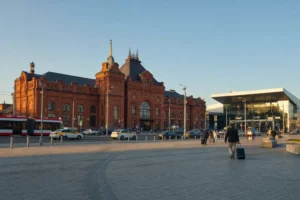 Kazan Railway Station, Kazanabout 1.6 km away (~26 min walk)
Main image: AI-generated illustration. It may not show the place exactly as it looks.
Related guides
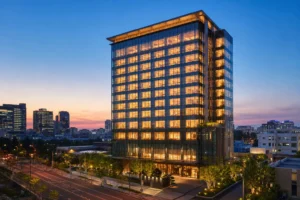 Korston Royal Hotel, Kazan: Luxury Accommodation with On-Site Shopping and Spa
Main image: AI-generated illustration. It may not show the place exactly as it looks.
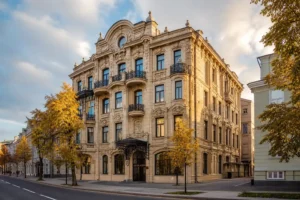 Kazan Palace by Tasigo: Luxury Hotel in a 1910 Heritage Building
Main image: AI-generated illustration. It may not show the place exactly as it looks.
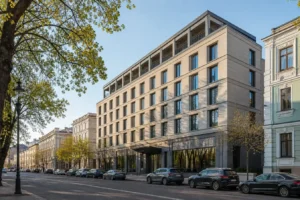 Ramada by Wyndham Kazan City Centre: Reliable Midrange Hotel Near the Railway Station
Main image: AI-generated illustration. It may not show the place exactly as it looks.
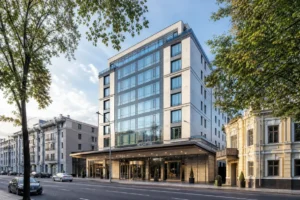 Ramada Kazan City Centre: Central Hotel Near Railway Station and Kremlin
Main image: AI-generated illustration. It may not show the place exactly as it looks.
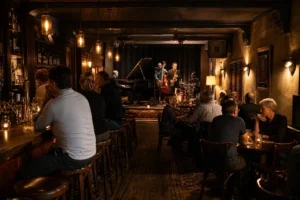 Shha: Kazan’s Top-Ranked Jazz BarOpen daily 17:00–03:00
Main image: AI-generated illustration. It may not show the place exactly as it looks.
Browse more: More in Vakhitovsky · All Kazan · All Neighborhoods · All Neighborhoods · All Neighborhoods in Kazan
FAQ: Old Tatar Quarter, Kazan
Is the Old Tatar Quarter part of the Kazan Kremlin?
No. The Old Tatar Quarter and Kazan Kremlin are separate places on opposite sides of the city. The Kremlin is a fortified complex north and west of the quarter. They can be visited in one day but require separate metro stops and tickets.
Can I walk through the Old Tatar Quarter for free?
Yes. The streets, public spaces, and exteriors of historic buildings are freely accessible to walk through. However, if you wish to enter specific house-museums or exhibitions, those require separate admission tickets.
How long should I spend in the Old Tatar Quarter?
2–3 hours is typical for walking the main streets and observing architecture. If you enter museums, add 1–2 hours. Many visitors spend a half-day combining walking with tea and conversation at local cafés.
What is the main street to visit?
Kayuma Nasyri Street runs through the heart of the quarter and has the highest concentration of historic mansions, mosques and museums. Mardzhani Street and Tukay Street are also important, but Kayuma Nasyri is where most visitors focus.
Is it safe to visit?
Yes. The Old Tatar Quarter is generally safe, particularly during daylight hours. It is a residential neighborhood actively used by locals. Apply standard precautions as you would in any city neighborhood.
Can I take photos?
Yes. Street photography is allowed throughout the quarter. Interior photography in museums requires asking permission, which is typically granted; flash is usually prohibited. Drones are not permitted in this residential urban area.
Are there restaurants in the Old Tatar Quarter?
Yes. The quarter has several traditional Tatar tea houses and cafés serving local food and drinks. These are smaller establishments than restaurants outside the quarter, but they offer authentic, often inexpensive options.
Which metro stations serve the Old Tatar Quarter?
Ploshchad Tukaya (Sokolniki Line) is the closest, a 5-minute walk downhill to Kayuma Nasyri Street. Kremlyovskaya (Krasnaya Line) offers access from the west, about 10 minutes walk.
Russia Vibes is a one-person project. A coffee keeps it going
Last updated: October 18, 2026.
How we research and update our guides
About this guide: AI assistance and accuracy
This guide is created with the help of AI and is based on official sources where available. Mistakes can still happen. Opening hours, prices, rules and other details are given to the best of our knowledge as of the date shown and can change without notice. It offers general recommendations only, not professional, legal or travel advice. Please confirm important details with the official source before you travel; you are responsible for your own plans and decisions.
International sanctions affect payments between Russia and many other countries. In practice, cards issued in the EU, the UK, the US and several other countries often do not work in Russia, Russian cards usually do not work abroad, and some booking platforms, airlines and payment providers limit or suspend their services for Russia. The situation changes frequently. We do not give legal or financial advice, and this site does not encourage anyone to break or circumvent sanctions. Whatever you plan, you are responsible for following the laws and regulations that apply to you, including those of your country of residence and citizenship. Many travelers still organise their stay lawfully. It is worth asking your bank or payment provider what is currently permitted, contacting hotels, tour operators and carriers directly about the payment methods they accept, and checking which services are open to customers from your country. Clarify payment, cancellation and refund terms before you commit to a booking, and keep your plans flexible. Partner links on this site may not be available in every country, and prices, availability and rules in our guides can differ from what you see when you book.Paying for your trip: please read
Report an issue on this page

Take this guide with you
Get a free PDF of this guide to print or read offline: key facts, tips and a map link on a few clean pages.