
Updated
Fort #5 King Frederick Wilhelm III stands as one of Kaliningrad‘s most accessible windows into the city’s military past. Built between 1878 and 1884 as part of Königsberg’s defensive ring, this hexagonal fortification exemplifies 19th-century Prussian military engineering funded by French reparations following the Franco-Prussian War.
Named after the Prussian king who ruled during the Napoleonic Wars, the fort saw intense fighting in April 1945 when Soviet forces besieged Königsberg. Today it functions as a branch of the Kaliningrad Regional Museum of History and Art, welcoming visitors to descend into its labyrinth of brick and reinforced concrete chambers.
Quick Facts
| Russian name | Форт № 5 — Король Фридрих Вильгельм III |
|---|---|
| Built / opened | 1878–1884 |
| Address | Bulатова улица, Калининград, Калининградская область, 236019 OpenStreetMap · Google Maps |
| District | Kaliningrad |
| Opening hours | Daily 10:00-19:00 |
| Admission | ₽ |
| Best time to visit | Spring (April–May) and early autumn (August–September) offer the most comfortable weather for exploring the exterior rampart and moat. Summer (June–August) extends opening hours (until 20:00 on some days) but brings larger tour groups, especially in mid-afternoon. Weekday mornings are quieter than weekends and afternoon hours. Winter is possible (the museum is open year-round) but the short daylight hours and cold make exterior exploration less pleasant. The fort's interior remains cool and damp year-round. |
| Recommended duration | 1.5–2 hours |
| Website | fort5.westrussia.org |
What Is (and Isn't) Part of a Visit to Fort #5 King Frederick Wilhelm III, Kaliningrad?
| Part | Status | Notes |
|---|---|---|
| Interior casemates, tunnels and central gallery | Included in the standard ticket | Accessible with a standard ticket; modern electric lighting installed. |
| Barracks, hospital, kitchen, ammunition magazines | Included in the standard ticket | Displayed as reconstructed or preserved; not all sections may be lit or accessible on every day. |
| Rampart and moat walk | Included in the standard ticket | Exterior access around the fort perimeter; no additional ticket needed. |
| Military vehicles and weaponry exhibition | Included in the standard ticket | Open-air display outside the main structure; part of the standard admission. |
| Exhibitions: 'The Storming of Königsberg' and 'Monuments of Fortification Architecture' | Included in the standard ticket | Two main thematic exhibitions; text in Russian with audio guides available. |
| Audio guides (English, German, Russian) | Separate ticket or institution | Available for rent; verify availability and language before purchasing. |
| Kaliningrad Regional Museum of History and Art main building | Separate ticket or institution | Located on Klinicheskaya Street, not at the fort; separate ticket and visit required. |
| Bunker Museum (Soviet command bunker) | Separate ticket or institution | Another branch of the museum on Universitetskaya Street; separate ticket. |
Why Visit Fort #5 King Frederick Wilhelm III, Kaliningrad?
The fort offers a tangible sense of 19th-century military design and World War II combat history. Walk through the central gallery that once housed barracks, hospitals, ammunition stores and kitchens. The intact moat, earthen ramparts and massive concrete ceilings demonstrate how thoroughly the structure was engineered to withstand artillery. Above ground, exhibitions display Soviet and German weaponry alongside a memorial to the Red Army soldiers who died assaulting the position. Audio guides available in English, German and Russian help interpret the damage visible in the walls—holes punched by shells that failed to breach the concrete mass.
How Fort #5 King Frederick Wilhelm III, Kaliningrad Is Laid Out
The fort occupies 15.5 hectares arranged as an elongated hexagon 360 metres long and 180 metres wide. From the entrance on Bulatova Street, you cross a 20–25 metre-wide moat to reach the main gateway, originally protected by a concrete pillbox. Inside, a central gallery runs the length of the structure, accessed by artificial lighting. The interior is symmetrically arranged with two rows of casemates (armoured rooms) flanking the gallery: officers’ and soldiers’ barracks, storage rooms, kitchens, a hospital and ammunition magazines. Above the casemates, the earthen rampart and six-metre-high walls dominate the skyline. External exhibition areas to one side display military vehicles and a memorial stone honouring Soviet heroes.
Highlights of Fort #5 King Frederick Wilhelm III, Kaliningrad
The Central Gallery
The spine of the fort runs 360 metres through the interior, lit by modern fixtures that reveal the scale of the bunker. This passage originally connected all functional spaces: soldiers would have slept in the barracks to either side, eaten in the dining room, and stored ammunition in the magazines. The ceiling demonstrates the engineering: multiple courses of brick reinforced with concrete up to 5 metres thick. Modern visitors can walk the full length, gaining a sense of the vertical and horizontal maze soldiers and officers navigated.
Tip: Move slowly; the low ceilings and uneven brick floors require attention. Bring a torch if your phone's light is weak.
The Moat and Rampart
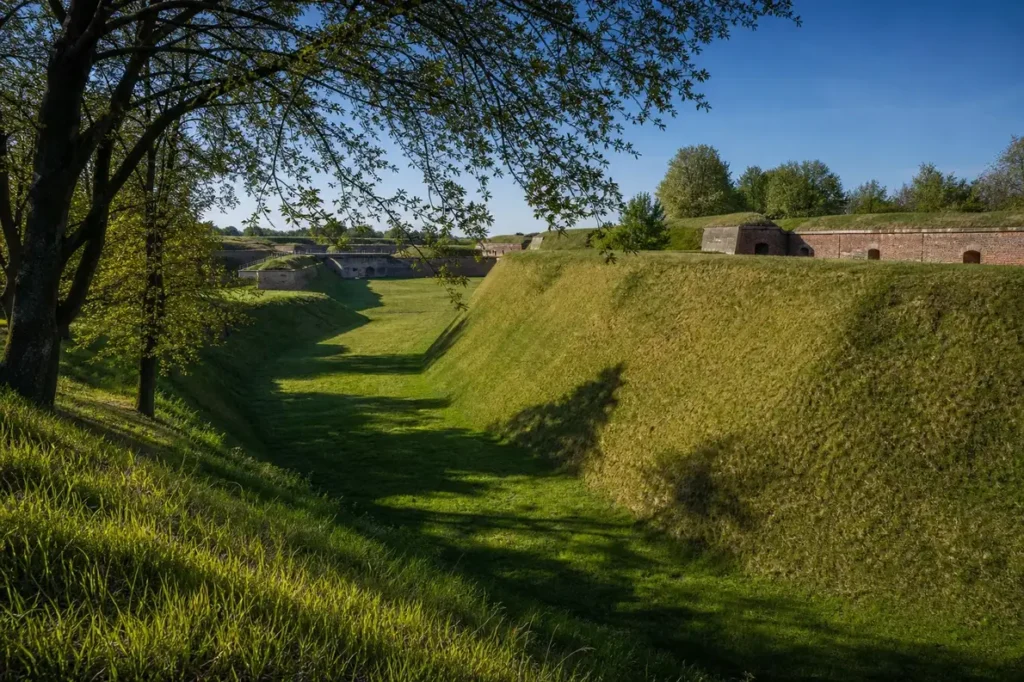
The fort's outer defences are as impressive as the interior. A moat 3–5 metres deep and 20–25 metres wide once filled with water to impede approach. The inner earthen rampart, six metres high and planted with trees for camouflage, still dominates the landscape when viewed from the moat's edge. This layered design—water, then earth, then stone walls—exemplifies 19th-century fortress theory. The visible breaches in the rampart show where Soviet assault troops and artillery broke through in April 1945.
Tip: Walk the entire perimeter if time permits (20–25 minutes); the view from the far side shows how the trees still frame the structure, as originally intended.
Battle Damage and Exhibits
The fort bears scars from 16 hours of intense fighting on 7–8 April 1945. Cracks and holes in concrete walls and ceilings testify to the fury of Soviet assault artillery. The museum displays feature shells, mortars, submachine guns and personal effects recovered from the bunker. Two main exhibitions—'The Storming of Königsberg' and 'Monuments of Fortification Architecture'—explain the siege and the fort's role in the defensive belt. A memorial stone at the entrance names Soviet soldiers awarded Hero of the Soviet Union for actions here.
Tip: Photographs of the damage with captions explain how each type of weapon or event created specific patterns in the concrete. Pay attention to the size comparisons.
Military Vehicles Exhibition
Outside the fort, an open-air display of German and Soviet armour from the 1945 campaign sits on the grounds. Tanks, self-propelled guns, and artillery pieces show the weapons that bombarded the structure. This collection provides context: the damage inside the fort becomes more meaningful when you see the scale of the guns that caused it. The exhibition explains the East Prussian Operation (January–April 1945) and the assault on Königsberg.
Tip: Visit this section near the end of your time at the fort, when daylight is lower and shadows enhance the vehicles' shapes and detail.
Officer and Soldier Barracks
Multiple rooms still contain period-appropriate reconstructions of military life. Bunks, lockers, mess tables and a hospital section illustrate how 300 German soldiers and officers lived in confinement. The contrast between the officers' quarters (slightly more space, separate latrine) and the soldiers' sleeping areas (bunk stacked tight) reveals hierarchy even underground. A working soldier's toilet, preserved in situ, is one of the small human details that make the fort memorable.
Tip: The barracks are accessed from the central gallery; ask staff which sections are lit, as not all casemates may be accessible on every day.
The Franco-Prussian Legacy
Fort #5 was constructed between 1878 and 1884 using money extracted from France as war reparations after the 1870–1871 Franco-Prussian War. Prussian military engineers designed the structure, and French prisoners of war are recorded as having laboured on the construction. This global entanglement—French money, French labour, German engineering, defending a Prussian city—reflects the era's power dynamics. The fort is a physical monument to that conflict's aftermath, standing 70 years before World War II consumed it.
Tip: The official museum plaques inside mention this Franco-Prussian connection; reading them adds depth to the experience.
Atmosphere
The fort feels like a sealed time capsule. Stepping from daylight into the casemates, you leave behind the modern city and enter a realm of concrete, brick and dim artificial light. The air is cool and slightly damp. The echoes of footsteps on brick floors reinforce the scale and emptiness—these were once crowded bunkers; now they are quiet except for the occasional sound of other visitors. The graffiti and markings left by 1945 defenders and conquerors add an intimate, unsettling layer.
Weekday mornings are quieter than afternoons; group visits cluster in summer. The scars of the final assault—shell holes, cracked ceilings, charring—are visible throughout and maintain a sober, respectful atmosphere. Visitors tend to speak quietly. Outside, the rampart and moat feel removed from the city, surrounded by trees and grass, creating a pocket of nature and history separate from urban Kaliningrad.
History of Fort #5 King Frederick Wilhelm III, Kaliningrad
Construction and the Franco-Prussian War (1870–1884): Fort #5 was conceived as part of Königsberg’s outer defensive belt, built during the reign of King Friedrich Wilhelm III (who actually died in 1840, so the name was given in honour). It was built after the Franco-Prussian War in 70s of the XIXth century by means of the French indemnity. Constructed between 1878 and 1884, the fort took an elongated hexagonal shape, 360 by 180 meters in dimension. Its power was emphasized by a water moat 20–25 meters wide and up to 5 meters deep, as well as concrete and brick walls with massive vaulted ceilings up to 5 meters thick. The garrison capacity was originally 350 officers and soldiers.
Early 20th Century Modernization: In the early part of the 20th century attempts were made to re-fortify the network of forts and the ceilings of Fort 5 were replaced by reinforced concrete. This upgrade reflected changing military technology and the emerging threat of modern artillery.
World War II and the 1945 Siege (February–April 1945): With World War II approaching Königsberg, the fortress was strengthened again and converted into a might pillbox with 8 heavy guns, 25 mortars and over 50 machine gun posts. The garrison who manned the fort numbered approximately 300 men and the fort was now equipped with barracks, kitchens, food and ammunition stores and hospital. When the Soviet Red Army launched the East Prussian Operation in January 1945, Königsberg became encircled. During the battle of Königsberg, Fort V “Friedrich Wilhelm III” was defended by a 200 man German garrison, which capitulated on 8 April 1945 after 16 hours of heavy fighting. The shells did not break through the concrete mass, but they were able to fracture the fortification. Around 15 soldiers of the Red Army were awarded the highest title in the Soviet military, Hero of the Soviet Union. Their names are forever immortalized on a memorial stone at the site.
Soviet Era and Soviet Closure (1945–1990): After the war, Königsberg became Kaliningrad, part of the Soviet Union. Initially, Fort #5, like much of Kaliningrad’s military infrastructure, remained off-limits to tourists and was under the control of the Soviet armed forces. The fort was used for storage and military purposes, remaining closed to civilians.
Museum Era (2010–Present): Since 2010 it is a part of The Kaliningrad Regional Museum of History and Art. Part of this historical complex has been open to visitors, offering a unique opportunity to explore its casemates, ramparts, and courtyards. There are two exhibitions «The storming of Koenigsberg» and «Monuments of fortification architecture».
Legends and Myths about Fort #5 King Frederick Wilhelm III, Kaliningrad
The Invisible Fort
Legend – historically unreliable. Local legend holds that Fort #5 was so well camouflaged that Soviet assault troops, even at close range, had difficulty identifying its exact extent and were surprised by its defensive strength. The fort's earthen rampart was planted with mature trees and earthen berms disguised the concrete structures. Some accounts claim that German defenders deliberately cultivated the appearance of a small rise in the landscape rather than a fortress, causing attackers to underestimate the defensive firepower until they came under fire. While Soviet planners certainly knew the fort's location and strength, the story captures the genuine difficulty of assaulting such a well-engineered position.
The Soldier's Toilet
Legend – historically unreliable. Museum staff often mention a preserved latrine—a soldier's toilet—found deep in the casemates, still identifiable and functional despite decades of exposure. Visitors speak of this detail with a mixture of curiosity and respect, as it humanizes the 300 men confined in the bunker for weeks. The toilet's survival and preservation touches on a larger truth: that ordinary human needs persisted even during extraordinary siege conditions, and that even the most imposing military structure ultimately served mortal bodies.
Tickets and Booking for Fort #5 King Frederick Wilhelm III, Kaliningrad
| Ticket | Price | Includes |
|---|---|---|
| Adult admission | ₽ | Access to all interior casemates, exhibitions, rampart and outdoor displays; standard museum hours. |
| Child/student concession | ₽ | Same access; reduced rate for Russian citizens and verified students (concession rates differ). |
| Free categories | Free | Children under a certain age; verify current age limit on the official site. |
| Audio guide rental (optional) | ₽ | Guided interpretation in English, German or Russian; ask at the ticket window. |
₽ budget · ₽₽ moderate · ₽₽₽ upscale · ₽₽₽₽ splurge. Price levels are estimates compared with typical prices for visitors.
Tickets are sold at the entrance ticket window (open 10:00–18:00). No advance online booking is typically required for individual visitors; simply arrive and purchase at the gate. Rates for Russian citizens and concessions (pensioners, students, service members) differ from those for international visitors; the museum does not advertise exact prices on the English-language website. Audio guides in English, German and Russian are available for rent at an additional cost; ask the ticket seller about availability. For detailed current pricing, concession eligibility and group bookings, consult the official museum site (fort5.westrussia.org) or call +7 (952) 058-83-53 or +7 (4012) 299-49-00.
Plan and Book
Suggested itineraries Fort #5 King Frederick Wilhelm III, Kaliningrad
1 hour
Enter via the central gallery and walk its full length, observing the barracks and storage rooms on either side. Exit to the exterior exhibitions of military vehicles and the memorial stone. Climb the rampart for an overview of the structure's scale. This brisk tour captures the layout and main sights.
1.5 hours
As above, but spend time examining one or two detailed exhibition panels inside the fort, reading about the 1945 siege. Descend into at least one side casemate to inspect the concrete damage caused by shells. Spend 15 minutes on the rampart perimeter. Include the outdoor weaponry displays and photographs.
2 hours
Follow the full 1.5-hour itinerary and expand it by using an audio guide (if available in your language). Spend time examining the reconstructed officer and soldier barracks, the hospital room and the kitchen. Observe the preserved details (graffiti, markings, damage patterns). Walk the full moat perimeter if energy permits. Conclude with the memorial stone and a review of the main exhibition panels.
How to Get to Fort #5 King Frederick Wilhelm III, Kaliningrad
The fort is located on Bulatova Street on the southern outskirts of Kaliningrad, roughly 6–7 km from the city centre.
By public transport: Take a marshrutka (shared minibus) or local bus heading toward Svetlogorsk from the centre of Kaliningrad; ask the driver to drop you near the ‘Svetlogorsky highway’ sign or a landmark near the fort entrance. The journey takes 15–25 minutes depending on traffic. Alternatively, take a taxi or ride-hailing car (Yandex Taxi) directly to ‘Fort 5, Bulatova Street’ (the driver will need the address in Russian: Форт № 5, улица Булатова, Калининград). Expect a fare of ₽₽ to ₽₽₽ depending on distance.
Walking: The fort is not easily accessible on foot from central Kaliningrad without substantial time or a long walk. Driving or ride-sharing is recommended.
Entrance: The main entrance is on Bulatova Street, marked by the museum sign. A small car park is available nearby.
Accessibility
The fort's uneven brick floors, low ceilings in sections and steep stairs make full accessibility challenging. Most interior casemates are accessible via the central gallery, which has been lit for visitor safety, but some side chambers may be narrow or require stooping. The exterior rampart is accessible and offers an accessible overview of the structure. Wheelchair users should contact the museum in advance (+7 (952) 058-83-53) to discuss accessible routes. The museum site notes provisions for accessible visits ('Доступная среда').
Food Nearby
Limited food options are available immediately at the fort; the museum operates a small café inside offering basic refreshments and snacks. For a full meal, restaurants and cafés in central Kaliningrad (6–7 km away) are more abundant. Bring water and snacks, especially in summer or if visiting for more than two hours. The nearby highway area has petrol-station shops with basic supplies, but no sit-down restaurants are within easy walking distance.
What to Bring
Comfortable walking shoes with good grip (brick floors can be slippery, especially if damp). A warm layer: the interior is cool year-round. A torch or strong phone light for examining details in dimly lit casemates. Insect repellent in summer. Sunscreen and a hat for walking the open rampart. A camera for the weaponry displays and landscape views. A water bottle. Small bags are allowed; the museum has not published restrictions, but oversized bags may be inconvenient in narrow passages.
Best Views and Photo Spots of Fort #5 King Frederick Wilhelm III, Kaliningrad
Moat and rampart rim
Looking inward from the moat's edge toward the earthen rampart and the fort's upper walls. The morning light from the east illuminates the rampart's slope and highlights the surviving defensive profile. Trees frame the view, creating depth.
Best time: Early morning or late afternoon, when sunlight is low and long shadows accentuate the rampart's contours. Avoid midday when shadows are minimal.
Central gallery interior, looking toward a light source
The barrel-vaulted brick ceiling and the receding perspective of the 360-metre gallery. Modern lighting fixtures highlight the masonry and the tunnel-like isolation. The view conveys scale and claustrophobia.
Best time: Interior light is consistent; any time of day works, but overcast outdoor light makes the contrast between exterior entrance and interior darker passages more dramatic.
Military vehicles exhibition, low angle
Soviet tanks and German guns arranged on the grass, photographed from ground level to emphasize their bulk and silhouettes against the sky or rampart backdrop.
Best time: Late afternoon, when side-light rakes across the vehicles, emphasizing detail and texture. The rampart behind creates a moody background.
Rampart perimeter, overview
Standing on the rampart crest looking out across the surrounding landscape—trees, grass, the moat beyond, and the city in the distance. The elevated vantage point conveys isolation and strategic position.
Best time: Golden hour (early morning or late evening), when warm light sweeps across the grass and rampart, or after rain when the fort and rampart are wet and colours deepen.
Casemate damage detail, close-up
A shell hole or crack in concrete, showing the layered defensive structure and the evidence of 1945 combat. Macro detail showing concrete, brick and rebar reinforcement.
Best time: With a bright hand torch (flashlight) to illuminate the interior texture and depth. Interior photography benefits from controlled light rather than ambient museum lighting.
Photography Rules
Photography is permitted throughout the fort, including interior casemates and exterior displays. No flash photography inside the casemates (to preserve artifacts and for visitor comfort in the low-light environment). Tripods and professional equipment should be cleared with staff in advance. Aerial drones are not permitted.
Family Suitability
Families with children aged 8 and above will find the fort engaging if interested in history and military architecture. The interior casemates and tunnels appeal to older children; the outdoor vehicles exhibition attracts younger visitors. However, the uneven brick floors, low ceilings in places, and the historical focus on warfare and destruction mean young children (under 6) may find the experience uncomfortable or upsetting. Strollers are difficult in the narrow galleries; child carriers are recommended for small children if adults wish to explore the full interior. The rampart walk and exterior areas are more suitable for families with very young children. No dedicated family facilities are advertised; the small café provides basic refreshments. A 1.5–2-hour visit suits most family schedules.
Russia Vibes Tips
- Visit on a weekday morning if possible. Weekend afternoons, especially in summer, attract large tour groups; the narrow casemates become crowded and the experience less immersive. Weekday mornings (Tuesday–Thursday) are noticeably quieter.
- Rent an audio guide if you speak English or German and are interested in detailed explanation. The guided interpretation adds layers of context to the shell damage, garrison life and 1945 siege that casual observation misses. Russian guides are more readily available than English or German.
- Bring a torch. Even with modern electric lighting, many side casemates and detail shots (shell holes, graffiti, machinery) are easier to see with supplementary light. The museum's lighting is functional, not bright.
- Walk the rampart perimeter before or after the interior exploration, not during. The shift between the claustrophobic underground and the open air above is psychologically significant and helps you understand the fort's dual nature: buried bunker and surface fortress.
- Don't rush the weaponry exhibition outside. Those vehicles and guns—Soviet T-34 tanks, German self-propelled guns, mortars—created the damage you see inside. Understanding them adds meaning to the crater-pocked concrete.
- Ask staff (if language permits) about any sections currently closed or undergoing conservation. Not all casemates are always accessible; a quick inquiry saves frustration.
Explore Nearby Fort #5 King Frederick Wilhelm III, Kaliningrad
Related guides
 Tram system, Kaliningrad: Historic rides through the city
Main image: AI-generated illustration. It may not show the place exactly as it looks.
 Port of Kaliningrad: Working Cargo Port, Historic Maritime Hub
Main image: AI-generated illustration. It may not show the place exactly as it looks.
 Khrabrovo Airport: Getting to Kaliningrad by Air
Main image: AI-generated illustration. It may not show the place exactly as it looks.
 Central District, Kaliningrad: Local Neighborhoods and What to See
Main image: AI-generated illustration. It may not show the place exactly as it looks.
 Day of the Navy, Kaliningrad: Parades, Fireworks and Naval Displays
Main image: AI-generated illustration. It may not show the place exactly as it looks.
Browse more: More in Kaliningrad · All Kaliningrad · All Landmarks · All Sightseeing · All Sightseeing in Kaliningrad
FAQ: Fort #5 King Frederick Wilhelm III, Kaliningrad
How long does a typical visit take?
Most visitors spend 1.5 to 2 hours. This allows time to walk the central gallery, examine a few casemates, see the exhibitions and outdoor displays, and climb the rampart. Detailed study with an audio guide or photography may extend this to 2.5–3 hours.
Is Fort #5 the only fort in Kaliningrad open to visitors?
Yes, Fort #5 is the most visitor-friendly and the only fort with a permanent museum. Other forts in the ring (Fort IV, Fort Va, Fort IX) remain abandoned or restricted. Fort #5 is the practical choice for touring the fortification network.
What is the difference between Fort #5 and the Bunker Museum?
Fort #5 is a 19th-century fortress with museums inside its casemates. The Bunker Museum is a separate Soviet-era command bunker in the city centre, used by Soviet generals during the 1945 siege. Both are branches of the same Kaliningrad Regional Museum of History and Art but require separate tickets and visits.
Do I need to book tickets in advance?
No. Individual visitors can buy tickets at the entrance (open 10:00–18:00). Advance booking is not required. Large groups should contact the museum ahead (+7 (952) 058-83-53) to arrange group rates and timing.
Are the interior passages safe for visitors with mobility issues?
The central gallery is walkable, but most side casemates have uneven brick floors, low ceilings and occasional steps. Contact the museum to discuss accessible routes. Strollers are impractical in narrow passages; child carriers are better if visiting with very young children.
Can I take photos inside the fort?
Yes. Photography is allowed throughout, including interior and exterior. Flash is discouraged inside casemates to preserve artifacts and ambient conditions. Professional tripods and drones require advance staff approval.
Is there a café or restaurant at the fort?
A small café is inside the museum offering basic refreshments and snacks. No sit-down restaurant is on-site. Bring water and snacks if visiting for more than an hour, or plan lunch in central Kaliningrad beforehand.
What language are the exhibitions in?
Exhibitions are primarily in Russian. Audio guides in English, German and Russian are available for rent at the ticket desk. Staff may have limited English; learning a few key Russian phrases or using a translation app is helpful.
Russia Vibes is a one-person project. A coffee keeps it going
How we research and update our guides
About this guide: AI assistance and accuracy
This guide is created with the help of AI and is based on official sources where available. Mistakes can still happen. Opening hours, prices, rules and other details are given to the best of our knowledge as of the date shown and can change without notice. It offers general recommendations only, not professional, legal or travel advice. Please confirm important details with the official source before you travel; you are responsible for your own plans and decisions.

Take this guide with you
Get a free PDF of this guide to print or read offline: key facts, tips and a map link on a few clean pages.
Report an issue on this page
Paying for your trip: please read
International sanctions affect payments between Russia and many other countries. In practice, cards issued in the EU, the UK, the US and several other countries often do not work in Russia, Russian cards usually do not work abroad, and some booking platforms, airlines and payment providers limit or suspend their services for Russia. The situation changes frequently.
We do not give legal or financial advice, and this site does not encourage anyone to break or circumvent sanctions. Whatever you plan, you are responsible for following the laws and regulations that apply to you, including those of your country of residence and citizenship.
Many travelers still organise their stay lawfully. It is worth asking your bank or payment provider what is currently permitted, contacting hotels, tour operators and carriers directly about the payment methods they accept, and checking which services are open to customers from your country. Clarify payment, cancellation and refund terms before you commit to a booking, and keep your plans flexible.
Partner links on this site may not be available in every country, and prices, availability and rules in our guides can differ from what you see when you book.