
Updated
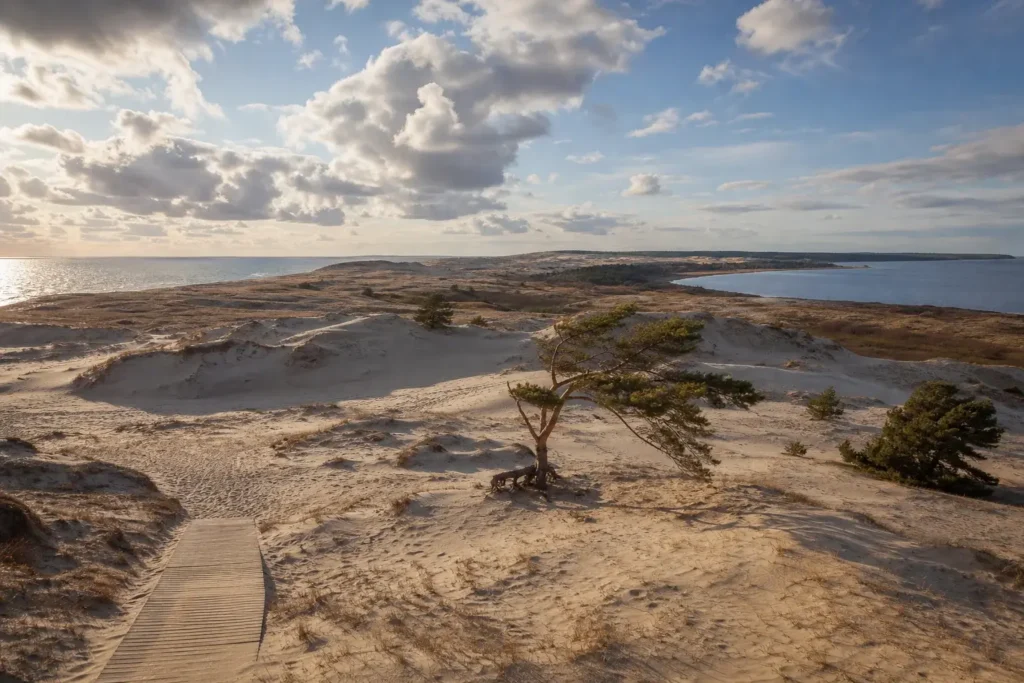
The Curonian Spit features dunes over 60 metres high and a forest of twisted pines, a narrow sand peninsula that stretches across the southeastern Baltic. The Russian national park covers 41 km of the 98 km long spit, established in 1987. Accessed from Kaliningrad city, it makes an ideal day trip to see one of Europe’s most distinctive landscapes shaped by wind and water.
The area is one of high biodiversity due to the many different ecological communities in close proximity to each other: beach, dune ridge, wetlands of various types, meadows and forests. The park is famous for migratory birds and offers hiking trails through shifting sands and ancient forests.
Quick Facts
| Russian name | Национальный парк «Куршская коса» |
|---|---|
| Distance from the nearest major city | approximately 2,350 km |
| Travel time from the nearest major city | approximately 5 hours by plane to Kaliningrad, then 1–1.5 hours by car to the park |
| Built / opened | 1987 |
| Address | Zelenogradsky District, Rybachy Village, Lesnaya Street 7 OpenStreetMap · Google Maps |
| Opening hours | May 1 – September 30: Daily 09:00-17:00
October 1 – April 30: Daily 09:00-17:00; Closed Monday and Tuesday |
| Admission | ₽ |
| Best time to visit | Late May through September offers the most reliable weather and full access to trails. The trail is open year-round and is beautiful to visit anytime. Early autumn (September–early October) is ideal: warm days, fewer tourists, and peak bird migration through the Fringilla station. Spring (April–May) brings migrating birds and wildflowers, though facilities are beginning to ramp up after winter. Summer (June–August) is busiest; the dunes can be hot, but the trees provide shade. Winter visits are possible but challenging—facilities reduce hours, the ground is icy, and the Baltic wind is intense. |
| Recommended duration | 4–5 hours |
| Website | park-kosa.ru |
What Is (and Isn't) Part of a Visit to Curonian Spit National Park, Kaliningrad?
| Part | Status | Notes |
|---|---|---|
| Russian southern section of Curonian Spit National Park (41 km) | Included in the standard ticket | The entire Russian side is protected; you can drive or walk the main road and marked trails freely with a valid park ticket. |
| Lithuanian northern section (52 km, including towns Nida, Juodkrantė, Neringa) | Outside / not part of it | Requires separate ferry crossing from Klaipėda, Lithuania, and separate Lithuanian park entrance fee. Covered by separate Lithuania guides. |
| Zelenogradsk beach town | Outside / not part of it | Gateway town just north of the park; charming but separate from the park itself. Covered in separate Zelenogradsk guides. |
| Museum Complex and Visitor Centre (near Rybachy) | Included in the standard ticket | Includes exhibits on geology and ecology. Entrance is typically included with park admission, though some sources list a small additional fee. |
| Marked walking and driving trails (Swan Lake, Epha Dune, Dancing Forest, etc.) | Included in the standard ticket | All main attractions are accessible with park entry. Some trails require short walks on wooden boardwalks or sand; all are free once inside the park. |
| Fringilla Ornithological Station | Included in the standard ticket | Open to visitors April–October. No additional fee; you observe from a designated viewing platform. |
| Beach access (Baltic Sea side) | Included in the standard ticket | You can access sandy beaches throughout the park. Swimming is technically possible but the water is cold and often has strong currents. |
| Accommodation within the park (villages of Lesnoy, Rybachy, Morskoye) | Separate ticket or institution | Small guesthouses and private rooms exist in park villages. These are separate bookings; park entry ticket does not include lodging. |
How to Get from the nearest major city to Curonian Spit National Park, Kaliningrad
| Option | Duration | Price | Notes |
|---|---|---|---|
| Train from Kaliningrad to Zelenogradsk + bus into the park | 1–1.5 hours total travel | ₽ | Trains run frequently from Kaliningrad to Zelenogradsk (approximately 25–40 minutes). From Zelenogradsk railway station, take a local bus south toward the spit. This is the most economical option for independent travellers. |
| Organised day tour from Kaliningrad | 6–7 hours including guide and transport | ₽₽ | Various tour operators offer guided excursions departing from Kaliningrad city hotels or the airport, including park entry fee, guide, and usually a vehicle tour of main attractions. Convenient for visitors without a rental car or Russian language skills. |
| Rental car from Kaliningrad | 1–1.5 hours each way | ₽₽ | Self-drive gives maximum flexibility. Zelenogradsk is the main gateway; from there, head south to Rybachy village and the park entrance. Road is paved and well-signposted. Fuel and rental costs apply. |
| Taxi or ride-hailing from Kaliningrad city centre | 1–1.5 hours | ₽₽₽ | Most convenient but most expensive option. Drivers familiar with the park are available through local ride-hailing apps or hotel concierge. Can arrange a fixed-price return, or negotiate hourly waiting time. |
₽ budget · ₽₽ moderate · ₽₽₽ upscale · ₽₽₽₽ splurge. Price levels are estimates compared with typical prices for visitors.
Why Visit Curonian Spit National Park, Kaliningrad?
The Curonian Spit National Park is known for its sometimes spectacularly high shifting sand dunes and is a hotspot for ornithologists. The foundations of the spit were created about 15,000 years ago as the receding glaciers left the Baltic Sea behind, and the sea and wind build large dunes which average 35 meters on the spit.
Visitors can drive or walk the length of the protected area, visiting marked attractions such as dunes, bird-ringing stations, and viewpoints overlooking both sea and lagoon. The park is compact and easily explored in a few hours, offering an escape from Kaliningrad city into pristine nature. The dramatic sandscapes change constantly—wandering dunes have repeatedly buried and exposed settlements over centuries.
Highlights of Curonian Spit National Park, Kaliningrad
Epha Dune (Efa Heights)
One of the highest dunes, about 60 metres, with a wooden trail and a viewpoint where you can see the sea and the lagoon at the same time. This is the most visited viewpoint in the park, offering a vantage point where both bodies of water are visible. On clear days, the views extend across the lagoon to Lithuanian territory. The dune constantly shifts; winter storms and spring winds reshape it visibly from year to year.
Tip: Arrive early in the morning or late afternoon to avoid crowds and to catch better light for photos of the surrounding landscape.
Dancing Forest (Muller Height)
A pine forest with an unusual natural phenomenon: the trees grow in bizarre twisted shapes, bending and spiralling in a pattern that looks almost choreographed. The exact cause of the twisting is debated, though wind, soil conditions, and possibly human activity in the Soviet era have all been proposed. The effect is distinctive and unsettling—the trees seem frozen in motion.
Tip: The forest floor is soft sand; wear sturdy shoes. The phenomenon is most apparent when you walk through, rather than viewing from a distance.
Swan Lake (Laboe)
A shallow lagoon hosting migratory waterfowl, marked by a simple wooden observation platform. In spring and autumn, thousands of birds pass through during migration. The lake offers a quieter, less dramatic experience than the dunes but provides insight into the park's role as a crucial stopover for birds traveling between the Arctic and Africa. Best visited during spring and autumn migration seasons.
Tip: Bring binoculars and move slowly; sudden movements will frighten birds. Early morning offers the most activity.
Fringilla Ornithological Station (Km 23)
Giant nets for ringing birds, in use from April to October. In autumn, thousands of birds pass through every day. This working research station allows visitors to watch scientists and volunteers capture, tag, and release migratory birds. It is one of Europe's most important bird-ringing stations, contributing crucial data to European ornithology.
Tip: Visit in September and October for peak bird activity. The station staff welcome visitors; you may see birds being banded if you time your arrival correctly.
Royal Forest (Korolevskiy Les)
An old-growth pine forest of unusual density and character, named in honor of past nobility. This section of the park preserves the darker, more traditional woodland ecosystem before the open dunes. Walking through shows the forest's ability to stabilize sand and create an entirely different microclimate from the exposed dune tops.
Tip: This area is quieter and better for contemplative walks. It is a good spot for mushroom and berry foraging in season.
Museum Complex and Visitor Centre
Located near the southern entrance, the centre provides context on the park's geology, ecology and history. Exhibits explain dune formation, the Ice Age origins, and the park's role in bird migration. Staff can provide maps and advise on current conditions. Opening hours from October 1 to April 30: 09:00 a.m. to 5:00 p.m., closed on Mondays and Tuesdays. From May 1 to September 30, the visitor center is open seven days a week.
Tip: Stop here first to pick up a detailed map and checklist of birds and plants you might see. Staff speak English and Russian.
Atmosphere
Mass tourism is almost impossible here due to the limitations imposed by the national park status. Therefore, you will hardly see large crowds of people resting on the vast sandy beaches of the Spit. The air smells of salt and resin. Wind is almost constant, shaping every tree and grain of sand. In summer, the dunes radiate heat; in winter, storms roll in from the Baltic with dramatic force. The park feels isolated despite being just over an hour from Kaliningrad city—the narrow road and limited facilities enforce a sense of solitude. Visitors range from birders with telescopes to families climbing dunes. The landscape is active and changing; every season looks different, and returning visitors notice shifts in the dunes.
History of Curonian Spit National Park, Kaliningrad
The foundations of the spit were created about 15,000 years ago as the receding glaciers left the Baltic Sea behind, and the sand dunes of the Curonian built on the glacial moraine. Over millennia, wind and sea currents shaped the sand into an increasingly distinctive landform.
Until 1991, the Kaliningrad region, formerly Königsberg, was a restricted area due to its military significance. The spit’s remote location made it ideal for Soviet military use, and civilian access was forbidden for decades. During the time of the Soviet Union, it was a restricted military area and completely inaccessible to the civilian population for many years.
The Curonian Spit is a narrow sand dune peninsula, preserved from erosion through human efforts since the 19th century. Earlier German and Russian rulers recognised the threat of migrating dunes that could bury settlements and roads. Sand stabilisation through tree-planting became systematic policy.
The spit is a UNESCO World Heritage Site shared by the two countries, inscribed in 2000. The shared designation reflects its binational character—the southern portion of the spit lies within Zelenogradsky District in Kaliningrad Oblast, Russia; the northern portion lies within southwestern Lithuania. Joint management agreements ensure coordinated conservation of the entire spit’s ecology and heritage.
Tickets and Booking for Curonian Spit National Park, Kaliningrad
| Ticket | Price | Includes |
|---|---|---|
| Day entry (adults) | ₽ | Access to the entire Russian section of the park, all marked trails, vehicle pass (if arriving by car), and typically the museum complex. |
| Vehicle entry | ₽ | Permits the vehicle to drive the full length of the park road. Charged per vehicle, not per occupant; standard fee structure includes all passengers in that vehicle. |
| Group entry | ₽ | Reduced per-person rate for groups of 10 or more. Contact the official website or visitor centre for current group rates. |
₽ budget · ₽₽ moderate · ₽₽₽ upscale · ₽₽₽₽ splurge. Price levels are estimates compared with typical prices for visitors.
Entry to the Russian Curonian Spit National Park is paid at a checkpoint near the southern entrance (Rybachy village). Park entry is mandatory; you cannot bypass it.
How to enter: Visitors arriving by car stop at the entrance gate, where staff issue a vehicle pass. Pedestrians and passengers also pay per person. Tickets are sold on-site; no advance online booking is typical. Rates for Russian citizens and children differ from international visitors’ rates.
Hours: October 1 – April 30: 09:00 a.m. to 5:00 p.m., closed on Mondays and Tuesdays. From May 1 to September 30, the visitor center is open seven days a week.
Payment: Cash (rubles) is accepted; card payment availability varies—confirm at the entrance or contact the official website in advance. No exchange facilities are available in the park.
For complete current rates and any special categories, check the official Curonian Spit National Park website (park-kosa.ru) or contact the visitor centre: +7 (4012) 53 29 07.
Plan and Book
Suggested itineraries Curonian Spit National Park, Kaliningrad
Half-day (4 hours on-site)
Arrive at the southern entrance by late morning. Visit the Museum Complex and Visitor Centre (30 min). Drive north 15 km to Epha Dune (Km 42) and climb the viewpoint (45 min). Continue to Dancing Forest (Muller Height) and walk among the twisted pines (30 min). Stop at Swan Lake if time permits (20 min). Drive back south by early afternoon. Depart for Kaliningrad.
Full day (6–7 hours including travel)
Leave Kaliningrad by 09:00. Arrive at the park entrance by 10:30. Visit Museum Complex (30 min). Drive to Fringilla Bird-Ringing Station (Km 23) and observe (45 min). Continue north to Swan Lake and walk the boardwalk (30 min). Stop for a simple lunch in Rybachy village (1 hour). Drive to Epha Dune and climb (45 min). Explore Dancing Forest (30 min). Visit Royal Forest if time permits. Begin return to Kaliningrad by 17:00, arriving by 18:30.
Extended day with overnight
Travel from Kaliningrad to the park by midday. Check into accommodation in Rybachy, Lesnoy, or Morskoye village. Explore the Museum Complex and main attractions. Spend the evening walking the beach or forest at dusk. Next morning, wake early to visit Fringilla Station during active bird-ringing season, or take a long walk through one of the less-visited forest sections. Return to Kaliningrad by mid-afternoon.
How to Get to Curonian Spit National Park, Kaliningrad
From Kaliningrad city centre by train and bus: Walk or take a local bus to Kaliningrad Railway Station. Purchase a ticket to Zelenogradsk (approximately 25–40 minutes, frequent trains). From Zelenogradsk Station, take a local marshrutka (minibus) or taxi heading south toward Rybachy and the Curonian Spit entrance. Journey time varies (30 min – 1 hour depending on traffic and stops). The marshrutka drop-off is near the park entrance checkpoint.
By car: From central Kaliningrad, take the main road southward toward Zelenogradsk (approximately 25–30 km). From Zelenogradsk, continue south. The road is paved and clearly signposted toward Curonian Spit National Park (Куршская коса). Follow signs to Rybachy village and the southern entrance gate. Parking is available near the entrance. The journey is approximately 45 minutes to 1 hour from Kaliningrad city centre.
By taxi or ride-hailing app: Use local apps (Yandex Taxi, Uber) to request transport from your hotel directly to the park entrance. Request a driver familiar with the Curonian Spit; many offer to wait and provide a return trip on a fixed-price or hourly basis, which is convenient for single-day visitors.
By organised tour: Tour operators in Kaliningrad offer pickup from major hotels and the airport, with transport, guide, and park entry included. This is the simplest option if you prefer not to arrange logistics yourself.
Accessibility
Most visitor facilities are concentrated at the southern entrance and along the main road. The Museum Complex has level access. Main dune viewpoints (Epha Dune) are reached via wooden boardwalk trails that are steep and not wheelchair-accessible; the boardwalk has railings but sandy areas are difficult for wheeled mobility. Parking is available near key stops. Accessible toilets are limited; ask at the visitor centre. The park road itself is paved and accessible by car. Dogs are allowed on some trails but not on others; confirm at the entrance.
Food Nearby
Limited food options exist within the park. Small cafés and restaurants operate in the villages of Rybachy, Lesnoy, and Morskoye, but these have inconsistent hours (especially outside summer season). Bring snacks and water, or plan a lunch stop in Zelenogradsk (the nearest town with wider restaurant choice) before or after your park visit. A picnic on the beach or in the forest is common and encouraged.
What to Bring
Sturdy hiking shoes or boots (sand and soft paths); the dunes are loose and slippery. Sunscreen and a hat; exposure on open dunes is intense. A light wind-resistant jacket; the Baltic wind is constant and can be cold even in summer. Binoculars for birdwatching. Water bottle (refill at the visitor centre if possible). A small backpack for snacks. In spring and autumn, bring layers for unpredictable weather. Winter: warm gloves, thermal layers, and a windproof coat. Bags are not restricted; the park does not have formal security procedures.
Best Views and Photo Spots of Curonian Spit National Park, Kaliningrad
Epha Dune summit
The highest viewpoint in the Russian park, approximately 60 metres above sea level. From the top, the Baltic Sea stretches to the west, and the Curonian Lagoon lies to the east, creating a dramatic contrast of blue and grey waters separated by the narrow strip of forest and dunes you're standing on. On clear days, the horizon is unbroken.
Best time: Golden hour (early morning or late afternoon) offers the warmest light and casts shadows that emphasize the dune's texture. Avoid midday when the sun is harsh and flat.
Dancing Forest boardwalk
Twisted pine trunks in impossible curves and spirals, framed by thick forest on either side. The perspective is intimate; the boardwalk winds through the trees at eye level, making the distortions more striking. Dappled sunlight filters through the canopy.
Best time: Overcast days reduce harsh shadows and show the full contorted detail of the trees. Any time of day works; avoid harsh midday sun.
Swan Lake overlook platform
A low wooden platform overlooks a shallow, pale lagoon surrounded by marsh and forest. Waterfowl—grebes, swans, ducks—are often visible. The composition is subtle and peaceful, with layers of water, reeds, and treeline.
Best time: Early morning in spring or autumn, when bird activity is high and the light is soft and warm. Avoid windy days, which churn the water and disperse birds.
Fringilla Ornithological Station viewing area
Close view of bird-ringing nets, banding tables, and researchers at work. The scene captures the park's role in ornithology; you're looking at a working research station, not a manicured viewpoint.
Best time: April–October, particularly September–early October when thousands of migrants move through daily. Early morning offers the most activity. Weather affects bird traffic; overcast, drizzly days often see more birds.
Main road panorama (various pullouts)
The paved main road runs the length of the spit with frequent pullouts. From these stops, you see the landscape in cross-section: dunes and forest on one side, lagoon or sea on the other. Different sections offer varied perspectives as the dunes rise and fall.
Best time: Any time. Drive slowly and stop whenever the view strikes you. Changing light throughout the day reveals different moods.
Photography Rules
Photography is permitted throughout the park. Drones are not permitted without special permission from the park administration; contact them in advance if you wish to operate a drone. Tripods are allowed on trails and viewpoints. There are no flash restrictions; most of the park is outdoors. The twisted trees of the Dancing Forest are particularly photogenic; arrive early in the morning or late afternoon for the best light.
Family Suitability
The park is suitable for families with children, though the experience depends on age and interests. Young children (under 5) may tire on dune climbs; the sand is soft and walking is effortful. Epha Dune's boardwalk is safe for older children (6+) but steep. The park has no playgrounds or child-specific amenities. Strollers are difficult on sand; a child carrier is more practical. Older children enjoy the nature-walk experience, spotting birds and collecting interesting rocks and shells on the beach. Families often picnic on the beach, which children enjoy. The park lacks commercial attractions or indoor shelter, so the experience is outdoor-focused. All-weather gear is important.
Russia Vibes Tips
- Visit the Museum Complex first. It provides essential context on dune formation and bird migration that makes the rest of the park more meaningful. The 30-minute stop pays dividends for understanding what you're seeing.
- September and early October are underrated. Fewer tourists, warm days, and peak bird migration create perfect conditions. Most visitors crowd the park in July and August.
- Bring food and water from Kaliningrad or Zelenogradsk. Park cafés are sparse and irregular. A picnic at Swan Lake or on a quiet beach section is far better than relying on spotty food options.
- Start early from Kaliningrad (before 10:00) if doing a half-day visit. Parking near Epha Dune fills on weekends and summer afternoons. Early arrival guarantees spots at main attractions.
- Don't skip the Dancing Forest even if it seems less dramatic than the dunes. The twisted pines are genuinely strange and deserve 20–30 minutes of exploration; they're one of Europe's most unusual forests.
Explore Nearby Curonian Spit National Park, Kaliningrad
Related guides
 Zelenogradsk: Beach, Promenade and Baltic Escape from Kaliningrad
Main image: AI-generated illustration. It may not show the place exactly as it looks.
Browse more: All Day Trips · All Day Trips in Kaliningrad · All Kaliningrad · All Parks
FAQ: Curonian Spit National Park, Kaliningrad
Do I need a guide to explore the Curonian Spit?
No. The main road and trails are well-marked, and signage is posted at attractions. A detailed map from the visitor centre is sufficient for independent exploration. Hire a guide only if you want specialist knowledge about birds, geology, or history, or if you prefer not to navigate alone.
Can I drive the entire length of the park?
Yes. The main paved road runs the full 41 km of the Russian section. You can drive from south to north in about 1.5 hours without stopping. Most visitors pull over at marked stops and walk short trails from their car.
Is the Lithuanian side of the Curonian Spit worth visiting?
Yes, it's different and worth seeing if you're in the region, but it requires a separate ferry crossing from Klaipėda, Lithuania, and separate park tickets. The Lithuanian section has larger towns (Nida, Juodkrantė), museums, and a different landscape feel. For a day trip from Kaliningrad, the Russian side alone is sufficient.
How long should I spend in the park?
A minimum of 4 hours is reasonable to see main attractions (Museum, Epha Dune, Dancing Forest). A full day allows for more thorough exploration, including Swan Lake, the bird station, and quieter forest walks. Overnight stays give time for sunset and sunrise viewing plus a more relaxed pace.
Is swimming safe in the Baltic?
Technically yes, but the water is cold (14–17°C even in summer) and currents can be strong. Most visitors don't swim; they wade briefly or simply enjoy the beach without entering the water. Bring a wetsuit if you plan to swim.
When is the best time to see migrating birds?
Spring (April–May) and autumn (September–early October) are peak migration times. The Fringilla station operates April–October and is busiest in September. Late summer (August–September) sees the heaviest numbers of birds moving south.
Is the park accessible in winter?
Yes, but conditions are challenging. The road remains open and drivable, but icy stretches can be hazardous. Visitor facilities operate on reduced hours (typically closed Mondays and Tuesdays). Extreme cold, snow, and strong winds are common. Winter visits appeal to hardy nature enthusiasts; casual visitors should avoid.
Can I camp or stay overnight in the park?
Camping is not permitted. Accommodation exists only in the park villages (Rybachy, Lesnoy, Morskoye) as private guesthouses and small hotels. Book in advance, especially in summer. Facilities are basic but comfortable.
Russia Vibes is a one-person project. A coffee keeps it going
How we research and update our guides
About this guide: AI assistance and accuracy
This guide is created with the help of AI and is based on official sources where available. Mistakes can still happen. Opening hours, prices, rules and other details are given to the best of our knowledge as of the date shown and can change without notice. It offers general recommendations only, not professional, legal or travel advice. Please confirm important details with the official source before you travel; you are responsible for your own plans and decisions.

Take this guide with you
Get a free PDF of this guide to print or read offline: key facts, tips and a map link on a few clean pages.
Report an issue on this page
Paying for your trip: please read
International sanctions affect payments between Russia and many other countries. In practice, cards issued in the EU, the UK, the US and several other countries often do not work in Russia, Russian cards usually do not work abroad, and some booking platforms, airlines and payment providers limit or suspend their services for Russia. The situation changes frequently.
We do not give legal or financial advice, and this site does not encourage anyone to break or circumvent sanctions. Whatever you plan, you are responsible for following the laws and regulations that apply to you, including those of your country of residence and citizenship.
Many travelers still organise their stay lawfully. It is worth asking your bank or payment provider what is currently permitted, contacting hotels, tour operators and carriers directly about the payment methods they accept, and checking which services are open to customers from your country. Clarify payment, cancellation and refund terms before you commit to a booking, and keep your plans flexible.
Partner links on this site may not be available in every country, and prices, availability and rules in our guides can differ from what you see when you book.