
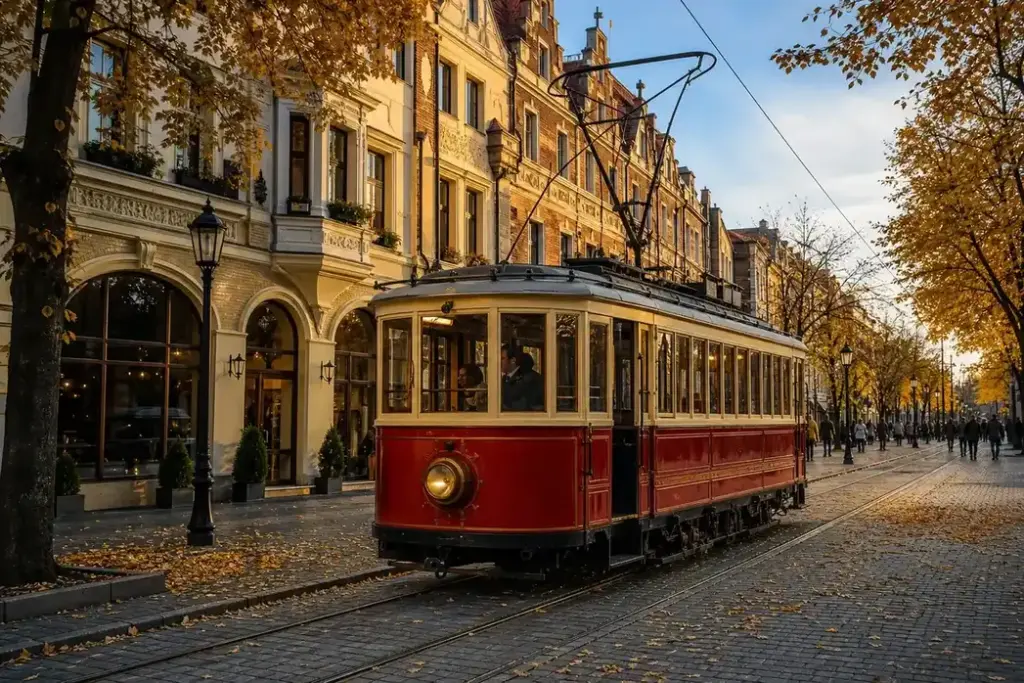
The tram system in Kaliningrad is one of the most characterful ways to get around the city. The first electric tram line in what is now Russian territory opened here in 1895, and trams still rattle along their narrow-gauge tracks today, carrying commuters, students and curious visitors.
Two routes, numbered 3 and 5, are the heart of the network. Together they link the main railway station area, the river quarter, the markets and the city’s green spaces. This page explains what the ride is like, which parts of the city it opens up, how fares and payment work for visitors, and how to fit a tram trip into a day of sightseeing.
Quick Facts
| Russian name | Калининградский трамвай |
|---|---|
| Built / opened | 1895 |
| District | Kaliningrad |
| Opening hours | Daily 06:00-22:45 |
| Best time to visit | Trams run all year, and the ride is comfortable in spring and autumn. In summer the cars can get warm and the centre is busier with visitors, so mid-morning or late afternoon rides are calmer. In winter the cars are heated but windows may fog up, and heavy snow can cause delays.
Weekday rush hours are crowded, so for sightseeing aim for the middle of the day or for weekends outside the evening peak. |
Why Visit Tram system, Kaliningrad?
A tram ride shows you Kaliningrad at walking pace, from a seat with a big window. You pass a mix of old brick buildings, prewar villas, apartment blocks and new waterfront development, and the changes from street to street tell the story of the city better than a single sight can.
It is also simply practical. The tram runs on its own tracks through areas where traffic can be slow, it is cheap by local standards, and it reaches places such as the Fish Village embankment, the central market and the zoo area without a car or taxi. For anyone who likes railways and vintage transport, the network is a living piece of the city’s history, and a museum near the old Friedland Gate even offers a ride in a restored German tram.
How Tram system, Kaliningrad Is Laid Out
Think of the network as a long north-south spine with one route doing most of the work. Route 3 links the area around the Southern Station (Yuzhny Vokzal) with Central Park (Park Tsentralny) at the other end, and it passes stops named after the Fish Village (Rybnaya Derevnya), the central market, the technical university and the zoo along the way.
Route 5 overlaps with route 3 for part of its way, so on shared stretches you can take whichever tram comes first. The exact stop list and any temporary changes are best checked on the operator’s route map or in a local map app, because lines are sometimes diverted during roadworks.
For orientation, start at the Southern Station if you arrive by train, or hop on near the river quarter if you are already in the centre. Look for the tram stop signs and the overhead wires on the street, then ride a few stops in one direction and walk back if you want a closer look at something you passed.
Highlights of Tram system, Kaliningrad
Narrow-gauge tracks with a long history
Kaliningrad's tram lines use a narrow gauge that is rare among Russian cities, and the system goes back to the horse trams of 1881 and the first electric service in 1895. When you ride, the rhythm of the wheels over the rail joints and the tight curves are part of the experience. Many sections still follow the original street layout of the old Königsberg grid, so you are literally travelling along streets planned more than a century ago.
Tip: Sit near the front or the rear window if you can: the view along the track is the best on the curves.
Czech-built Tatra cars
For decades the backbone of the fleet was formed by Tatra trams built in Czechoslovakia, delivered from the early 1970s and, as articulated KT4 cars, from the late 1980s. They are boxy, noisy and loved by tram fans, with large windows and wooden-look interiors that feel like a time capsule. They have become a signature of the network even as newer cars arrive.
Tip: You cannot choose which car arrives, so if you want a Tatra, let one or two modern cars pass and take the next.
The Fish Village stretch
Route 3 serves stops near the Fish Village (Rybnaya Derevnya), the reconstructed riverside quarter with timber-framed buildings, a lighthouse-style tower, restaurants and shops. The tram brings you to the edge of the quarter, and from there it is a short walk to the embankment. It is one of the easiest ways to combine a tram ride with a stroll along the river.
Tip: Get off at the Fish Village stop in the morning or late afternoon for softer light and fewer people on the embankment.
Central market and everyday city life
Stops around the central market show the working side of Kaliningrad. In the morning the trams fill with shoppers carrying bags, and the streets outside are busy with stalls, delivery vans and people on their way to work. It is not a postcard view, but it is where you feel the city's daily rhythm and see what local people eat and buy.
Tip: Visit the market area before lunch, when the choice of fresh produce and baked goods is at its widest.
Zoo and park end of the line
At the northern end of route 3 the tram reaches Central Park, close to the zoo and the green spaces that locals use for walks and weekend outings. The terminus is a good place to step off, stretch your legs and take a relaxed loop through the trees before riding back. It makes a pleasant half-day with children.
Tip: Check the zoo's own opening times before you set out, as they differ from the tram's operating hours.
A vintage German tram at the Friedland Gate museum
The museum in the old Friedland Gate offers rides in a restored German tram from 1963, built by Düwag, which runs on the city's tracks for sightseeing trips. It is a different experience from the everyday service, with a guide-style focus on the old centre and the history of the network. It is a small extra that tram enthusiasts will want to know about.
Tip: Ask the museum or look at its official website for current tour times and how to book, since these rides are run by the museum rather than by the regular tram operator.
Atmosphere
Inside a Kaliningrad tram the mood is calm and unhurried. The doors slide open with a clank, the driver announces the stop, and the car sways gently as it rolls down the street. In the mornings and early evenings the cars are full of commuters and students, so you will hear a lot of everyday Russian conversation and the soft rattle of the track underneath.
Outside the large windows the city slides by: red-brick buildings, tall poplars, parks, small shops, and the occasional glimpse of water between the houses. In winter the glass fogs up and the passengers are wrapped in coats and scarves, while in summer the windows are open and the air smells of cut grass and warm asphalt. Between rush hours the car is quiet, ideal for taking in the surroundings.
History of Tram system, Kaliningrad
Public transport on rails in Königsberg began with horse-drawn trams in 1881, a simple service that carried passengers along the main streets of the growing city.
On 31 May 1895 the first electric tram line opened, the first of its kind in what is now Russian territory. The system was built to a narrow gauge, which later made it unusual among Russian tram networks. Electric service quickly proved popular, and the network grew fast: there were four routes by 1899, eight by 1902 and eleven by 1904.
By 1937 Königsberg had 15 tram routes, each marked by its own colour, and a fleet of around 250 cars. Service started early in the morning and ran until late evening, and the tram was the main way for people to move around the city.
The Second World War caused heavy damage to the network. Four of the city’s five tram substations were destroyed and many cars were put out of action. Restoration began soon after the war ended, and in 1946 service restarted, with roughly half of the prewar fleet back on the rails.
In the following decades the system was rebuilt and extended. By the late 1960s there were around nine routes, and in 1971 the first Tatra cars arrived from Czechoslovakia. Articulated Tatra KT4 trams followed from 1987 and became the typical Kaliningrad tram for a generation. In the 1990s the city also took in used trams from Germany, and for a few years a pair of Düwag cars ran on one of the routes.
From the mid-1990s the tram faced strong competition from buses and minibuses. Routes were cut back, and during road reconstruction some tracks were removed and not replaced. The network shrank until only a few lines remained.
In the 2010s the city began to renew the fleet, with the first low-floor car entering service in 2012 and more modern trams joining later. Today two routes, numbered 3 and 5, remain in daily service, and the city has talked about further improvements to tracks, stops and traffic priority for trams.
The tram is now seen less as a mass transport system and more as a character-rich piece of the city’s heritage that still does useful work. Together with the museum tram at the Friedland Gate, it keeps a link with the days when colour-coded lines covered most of old Königsberg.
Tickets and Booking for Tram system, Kaliningrad
Fares are paid on board or by a few other means. As of October 2026, the city’s official information describes these options for trams, buses and trolleybuses, but check the official sources before you travel because systems and rules change.
- Level: ₽ (budget). A single ride costs the same on trams as on city buses and trolleybuses.
- Transport card: the local Volna Baltiky card usually gives the lowest fare, but it is topped up through Russian banking services and is mainly practical for residents.
- Bank card, Fast Payment System or QR code: many vehicles accept contactless payment from Russian bank cards or a QR code scanned inside the tram. Cards issued outside Russia do not work, so carry cash.
- Cash: usually accepted, but often at a higher fare than the card. Keep small notes ready.
Rush hours on weekdays are typically around the morning and early evening commutes, when cars are full. For current fares and payment rules, see the city administration’s website (klgd.ru) and the city’s tourism website (visit-kaliningrad.ru).
How to Get to Tram system, Kaliningrad
The network does not have one central entrance, so the easiest way to start is from one of two points.
- Southern Station (Yuzhny Vokzal): if you arrive by train, the route 3 terminus is next to the station. Look for the tram stop near the station building and the overhead wires above the street.
- City centre and river quarter: from the Fish Village embankment, walk to the nearby stop and take a tram in either direction. Local map apps show the stop names and live positions of the cars, which makes it easy to see when the next one is due.
On the way you can use buses and trolleybuses if a tram is delayed or diverted. Taxis are a quick backup, especially late in the evening after the last tram has gone.
Accessibility
Older Tatra cars have steps at the doors and are hard to use with a wheelchair, a stroller or heavy luggage. Newer cars on the network are partly low-floor, but you cannot choose which one arrives, so it is wise to allow extra time or to ask staff or locals which stops have easier boarding.
Seats near the doors are usually reserved for passengers who need them, and cars can be crowded at peak times. Check the operator's information if you need step-free travel.
Food Nearby
Along the tram routes you will find several types of places to eat. The Fish Village area has a concentration of restaurants and cafés with views of the river. Around the central market there are small bakeries, grocery stalls and simple canteens that suit a quick local meal. Near the Southern Station and in the main shopping streets you will find coffee shops and fast-casual options. Menus and opening times change, so look up current details in a map app or on the venue's official site.
What to Bring
Bring small notes or a Russian bank card for the fare, a charged phone with an offline map, and a light jacket for draughty cars in spring and autumn. A bottle of water helps on warm days. Keep valuables close in busy cars.
Best Views and Photo Spots of Tram system, Kaliningrad
Fish Village embankment
Timber-framed buildings, the river and the tower-style structures make a classic Kaliningrad scene. You can frame a tram in the foreground on the street behind the embankment.
Best time: Morning or late afternoon for soft light
Southern Station tram stop
A busy turning point where trams, buses and trains meet. It is a good place for street shots of trams arriving, with the station buildings behind.
Best time: Weekday mornings when the cars are full
Friedland Gate area
The old brick gate stands next to the street and gives a historic backdrop. If the museum's vintage tram is running, you can photograph it passing the gate.
Best time: Dry days with clear light on the brick
Central Park terminus
A quieter spot at the end of route 3 with trees around the tracks and trams waiting to turn. It works well for autumn colours and winter snow.
Best time: Autumn afternoons or after fresh snow
Central market stop
Everyday city life with shoppers, stalls and trams side by side. Good for documentary-style pictures of the city's rhythm.
Best time: Late morning on weekdays
Photography Rules
Taking photos of the street from inside the tram for personal use is generally fine. Be considerate: do not block the doors or aisles, avoid flash that can distract the driver, and ask before photographing other passengers. Do not photograph the driver's cab. Drones and tripods are not appropriate on board.
Family Suitability
Children often enjoy the ride, especially with window seats and the sway of the tram. The ride is calm, but older cars have steps, so strollers can be awkward and may need to be folded. At rush hours the cars are crowded, so travel with children in the middle of the day. Combine a ride with the zoo or the Fish Village for a relaxed family outing.
Russia Vibes Tips
- Ride one direction, walk back. Get off a few stops before the end of the line and walk along the street for a closer look at buildings you passed from the window.
- Use a map app with live transport data. It shows tram positions, so you can avoid long waits and see if a route is temporarily diverted.
- Let the first car go if you want a Tatra. The older cars are a different experience from the newer ones, and tram fans may enjoy waiting for one.
- Pair the tram with a walk. The Fish Village, the central market and the zoo area are each worth an hour, and the tram connects them without the need for a taxi.
- Carry small change or a Russian bank card. Foreign cards often do not work on board, and having a plan avoids awkward moments at the door.
- Ask the museum about its vintage tram. Rides in the 1963 car are organised by the Friedland Gate museum, so the details depend on its own schedule.
Explore Nearby Tram system, Kaliningrad
Sights near Tram system, Kaliningrad
 Fishing Village, Kaliningrad · typical visit: 1.5–2 hoursOpen 24 hours
Main image: AI-generated illustration. It may not show the place exactly as it looks.
Related guides
 Zdravcity, Kaliningrad: 24-Hour Pharmacy Chain and Online Marketplace
Main image: AI-generated illustration. It may not show the place exactly as it looks.
 SPAR, Kaliningrad: 70+ Supermarket Locations for Groceries and Meals
Main image: AI-generated illustration. It may not show the place exactly as it looks.
 Port of Kaliningrad: Working Cargo Port, Historic Maritime Hub
Main image: AI-generated illustration. It may not show the place exactly as it looks.
 Khrabrovo Airport: Getting to Kaliningrad by Air
Main image: AI-generated illustration. It may not show the place exactly as it looks.
 Central District, Kaliningrad: Local Neighborhoods and What to See
Main image: AI-generated illustration. It may not show the place exactly as it looks.
Browse more: More in Kaliningrad · All Kaliningrad · All Metro Stations · All Metro Stations in Kaliningrad · All Other Hubs
FAQ: Tram system, Kaliningrad
How many tram routes does Kaliningrad have?
Two routes, numbered 3 and 5, are in regular service. They partly overlap in the centre. The network used to be much larger, so many old lines are gone, and temporary changes are possible during roadworks.
Can tourists use the tram?
Yes. The tram is a normal part of city transport and open to everyone. The main practical point is payment, because foreign bank cards often do not work, so keep cash ready or use a local option if available.
How do I pay for a ride?
Options include cash, Russian bank cards, the Fast Payment System and QR codes inside the car, plus the local transport card. See the booking section for the details and for the official websites to check.
Is the tram suitable for a first-time sightseeing trip?
It works well for a relaxed look at the city, especially along the Fish Village stretch and the market area. For landmarks that are farther apart, you may combine it with walking or a bus.
Which trams are the vintage ones?
Czech-built Tatra cars are the older, boxy type on the network. A separate 1963 German tram is offered by the Friedland Gate museum for sightseeing rides.
Does the tram run in winter?
Yes, trams run all year. Cars are heated, but windows can fog up and heavy snow may cause delays, so allow some extra time.
Is the tram accessible for wheelchair users?
Older cars have steps and are difficult. Newer cars are partly low-floor, but you cannot predict which type arrives, so plan extra time or ask locals for the easiest stops.
Where is the best place to start?
Many visitors start at the Southern Station terminus or near the Fish Village, then ride toward the park and zoo end of route 3. A map app helps to identify the nearest stop.
Russia Vibes is a one-person project. A coffee keeps it going

Take this guide with you
Get a free PDF of this guide to print or read offline: key facts, tips and a map link on a few clean pages.
Report an issue on this page
Paying for your trip: please read
Payments and bookings between Russia and many other countries are currently restricted. In practice, cards issued in the EU, the UK, the US and several other countries often cannot be used in Russia, Russian cards usually cannot be used abroad, and some booking platforms, airlines and payment providers limit or pause their services for Russia. The situation changes frequently.
We do not give legal or financial advice, and this site does not encourage anyone to break any rule that applies to them. Whatever you plan, you are responsible for following the laws and regulations that apply to you, including those of your country of residence and citizenship.
Many travelers still organise their stay without problems. It is worth asking your bank or payment provider what is currently possible, contacting hotels, tour operators and carriers directly about the payment methods they accept, and checking which services are open to customers from your country. Clarify payment, cancellation and refund terms before you commit to a booking, and keep your plans flexible.
Partner links on this site may not be available in every country, and prices, availability and rules in our guides can differ from what you see when you book.
How we research and update our guides
About this guide: AI assistance and accuracy
This guide is created with the help of AI and is based on official sources where available. Mistakes can still happen. Opening hours, prices, rules and other details are given to the best of our knowledge as of the date shown and can change without notice. It offers general recommendations only, not professional, legal or travel advice. Please confirm important details with the official source before you travel; you are responsible for your own plans and decisions.
* Affiliate link: as an Amazon Associate we earn from qualifying purchases at no extra cost to you.