
Updated
Fort 5, formally named Fort No. 5 “King Friedrich Wilhelm III,” stands as one of Kaliningrad‘s most imposing relics of Prussian military architecture. Built between 1872 and 1892, it was part of Königsberg’s outer ring of 12 major forts, strategically positioned 8–10 km from the city center and collectively spanning 43 kilometers.
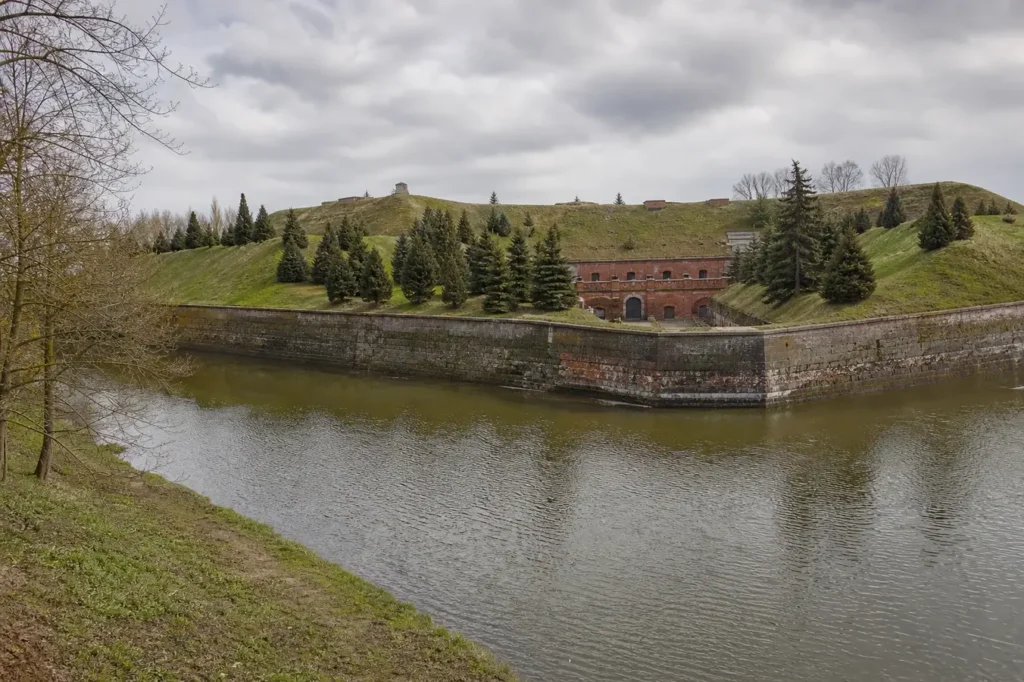
Today a federal heritage museum, the fort reopened to visitors in 2010 with expanded exhibitions. It represents one of the finest surviving examples of late 19th-century fortification design: a hexagon roughly 360 meters wide and 180 meters deep, ringed by a formidable moat and surrounded by earthen ramparts planted with trees.
Quick Facts
| Russian name | Форт №5 имени короля Фридриха Вильгельма III |
|---|---|
| Distance from the nearest major city | About 1,088 km |
| Travel time from the nearest major city | By train: approximately 20 hours; by flight: approximately 2 hours (plus transfers) |
| Built / opened | 1872–1892 (built) |
| Address | 35 Ulitsa Bulatova, Kaliningrad, 236019 OpenStreetMap · Google Maps |
| Opening hours | May–September: 10:00–20:00; October–April: 10:00–19:00 |
| Admission | ₽ |
| Best time to visit | Late spring (May–June) and early autumn (September–October) offer mild weather and comfortable visiting conditions. Summer (July–August) is warm but crowded. Winter (November–March) is cold but the fort is less visited; dress warmly and expect frozen ground and ice. The fort's thick walls keep interiors cool even in summer, so expect a significant temperature drop underground year-round. |
| Recommended duration | 1.5–2 hours |
| Website | fort5.westrussia.org |
What Is (and Isn't) Part of a Visit to Fort 5, Kaliningrad?
| Part | Status | Notes |
|---|---|---|
| Fort 5 main structure, casemates, ramparts, courtyard and above-ground areas | Included in the standard ticket | All accessible public areas of the fort—both underground and above-ground—are part of the standard ticket. |
| Permanent exhibitions ("Monuments of Fortification Architecture," "The Assault of Königsberg," "The Germans against Hitler," "East Prussia") | Included in the standard ticket | These small exhibitions are housed inside the fort and included in the admission price. |
| Memorial to Soviet Heroes and interpretive signage | Included in the standard ticket | The memorial stone and surrounding displays are part of the site. |
| Guided tours in English | Separate ticket or institution | English-language guides are not routinely available. Tours in Russian may be arranged in advance; inquire at the site or through the official website. Most visitors explore independently. |
| Fort 3 (King Friedrich Wilhelm I) and other forts in the ring | Outside / not part of it | Other forts in Königsberg's outer ring are separate sites. Fort 3 is one of the largest and most visited; it requires its own visit and ticket. Fort 5 is the most accessible and most frequently visited by tourists. |
| Inner Ring fortifications (gates, towers, museums like Amber Museum at Dohna Tower) | Outside / not part of it | The Inner Ring, built 1843–1859, is a separate defensive circle closer to the city center. Sites like Friedrichsburg Gate, Kings Gate, and other inner defenses are distinct from Fort 5. |
How to Get from the nearest major city to Fort 5, Kaliningrad
| Option | Duration | Price | Notes |
|---|---|---|---|
| Train from Moscow | Approximately 20 hours from Moscow to Kaliningrad | ₽₽ | Russian Railways operates direct trains (train 029Ч Moscow–Kaliningrad and 030Ч Kaliningrad–Moscow) twice daily from Belorussky Station in Moscow to Kaliningrad Passenger Station. Journey time is typically 19–20 hours. From Kaliningrad railway station, take local bus No. 36 to the fort (approximately 20–30 minutes). The station is marked "Fort No. 5" on the bus route. Most travelers book tickets in advance online via Russian Railways or ticket booking agents. |
| Flight from Moscow | Approximately 2 hours flight time plus transfers (total 5–6 hours door-to-door) | ₽₽₽ | Flights depart from Moscow's major airports (Sheremetyevo, Domodedovo, Vnukovo) to Kaliningrad Khrabrovo Airport. The airport is located roughly 20 km south of the city center. From the airport, take a taxi or ride-hailing service to Kaliningrad city center (30–40 minutes), then use local transport (bus No. 36) to the fort. This option is faster but more expensive than train travel. |
| Bus or minibus (marshrutka) from nearby towns | From Kaliningrad city center: 20–40 minutes depending on traffic | ₽ | Once in Kaliningrad, local bus No. 36 runs directly to Fort 5 from the city center. The stop is clearly marked. Buses depart regularly throughout the day. A minibus (marshrutka) may also serve the route; ask at central transit hubs. |
₽ budget · ₽₽ moderate · ₽₽₽ upscale · ₽₽₽₽ splurge. Price levels are estimates compared with typical prices for visitors.
Why Visit Fort 5, Kaliningrad?
Fort 5 offers a visceral encounter with military history spanning nearly two centuries. Walk through vaulted casemates with concrete walls 5 meters thick, explore ammunition stores and barracks, and trace the story of the 1945 East Prussian campaign when the fort held out for days against the Soviet 43rd Army. The permanent exhibitions—”Monuments of Fortification Architecture,” “The Assault of Königsberg,” and others—detail both the engineering marvel and the human sacrifice. The sprawling underground and above-ground spaces allow hours of unhurried exploration in an authentic wartime setting.
Highlights of Fort 5, Kaliningrad
The Hexagonal Fort Structure
The fort itself is the main attraction—a geometric marvel of defensive engineering. Its hexagonal shape with a 20–25 meter-wide, 5-meter-deep moat was designed to maximize fields of fire. The outer ramparts, planted with trees for camouflage, are still largely intact. Walk the top of the embankments to appreciate the scale: roughly 360 by 180 meters of fortified ground. The concentric design—moat, earth ramparts, then brick and concrete walls—becomes clear as you circle the structure.
Tip: Wear comfortable shoes with good grip; ramparts are sloped earth and can be muddy after rain. The fort stays cool year-round, even in summer, so bring a layer.
The Casemates and Underground Passages
Descend into vaulted brick casemates that once housed artillery, ammunition, and supplies. The low-ceilinged corridors—some barely 2 meters high—connect rooms lined with gun emplacements. The thick concrete and brick construction is evident everywhere. Gun slits in the outer walls still frame views across the moat. Several rooms are left largely empty, letting you imagine the sounds and activity of a fortress under siege.
Tip: Some sections are unlit; bring a flashlight or phone torch. Ceilings in places are lower than they appear, so move carefully.
The Central Courtyard and Barracks
The heart of the fort is an open courtyard surrounded by two-story brick barracks buildings. These quarters once housed roughly 200 soldiers. The courtyard was the administrative and logistical hub—soldiers drilled here, supplies were distributed, and communications ran through the surrounding rooms. Today the courtyard is largely open; its proportions convey the tight-knit fortress life.
Tip: This is the sunniest and most photographable spot in the fort; visit in mid-morning or afternoon for the best light.
"The Assault of Königsberg" Exhibition
Inside the fort, permanent exhibits detail the 1945 Battle of Königsberg. The "Assault of Königsberg" display uses photographs, maps, and objects to recount how the 43rd Soviet Army attacked Fort 5 on April 6, 1945. The German garrison held the position through April 8 despite Soviet artillery that could not penetrate the massive walls. A memorial stone near the entrance bears the names of 15 Soviet soldiers awarded Hero of the Soviet Union for their roles in the assault.
Tip: Exhibitions are primarily in Russian; English captions are limited. Bring a translation app or audio guide if detail matters to you.
Monument to the Soviet Heroes
Just inside or near the main entrance stands a memorial stone engraved with the names of Soviet soldiers who were killed or mortally wounded during the 1945 assault and posthumously awarded Hero of the Soviet Union. This is one of the few places in Russia where such a concentration of individuals from a single battle is honored at a single site. The stone is a quiet focal point for reflection on the cost of the battle.
Tip: Look for the engraved plaques; the names are listed in Cyrillic. If you're interested in Soviet military history, spend time reading the adjacent explanatory panels.
The Moat and Earthen Ramparts
The moat—originally filled with water and now largely dry or muddy—remains the fort's most distinctive feature. At 20–25 meters wide and 5 meters deep, it is immediately obvious why this obstacle was formidable. Walk along the outer rim of the moat to appreciate the sheer scale. The earthen ramparts rising from the far side are planted with mature trees, creating a forested appearance that disguised the fort from aerial reconnaissance.
Tip: In wet weather, the moat bottom can be waterlogged or muddy; stay on marked paths and avoid attempting to cross.
Atmosphere
Fort 5 is atmospheric in the truest sense—a place where history presses down physically. Inside the casemates, the heavy silence and dim light evoke a garrison waiting for an enemy that never overran them until April 1945. The corridors smell of damp brick and concrete. Above ground, the open courtyard and ramparts offer relief; on a clear day, you can see across the moat into surrounding forest.
Visitors are often alone or in small groups, especially outside peak summer season. The site feels neither manicured nor abandoned—it is preserved but unpolished, which adds authenticity. Families with children explore the ramparts; history enthusiasts spend hours in the casemates. The thin crowds and remote location (on the city’s outskirts) create a contemplative mood rather than the bustle of a major museum.
History of Fort 5, Kaliningrad
Fort 5 was built as part of Königsberg’s massive outer defensive ring, constructed between 1872 and 1892. The fort was originally named Gross Charlottenburg; in 1884, as the outer ring was completed, all forts were renamed after Prussian military leaders and monarchs. Fort 5 received the name of King Friedrich Wilhelm III, a Prussian ruler of the early 19th century.
The outer ring of 12 major forts and 4 batteries was engineered to replace an earlier, obsolete inner ring. By the 1870s, advances in artillery made traditional medieval walls ineffective. The new forts were designed as hexagonal structures of brick and earth, spaced roughly 5 km apart and ringed by wide moats. Each was manned by about 200 soldiers and armed with artillery. The scale was impressive: the total fortification circle stretched 43 kilometers and was considered one of the most formidable in Germany.
Throughout the early 20th century, the forts were recognized as obsolete. By 1920, military planners acknowledged that the fort design was outdated due to rapid advances in military technology, particularly aircraft and long-range artillery. The forts saw no significant military action during the First World War or the interwar period.
The fort’s only true test came in 1945. As the Soviet 43rd Army pushed into East Prussia in the final months of the Second World War, Königsberg became a critical stronghold of German resistance. On April 6, 1945, Soviet forces attacked Fort 5. Despite overwhelming Soviet artillery bombardment, the German garrison, led by a small officer cadre and non-commissioned officers, held the position. The thick concrete walls—up to 5 meters thick—resisted the artillery shells. Soviet troops attacked throughout April 8, and after a fierce day-long engagement, the German garrison finally surrendered.
After the war, Soviet engineers deliberately detonated much of the remaining ammunition inside the fort to destroy undiscovered ordnance. This explosion caused greater damage than the 1945 battle itself, fracturing walls and ceilings that had survived artillery fire. The fort was first opened as a museum in 1979. In 2010, it became part of the Kaliningrad Regional History and Art Museum, and a new exhibition was opened to visitors. Since then, visitors have been able to explore both the underground casemates and the above-ground ramparts, making it one of Kaliningrad’s most intact and accessible Soviet-era fortification museums.
Tickets and Booking for Fort 5, Kaliningrad
| Ticket | Price | Includes |
|---|---|---|
| Adult admission | ₽ | Access to all open areas of the fort: casemates, tunnels, courtyard, ramparts, and permanent exhibitions. |
| Child/student admission (if available) | ₽ | Reduced-rate admission for children and students; exact age and discount terms vary. Verify current rates at the site or on the official website. |
₽ budget · ₽₽ moderate · ₽₽₽ upscale · ₽₽₽₽ splurge. Price levels are estimates compared with typical prices for visitors.
Fort 5 is open to walk-in visitors; advance booking is not typically required. Visit during published hours: May–September 10:00–20:00; October–April 10:00–19:00. Admission is paid at the entrance gate. The official website is fort5.westrussia.org; confirm current hours and any seasonal closures before traveling.
No concessions (military, pensioners, or residents) or voucher exchanges are described on the site; standard rates apply. Entrance is at the main gate from the bus stop. Bag checks are routine but not intrusive. Photography is permitted throughout the fort for personal use; tripods and drones are not allowed without permission.
For all categories, rates for Russian citizens and concessions (military, pensioners, students) differ from international visitor rates and change periodically. Check the official website (fort5.westrussia.org) for the current full price list and any special promotions.
Plan and Book
Suggested itineraries Fort 5, Kaliningrad
2–3 hours on site
Arrive at the main gate and pay admission. Spend 20–30 minutes circling the moat and outer ramparts to appreciate the scale. Then enter the courtyard, explore the casemate buildings and underground tunnels for 1–1.5 hours, visiting key rooms (ammunition storage, barracks, gun emplacements). View the exhibitions and memorial stone (30 minutes). Exit and walk the ramparts again at sunset if time permits.
4–5 hours including travel
From Kaliningrad city center, take bus No. 36 directly to Fort 5 (30–40 minutes). Spend 2–3 hours at the fort as described above. Return on the same bus route. This allows a half-day visit without rushing.
Full day (6+ hours in Kaliningrad)
Combine Fort 5 with another nearby sight. Morning: take bus No. 36 to Fort 5 and explore thoroughly (2–3 hours). Afternoon: return to the city center and visit nearby attractions such as the Kaliningrad Regional Museum, Königsberg city fortifications, or Amber Museum at Dohna Tower. Evening: explore the old town or waterfront.
How to Get to Fort 5, Kaliningrad
From Kaliningrad city center: Board local bus No. 36 at any central transit stop. The bus runs throughout the day on a regular schedule. Request the driver to drop you at “Fort No. 5” (Форт №5). The journey takes 20–40 minutes depending on traffic. The bus terminates near the fort’s main gate. There is no metro in Kaliningrad.
Walking from the bus stop: Once dropped at the Fort No. 5 stop, walk toward the main entrance gate, visible from the road. The path is marked and takes 2–5 minutes.
By taxi or ride-hailing: Use Yandex Taxi or similar ride-hailing apps to request a ride to “Fort No. 5, Ulitsa Bulatova.” Fares are typically modest from the city center.
From Kaliningrad Railway Station: Exit the station and look for the tram or bus terminal. Board bus No. 36 heading toward Fort 5.
From Kaliningrad Airport (Khrabrovo): Take a taxi or ride-hailing service to the city center or directly to Fort 5. From the center, board bus No. 36 as described above.
Accessibility
Fort 5 has limited formal accessibility infrastructure. The exterior ramparts involve climbing earthen slopes and stairs; wheeled access is not possible. The interior casemates are on ground level but involve narrow passages, low doorways, and uneven floors. There are no elevators or lifts. Visitors with limited mobility should confirm accessibility with the site in advance. There are benches in the courtyard for rest. The nearest parking area is at the main gate.
Food Nearby
No restaurants or cafes are located directly at Fort 5. The site is on the outskirts of Kaliningrad with limited nearby development. Bring water and snacks. For a full meal, return to the city center (via bus No. 36, 20–40 minutes) where cafes and restaurants are abundant. Consider packing a picnic to enjoy in the fort's courtyard on a sunny day.
What to Bring
Comfortable walking shoes with good grip (ramparts are sloped earth). A light jacket or sweater (the fort is cool year-round, and underground spaces are particularly cold). A flashlight or phone torch for exploring dark casemate passages. Sun protection (hat, sunscreen) for above-ground ramparts. Water and snacks. A translation app if you do not read Russian (some signage is in Russian only). Insect repellent in summer. Avoid large backpacks; a day pack is sufficient.
Best Views and Photo Spots of Fort 5, Kaliningrad
The moat and outer embankment at sunrise or sunset
The wide moat in foreground, earthen ramparts planted with trees creating a natural fortress silhouette. Golden light at dawn or dusk illuminates the brick and earth structures. The geometric hexagonal outline is clearest from a high vantage point on the far side of the moat.
Best time: Early morning or late afternoon light; late spring through early autumn for clearest skies. Visit on an overcast day to avoid harsh shadows in the moat.
The central courtyard from the casemate walkway
Symmetrical brick barracks buildings surrounding the open courtyard, with ramparts visible above. A sense of the fortress's compact garrison life. The composition emphasizes the fortress's self-contained design.
Best time: Mid-morning to mid-afternoon when the courtyard is sunlit. Avoid the mid-day harsh light; 10:00–11:00 or 14:00–15:00 works best.
The memorial stone and engraved nameplate
Close detail of the Soviet Heroes memorial, with the engraved names and surrounding explanatory plaques. A somber, historically grounded image. Include the brick wall or fortress background for context.
Best time: Any time of day; the memorial is in shadow most of the day. Soft, diffuse light works best for detail photography.
Interior casemate gun emplacements with slits framing the moat
Looking outward through a narrow gun slit in a casemate wall; the moat and outer landscape visible in the distance. Dramatic contrast of dark interior and bright exterior. A sense of the garrison's viewing perspective.
Best time: Midday when exterior light is strongest and the contrast with dark interior casemate is most dramatic. Bring a flashlight to illuminate the interior wall detail.
Photography Rules
Personal photography is permitted throughout the fort. Tripods and professional filming equipment are not allowed without prior permission; inquire at the entrance. Flash photography is not necessary and is disruptive in casemates. Drones are prohibited. Some exhibitions may have restrictions on photography; observe posted notices.
Family Suitability
Fort 5 is suitable for families with children ages 8 and older. Older children and teenagers find the underground passages and ramparts engaging. The moat, ramparts, and open spaces allow active exploration. Younger children (under 6–8) may struggle with narrow, low-ceilinged casemate passages and the uneven terrain. Stroller access is not practical; the exterior ramparts and moat are not stroller-friendly. There are benches in the courtyard for rest. Some exhibition panels include brief English text but are primarily in Russian; older children interested in history will benefit from a translation app. The site has no dedicated children's facilities (playgrounds, family restrooms); facilities are basic.
Russia Vibes Tips
- Arrive early (soon after opening at 10:00) to explore with fewer crowds and better light in the casemates. The site quiets significantly in late morning.
- Bring a flashlight (even during summer). Many casemate passages and gun emplacements are lit only by openings; a torch or phone flashlight reveals architectural details and ensures safe footing.
- Wear layers. The fort's massive concrete and brick walls keep underground spaces surprisingly cold even on hot days. Descend into the casemates prepared for a 10–15 degree Celsius temperature drop.
- The fort's hexagonal geometry means visitors often lose their orientation underground. Take a photo of the site map at the entrance or download a map in advance to understand the layout and plan a route.
- Do not attempt to visit Fort 5 as a same-day round trip from Moscow. The journey is nearly 20 hours by train or requires an overnight stay. Plan at least a 2–3 day stay in Kaliningrad to make the trip worthwhile. Combine Fort 5 with other Kaliningrad attractions (Amber Museum, Königsberg fortifications, regional museums) to maximize the visit.
- In rain or immediately after, the moat bottom and earth ramparts become slippery and muddy. Avoid climbing steep sections if the ground is wet; stick to marked pathways and use handholds if available.
Explore Nearby Fort 5, Kaliningrad
Sights near Fort 5, Kaliningrad
 Fort #5 King Frederick Wilhelm III, Kaliningrad – about 50 m away (~1 min walk) · typical visit: 1.5–2 hoursOpen daily 10:00–19:00
Main image: AI-generated illustration. It may not show the place exactly as it looks.
Browse more: All Day Trips · All Day Trips in Kaliningrad · All Kaliningrad · All Landmarks
FAQ: Fort 5, Kaliningrad
Can you visit Fort 5 as a day trip from Moscow?
Not realistically. The train journey from Moscow to Kaliningrad takes approximately 20 hours each way, plus 2–3 hours at the fort. A round trip consumes 2–3 days. Flying is faster (6 hours round-trip including transfers) but expensive. Most visitors stay 2–3 days in Kaliningrad to justify the journey and explore multiple sites.
Is Fort 5 open year-round?
Yes. Hours vary by season: May–September 10:00–20:00; October–April 10:00–19:00. Winter visits are possible but cold; dress warmly.
Do I need to buy a ticket or can I just walk in?
You must buy a ticket at the entrance gate. Prices are modest (budget level). The ticket grants access to all open areas—casemates, ramparts, courtyard, and exhibitions.
Are there English-language guides or audio guides available?
English guides are not routinely available. Most exhibitions are in Russian with minimal English labels. A translation app helps. Many visitors explore independently; the layout is intuitive enough to navigate without a guide.
What is the difference between Fort 5 and Fort 3?
Both are large outer-ring forts built in the late 19th century. Fort 5 is more accessible and frequently visited; it has a museum with exhibitions and is fully open to visitors. Fort 3 is larger and more mysterious but offers only external inspection and is less developed as a tourist site. Fort 5 is the better choice for most visitors.
Is the fort suitable for young children?
Yes, for older children (8+). Younger children may find narrow, low-ceilinged casemate passages challenging. The exterior ramparts and courtyard are ideal for active kids. There are no dedicated children's facilities.
What happened at Fort 5 in 1945?
The Soviet 43rd Army attacked Fort 5 on April 6, 1945, during the battle for Königsberg. The German garrison held the position for two days despite overwhelming artillery. Soviet forces finally overran the fort on April 8. Fifteen Red Army soldiers were posthumously awarded Hero of the Soviet Union for their roles; their names are engraved on a memorial at the site.
Can I visit Fort 5 and other fortifications in one day?
Yes. Fort 5 takes 2–3 hours. Other inner-ring sites (Friedrichsburg Gate, Kings Gate, Dohna Tower Amber Museum) are closer to the city center and can be combined in a single day itinerary. Plan a full day to see 2–3 major sites without rushing.
Russia Vibes is a one-person project. A coffee keeps it going
How we research and update our guides
About this guide: AI assistance and accuracy
This guide is created with the help of AI and is based on official sources where available. Mistakes can still happen. Opening hours, prices, rules and other details are given to the best of our knowledge as of the date shown and can change without notice. It offers general recommendations only, not professional, legal or travel advice. Please confirm important details with the official source before you travel; you are responsible for your own plans and decisions.

Take this guide with you
Get a free PDF of this guide to print or read offline: key facts, tips and a map link on a few clean pages.
Report an issue on this page
Paying for your trip: please read
International sanctions affect payments between Russia and many other countries. In practice, cards issued in the EU, the UK, the US and several other countries often do not work in Russia, Russian cards usually do not work abroad, and some booking platforms, airlines and payment providers limit or suspend their services for Russia. The situation changes frequently.
We do not give legal or financial advice, and this site does not encourage anyone to break or circumvent sanctions. Whatever you plan, you are responsible for following the laws and regulations that apply to you, including those of your country of residence and citizenship.
Many travelers still organise their stay lawfully. It is worth asking your bank or payment provider what is currently permitted, contacting hotels, tour operators and carriers directly about the payment methods they accept, and checking which services are open to customers from your country. Clarify payment, cancellation and refund terms before you commit to a booking, and keep your plans flexible.
Partner links on this site may not be available in every country, and prices, availability and rules in our guides can differ from what you see when you book.