
Updated
Fort No. 11 Dönhoff is one of fifteen main forts built between 1877 and 1881 as part of Königsberg city-fortress’s outer defensive ring. Located on the outskirts of what is now Kaliningrad, this hexagonal fortification remains the best-preserved example of the system that once ringed the city.
A day trip to Fort 11 combines 19th-century military engineering with accessible history. The fort is the best preserved of the defensive line built over centuries around the city, with well-preserved metal parts like stairs, flaps, devices for feeding shells, and an armored observation deck. You can explore the sprawling underground chambers, climb the earth ramparts, and understand how this fortress fit into the geopolitics of late 19th-century Prussia.
Quick Facts
| Russian name | Форт № 11 «Дёнхофф» |
|---|---|
| Distance from the nearest major city | approximately 1,700 km |
| Travel time from the nearest major city | approximately 3 hours by air |
| Built / opened | 1877 |
| Address | ул. Энергетиков, 12, Калининград OpenStreetMap · Google Maps |
| Opening hours | Mon-Fri 10:00-18:00; Sat-Sun 10:00-18:00 |
| Admission | ₽₽ |
| Best time to visit | Spring (May–June) and early autumn (September–October) offer mild weather and fewer crowds. Summer (July–August) is warmest but busiest. Winter (November–March) is cold and grey; short daylight hours limit visibility. Weekday mornings are quieter than weekends. Aim to arrive by 11:00 to catch the first guided tour and avoid waiting. |
| Recommended duration | 2–3 hours |
| Website | fortdonhoff.ru |
What Is (and Isn't) Part of a Visit to Fort 11, Kaliningrad?
| Part | Status | Notes |
|---|---|---|
| Fort 11 Dönhoff museum and underground chambers | Included in the standard ticket | The entire fort complex, including all chambers, ramparts, and exhibits, is accessible with a single admission ticket. |
| Guided tour in Russian | Included in the standard ticket | Tours are included with admission and depart at scheduled times (see booking_info). Tours last approximately 50 minutes; independent exploration is allowed afterward. |
| Planetarium or interactive science museum | Separate ticket or institution | The fort hosts temporary science exhibits; these may require an additional ticket and should be confirmed by phone or website before your visit. |
| Parking and disabled access facilities | Included in the standard ticket | Accessible parking and wheelchair access are available according to official information; confirm details before visiting. |
| Other forts in the Kaliningrad Ring | Outside / not part of it | Fort 11 is one of twelve outer-ring forts. Other forts (such as Fort 5) may be partially visible or accessible elsewhere in the region but are separate sites with separate visits. |
| City of Kaliningrad itself | Outside / not part of it | Fort 11 is located on the outskirts, 8–10 km from the city centre. A full day trip typically includes both the fort and Kaliningrad's central attractions such as the Cathedral or Königsberg Castle ruins. |
How to Get from the nearest major city to Fort 11, Kaliningrad
| Option | Duration | Price | Notes |
|---|---|---|---|
| Fly from Moscow to Kaliningrad, taxi or bus to fort | 4–5 hours total | ₽₽₽ | Pulkovo International Airport serves Kaliningrad. From airport, take taxi or marshrutka (shared minibus) to Energetikov Street. Allow 2–3 hours for the flight plus 30 minutes to/from airports. |
| Train from Moscow to Kaliningrad | 24–30 hours | ₽₽ | Direct overnight trains run from Moscow's Belorussky Railway Station. Most convenient for a multi-day visit. From Kaliningrad Railway Station, take taxi or public transport to the fort (about 30 minutes). |
| Hire a car or join a tour in Kaliningrad | 3–4 hours in Kaliningrad | ₽₽–₽₽₽ | Fort 11 is located outside the city centre on Energetikov Street. Having a car makes the visit easier, though public transport is available. Many tour companies offer guided excursions from central Kaliningrad. |
₽ budget · ₽₽ moderate · ₽₽₽ upscale · ₽₽₽₽ splurge. Price levels are estimates compared with typical prices for visitors.
Why Visit Fort 11, Kaliningrad?
The fort is a hexagon surrounded by a moat, with the central construction protected by an earth mound and symmetrically arranged inner yards relative to a central corridor. You will find well-preserved metal details where flaps move, an observation hood rotates with minimal effort, and there is even a screw chair for the observer—all still operational.
During the attack on Königsberg in April 1945, the fort was taken by a combined detachment of junior officers’ courses; Guards Sergeant A. Yelizarov and Guard Private N. Andrusenko died heroically and were buried on the fort’s territory. The site tells a complex story of Prussian military ambition and Cold War history.
Highlights of Fort 11, Kaliningrad
The Hexagonal Structure and Moat
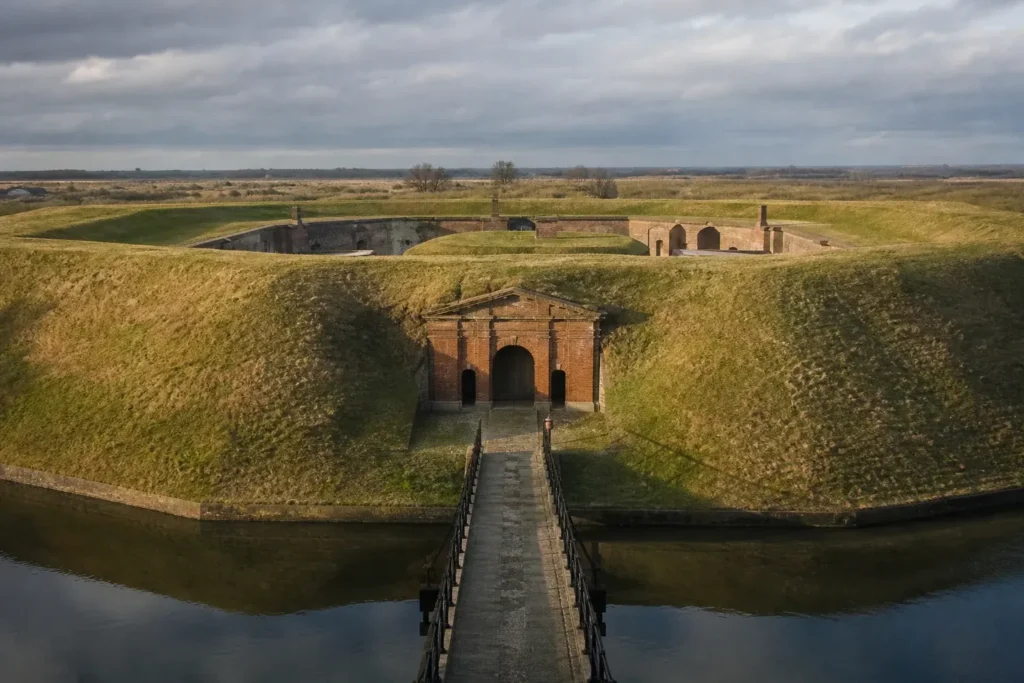
The fort is a hexagon surrounded by a moat, with the central construction protected by the earth mound. The moat is water-filled and crossed only by a single access bridge. Standing on this bridge, you grasp immediately the defensive principle: a narrow chokepoint for any attacker. The ramparts rise steeply from the moat, covered in grass and offering panoramic views of the surrounding flat Kaliningrad region.
Tip: Best viewed from the access bridge and the outer ramparts; early morning light makes for the strongest photographs.
Armored Observation Decks
Well-preserved metal parts include an armored observation deck from which the last German garrison watched the burning Königsberg during 1945. You can yourself turn old mechanisms in the armored gun point and imagine how people lived and served here over a hundred years ago. The rotating hood and sighting mechanisms are still functional.
Tip: Allow extra time at these positions; they offer the clearest understanding of how the fort operated and are favorite photo spots.
Underground Chambers and Living Quarters
The forts offered 50,000m2 of space in over 1,200 rooms consisting of accommodation for men and officers, kitchens, dining halls, hospitals and storage facilities as well as command posts and bunkers. The labyrinth of narrow corridors and vaulted ceilings creates a visceral sense of being below ground in a military installation. Thick brick and stone construction demonstrates the engineering standards of the era.
Tip: Wear a jacket; underground sections are cool even in summer. Bring a flashlight if you have one, though the fort provides minimal lighting.
Dönhoff Family Coat of Arms
Above the entrance to the fort, one can see a well-preserved coat of arms of the Dönhoff family featuring a boar's head. The fort was renamed in honor of Friedrich Reichsgraf von Dönhoff (1639-1696), the Governor-General of Memel (now Klaipeda, Lithuania) and the owner of the Friedrichstein estate. This heraldic detail marks the fort as part of the Prussian aristocratic landscape.
Tip: Look for it directly above the entrance arch; it's easy to miss if you're not paying attention.
The April 1945 Garrison Graves
During the attack on Königsberg, fort No. 11 Dönhoff was taken by a combined detachment around 1 p.m. on April 7, 1945. Guards Sergeant A. Yelizarov and Guard Private N. Andrusenko died heroically and were subsequently buried on the territory of the fort. This site memorializes the Soviet soldiers who fell in the final assault on Königsberg.
Tip: Ask the guide to point these out; they are on the grounds but not always immediately obvious to self-guided visitors.
Rampart Walls and Earth Fortifications
The forts were typically 360 metres wide and 180 metres deep arranged as symmetrical hexagons surrounded by a 20 metre wide and 3-5 metre deep moat and the construction was reinforced and covered by a 3-4 metre layer of soil. The scale of the earthworks is impressive; climbing the ramparts gives a sense of the geometric precision and the massive labor involved in their construction.
Tip: The ramparts offer the widest views; climb them in late afternoon for golden light and fewer crowds.
The Defensive Ring Context
This remarkable network of 12 forts and 4 batteries rings the city at a distance of 8-10km from the centre and stretches for 43km, built between 1872 and 1892. The forts were connected to each other by an inner ring road and to the city by branch roads and would be typically manned by approximately 200 men. Fort 11 is one piece of an enormous defensive system; the exhibits and layout help you visualize its role.
Tip: Before visiting, research the locations of the other forts to understand Fort 11's position in the wider fortification network.
Atmosphere
The fort is an atmospheric place where you can turn old mechanisms and imagine how people lived here over a hundred years ago. The contrast is striking: stern military architecture alongside unexpected gentle details—rabbits freely hopping across the grounds and ducks swimming in the moat. The air is cool and damp underground, with echoing footsteps in brick corridors that date to the 1870s. Above ground, the ramparts offer open views of flat countryside.
Visitors are a mix of history enthusiasts, military buffs, and families. Weekends bring more crowds; weekday mornings are quieter. Guided tours create a social atmosphere around the entrance and for the first hour, but the underground chambers invite solitary exploration. The fort feels frozen in time—Soviet-era markings still visible on walls, German names scratched into bricks decades ago, the everyday objects of soldiers preserved in display cases.
History of Fort 11, Kaliningrad
The Germans set about building a remarkable ring of fortifications on the outskirts of the city. This network of 12 forts and 4 batteries rings the city at a distance of 8-10km from the centre and stretches for 43km.
Built between 1872 and 1892, the forts were typically 360 metres wide and 180 metres deep arranged as symmetrical hexagons surrounded by a 20 metre wide and 3-5 metre deep moat and were spaced approximately 5km apart. Much of the labour and much of the cost was supplied by the French following their defeat in the Franco-German War of 1870-71.
Fort No. 11 was built in 1877-1881. Originally the fort was called Seligenfeld. In 1894, it was renamed in honour of Friedrich Reichsgraf von Dönhoff (1639-1696), the Governor-General of Memel and the owner of the Friedrichstein estate.
The Outer Ring was further strengthened in 1912 by additional infantry bases and the ceilings of the forts were replaced with reinforced concrete. By this time, however, military technology was advancing beyond what fort-based defences could manage.
The fort was never involved in any war: the First World War did not reach it, and in 1945 the garrison of the Fort capitulated almost without a fight. During the attack on Königsberg, fort No. 11 Dönhoff was taken by the combined detachment of the junior lieutenants’ courses of the 11th Guards Army at around 1 p.m. on April 7, 1945.
For 70 years after the war, entry to the territory was allowed only to military personnel. By Resolution No. 132 of the Kaliningrad Region Government dated March 23, 2007 the fort acquired the status of the cultural heritage object of regional importance. Currently, the fort is open to the public as a museum.
Tickets and Booking for Fort 11, Kaliningrad
| Ticket | Price | Includes |
|---|---|---|
| Adult admission | ₽₽ | Access to all chambers, ramparts and exhibits. Guided tour in Russian included and departs at scheduled times. Unlimited self-guided exploration afterward. |
| Child (7–17) and student admission | ₽ | Same as adult ticket; rates differ for Russian citizens and are lower for this category. |
| Child under 7 and Soviet Great Patriotic War veteran | Free | Free admission; same access as paid visitors. |
₽ budget · ₽₽ moderate · ₽₽₽ upscale · ₽₽₽₽ splurge. Price levels are estimates compared with typical prices for visitors.
Fort 11 is open daily. Hours: As of October 2026, summer hours (June–August) are 10:00–18:00; autumn–winter hours are 10:30–17:30 (check the official website fortdonhoff.ru to confirm current hours, as they vary seasonally).
Guided tours: Tours depart at scheduled times and are included in the ticket price. Weekdays: 11:00, 13:00, 15:00, 17:00. Weekends and holidays: hourly from 11:00 to 17:00. Tours last approximately 50 minutes; afterward, you may explore the fort freely for the remainder of opening hours.
Tickets: Buy tickets at the main entrance. Tours are conducted in Russian; independent exploration is available at your own pace. Groups of more than 10 should book in advance (email: 390699@mail.ru or phone: +7 4012 39-04-61). Note that Russian citizens and concession holders (pensioners, disabled persons) pay reduced rates; see fortdonhoff.ru for all categories and current prices.
Plan and Book
Suggested itineraries Fort 11, Kaliningrad
2–3 hours on site
Arrive for the 11:00 or 13:00 guided tour. The tour covers the main chambers and history, lasting 50 minutes. Afterward, climb the ramparts for views and explore the observation decks independently. Examine the Dönhoff coat of arms above the entrance. If time permits, visit the memorial graves. Depart 30 minutes before the fort closes to avoid rush.
Half day (4–5 hours including travel)
From central Kaliningrad, take a taxi or tour bus to Fort 11 (30 minutes). Tour the fort with a guide (50 minutes). Spend 1.5–2 hours exploring underground chambers and ramparts independently. Have a light lunch or coffee at nearby establishments (note: facilities are limited; bring snacks). Return to central Kaliningrad by mid-afternoon.
Full day (6–8 hours)
Spend the morning at Fort 11 with a guided tour and independent exploration (3–4 hours). Return to central Kaliningrad for lunch and visit nearby attractions such as the Cathedral, Königsberg Castle ruins, or the Friedland Gate Museum (2–3 hours). Consider a second fort (Fort 5) if interested in comparing the fortification system. Return to your accommodation by early evening.
How to Get to Fort 11, Kaliningrad
From central Kaliningrad: Fort 11 is located on Energetikov Street (ул. Энергетиков), approximately 8–10 km from the city centre. The Moskovskiy District location is on the outskirts.
By taxi or ride-hailing: The fastest option. Journey time: 20–30 minutes from central hotels, depending on traffic. The fort address is straightforward: ул. Энергетиков, 12.
By public transport:
- From central Kaliningrad, take a bus or marshrutka (shared minibus) heading toward the outskirts in the Moskovskiy District direction.
- Ask the driver for Energetikov Street or reference the fort by name (Форт 11 Дёнхофф).
- The nearest stops may be 5–10 minutes’ walk from the fort entrance.
- Journey time: 40–60 minutes depending on the route and traffic.
Walking from the nearest stop: The final stretch from a bus stop involves walking along a narrow road (Energetikov Street) with vehicle traffic; sidewalk space is limited. Wear visible clothing and be cautious of passing vehicles.
By car or organized tour: Most convenient. Tour operators in Kaliningrad offer guided excursions that include transport; book via your hotel or tour agency.
Accessibility
The fort has wheelchair access to ground-level and some upper rampart areas. Disabled parking is provided near the entrance. However, many underground chambers involve stairs, narrow corridors, and uneven flooring, making full exploration difficult for those with mobility limitations. Call ahead (+7 4012 39-04-61) to discuss your specific needs. Guides can advise on which areas are fully accessible.
Food Nearby
Limited food facilities exist near the fort. The nearest cafés and shops are in central Kaliningrad (8–10 km away). Bring water and snacks, or plan a meal before or after your visit. Some tour groups include lunch stops in the city as part of a full-day itinerary. A few small vendors may operate seasonally near the fort entrance, but do not rely on this.
What to Bring
Comfortable walking shoes with good grip (ramparts and chambers have uneven surfaces). A light jacket, even in summer, because underground chambers are cool and damp. A flashlight or headlamp makes reading plaques and navigating dark corridors easier. Sun protection (hat, sunscreen) for the exposed ramparts. Binoculars for viewing the surrounding landscape from the ramparts. Water and snacks, as food is scarce nearby. A camera or smartphone for photography. Respectful dress (this is a war memorial site).
Best Views and Photo Spots of Fort 11, Kaliningrad
The main entrance bridge spanning the moat
The moat reflects the hexagonal fortification and earth ramparts, creating a striking symmetrical composition. The bridge provides perspective and scale. Best angle: from the moat's edge or midway across the bridge looking back toward the fort entrance.
Best time: Early morning (06:00–08:00) for soft light and mirror-like water reflections before crowds arrive. Golden hour in late afternoon (17:00–18:30) is also excellent.
Top of the ramparts (earth mound)
Wide panoramic views of the flat surrounding landscape. The hexagonal fort layout is visible from above. On clear days, you see the extent of the earthwork fortifications. Trees and grass frame the vista.
Best time: Midday for clear skies and full visibility. Late afternoon for long shadows that emphasize the undulating terrain.
Armored observation deck (rotating hood visible)
Close-up detail of 19th-century military hardware. The restored mechanisms and observation slit create a focused, technically interesting shot. Context: interior chamber walls and metal work.
Best time: Midday when internal light is sufficient. Avoid harsh shadow from the hood that can obscure details.
Dönhoff family coat of arms above the entrance arch
A heraldic detail combining history and craftsmanship. The boar's head is clear and well-preserved. Requires close perspective and natural light to show stonework detail.
Best time: Morning or midday, when the entrance is well-lit. Afternoon can create unflattering shadows across the arch.
Underground corridor vault (central postern)
Brick arches, electric lighting, and historical markings create a atmospheric, time-capsule feeling. Narrow perspective emphasizes depth. Soviet-era stenciling visible on walls adds historical texture.
Best time: Midday to lunchtime when interior lighting is predictable. Flash may be needed for shadow detail.
Courtyard view from within the hexagon
Looking outward from the interior toward ramparts, showing the layered fortification design. Sky and rampart slope create a sense of containment and scale.
Best time: Any time during opening hours; the courtyard is protected from extreme shadow. Late afternoon provides warm color.
Photography Rules
Photography is permitted throughout the fort, including underground chambers and ramparts. Tripods may be used outdoors but are discouraged in narrow underground corridors due to space constraints. Flash photography is generally allowed but can be startling in enclosed spaces; use it thoughtfully. Drones are not permitted on the premises. The Dönhoff coat of arms and water moat at sunrise offer striking compositions.
Family Suitability
Fort 11 suits families with children aged 7 and up who are comfortable with stairs, narrow spaces, and military history. Children under 7 enter free. The ramparts and courtyards are safe for running and exploring; many surfaces are uneven. The underground chambers can feel cramped and dark, which younger children may find unsettling. Stroller access is limited in the fort itself, though paths are paved. Guided tours include military and casualty details appropriate for older children but may be intense for young ages. The site offers no playground or child-specific activities; interest in fortifications and history is essential. Allow 2–3 hours for families to explore at a comfortable pace.
Russia Vibes Tips
- Arrive early in the day and aim for the 11:00 guided tour. This secures your slot before weekday tours fill up, gives you the afternoon for independent exploration, and takes advantage of better morning light for photography.
- Bring a basic flashlight or enable your smartphone's flashlight app. The underground chambers are sparsely lit; a light makes reading historical plaques and navigating dark corridors much easier and safer.
- The guided tour is in Russian. Even if you don't speak Russian, join the tour to follow the group through chambers and gain the guide's knowledge of layout and history. Many guides are enthusiastic and may offer English explanations if asked politely.
- Wear shoes with good grip. Rampart surfaces and underground flooring are uneven, wet, and sometimes slippery, especially after rain or in winter. Lightweight hiking boots or trail shoes are ideal.
- Do not rely on food or drink at the fort. Pack water and snacks. The nearest café or shop is in central Kaliningrad. If you visit as part of a full-day Kaliningrad tour, plan meals in the city before or after the fort visit.
- The fort is best experienced as part of a broader Kaliningrad itinerary that also includes the Cathedral, city museums, and possibly a second fort (such as Fort 5). Use the fort as a morning or afternoon anchor, leaving time to explore the city's urban history.
Explore Nearby Fort 11, Kaliningrad
Sights near Fort 11, Kaliningrad
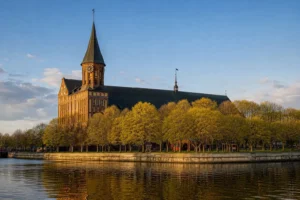 Königsberg Cathedral, Kaliningrad – about 6.5 km away · typical visit: 2–3 hoursOpen daily 10:00–19:00
Main image: AI-generated illustration. It may not show the place exactly as it looks.
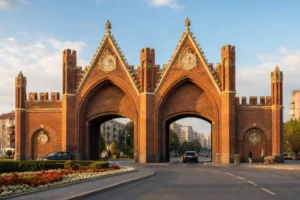 Brandenburg Gate, Kaliningradabout 6.4 km away · typical visit: 30–45 minutes
Main image: AI-generated illustration. It may not show the place exactly as it looks.
Browse more: All Day Trips · All Day Trips in Kaliningrad · All Kaliningrad · All Landmarks
FAQ: Fort 11, Kaliningrad
Is Fort 11 the best-preserved fort in Kaliningrad?
Yes. Fort 11 is generally considered the best-preserved because it was never involved in sustained combat during its military service. It capitulated in April 1945 with minimal fighting, unlike other forts that saw heavy combat. However, all twelve outer-ring forts remain standing.
How long should I spend at Fort 11?
Plan 2–3 hours: 50 minutes for the guided tour and 1–2 hours for independent exploration of chambers and ramparts. If you rush, 90 minutes is the bare minimum; three hours is ideal.
Is the guided tour available in English?
No, tours are conducted in Russian. However, you may ask the guide if they speak English; some do and may offer brief explanations. Alternatively, self-guided exploration after the tour works well with printed materials or a travel guide.
Can I visit Fort 11 without a car?
Yes. From central Kaliningrad, use a taxi, ride-hailing app, or tour bus. Public transport (bus or marshrutka) is available but less convenient. Expect 30–60 minutes travel time from the city centre depending on your transport method.
What is the admission cost?
As of October 2026, adults pay moderate rates; children (7–17) and students pay less. Children under 7 and Soviet Great Patriotic War veterans enter free. Exact prices vary and may change; confirm on fortdonhoff.ru or call before your visit.
Is Fort 11 suitable for young children?
For children 7 and up, yes, if they are comfortable with military history, stairs, and dark spaces. Very young children (under 7) may find the underground chambers unsettling. The ramparts are safe but uneven; constant supervision is needed.
What are the seasonal hours?
Summer hours (June–August): 10:00–18:00. Autumn–winter hours: 10:30–17:30. Winter is cold and grey; spring and early autumn offer pleasant weather. Check fortdonhoff.ru for current hours, as they can vary.
Are there other forts I should visit?
Fort 5 (King Frederick William III) is another notable outer-ring fort and is also open to visitors. The twelve forts form a ring around the city; visiting two provides a better sense of the defensive system. Allow a full day to visit both the fort and central Kaliningrad attractions.
Russia Vibes is a one-person project. A coffee keeps it going
How we research and update our guides
About this guide: AI assistance and accuracy
This guide is created with the help of AI and is based on official sources where available. Mistakes can still happen. Opening hours, prices, rules and other details are given to the best of our knowledge as of the date shown and can change without notice. It offers general recommendations only, not professional, legal or travel advice. Please confirm important details with the official source before you travel; you are responsible for your own plans and decisions.

Take this guide with you
Get a free PDF of this guide to print or read offline: key facts, tips and a map link on a few clean pages.
Report an issue on this page
Paying for your trip: please read
International sanctions affect payments between Russia and many other countries. In practice, cards issued in the EU, the UK, the US and several other countries often do not work in Russia, Russian cards usually do not work abroad, and some booking platforms, airlines and payment providers limit or suspend their services for Russia. The situation changes frequently.
We do not give legal or financial advice, and this site does not encourage anyone to break or circumvent sanctions. Whatever you plan, you are responsible for following the laws and regulations that apply to you, including those of your country of residence and citizenship.
Many travelers still organise their stay lawfully. It is worth asking your bank or payment provider what is currently permitted, contacting hotels, tour operators and carriers directly about the payment methods they accept, and checking which services are open to customers from your country. Clarify payment, cancellation and refund terms before you commit to a booking, and keep your plans flexible.
Partner links on this site may not be available in every country, and prices, availability and rules in our guides can differ from what you see when you book.