- Address
- Санкт-Петербург, Невский проспект, мост через реку Фонтанку
- Nearest metro
- Gostiny Dvor (Line 3), Mayakovskaya (Line 3), Nevsky Prospekt (Line 2)
- Time needed
- 20–30 minutes for the bridge and sculptures; 1–2 hours with the Fontanka embankment and nearby landmarks
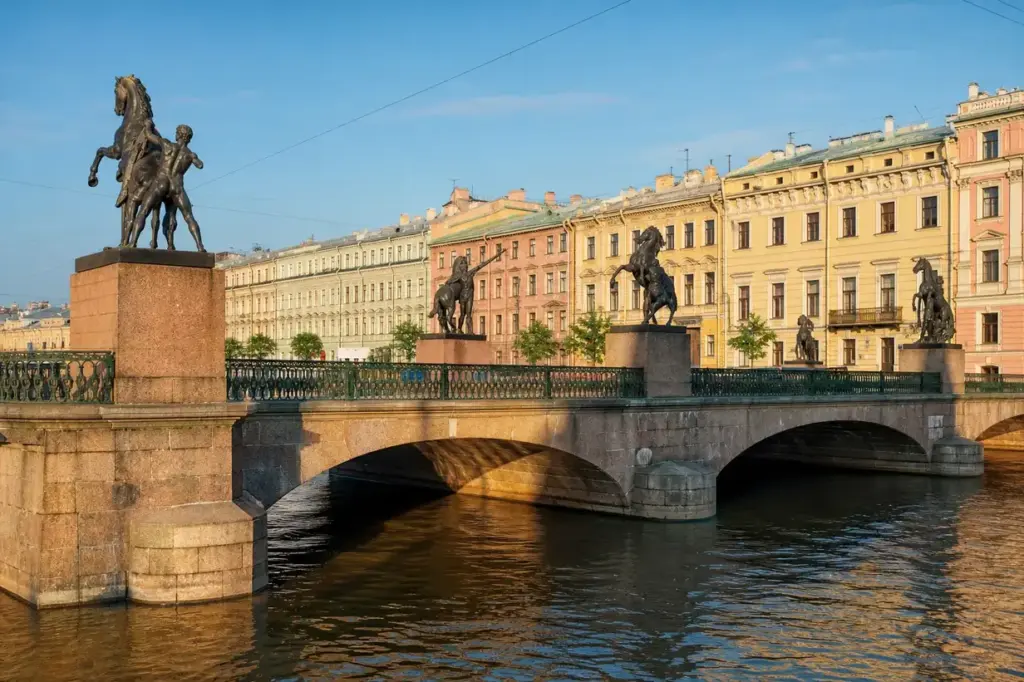
Anichkov Bridge, Saint Petersburg, is one of the most recognizable crossings in Russia’s northern capital. Carrying Nevsky Prospekt over the Fontanka River, the bridge is famous for four dramatic bronze sculptures showing powerful horses and the men attempting to control them. Created by sculptor Peter Klodt, the figures turn an otherwise functional river crossing into an open-air exhibition of nineteenth-century sculpture.
The bridge occupies a central position along Saint Petersburg‘s principal avenue, surrounded by historic palaces, theatre buildings and elegant embankments. Its horse sculptures are visible from the pavement, while the cast-iron railings reveal smaller decorative details that many pedestrians overlook. Unlike the city’s famous opening drawbridges, Anichkov Bridge is a fixed crossing and forms part of everyday street life. Visitors can walk across it without a ticket, examine the sculptures individually and continue along the Fontanka for views of its three arches. A short stop works well, but the bridge rewards a slower visit that includes its history, architecture and relationship with the surrounding city.
Quick Facts
| Russian name | Аничков мост |
|---|---|
| Built / opened | 1841 |
| Architect(s) | Engineers Ivan Buttantz and Alexander Reder; sculptor Peter Klodt |
| Address | Санкт-Петербург, Невский проспект, мост через реку Фонтанку Google MapsApple MapsYandex Maps2GIS |
| District | Tsentralny |
| Metro | Gostiny Dvor (Line 3, Exit towards Nevsky Prospekt and walk east along the avenue towards the Fontanka River. The bridge is identifiable by four large horse sculptures.) Mayakovskaya (Line 3, Follow Nevsky Prospekt west towards the Fontanka River and the horse sculptures.) Nevsky Prospekt (Line 2, Use the underground connection towards Gostiny Dvor and continue east along Nevsky Prospekt.) |
| Admission | free |
| Best time to visit | Anichkov Bridge is attractive throughout the year, although the experience changes considerably with the season. Spring and summer are convenient for combining sculpture viewing with longer walks along the Fontanka. The river and surrounding facades provide particularly attractive photographic settings during the long summer evenings.
Autumn brings softer light and changing foliage in nearby public spaces. Winter offers a more restrained atmosphere, with the dark bronze figures standing out against snow and pale skies when conditions permit. Early morning is a practical time to examine the sculptures with less interference from the surrounding street activity. Late afternoon and evening can provide appealing side lighting and illuminated city views. The bridge is an active crossing on Nevsky Prospekt, so pedestrians should expect traffic and use the designated public pavements and crossings. |
| Website | mostotrest-spb.ru/bridges/anichkov |
What Is (and Isn't) Part of a Visit to Anichkov Bridge, Saint Petersburg?
| Part | Status | Notes |
|---|---|---|
| Anichkov Bridge pedestrian pavements | Included in the standard ticket | The public pavements allow visitors to cross the Fontanka and examine the bridge without admission. |
| Four Horse Tamers sculptures | Included in the standard ticket | All four monumental bronze groups are positioned beside the public bridge approaches. |
| Decorative cast-iron railings | Included in the standard ticket | The ornamental railings can be examined directly from the pedestrian pavement. |
| Granite sculpture pedestals | Included in the standard ticket | The pedestals form part of the bridge monument, although they are not intended for climbing. |
| Bridge arches and structural supports | Not open to visitors | The masonry structure is not an interior visitor attraction; its arches can be viewed from the surrounding embankments. |
| Fontanka River Embankment | Outside / not part of it | The public embankments are separate riverside spaces offering additional views of the bridge. |
| Anichkov Palace | Separate ticket or institution | The neighbouring historic palace is a distinct institution with its own activities and access arrangements. |
| Beloselsky-Belozersky Palace | Separate ticket or institution | The palace beside the eastern bridge approach is a separate cultural venue. |
| Alexandrinsky Theatre | Separate ticket or institution | The nearby historic theatre has independent performances, excursions and admission requirements. |
| Nevsky Prospekt | Outside / not part of it | The avenue crosses the bridge but extends through the wider city centre as a separate public street. |
Why Visit Anichkov Bridge, Saint Petersburg?
Anichkov Bridge offers an unusually close encounter with monumental bronze sculpture. Peter Klodt’s four horse groups depict different stages in the struggle between human strength and an untamed animal. Rather than showing four identical monuments, the compositions create a sequence that rewards careful examination.
The bridge also reveals an important chapter in Saint Petersburg’s development. Its present masonry structure replaced earlier crossings dating back to the city’s formative years, when the Fontanka marked an important urban boundary.
Architectural details extend beyond the famous horses. The ornamental iron railings contain mermaids, dolphins and mythological sea creatures, while the granite pedestals preserve visible traces of the city’s twentieth-century history.
Its central location makes the bridge an excellent addition to a walking route along Nevsky Prospekt.
How Anichkov Bridge, Saint Petersburg Is Laid Out
Anichkov Bridge carries Nevsky Prospekt across the Fontanka River in Tsentralny District. The structure has three shallow masonry arches, granite-faced supports, decorative cast-iron railings and pedestrian pavements beside the carriageway.
Its most recognizable features are the four bronze horse-taming groups positioned on tall granite pedestals at the bridge’s corners. Two stand on the western side of the river and two on the eastern side. Together, they depict successive moments in the encounter between a horse and its handler.
The sculptures are arranged beside the pedestrian approaches rather than inside a separate monument enclosure. Visitors can examine them from the public pavement, although the surrounding roadway remains busy.
Below the bridge, the Fontanka continues north and south between granite embankments. Walking away from the crossing along either bank provides a better view of the complete structure, including the arches that are difficult to appreciate while standing directly on the bridge.
Nearby Anichkov Palace and Beloselsky-Belozersky Palace are separate historical buildings. Their interiors are not included in a visit to the bridge.
Highlights of Anichkov Bridge, Saint Petersburg
Peter Klodt's Four Horse Tamers
The four monumental bronze groups are the bridge's defining attraction. Sculptor Peter Klodt developed a sequence commonly known as The Horse Tamers, depicting the changing relationship between a powerful horse and a young man attempting to control it. Each composition has a different balance of movement, tension and human effort. The figures occupy granite pedestals at the bridge approaches and can be examined from the public pavement. Look at the animals' raised legs, the position of the handlers and the direction of their bodies. The sculptures make more sense as a connected artistic sequence than as four unrelated statues.
Tip: Examine all four groups before choosing a favourite; comparing their different poses reveals the artistic sequence.
The First Horse-Taming Composition
One of Klodt's compositions shows a relatively controlled relationship between horse and handler. The animal's muscular body and the man's position suggest an encounter in which human guidance remains possible. This is an important starting point for understanding the artistic cycle, because the remaining groups introduce greater resistance and more dramatic movement. The sculpture's bronze surfaces emphasize muscles, joints and the tension of the reins. Visitors standing close to the pedestal can appreciate details that disappear in a wider photograph of the bridge.
Tip: Look at the handler's body position and the direction of the horse's head before comparing this group with the more dramatic compositions.
The Struggling Horse and Handler
Another sculpture presents the horse resisting human control, with the animal's body twisting into a more energetic pose. The contrast between the horse's strength and the handler's effort creates an impression of movement despite the stationary bronze. Klodt was particularly skilled at depicting equine anatomy, and this becomes apparent in the carefully modelled muscles and weight distribution. The group is best appreciated from more than one angle because the figures overlap differently as the viewer moves around the pedestal. The relationship between the two bodies is more important than any single decorative detail.
Tip: Move a few steps around the pedestal to see how the horse and handler form a different composition from the side.
The Horse Breaking Free
The most dramatic moments in the sculptural cycle show the horse asserting its strength and challenging the handler's control. The animal rises or twists with considerable energy, while the human figure struggles to maintain contact. The effect comes from the contrast between muscular animal movement and the handler's vulnerable position. These compositions were designed to be seen from street level, where their silhouettes remain expressive against the surrounding buildings. They provide an opportunity to appreciate how nineteenth-century sculptors represented movement, tension and narrative without relying on an architectural background.
Tip: Photograph the group from an angle that separates the horse's raised legs from the handler's body.
The Cast-Iron Railings
The bridge's decorative cast-iron railings are easily overlooked because the bronze horses attract most of the attention. Their repeating patterns include mermaids, dolphins and hippocamps, mythological sea creatures combining the features of horses and fish. The design is related to the railings of Berlin's Palace Bridge, associated with architect Karl Friedrich Schinkel. These ornamental panels provide an interesting contrast to the larger sculptures. The mythological imagery reflects the nineteenth-century preference for classical decorative themes, while the repeated ironwork creates a continuous visual rhythm along the crossing.
Tip: Pause beside the railing away from the busiest sculpture pedestal and look for the alternating sea creatures within the ironwork.
The Three Stone Arches
The bridge's structural character is most apparent from the Fontanka embankment. Instead of the opening mechanism found on some other Saint Petersburg bridges, Anichkov Bridge has three shallow masonry arches supported by granite-faced piers. The design allows Nevsky Prospekt to continue across the river as a fixed roadway. Its understated form deliberately leaves the monumental horse groups as the principal artistic features. From the riverbank, visitors can see how the arches, supports and decorative parapets form one composition. This viewpoint also makes the bridge's proportions easier to understand.
Tip: Walk a short way along the Fontanka embankment to photograph all three arches together.
Historical Marks on the Granite Pedestal
One of the granite sculpture pedestals preserves marks associated with damage sustained during the Siege of Leningrad. The bridge suffered from wartime bombardment, and some traces were deliberately retained as a visible historical reminder. The surviving marks are not an intended decorative feature, and visitors should distinguish them from the natural texture of the stone. A commemorative plaque provides additional context. This small detail introduces a very different dimension to the bridge's history, connecting an elegant nineteenth-century monument with the experiences of the city during the twentieth century.
Tip: Look for the commemorative plaque and nearby stone damage rather than assuming every irregular mark in the granite is historically significant.
The Fontanka River Views
Anichkov Bridge occupies a particularly attractive position along the Fontanka, surrounded by historic embankments and substantial nineteenth-century buildings. Looking along the river reveals a succession of bridges, stone quays and waterside facades. The river setting explains why this crossing became an important point in Saint Petersburg's early street network. From the bridge itself, visitors can appreciate the alignment of the embankments, although the most complete view of the bridge comes from farther along the water. The Fontanka provides a quieter visual perspective than the busy traffic corridor of Nevsky Prospekt.
Tip: Choose a viewpoint along the embankment where the bridge, reflected architecture and flowing river can appear in one composition.
Atmosphere
Anichkov Bridge brings together two characteristic sides of Saint Petersburg. On Nevsky Prospekt, traffic, pedestrians and the surrounding shops create the constant movement of a major city street. The horse sculptures rise above this activity, their dramatic poses drawing attention even from people simply crossing the river.
Closer to the railings, the atmosphere changes. The Fontanka opens into long views of granite embankments, historic buildings and reflections on the water. The bronze figures appear especially expressive when seen against the sky rather than the surrounding facades.
Morning light makes it easier to study individual details, while evening illumination gives the horses and stone pedestals a more theatrical appearance. The bridge never feels completely detached from city life, and that is part of its character: an important historical monument remains integrated into Saint Petersburg’s everyday streets.
History of Anichkov Bridge, Saint Petersburg
The first crossing over the Fontanka
Anichkov Bridge traces its origins to the early development of Saint Petersburg. In 1715, Peter the Great ordered a crossing over the Fontanka along the route that would become Nevsky Prospekt. The first wooden bridge was completed in 1716 by an engineering unit commanded by Lieutenant Colonel Mikhail Anichkov, whose name became associated with the crossing.
The original structure was considerably different from the present bridge. It crossed both the river and its marshy surroundings, allowing the developing road to connect important parts of the young city.
At that time, the Fontanka formed part of Saint Petersburg’s urban boundary. The bridge therefore had a practical significance beyond crossing water: it marked an important approach to the settlement.
Early rebuilding and the growing city
The wooden bridge required repeated improvements. In 1721, engineer Harmen van Bol’es supervised a reconstruction that introduced a movable section for river traffic. A guardhouse was established near the crossing in 1726, reflecting the Fontanka’s role as a boundary.
A ceremonial triumphal arch appeared nearby in 1730. It was subsequently altered and eventually dismantled as the surrounding area developed.
Another wooden crossing was built in 1749 under architect Semyon Volkov. Its exterior treatment imitated masonry, illustrating the increasing importance of appearance along the city’s major streets.
From wood to stone
During the eighteenth century, the Fontanka embankments were progressively reconstructed in granite. A new stone Anichkov Bridge appeared in 1785 as part of a broader programme of bridge construction along the river.
This version featured a central movable section and characteristic towers containing the lifting mechanism. Similar architectural forms survived elsewhere on the Fontanka, helping illustrate what Anichkov Bridge looked like before its nineteenth-century transformation.
As Nevsky Prospekt became more important, the bridge’s narrow roadway increasingly restricted movement along the avenue.
The nineteenth-century transformation
In 1839, plans were developed for a wider crossing. Engineers Ivan Buttantz and Alexander Reder designed the replacement, and construction proceeded after approval of the project. The new structure abandoned the movable central span and adopted three shallow masonry arches.
The artistic programme introduced granite pedestals and elaborate cast-iron railings. Sculptor Peter Klodt created the celebrated horse-taming groups that would transform the bridge’s appearance.
The sculptures were installed in stages over the following years. Some earlier casts were sent abroad as gifts, while the completed artistic cycle eventually occupied all four pedestals. By the middle of the nineteenth century, the bridge had acquired the visual character familiar to visitors.
Engineering changes and preservation
Structural problems appeared relatively soon after the reconstruction. Differences between the masonry and granite facing contributed to deterioration, requiring additional work.
The introduction of tram traffic along Nevsky Prospekt created new demands on the structure. During 1907–1908, the bridge underwent a substantial engineering reconstruction while its historic appearance was carefully preserved.
The twentieth century
During the Siege of Leningrad, the bronze horse groups were removed for protection and buried in the grounds of Anichkov Palace. The bridge itself suffered damage from bombardment, including harm to its railings and granite elements.
After the war, the sculptures returned to their pedestals. Some traces of damage were retained as historical evidence, adding a commemorative dimension to the monument.
Further conservation work maintained the bridge’s sculptures, railings and masonry.
The bridge today
Anichkov Bridge continues to carry Nevsky Prospekt across the Fontanka while remaining a protected architectural landmark. Its combination of engineering, sculpture and urban history makes it an unusually accessible place to understand Saint Petersburg’s development.
Legends and Myths about Anichkov Bridge, Saint Petersburg
The Horseshoes and the Old Blacksmiths
Legend – historically unreliable. A traditional Saint Petersburg story explains why the horses on one side of Anichkov Bridge have horseshoes while those on the opposite side do not. According to the legend, horses travelling away from the former blacksmith workshops near the Liteyny area were already shod, while animals approaching the workshops had not yet received their shoes. The story connects a visible sculptural detail with the historic geography of the surrounding district, but it is a popular interpretation rather than an established explanation of Klodt's design.
Tickets and Booking for Anichkov Bridge, Saint Petersburg
Admission is free. Anichkov Bridge is a public road and pedestrian crossing rather than a museum or ticketed attraction. Visitors can view its sculptures, railings and exterior architecture without making a reservation.
There is no official bridge-entry ticket, advance-sales calendar, visitor voucher or ticket-exchange procedure. The bridge can be approached from the public pavements of Nevsky Prospekt and from the adjoining Fontanka embankments.
Guided walking tours offered by separate operators may include the bridge, but payment for such a tour covers the guiding service rather than admission to the monument. Tours do not grant access to enclosed structural areas beneath the roadway.
No special identification is required for an ordinary pedestrian visit. Russian citizens and international visitors have the same free access to the public crossing, so concession rates do not apply.
For information about maintenance, temporary restrictions and bridge operation, consult the official bridge operator at mostotrest-spb.ru.
Suggested itineraries Anichkov Bridge, Saint Petersburg
20 minutes
Approach Anichkov Bridge along Nevsky Prospekt and begin with the two horse groups nearest your arrival point. Cross the bridge while examining the cast-iron railings, then compare the remaining sculptures on the opposite bank. Finish by stepping onto the Fontanka embankment for a wider view of the masonry arches. This compact visit introduces the bridge's principal artistic features without requiring a long diversion from Nevsky Prospekt.
45 minutes
Begin at one western corner and examine the horse-taming compositions individually. Continue across Nevsky Prospekt using designated crossings to view the remaining groups from suitable positions. Study the decorative railings and find the commemorative details on the granite pedestal. Walk along the Fontanka embankment to photograph the arches and surrounding riverside architecture. Return towards the bridge for a final view of all four sculptural groups.
90 minutes
Start at Anichkov Bridge and examine the bronze horses before continuing west along Nevsky Prospekt. View the exterior of Anichkov Palace, then walk towards Ostrovsky Square and Alexandrinsky Theatre. Spend time appreciating the theatre's neoclassical facade and its relationship with the square. Return towards the Fontanka through the surrounding central streets, finishing with a riverside view of the bridge.
Half day
Begin at Anichkov Bridge and explore the sculptures, railings and river views. Continue along the Fontanka towards the surrounding historic streets, then visit the exterior of Beloselsky-Belozersky Palace. Walk west along Nevsky Prospekt towards Anichkov Palace and Ostrovsky Square. Continue to Alexandrinsky Theatre and nearby architectural landmarks. Leave time for a café stop and additional photographs of the Fontanka before completing the route.
How to Get to Anichkov Bridge, Saint Petersburg
By metro: Gostiny Dvor on Line 3 is a convenient starting point. Exit towards Nevsky Prospekt and walk east until the avenue crosses the Fontanka River. The four bronze horse sculptures make the bridge easy to identify.
Alternative metro: Mayakovskaya on Line 3 provides another approach from farther east along Nevsky Prospekt. Nevsky Prospekt station on Line 2 connects underground with Gostiny Dvor.
From central Saint Petersburg: Travellers staying along Nevsky Prospekt can follow the avenue towards the Fontanka. The bridge lies between the historic central shopping district and the streets leading towards Moskovsky Railway Station.
By bus or trolleybus: Surface transport routes use Nevsky Prospekt, with stops in the surrounding area. Confirm the nearest stop and current service before departure.
By taxi: Use Anichkov Bridge or the Nevsky Prospekt and Fontanka River intersection as the destination. Arrange the drop-off at a suitable nearby location rather than expecting the vehicle to stop on the bridge itself.
Accessibility
Anichkov Bridge has pedestrian pavements along its roadway, making the main attraction viewable from street level. Visitors using wheelchairs can appreciate the sculptures without entering a building or climbing a monument.
Accessibility depends on the approach chosen. Kerbs, pedestrian crossings and the transitions between bridge pavement and embankment paths should be considered when planning the route. The bridge's public crossing is different from lower riverside viewpoints, some of which may involve steps or uneven surfaces.
There are no visitor lifts or interior facilities associated with the monument. Seating and accessible toilets should be sought in surrounding public or commercial facilities rather than on the bridge itself.
Winter snow and ice can make pavement conditions more challenging for wheelchair users and visitors with limited mobility.
Food Nearby
Anichkov Bridge stands on Nevsky Prospekt, where cafés, bakeries and restaurants are concentrated throughout the surrounding streets. Visitors can find options for coffee, a light meal or a longer lunch within walking distance of the crossing.
The streets around the Fontanka offer additional restaurants and smaller cafés, while the broader Nevsky Prospekt area provides a wider choice of cuisines and dining styles.
For a quieter stop, consider moving away from the main avenue into the adjoining streets rather than choosing a table immediately beside heavy traffic.
The bridge itself has no dedicated visitor restaurant or café. Dining arrangements belong to the surrounding commercial district, and individual opening hours should be checked before an evening visit.
What to Bring
Comfortable walking shoes are the most useful item for visiting Anichkov Bridge and exploring the surrounding streets. In warmer weather, bring water and a light layer suitable for changing conditions near the river. Spring and autumn visits may require a waterproof jacket.
During winter, warm clothing and footwear with reliable grip are important because pavements and embankment surfaces can become slippery.
A camera or smartphone is sufficient for general photographs, although a zoom lens helps capture the upper details of the horse sculptures. A downloaded city map is useful for extending the visit along the Fontanka.
Keep personal belongings secure while standing near busy pedestrian areas and traffic.
Best Views and Photo Spots of Anichkov Bridge, Saint Petersburg
Western Bridge Approach
The western approach provides close views of the first horse groups with the surrounding buildings of Nevsky Prospekt in the background. It works particularly well for emphasizing the contrast between the expressive bronze figures and the orderly architecture of the avenue.
Best time: Early morning, when there is less pedestrian movement around the pedestals.
Eastern Bridge Approach
The eastern side offers alternative angles on the horse-taming compositions and allows visitors to compare their silhouettes. Photographing the figures against the open sky can emphasize the raised legs, muscular anatomy and movement represented by the sculptor.
Best time: Late afternoon when the directional light adds depth to the bronze surfaces.
Fontanka Embankment North of the Bridge
A viewpoint along the northern embankment reveals the bridge as a complete structure rather than a collection of individual statues. The three arches, granite supports and horse groups can be included together, with the river providing a natural foreground.
Best time: Late afternoon or early evening when reflections and softer light add atmosphere.
Fontanka Embankment South of the Bridge
Looking towards the bridge from the southern embankment provides another perspective on its masonry arches and surrounding historic buildings. This position is especially useful for showing the relationship between Nevsky Prospekt and the Fontanka River.
Best time: Morning or evening, depending on the desired direction of light.
Nevsky Prospekt Bridge Pavement
From the public pavement, visitors can photograph individual horse sculptures together with the decorative railings. This perspective highlights the details of the bronze figures and the contrast between the large sculptures and smaller mythological ornaments.
Best time: Daylight with moderate contrast, allowing the bronze surfaces and decorative details to remain visible.
Photography Rules
Personal photography from public pavements and embankments is generally possible. Avoid obstructing pedestrians or entering the roadway to obtain a particular angle. Do not climb the sculpture pedestals or bridge railings. Commercial filming, tripods that obstruct passage and drone operations may require separate permission. Respect temporary restrictions and instructions issued by the bridge operator.
Family Suitability
Anichkov Bridge is a suitable short stop for families exploring central Saint Petersburg. The large horse sculptures provide an immediately recognizable attraction for children, while older visitors may enjoy learning about the artistic sequence and the bridge's history.
Younger children can look for differences between the four horses or identify the mythological creatures decorating the railings. These activities make the visit more engaging than a purely historical explanation.
Strollers can use the public pavements, although kerbs and the surrounding road crossings require attention. The bridge carries substantial traffic, so children should remain close to accompanying adults.
A visit can be combined with nearby public spaces or family-friendly activities without requiring a lengthy commitment.
Russia Vibes Tips
- Do not treat the four horses as identical decorations. Walk around the bridge and compare the handlers' positions to understand the progression of the sculptural cycle.
- Look beneath the famous bronze groups at the smaller cast-iron railing details. The mermaids and sea creatures are easy to miss when concentrating on the horses.
- Photograph the bridge from the Fontanka embankment rather than only from Nevsky Prospekt. The lower viewpoint reveals the three masonry arches and the crossing's relationship with the river.
- Compare the horses' hooves on opposite sides of the river. Their differences provide a visual clue connected with one of the bridge's best-known local stories.
- Combine the bridge with Alexandrinsky Theatre and Ostrovsky Square. The route introduces monumental sculpture, neoclassical architecture and historic city planning within one walk.
- For sculpture photography, avoid positioning yourself directly beneath a horse's raised legs. A slightly diagonal angle often separates the figures more effectively.
Sights Food and coffee Distances are approximate (straight line plus a detour allowance).Within a 10-Minute Walk (Nearby Sights & Food)
Keep reading
Nearby
FAQ: Anichkov Bridge, Saint Petersburg
Why is Anichkov Bridge famous?
Anichkov Bridge is celebrated primarily for Peter Klodt's four monumental bronze sculptures showing the taming of horses. The groups create a connected artistic narrative and are among the recognizable landmarks of Nevsky Prospekt. The bridge also has architectural importance because of its masonry arches, decorative iron railings and long history as a crossing over the Fontanka River.
Can visitors see all four horse sculptures for free?
Yes. The horse sculptures stand on granite pedestals beside the public approaches to Anichkov Bridge. Visitors can examine them from the pedestrian pavements without paying admission. Seeing the complete group requires looking at both sides of the river and using the appropriate pedestrian crossings to move safely between viewpoints.
Does Anichkov Bridge open for boats at night?
No. Anichkov Bridge is a fixed masonry crossing and does not operate as a drawbridge. It should not be confused with the larger opening bridges over the Neva River. Travellers interested in watching raised bridges should choose one of the designated drawbridges and check the official bridge-opening information for the relevant period.
Who created the horses on Anichkov Bridge?
The four horse-taming groups were created by Russian sculptor Peter Klodt, whose work became closely associated with monumental animal sculpture. The figures depict successive moments in the struggle between horses and their handlers. Their realistic anatomy and dramatic movement are central to the bridge's artistic character, making them more than ornamental additions to an engineering structure.
Is Anichkov Palace part of Anichkov Bridge?
No. Anichkov Palace is a separate historic building situated near the bridge along Nevsky Prospekt. The palace and crossing share a geographical and historical connection, but they have different functions and visitor arrangements. Exploring the bridge does not provide admission to the palace, and any interior visit to the palace must be considered independently.
What are the damaged marks on one of the bridge pedestals?
Some visible marks on a granite pedestal are associated with damage sustained during the Siege of Leningrad. Parts of the bridge were damaged by bombardment, and selected traces were preserved as a historical reminder. Visitors should look for the commemorative information accompanying the stonework to understand the significance of the marks.
Which metro station is closest to Anichkov Bridge?
Gostiny Dvor and Mayakovskaya, both on Line 3, are convenient stations for reaching the bridge on foot. Nevsky Prospekt station on Line 2 also provides access through its connection with Gostiny Dvor. The choice depends on the visitor's starting point and preferred direction of approach along Nevsky Prospekt.
Is a guided tour necessary for Anichkov Bridge?
A guide is not necessary to appreciate the main features. The sculptures, railings and bridge structure are visible from public areas, making independent exploration straightforward. A historical walking tour may add context about Peter Klodt, the earlier crossings and the surrounding architecture, but it does not provide a special form of admission to the bridge.
Russia Vibes is a one-person project. A coffee keeps it going
Hotels near Anichkov Bridge, Saint Petersburg
Distances are straight-line, from OpenStreetMap data.
Looking for more on this? The Hat Moscow: Jazz Jam Sessions on Tverskaya, Hours and Entry (Moscow Vibes)
Planning your trip? Russia Travel Guide

Take this guide with you
Get a free PDF of this guide to print or read offline: key facts, tips and a map link on a few clean pages.
About this page
Report an issue on this page
Paying for your trip: please read
Payments and bookings between Russia and many other countries are currently restricted. In practice, cards issued in the EU, the UK, the US and several other countries often cannot be used in Russia, Russian cards usually cannot be used abroad, and some booking platforms, airlines and payment providers limit or pause their services for Russia. The situation changes frequently.
We do not give legal or financial advice, and this site does not encourage anyone to break any rule that applies to them. Whatever you plan, you are responsible for following the laws and regulations that apply to you, including those of your country of residence and citizenship.
Many travelers still organise their stay without problems. It is worth asking your bank or payment provider what is currently possible, contacting hotels, tour operators and carriers directly about the payment methods they accept, and checking which services are open to customers from your country. Clarify payment, cancellation and refund terms before you commit to a booking, and keep your plans flexible.
Partner links on this site may not be available in every country, and prices, availability and rules in our guides can differ from what you see when you book.
How we research and update our guides
About this guide: AI assistance and accuracy
This guide is created with the help of AI and is based on official sources where available. Mistakes can still happen. Opening hours, prices, rules and other details are given to the best of our knowledge as of the date shown and can change without notice. It offers general recommendations only, not professional, legal or travel advice. Please confirm important details with the official source before you travel; you are responsible for your own plans and decisions.
* Affiliate link: as an Amazon Associate we earn from qualifying purchases at no extra cost to you.