- Address
- Санкт-Петербург, площадь Островского, д. 6
- Nearest metro
- Gostiny Dvor (Line 3), Nevsky Prospekt (Line 2)
- Time needed
- 2–3 hours for a performance; 45–150 minutes for a guided tour, depending on the programme
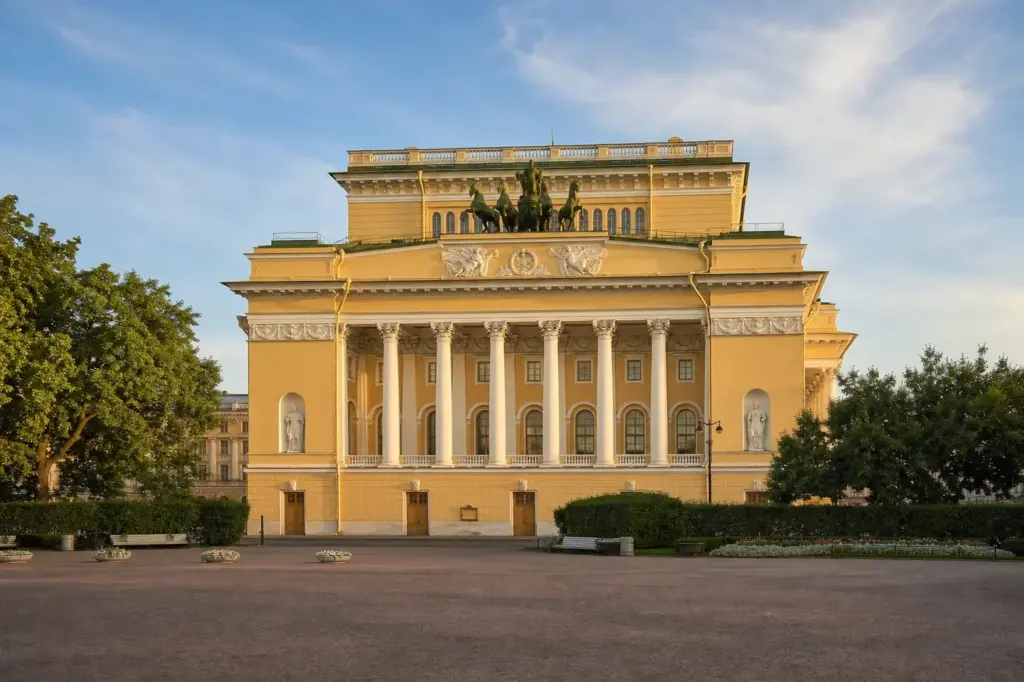
Alexandrinsky Theatre, Saint Petersburg, combines one of Russia’s longest theatrical traditions with a monumental neoclassical building in the city’s historic centre. Facing Ostrovsky Square, its grand portico, sculptural decoration and carefully proportioned facade make it immediately recognizable among Saint Petersburg‘s architectural landmarks.
Inside, the theatre offers something quite different from an ordinary sightseeing stop. The auditorium, ceremonial interiors and historical collections tell the story of Russian drama through the spaces where generations of performers have worked. Visitors can attend a production or explore selected interiors on an organized excursion. The institution also operates a separate New Stage dedicated to contemporary theatrical forms. For international travellers, understanding the difference between these venues is essential: the historic theatre is the architectural attraction, while the New Stage offers a contrasting experience of modern performance. Both belong to the same institution, but their programmes, entrances and tickets are distinct.
Quick Facts
| Russian name | Александринский театр |
|---|---|
| Built / opened | 1832 |
| Architect(s) | Carlo Rossi |
| Address | Санкт-Петербург, площадь Островского, д. 6 Google MapsApple MapsYandex Maps2GIS |
| District | Tsentralny |
| Metro | Gostiny Dvor (Line 3, Follow the signs for Nevsky Prospekt, then walk towards Ostrovsky Square and the theatre's columned facade.) Nevsky Prospekt (Line 2, Use the underground connection towards Gostiny Dvor and continue along Nevsky Prospekt towards Ostrovsky Square.) |
| Admission | Performances: ₽₽–₽₽₽ depending on production and seating. Guided tours: ₽₽–₽₽₽. Exterior viewing: free. |
| Best time to visit | The theatre operates as a performance venue rather than an attraction with one continuous public visiting schedule. The best time to experience its theatrical atmosphere is during a scheduled production, while guided excursions are better suited to visitors primarily interested in architecture and history.
Spring and autumn are comfortable seasons for combining an interior programme with walking through the surrounding streets. Summer provides long daylight hours for exterior photography, while winter can make the illuminated facade and evening surroundings especially atmospheric. For outdoor architectural viewing, late afternoon often provides more interesting light than midday. Check the theatre's programme before planning a visit around a particular day, because performance and excursion schedules vary. |
| Website | alexandrinsky.ru |
What Is (and Isn't) Part of a Visit to Alexandrinsky Theatre, Saint Petersburg?
| Part | Status | Notes |
|---|---|---|
| Historic Stage performance | Included in the standard ticket | A standard performance ticket provides admission to the specified production and assigned seating area. |
| Public foyers at the Historic Stage | Included in the standard ticket | Public foyer areas associated with the booked performance are accessible subject to the event's arrangements. |
| Historic-interiors guided excursion | Separate ticket or institution | A dedicated excursion provides access to selected historical interiors according to the advertised route. |
| Museum of Russian Drama | Separate ticket or institution | The historical exhibition is accessible through specified excursion programmes rather than unrestricted general entry. |
| New Stage of the Alexandrinsky Theatre | Separate ticket or institution | The modern venue on the Fontanka has its own performances and excursions. |
| Museum of Theatre and Musical Art | Separate ticket or institution | This neighbouring institution is distinct from the theatre, although a special combined excursion can include it. |
| Stage machinery and backstage working areas | Not open to visitors | These are working theatre spaces and are not open for independent exploration. |
| Ostrovsky Square | Outside / not part of it | The public square provides the principal exterior view of the theatre but is not part of the interior visit. |
| Zodchego Rossi Street | Outside / not part of it | The historic street belongs to the surrounding architectural ensemble and can be explored independently. |
Why Visit Alexandrinsky Theatre, Saint Petersburg?
The strongest reason to visit Alexandrinsky Theatre is the combination of its architectural setting and living theatrical tradition. Carlo Rossi’s exterior forms part of a larger urban composition that includes Ostrovsky Square and the adjoining streets. The building is not simply a preserved monument: performances continue inside the historic auditorium.
The theatre’s history is closely connected with major Russian playwrights, including Nikolai Gogol, Alexander Ostrovsky and Anton Chekhov. Productions associated with their works helped shape theatrical culture far beyond Saint Petersburg.
A guided excursion reveals spaces normally outside the experience of an audience member, including ceremonial foyers, historical displays and selected architectural features. Attending an actual performance adds another dimension: the relationship between the stage, the auditorium and the audience becomes part of the experience.
How Alexandrinsky Theatre, Saint Petersburg Is Laid Out
The Alexandrinsky Theatre consists of two principal performance venues within the historic centre of Saint Petersburg.
The Historic Stage occupies Carlo Rossi’s neoclassical building on Ostrovsky Square. Its public facade faces the square, while the building connects visually with the surrounding architectural ensemble. Inside are the main auditorium, foyers, circulation galleries and historical exhibition spaces. Access to different interiors depends on the performance or excursion booked.
The New Stage, named after Vsevolod Meyerhold, stands separately at 49A Fontanka River Embankment. It is a modern theatre complex designed for contemporary productions and experimental formats. Its architecture and interior arrangement differ substantially from those of the historic venue.
The nearby Museum of Theatre and Musical Art is another institution and should not be confused with the theatre’s own Museum of Russian Drama exhibition. Certain organized excursions connect these collections, but ordinary admission to a performance does not automatically include them.
For an architecture-focused visit, begin at Ostrovsky Square, examine the historic facade and then follow the route specified for the selected performance or guided excursion.
Highlights of Alexandrinsky Theatre, Saint Petersburg
Carlo Rossi's Neoclassical Facade
The theatre's exterior is one of Carlo Rossi's most recognizable architectural compositions in Saint Petersburg. Its symmetrical design places a monumental columned portico at the centre of the facade, creating a strong visual focus across Ostrovsky Square. The classical proportions were conceived as part of a coordinated urban ensemble rather than an isolated building. Visitors should stand back far enough to see how the portico, upper sculptural group and surrounding square work together. The facade is particularly rewarding for travellers interested in the relationship between architecture and city planning.
Tip: Cross towards the central part of Ostrovsky Square to appreciate the facade's symmetry rather than photographing it directly from the entrance steps.
Apollo's Chariot Above the Portico
Look above the main columns for the sculptural quadriga associated with Apollo, the classical patron of the arts. The composition crowns the theatre's central facade and reinforces its identity as a building devoted to performance and artistic culture. The horses and chariot provide a dramatic silhouette against the sky, especially when viewed from the square. This detail is easy to miss when approaching directly from Nevsky Prospekt because attention naturally falls on the entrance and columns. It is one of the most distinctive exterior features and can be appreciated without entering the building.
Tip: View the sculpture from an angle with open sky behind it; the individual horses become easier to distinguish.
The Historic Auditorium
The main auditorium preserves the essential character of a traditional European theatre, with a stage framed by tiers of audience seating and private boxes. Its design reflects a period when the arrangement of spectators was itself an important part of theatrical life. From inside, the visual relationship between the stage, boxes and upper galleries is immediately apparent. A seat in the stalls provides a different impression from a place in the higher tiers. Visitors interested mainly in architecture should look for an excursion that explicitly includes the auditorium, as normal performance admission does not grant unrestricted access to other seating areas.
Tip: Before choosing a performance seat, examine the official seating plan and consider the viewing angle as well as the distance from the stage.
Ceremonial Foyers and Historic Interiors
The theatre's ceremonial interiors include spaces traditionally used by audiences and distinguished guests. Organized excursions can introduce the public foyer, imperial foyer and other rooms associated with the building's original social functions. Decorative finishes, formal proportions and the arrangement of passages reveal how architecture shaped the experience of attending a performance. These interiors also provide a contrast to the practical working areas of a modern theatre. Not every space is accessible on every excursion, because the route depends on rehearsals and performances taking place inside the building.
Tip: Choose a dedicated historical-interiors excursion if examining the building matters more than attending a particular production.
Imperial Boxes and Theatre Traditions
The theatre retains spaces associated with its imperial-era audience, including ceremonial boxes discussed during official historical excursions. Their position within the auditorium illustrates the relationship between architectural design, visibility and the social customs of nineteenth-century theatre-going. From a visitor's perspective, the most interesting feature is how these special seating areas relate to the central stage and surrounding tiers. They are not independent attractions that visitors can enter freely. When included in an excursion, their history adds context to the auditorium's arrangement and the ceremonial character of the building.
Tip: Pay attention to the distinction between seeing a historic box from the auditorium and actually entering it; guided routes may offer different levels of access.
Museum of Russian Drama Exhibition
The theatre maintains a historical exhibition devoted to Russian drama, drawing on its collections of costumes, theatrical objects, furniture and stage-related material. The displays help visitors understand how productions were created and how the theatre's visual language changed across generations. The exhibition occupies spaces within the historic theatre rather than a completely separate museum building. Selected excursions include the collection, while access during ordinary performances should not be assumed. It is particularly useful for visitors who want to connect familiar literary names with the practical work of actors, designers and theatre workshops.
Tip: Look for excursions that specifically name the Museum of Russian Drama; a performance ticket alone is not a substitute for an exhibition visit.
The New Stage on the Fontanka
The Alexandrinsky Theatre's New Stage is a separate contemporary performance complex near the Fontanka River. Designed by Saint Petersburg architect Yuri Zemtsov, it provides a striking architectural contrast to Rossi's classical theatre. Its programme accommodates modern drama, interdisciplinary performances and other experimental formats. The building also includes facilities associated with contemporary cultural production. Although both venues share the Alexandrinsky name, they have different addresses and event schedules. Visitors should regard the New Stage as a second destination rather than an additional room within the historic building.
Tip: Check the venue name on the performance listing before travelling; a New Stage production does not take place inside the famous columned theatre.
The Rossi Street Architectural Ensemble
Behind the historic theatre, Zodchego Rossi Street continues the architectural composition associated with Carlo Rossi. Its disciplined facades and strong linear perspective demonstrate the architect's approach to planning entire urban spaces. The street creates a quieter architectural experience than the open setting of Ostrovsky Square and gives visitors another perspective on the theatre's surroundings. Although it forms part of the larger Rossi-designed environment, it is a public street rather than an interior section of the theatre. Exploring it complements an exterior visit without requiring access to a performance.
Tip: Walk along the street after examining the theatre's main facade to understand how Rossi connected individual buildings into a larger urban design.
Atmosphere
Alexandrinsky Theatre changes character throughout the day. Outside, Ostrovsky Square offers a broad view of the classical facade, with pedestrians crossing between Nevsky Prospekt, the surrounding gardens and neighbouring cultural attractions. The architecture feels formal and measured, particularly when the columns catch the low sunlight.
Before an evening performance, the interior becomes a social space. Visitors gather in the foyers, find their seats and settle into the layered auditorium. Once the performance begins, attention shifts from the ornate surroundings to the stage and the rhythm of spoken Russian drama.
A guided daytime excursion has a different atmosphere: quieter corridors and historical rooms invite closer attention to architectural details. The New Stage offers a more contemporary environment, with an emphasis on the performance itself rather than the ceremony associated with the historic auditorium.
History of Alexandrinsky Theatre, Saint Petersburg
The beginnings of Russian professional theatre
The Alexandrinsky Theatre traces its institutional history to 1756, when Empress Elizabeth established a public theatre for Russian tragedy and comedy in Saint Petersburg. Playwright Alexander Sumarokov became its director, while actor Fyodor Volkov led the company. Performances initially took place in a building on Vasilyevsky Island, long before the present theatre existed.
The company developed through several organizational changes and performance venues. During the eighteenth century, professional Russian-language drama gradually acquired a more established theatrical infrastructure. Ivan Dmitrevsky became an influential figure after Volkov’s death, and the company later performed in the city’s Bolshoi Stone Theatre.
The move to Ostrovsky Square
The decisive architectural change came when the company moved into a purpose-built theatre designed by Carlo Rossi. The architect had already become closely associated with Saint Petersburg’s monumental neoclassical town planning. His design connected the new theatre with an extensive urban composition of squares, streets and coordinated facades.
The new building received the name Alexandrinsky in honour of Empress Alexandra Feodorovna. Its auditorium and ceremonial interiors provided a permanent architectural home for the developing Russian dramatic repertoire.
The great literary premieres
The theatre became closely associated with major works of Russian literature. Nikolai Gogol’s The Inspector General was performed here in 1836, with the playwright actively involved in its production. Alexander Ostrovsky’s The Storm later joined the theatre’s history, followed by important productions of works by Alexander Pushkin, Ivan Turgenev and other writers.
In the late nineteenth century, the Alexandrinsky stage continued to serve as a prominent venue for new dramatic writing. Anton Chekhov’s The Seagull received its famously unsuccessful first performance here in 1896. The event became an important episode in theatrical history, particularly when considered alongside the play’s later success through a different theatrical interpretation.
New approaches to stage design
The early twentieth century brought increasingly ambitious theatrical experiments. Director Vsevolod Meyerhold worked at the theatre with stage designer Alexander Golovin, combining innovative staging with elaborate visual compositions. Their production of Lermontov’s Masquerade in 1917 became one of the defining artistic achievements associated with the Alexandrinsky stage.
During the following decades, the theatre operated under several official names while continuing to perform Russian and international drama. Its institutional name incorporated Alexander Pushkin, and it developed a repertoire spanning established classics and contemporary works.
During the Second World War, the theatre company worked in Novosibirsk, while the historic building remained in Leningrad. The company subsequently returned and continued its theatrical activities.
Restoration and contemporary theatre
The historic building underwent a major reconstruction and restoration completed in 2006. The work restored important interiors while modernizing the theatre’s technical facilities. The Museum of Russian Drama exhibition also opened as part of the institution’s renewed presentation of its history.
The opening of the New Stage in 2013 marked another significant development. It extended the theatre’s activities into contemporary performance and supplied a modern setting for productions that differ from those traditionally associated with the historic auditorium.
Today, Alexandrinsky Theatre maintains the relationship between architectural heritage, classical drama and newer forms of theatrical expression. Its significance lies not only in celebrated productions of the past but also in the continued use of both venues for live performance.
Tickets and Booking for Alexandrinsky Theatre, Saint Petersburg
| Ticket | Price | Includes |
|---|---|---|
| Historic Stage performance — adult | ₽₽–₽₽₽ | Admission to the selected production at the Historic Stage, with seating in the chosen section. The level varies according to the performance and seat category. |
| Historic Stage performance — child or teenager | ₽₽–₽₽₽ | Admission to an age-appropriate production where tickets are available. Any applicable age-based concession must be checked for the specific performance. |
| New Stage performance | ₽₽–₽₽₽ | Admission to the selected contemporary production or event at the separate New Stage venue. |
| Historic theatre guided excursion | ₽₽–₽₽₽ | A scheduled guided visit to selected historical interiors. The exact rooms depend on the excursion format and theatre operations. |
| Extended theatre and museum excursion | ₽₽₽ | A longer organized programme combining the theatre's history with relevant exhibitions or museum spaces, according to the published description. |
| Free admission categories | Free | Only where an officially listed eligibility category or special programme applies. Documentation and availability conditions must be confirmed with the theatre. |
₽ budget · ₽₽ moderate · ₽₽₽ upscale · ₽₽₽₽ splurge. Price levels are estimates compared with typical prices for visitors.
Purchase tickets through the official Alexandrinsky Theatre programme or the theatre’s own box office. The official calendar distinguishes between the Historic Stage and the New Stage, so check the venue and event title before selecting seats.
Online availability depends on the theatre’s published repertoire. A date that has not appeared in the calendar should not automatically be interpreted as sold out. The theatre does not establish a single fixed advance-sales interval for every event in the visitor information checked.
The box office operates daily from 11:00 to 20:00. Same-day purchases are possible when unsold places remain. Tickets for excursions are also offered through the official booking channels.
Bring the ticket in its accepted presentation format and supporting identification if a concession requires it. Follow the entrance information for the relevant venue. Security screening is conducted, and visitors should arrive ahead of the performance; entry to the auditorium is not permitted after the third bell.
Rates for Russian citizens and concession categories may differ. Check the official ticket and visitor information at alexandrinsky.ru for the applicable conditions.
Suggested itineraries Alexandrinsky Theatre, Saint Petersburg
45 minutes
Begin outside the Historic Stage on Ostrovsky Square. Examine the columned facade and Apollo's chariot, then walk around the exterior to appreciate the architectural relationship with Zodchego Rossi Street. This short plan is suitable when no performance or guided excursion is available. Finish by returning towards Nevsky Prospekt, where the surrounding urban setting gives another perspective on the theatre's position.
90 minutes
Choose a dedicated historical-interiors excursion. Start with the theatre's exterior before entering for the organized route. Depending on the programme, explore ceremonial foyers, selected auditorium spaces and historical displays. Concentrate on the contrast between the public social rooms and the performance space. Leave a little time afterwards to view the building from the opposite side of Ostrovsky Square.
3 hours
Spend a short period examining the facade and the neighbouring Rossi architectural ensemble before attending a full theatrical performance. Inside, observe how the auditorium is arranged around the stage and how the setting changes as the audience assembles. After the performance, continue along Nevsky Prospekt or the surrounding streets to experience the historic centre in the evening.
Half day
Combine a scheduled historical excursion with a broader walk through the surrounding cultural district. Begin at Ostrovsky Square, visit the theatre's interiors during the organized programme and continue towards the nearby Museum of Theatre and Musical Art. Then explore Zodchego Rossi Street and the Fontanka area, where the Alexandrinsky New Stage offers a contrasting architectural setting.
How to Get to Alexandrinsky Theatre, Saint Petersburg
By metro: Gostiny Dvor on Line 3 is the most convenient nearby station for the Historic Stage. Exit towards Nevsky Prospekt and walk towards Ostrovsky Square. The theatre’s main columned facade faces the open square. Nevsky Prospekt station on Line 2 connects with Gostiny Dvor through the underground interchange.
From central Saint Petersburg: Visitors staying near Nevsky Prospekt can often reach the theatre on foot. The route passes through one of the city’s principal central streets, making it straightforward to combine the theatre with nearby architectural attractions.
By bus or trolleybus: Several surface transport services operate along the Nevsky Prospekt corridor. Check the current stop and route before departure, as services may change.
By taxi: Request the Historic Stage at Ostrovsky Square rather than simply entering the theatre’s name. For the New Stage, use its separate address on the Fontanka River Embankment.
Accessibility
The Historic Stage and New Stage have different accessibility arrangements. According to the theatre's official visitor information, the historical building was not originally designed with modern step-free access throughout, and visitors with mobility requirements should contact the administration approximately two to three days before their intended visit.
At the Historic Stage, designated wheelchair spaces are provided near the side areas of the first row of the stalls, with nearby places for accompanying visitors. A call button for assistance is available near the ticket-office entrance.
The New Stage has an adapted entrance and a lift connecting several public levels. Assistance call buttons are provided at designated locations, including the entrance area. Visitors should confirm the accessible route and appropriate seating arrangements for their chosen event directly with the theatre.
Food Nearby
The theatre stands close to Nevsky Prospekt, where cafés, restaurants and casual dining options are concentrated within the surrounding city blocks. Visitors can find places for a light meal before an evening performance or a longer dinner afterwards.
The historic centre also offers bakeries and coffee shops suited to a shorter stop. Choosing a venue near Ostrovsky Square reduces the need to cross busy intersections shortly before a performance.
The theatre itself has café and buffet facilities associated with its venues. Their availability depends on events and operating arrangements. For a substantial meal, the nearby streets around Nevsky Prospekt provide a wider choice than the performance foyers.
What to Bring
Bring clothing suitable for the season and comfortable shoes for walking through central Saint Petersburg. In winter, outerwear suited to cold temperatures and potentially slippery pavements is important, especially when combining the theatre with outdoor sightseeing.
A small pair of theatre binoculars can be useful when watching a production from an upper tier. Visitors who do not understand Russian may benefit from reading a synopsis of the selected play beforehand.
Carry a small bag rather than bulky luggage, as personal belongings may be inspected and cloakroom arrangements apply. A locally usable payment method is advisable for refreshments or additional purchases.
Best Views and Photo Spots of Alexandrinsky Theatre, Saint Petersburg
Ostrovsky Square
The open square provides the most complete view of the theatre's principal facade. From here, the columned portico and central sculptural group can be framed together, making it the strongest location for a straightforward architectural photograph.
Best time: Late afternoon or early evening, depending on the season and direction of sunlight.
Nevsky Prospekt Approach
Approaching from Nevsky Prospekt reveals the theatre within the surrounding cityscape rather than as a standalone monument. The change from the busy street to the more formal setting of Ostrovsky Square gives photographs a sense of urban context.
Best time: Morning or periods with lighter pedestrian activity.
Central View of the Portico
A frontal position emphasizes the symmetry of Rossi's architecture and the relationship between the columns, upper facade and Apollo's chariot. This perspective is particularly useful for showing the disciplined classical composition.
Best time: Clear daylight with enough contrast to reveal sculptural details.
Zodchego Rossi Street
The long architectural perspective of Zodchego Rossi Street offers a complementary subject to the theatre facade. Its uniform buildings demonstrate how the theatre relates to the larger urban ensemble designed around it.
Best time: Early morning for a calmer street scene and softer shadows.
Ostrovsky Square Gardens
The garden area provides opportunities to combine greenery, pedestrian paths and the theatre's monumental architecture. The contrast between planting and classical stonework creates a softer composition than a strictly frontal facade photograph.
Best time: Spring and summer, when seasonal planting and greenery are most visible.
Photography Rules
Photography rules depend on the area and event. Do not assume that photographs or video recordings are permitted during performances. Follow staff instructions regarding photography in foyers, exhibitions and guided excursions. Flash, tripods and professional recording equipment may require specific permission. Drone use should not be assumed permissible around the theatre.
Family Suitability
Alexandrinsky Theatre can be a rewarding destination for families with older children and teenagers who are interested in drama, literature or architecture. The suitability of performances varies considerably: some productions deal with mature themes, while others may be appropriate for younger audiences. The official programme lists age categories for individual events.
For children unfamiliar with Russian, a shorter excursion or exterior architecture walk may be more engaging than a lengthy dialogue-based production. Families should consider attention span, performance duration and language comprehension when choosing an event.
Strollers may be inconvenient within the historic building because of its architectural layout. Families requiring step-free arrangements should consult the theatre in advance.
Russia Vibes Tips
- Look at the theatre from more than one position in Ostrovsky Square. Rossi's architecture is intended to be appreciated as part of a coordinated urban setting, not only as a close-up facade.
- If the main purpose is to experience Russian drama, read a short plot synopsis before attending. Understanding the central characters makes a Russian-language production more accessible even without following every line.
- Combine the Historic Stage with a walk along Zodchego Rossi Street. The two locations reveal different aspects of the same architectural vision.
- When comparing performances, consider the director and production format as well as the playwright. A familiar classic may be presented in a distinctly contemporary interpretation.
- Use the New Stage as an architectural contrast to the Historic Stage. Seeing both buildings helps explain how the theatre balances inherited traditions with experimental performance.
- Explore the nearby cultural district on foot rather than immediately taking transport after an exterior visit. Several important architectural spaces are clustered around Nevsky Prospekt and the Fontanka.
Sights Distances are approximate (straight line plus a detour allowance).Within a 10-Minute Walk (Nearby Sights & Food)
Keep reading
Nearby
FAQ: Alexandrinsky Theatre, Saint Petersburg
Is Alexandrinsky Theatre worth visiting without seeing a performance?
Yes, particularly for architecture enthusiasts. Carlo Rossi's facade, Ostrovsky Square and the surrounding architectural ensemble can be appreciated from public areas. A scheduled historical excursion offers a more substantial experience for visitors interested in the auditorium and ceremonial interiors. Simply walking into the building, however, is not equivalent to taking a guided architectural tour.
Is the Alexandrinsky New Stage part of the historic theatre building?
No. The New Stage belongs to the same theatrical institution but occupies a separate modern complex on the Fontanka River Embankment. It has its own programme and entrance. The historic Rossi building is on Ostrovsky Square. Both can be visited during a stay in central Saint Petersburg, but they should be treated as separate destinations.
Can visitors see the auditorium without attending a play?
Selected organized excursions can provide access to the auditorium or viewpoints within it, depending on the advertised route and the theatre's working schedule. Rehearsals and technical preparations may affect what can be shown. The most reliable choice is an official guided tour that explicitly includes historical interiors rather than assuming unrestricted daytime access.
Does an ordinary theatre ticket include the Museum of Russian Drama?
Not automatically. The Museum of Russian Drama is a historical exhibition within the theatre, and access is included in particular excursion formats. A standard performance ticket is primarily for the selected production. Visitors wishing to examine costumes, historical objects and exhibition displays should choose an appropriate museum-related excursion.
How far in advance should international visitors book?
For a popular production, booking once the desired performance appears on the official calendar is sensible. The theatre's published programme determines which dates can be purchased, and the advance-sales window is not necessarily identical for all events. Travellers with a fixed itinerary should prioritize the specific performance they most want to see.
Do visitors need to understand Russian to enjoy the theatre?
Not necessarily, but language comprehension matters for dialogue-heavy drama. International visitors may prefer productions emphasizing movement, staging or visual storytelling. Reading a synopsis beforehand can make unfamiliar works easier to follow. Subtitles or other language support should only be expected when explicitly indicated for the selected production.
Is a guided tour necessary to appreciate Alexandrinsky Theatre?
A guide is not necessary for appreciating the exterior architecture, but organized excursions provide access and explanations that independent visitors cannot obtain simply by walking around the building. They are especially useful for understanding the theatre's historical interiors, special boxes and exhibition collections. The choice depends on whether the priority is architecture, performance or theatre history.
Is Alexandrinsky Theatre the same as the Museum of Theatre and Musical Art?
No. They are separate cultural institutions with different collections and admission arrangements. The Alexandrinsky Theatre is primarily a working performance venue with its own historical exhibition. The Museum of Theatre and Musical Art is a neighbouring museum institution. Some extended excursions connect the two, but visitors should not assume that ordinary admission to either one includes the other.
Russia Vibes is a one-person project. A coffee keeps it going
Hotels near Alexandrinsky Theatre, Saint Petersburg
Distances are straight-line, from OpenStreetMap data.
Looking for more on this? One Day in Moscow: The Perfect First-Time Visitor Itinerary: 6 Stops (Moscow Vibes)
Planning your trip? Russia Travel Guide

Take this guide with you
Get a free PDF of this guide to print or read offline: key facts, tips and a map link on a few clean pages.
About this page
Report an issue on this page
Paying for your trip: please read
Payments and bookings between Russia and many other countries are currently restricted. In practice, cards issued in the EU, the UK, the US and several other countries often cannot be used in Russia, Russian cards usually cannot be used abroad, and some booking platforms, airlines and payment providers limit or pause their services for Russia. The situation changes frequently.
We do not give legal or financial advice, and this site does not encourage anyone to break any rule that applies to them. Whatever you plan, you are responsible for following the laws and regulations that apply to you, including those of your country of residence and citizenship.
Many travelers still organise their stay without problems. It is worth asking your bank or payment provider what is currently possible, contacting hotels, tour operators and carriers directly about the payment methods they accept, and checking which services are open to customers from your country. Clarify payment, cancellation and refund terms before you commit to a booking, and keep your plans flexible.
Partner links on this site may not be available in every country, and prices, availability and rules in our guides can differ from what you see when you book.
How we research and update our guides
About this guide: AI assistance and accuracy
This guide is created with the help of AI and is based on official sources where available. Mistakes can still happen. Opening hours, prices, rules and other details are given to the best of our knowledge as of the date shown and can change without notice. It offers general recommendations only, not professional, legal or travel advice. Please confirm important details with the official source before you travel; you are responsible for your own plans and decisions.
* Affiliate link: as an Amazon Associate we earn from qualifying purchases at no extra cost to you.