
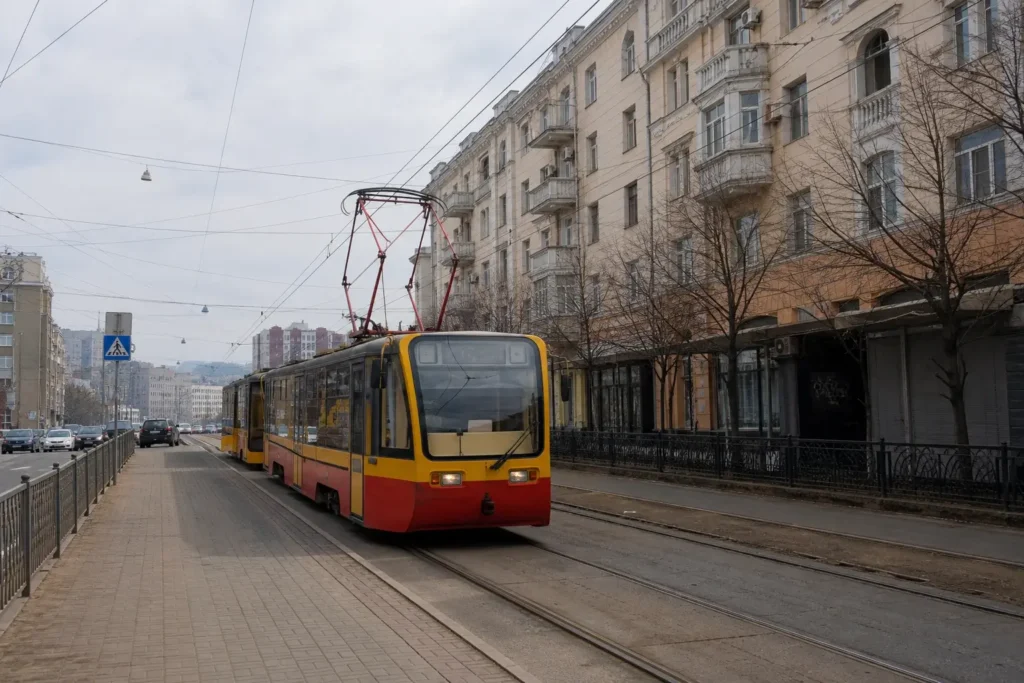
The Vladivostok Tram is one of Russia’s oldest and most reduced urban transit systems. Route 6 is the sole surviving line of what was once an extensive network that began service in the early 20th century.
Today, the tram system serves the central districts of Vladivostok on a single 5 km electrified route. The streetcars operate throughout the day on frequent schedules, offering an authentic way for visitors to move through the city and glimpse everyday life away from tourist areas.
Current access notice: As of October 2026, Route 6 operates on its published weekday and weekend schedule. No closures or major renovations are announced.
Quick Facts
| Russian name | Владивостокский трамвай |
|---|---|
| Type | Transport hub |
| Built / opened | 1912 |
| Address | Улица Борисенко 44, Владивосток OpenStreetMap · Google Maps |
| District | Vladivostok |
| Opening hours | Mon-Fri 05:39-22:47; Sat-Sun 05:35-22:23 |
| Best time to visit | Weekday mornings (05:30–07:30) and evenings (17:00–19:00) are peak times with more frequent crowds of commuters. Mid-day (09:00–15:00) is quieter and better for observing local life without rush-hour density. Weekends offer lighter loads throughout the day. The tram operates year-round; summer brings occasional delays due to street maintenance, while winter can mean icy conditions affecting brakes and acceleration. |
| Recommended duration | varies by route |
How to Get to and from Vladivostok Tram, Vladivostok
| Option | Duration | Price | Notes |
|---|---|---|---|
| Tram Route 6 | varies; full route ~25–30 minutes | ₽ | Direct service along Lugovaya, Sportivnaya, and ulitsa Borisenko. Weekday departures every 5 minutes 05:39–22:47; weekend 05:35–22:23. Longer intervals (30 min) after 20:00 on weekdays. Pay on board or use contactless card; cash is not accepted. |
| Tram to Sakhalinskaya Station | ~10–15 minutes from Minnyy Gorodok | ₽ | Connects to the railway station area for onward train travel or connection to city centre taxi stands. Useful for arriving or departing the city. |
| Tram to Market (Lugovaya Rynok) | ~8–12 minutes from Sakhalinskaya | ₽ | The market stop offers access to fresh produce and local shopping. Stop is named Lugovaya; this is the market stop, distinct from other stops on the line. |
₽ budget · ₽₽ moderate · ₽₽₽ upscale · ₽₽₽₽ splurge. Price levels are estimates compared with typical prices for visitors.
Why Visit Vladivostok Tram, Vladivostok?
The tram is a practical choice for getting around central Vladivostok. Unlike buses or taxis, it follows a predictable route and does not get caught in traffic; the reserved tracks alongside roads keep service reliable even during congested periods.
Riding the tram offers perspective on the city’s urban geography and local character. The route passes residential areas, markets, and small shops, giving travellers a sense of how ordinary Vladivostok residents move through their daily lives.
Highlights of Vladivostok Tram, Vladivostok
Route 6: Sakhalinskaya to Minnyy Gorodok
The single operational route spans 5 km and serves eleven stops across central Vladivostok. The line runs along Lugovaya ulitsa, Sportivnaya ulitsa, and ulitsa Borisenko, connecting the Sakhalinskaya area near the railway station to the Minnyy Gorodok neighbourhood. The tram operates on double track with 550 V DC overhead electrification, a gauge of 1,524 mm. Service runs every 5 minutes during peak hours, with frequencies increasing to 30 minutes after 20:00 on weekdays.
Tip: If boarding late in the evening, check the current timetable at the stop; intervals increase after 8 p.m.
The 1912 Opening
The Vladivostok Tram opened on 9 October 1912 as one of Russia's earliest electric streetcar systems. The first section of track represented a modern transport solution for the young Far Eastern port city. The system initially used narrow-gauge track (1,000 mm), which was rebuilt to broad Russian gauge (1,524 mm) in 1934 to standardise with the rest of the nation's rail network.
Tip: The tram depot at ulitsa Borisenko 44 is the operator's main facility; the address marks where to find route information and staff.
The Soviet Expansion Years
By 1991, the tram network had grown to 18.4 km of track and served the entire city with multiple routes. The system was a backbone of Vladivostok's public transport during the Soviet era, connecting residential areas to factories, ports, and administrative centres. This extensive network reflected Soviet planning principles: mass transit owned by the state and designed for workers and families.
Tip: Maps from 2019 showing the ghost network are available online; they reveal how dramatically the system contracted after 1991.
The 1990s Collapse
Following the dissolution of the Soviet Union, Vladivostok's tram system suffered catastrophic decline. Between 1991 and 2010, nearly all lines closed as the city lost funding for maintenance and operations. The recession and shift to market economics meant that unprofitable routes were abandoned. By 2010, only Route 6 remained in operation, preserved because it runs on dedicated track alongside roads and could be maintained more economically.
Tip: The closure was not unique to Vladivostok; many Russian cities shrunk their tram networks during the 1990s as local budgets collapsed.
Operating Today: Line 6
As of October 2026, Route 6 is operated by Elektricheskii Transport AO and serves as Vladivostok's only tram line. The fleet consists of 26 tram cars. Service begins at 05:39 on weekdays (05:35 on weekends) and continues until 22:47 (weekends 22:23), with trams departing every 5 minutes during normal hours. The line carries approximately 6.5 million passengers annually.
Tip: Pay using a contactless card; tram cards are sold at kiosks near major stops or use a bank card at card readers on board.
The Eleven Stops
Route 6 calls at Sakhalinskaya (near the railway station), Novozhilova, Borisenko (depot area), Klubnaya, Shkol'naya, Stadion, Sportivnaya, Ploshchad' Lugovaya, Lugovaya (market), Poliklinika, and Minnyy Gorodok. Each stop connects to different neighbourhoods with shops, schools, a stadium, a market, and clinic. The route offers access to residential and commercial Vladivostok away from the central tourist corridor.
Tip: The market stop (Lugovaya rynok) is useful for buying fresh produce or local goods; it operates daily and serves city residents.
Double Track and Reserved Right-of-Way
Unlike most remaining Russian trams, Route 6 operates on double track with a reserved right-of-way alongside roads rather than mixed traffic. This separation from car lanes keeps the tram operating on schedule even when streets are congested. The electrification system uses 550 V DC drawn from overhead wires, a standard configuration for Russian tramways.
Tip: The reserved track makes the tram one of the most reliable ways to cross the city on time; buses and taxis can get stuck in parking disputes, but trams do not.
The Operator and Fleet
Elektricheskii Transport AO (Electrical Transport Joint-Stock Company) has operated Vladivostok's tram since the Soviet era. The company maintains 26 tram cars that serve Route 6. Staff at the depot on ulitsa Borisenko manage maintenance, scheduling, and daily operations. The operator also maintains trolleybus service in the city.
Tip: Tram timetables and route maps are posted at all stops and available from the operator; staff at the depot can provide detailed information.
Atmosphere
The tram carries a mix of commuters, students, pensioners, and occasional tourists. Early morning (05:30–07:00) sees workers and school-age passengers rushing to jobs and classes. Mid-day traffic is lighter. Evening (17:00–19:00) brings another peak as people return home. The interiors of the tram cars show signs of Soviet-era construction: metal handrails, bench seating, and a no-frills utilitarian design. The sounds are characteristic—the electric hum of the motors, the screech of wheels on curves, the chime of the bell at stops, and announcements in Russian.
Riding the tram offers glimpses of daily Vladivostok life: small shops and apartments lining the streets, parked cars, pedestrians with shopping bags, street vendors near stops. The atmosphere is calm and routine, lacking the rush of major cities. Windows offer views of the cityscape and Soviet-era architecture. Passengers are generally quiet and focused on their journey.
History of Vladivostok Tram, Vladivostok
The Opening Years (1912): Vladivostok’s tram system opened on 9 October 1912, making it one of Russia’s earliest electric streetcar networks. The first section of track represented modern urban infrastructure for the young Far Eastern port city. Vladivostok was then a growing Russian military and commercial hub on the Pacific, and the tram connected this expanding population to key destinations. The system initially used narrow-gauge track (1,000 mm), reflecting engineering choices common in the Far East at that time.
Gauge Standardisation (1934): In 1934, the Vladivostok tram was rebuilt from its original narrow gauge to the broad Russian gauge of 1,524 mm. This standardisation brought the system into line with Soviet rail policy, allowing interoperability with the national network and making maintenance and parts supply more efficient across the Soviet Union.
Soviet Expansion (1945–1991): After World War II, Vladivostok was closed to foreigners and developed as a major Soviet naval and industrial centre. The tram network expanded to serve this growing population. By 1991, the system had reached its maximum extent of 18.4 km of track serving multiple routes. The tram was a pillar of Soviet urban transport, designed to move workers to factories and residential areas while fitting state ideals of mass transit. The fleet grew to serve the city’s expanding districts.
The Post-Soviet Crisis (1991–2010): Following the dissolution of the Soviet Union, Vladivostok faced economic collapse and loss of federal subsidies. The city struggled to maintain infrastructure. The tram system contracted sharply as routes became unprofitable and the city could not fund repairs. One by one, lines closed throughout the 1990s and 2000s. By 2010, only Route 6 survived because it ran on dedicated track that could be maintained more economically than mixed-traffic lines. The closure was symptomatic of broader problems across the post-Soviet Far East.
Route 6 to the Present (2010–2026): The sole remaining line has operated continuously for over a decade, preserving streetcar service in Vladivostok. Operated by Elektricheskii Transport AO, Route 6 serves about 6.5 million passengers per year. While far smaller than its Soviet-era predecessor, the system remains a functional part of Vladivostok’s transport network and a living relic of the city’s early 20th-century modernity and its Soviet-era expansion.
Tickets and Payment at Vladivostok Tram, Vladivostok
Tram tickets are purchased on board from the driver or conductor. As of October 2026, payment is by card only (bank cards or Vladivostok transport cards). Contactless readers are located on the tram cars.
Tram route maps are posted at all eleven stops along Route 6. Schedule information is available at the depot (ulitsa Borisenko 44) and online through the operator, Elektricheskii Transport AO. No advance booking is required; board at any stop during operating hours. Trams are wheelchair-accessible with ramps at designated stops; inquire at the depot or central stops for which stations offer this access.
For detailed current fares, accessibility features, and real-time timetables, contact the operator or visit their office at the depot. Conditions and fares are subject to change; check the official source before travel.
Flights, Transfers and Planning
How to Get to Vladivostok Tram, Vladivostok
Route 6 can be boarded at any of its eleven stops along the route:
- From the railway station area: Walk to the Sakhalinskaya stop (near Vladivostok Railway Station) and board heading toward Minnyy Gorodok or Lugovaya.
- From the city centre: Walk to the nearest stop along ulitsa Borisenko, Sportivnaya ulitsa, or Lugovaya ulitsa. Signs mark each stop with route information.
- Main depot: Ulitsa Borisenko 44 (Borисенко 44), where staff can provide directions and current schedules.
Accessibility
The tram includes wheelchair-accessible features at designated stops. Ramps are deployed at specific stations to facilitate boarding. Detailed information on which stops offer accessible boarding and seating should be confirmed with the operator (Elektricheskii Transport AO) before travel.
Food Nearby
Stops along Route 6 provide access to small shops, cafés, and the Lugovaya market (at the Lugovaya rynok stop). The market operates daily and sells fresh produce, baked goods, and prepared snacks. Small shops near Stadion and Klubnaya stops offer tea and simple food items. Most stops are near residential streets with local convenience stores.
What to Bring
In winter (November–March), bring warm clothing; tram interiors are heated but station platforms are exposed. In summer, sunscreen and a hat are useful if waiting at stops. Carry a contactless bank card or obtain a tram card for payment; the tram does not accept cash. A small rucksack or bag is practical for carrying purchases if stopping at the market.
Photography Rules
Photography inside the tram is permitted. Exterior shots of the tram cars and the right-of-way are allowed. Avoid photographing other passengers closely without permission. Tripods are not practical on a moving tram. Flash is permitted but may disturb passengers in dim lighting.
Family Suitability
The tram is suitable for families with children and strollers. Strollers can be stored in designated areas, and space is generally available. The journey is short enough for young children who may tire on longer trips. The route passes markets and parks, offering mild engagement for children. Families should note that peak commute times (early morning and evening) can be crowded.
Russia Vibes Tips
- Route 6 is the only functioning tram line in Vladivostok; do not expect other routes to exist. Older maps showing a vast network from the Soviet era no longer reflect reality.
- The tram is faster and more reliable than buses or taxis during congested periods. Use it to cross central Vladivostok efficiently, especially in late afternoon when traffic builds.
- After 20:00 on weekdays, trams run every 30 minutes rather than every 5 minutes. Plan for longer waits if using the tram in the evening; checking the posted timetable is essential.
- The market stop (Lugovaya rynok) is a genuine working market serving local shoppers, not a tourist destination. Arrive early (before 11:00) for the best selection; the market winds down by early afternoon.
- Tram cards and payment systems differ from buses and trolleybuses. Keep your card or ensure your bank card is compatible with readers before boarding multiple transport types.
- In winter, ice on the tracks can cause delays. The tram is still more reliable than other transport, but allow extra time during freezing weather.
Explore Nearby Vladivostok Tram, Vladivostok
Related guides
 Vladivostok Railway Station: Where the Trans-Siberian Railway Ends
Main image: AI-generated illustration. It may not show the place exactly as it looks.
 Pervomaysky, Vladivostok: Historic District and Railway Gateway
Main image: AI-generated illustration. It may not show the place exactly as it looks.
 Sovietsky, Vladivostok: Soviet Urban Planning and Centennial Avenue
Main image: AI-generated illustration. It may not show the place exactly as it looks.
 Pervorechensky, Vladivostok: A Residential District Guide
Main image: AI-generated illustration. It may not show the place exactly as it looks.
 Victory Day, Vladivostok: Parades, Ceremonies and War Remembrance
Main image: AI-generated illustration. It may not show the place exactly as it looks.
Browse more: More in Vladivostok · All Airports & Transport · All Airports & Transport in Vladivostok · All Other Hubs · All Vladivostok
FAQ: Vladivostok Tram, Vladivostok
Is there only one tram line left in Vladivostok?
Yes. Route 6 is the sole operating tram line. All other routes closed between the 1990s and 2010 due to budget cuts and the recession following the collapse of the Soviet Union.
What is the tram fare?
Fares are low and are paid on board using a contactless card or transport card. Cash is not accepted. The exact fare changes; ask the driver or check the operator's website for the current rate.
How often do trams run?
Every 5 minutes during normal hours (05:39–22:47 on weekdays; 05:35–22:23 on weekends). After 20:00 on weekdays, frequency increases to every 30 minutes.
Does the tram connect to the railway station?
Yes. The Sakhalinskaya stop is near Vladivostok Railway Station. Walk to the stop to board trams heading toward Minnyy Gorodok or Lugovaya.
Can I use my foreign credit card on the tram?
Contactless payment with international bank cards should work if your card supports contactless transactions and the reader is compatible. Alternatively, obtain a local tram card from a kiosk near major stops.
Is the tram wheelchair accessible?
Accessibility features exist at designated stops with ramps available. Contact the operator (Elektricheskii Transport AO) to confirm which stops offer accessible boarding before travel.
Where is the tram depot?
Ulitsa Borisenko 44. Staff there can provide schedules, route maps, and information about the service.
Is the tram the best way to see Vladivostok?
The tram is practical for moving around central Vladivostok and observing local life. It reaches residential areas and markets away from main tourist zones. Guides sometimes offer tram tours combining the streetcar with buses and suburban trains.
Russia Vibes is a one-person project. A coffee keeps it going
How we research and update our guides
About this guide: AI assistance and accuracy
This guide is created with the help of AI and is based on official sources where available. Mistakes can still happen. Opening hours, prices, rules and other details are given to the best of our knowledge as of the date shown and can change without notice. It offers general recommendations only, not professional, legal or travel advice. Please confirm important details with the official source before you travel; you are responsible for your own plans and decisions.

Take this guide with you
Get a free PDF of this guide to print or read offline: key facts, tips and a map link on a few clean pages.
Report an issue on this page
Paying for your trip: please read
International sanctions affect payments between Russia and many other countries. In practice, cards issued in the EU, the UK, the US and several other countries often do not work in Russia, Russian cards usually do not work abroad, and some booking platforms, airlines and payment providers limit or suspend their services for Russia. The situation changes frequently.
We do not give legal or financial advice, and this site does not encourage anyone to break or circumvent sanctions. Whatever you plan, you are responsible for following the laws and regulations that apply to you, including those of your country of residence and citizenship.
Many travelers still organise their stay lawfully. It is worth asking your bank or payment provider what is currently permitted, contacting hotels, tour operators and carriers directly about the payment methods they accept, and checking which services are open to customers from your country. Clarify payment, cancellation and refund terms before you commit to a booking, and keep your plans flexible.
Partner links on this site may not be available in every country, and prices, availability and rules in our guides can differ from what you see when you book.