
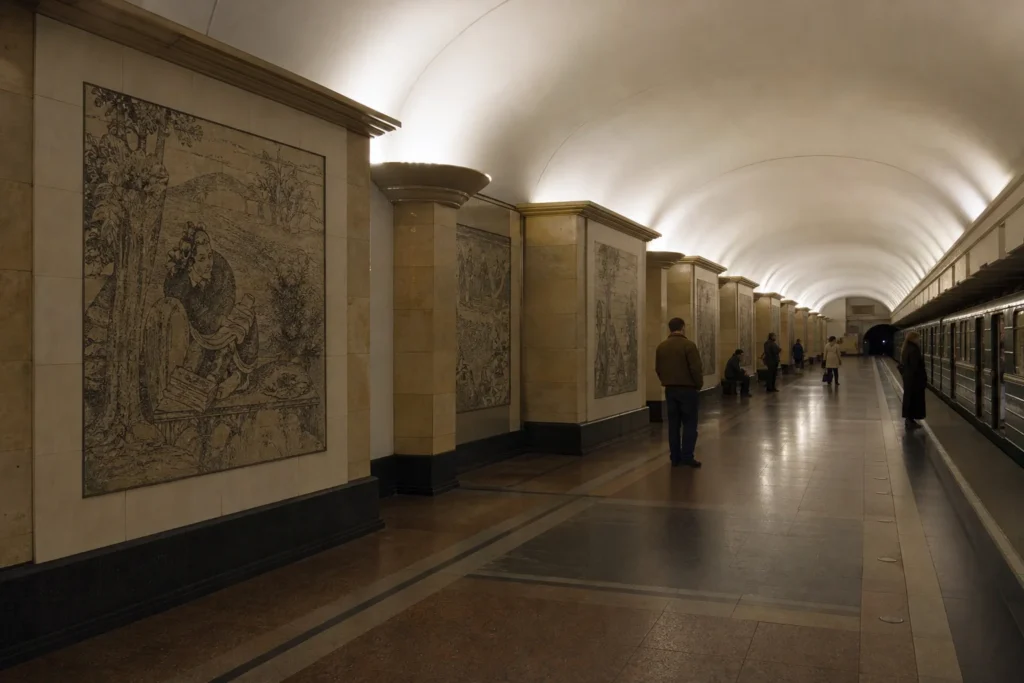
Dostoevskaya Metro Station opened on 30 December 1991 on Line 4, the orange line, and carries the name of Fyodor Dostoevsky, who lived and wrote in this part of Tsentralny District. It lies about 62 metres below Vladimirsky Prospekt, a short walk from Vladimirskaya Square and the writer’s last apartment, now a museum.
The hall is decorated in the style of illustrations for Dostoevsky’s novels, and a walkway connects the station to Vladimirskaya on Line 1. It opened in the year of the 170th anniversary of his birth. For visitors it is both an interchange and a small literary stop: the museum in Kuznechny Lane is a few minutes away on foot.
Quick Facts
| Russian name | Достоевская |
|---|---|
| Built / opened | 1991 |
| Architect(s) | V. G. Khilchenko and A. S. Konstantinov (ground vestibule); A. V. Tokman and colleagues (underground hall) – attribution to confirm |
| Address | Санкт-Петербург, Владимирский проспект, 23 OpenStreetMap · Google Maps |
| District | Tsentralny District |
| Interchanges | Dostoevskaya (Line 4, the ground pavilion on Vladimirsky Prospekt, near Vladimirskaya Square) Vladimirskaya (Line 1, transfer by an underground walkway) Spasskaya (Line 4, previous stop towards Gorny Institut) Ligovsky Prospekt (Line 4, next stop towards Ulitsa Dybenko) |
| Opening hours | The station runs with the metro network, daily from early morning until shortly after midnight. The ground pavilion on Vladimirsky Prospekt is reported to open later and close earlier than the rest of the network, and outside those hours you can enter through Vladimirskaya instead. Hours can change, so check before you travel (as of October 2026 – check the official site of the Saint Petersburg Metro). |
| Best time to visit | The station is underground, so it works in any season and in any weather. For a calm look at the hall, choose midday or a weekend morning. The weekday morning and evening rush fills the walkway to Vladimirskaya, and the museum and the market are best visited in the morning. |
| Last updated | October 16, 2026 |
Why Visit Dostoevskaya Metro Station, Saint Petersburg?
Dostoevskaya is one of the few stations in the city dedicated to a writer, and it sits in the neighbourhood that he used as the setting for several novels. Together with the nearby museum, the Vladimir Church and Kuznechny Market, it makes a short literary walk that starts underground.
It is also a practical interchange: a walkway leads to Vladimirskaya on the red line, and Line 4 runs from here south-east to the Neva’s right bank and west to Spasskaya and Gorny Institut. You pay only for a metro ride, and 15 to 30 minutes covers the hall and the walkway.
Highlights of Dostoevskaya Metro Station, Saint Petersburg
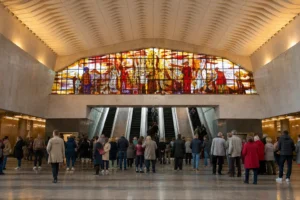
A hall in the style of novel illustrations
The underground hall was designed by A. V. Tokman and colleagues and decorated in the style of illustrations for Dostoevsky's novels. The decoration is the main reason to look around rather than head straight for the exit.
The exact form and position of the panels in the hall should be confirmed on site.
Tip: Spend a few minutes on the platform away from the escalators, where the decoration is easiest to see.
The vestibule beside the Delvig House
The ground pavilion on Vladimirsky Prospekt was designed by V. G. Khilchenko and A. S. Konstantinov. In the 1980s the plan was to demolish three buildings for the station, including the Delvig House, an early nineteenth-century building.
In 1986 defenders of the city's heritage, led by Academician Dmitry Likhachev, saved the Delvig House, and the builders found a way to construct the station without destroying it.
Tip: Look at the old building next to the pavilion; it is the reason the station is shaped as it is.
The walkway to Vladimirskaya
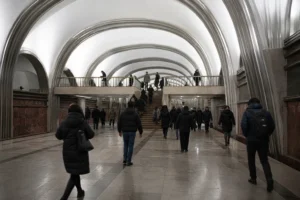
Underground walkways link Dostoevskaya with Vladimirskaya on Line 1, so you can change between the orange and red lines without going to the street.
The walk is short, but it can be crowded at rush hours, when commuters change in both directions.
Tip: Follow the red signs for Line 1, and allow a few extra minutes at peak times.
A station for the writer's year
Dostoevskaya opened on 30 December 1991, in the year of the 170th anniversary of Dostoevsky's birth and the 110th anniversary of his death. The street and the station both carry his name.
It opened as part of the section from Ploshchad Aleksandra Nevskogo to Sadovaya, together with Ligovsky Prospekt.
Tip: Combine the ride with a visit to the museum in Kuznechny Lane, a few minutes away on foot.
Tunnels left for Spasskaya
When the station opened in 1991, the tunnels were built on towards the centre, leaving a provision for the later station of Spasskaya. That station opened in 2009 and completed the stretch to Sennaya Ploshchad and Sadovaya.
Today trains on Line 4 continue through Spasskaya to Gorny Institut on Vasilyevsky Island.
Tip: Check the destination board; trains may end at Spasskaya or continue to Gorny Institut.
The museum in Kuznechny Lane
Dostoevsky's last apartment, in Kuznechny Lane, is now the writer's literary and memorial museum. You reach it by crossing Vladimirskaya Square from the station.
The museum has its own ticket and hours, separate from the metro, so check its official site before you go.
Tip: Visit in the morning, when the museum is quiet, then walk back through Kuznechny Market.
Atmosphere
The hall is calm and slightly muted, with a quiet decorative scheme that keeps the focus on the writer rather than on grandeur. The sounds are trains arriving, the long rumble of the escalators and the steady footsteps of people crossing to Vladimirskaya.
On weekday mornings and evenings it is busy with commuters changing between lines, and in the middle of the day it is much quieter. Above ground, the pavilion stands on a busy avenue of shops, with the church, the market and the old apartment houses of Dostoevsky’s neighbourhood a short walk away.
History of Dostoevskaya Metro Station, Saint Petersburg
Fyodor Dostoevsky was born in Moscow in 1821 and spent most of his adult life in Saint Petersburg. He lived in many apartments in the city, and the district around Vladimirskaya Square and Kuznechny Lane appears again and again in his novels. His last apartment, where he died in 1881, is now the writer’s literary and memorial museum.
Line 1 of the metro reached Vladimirskaya Square in 1955, and for decades it was the only station serving the area. The orange Line 4 was planned in the 1980s as a link between the right-bank districts and the centre, and a station near Vladimirsky Prospekt was part of the plan from the start.
The first plan called for demolishing three buildings to build the station, among them the Delvig House, an early nineteenth-century building. In 1986 defenders of the city’s heritage, led by Academician Dmitry Likhachev, protected the building, and the builders found a way to construct the station without destroying it.
The station was designed by a group of architects. V. G. Khilchenko and A. S. Konstantinov designed the ground vestibule, and A. V. Tokman and colleagues designed the underground hall, decorated in the style of illustrations for Dostoevsky’s novels.
Dostoevskaya opened on 30 December 1991 as part of the section between Ploshchad Aleksandra Nevskogo and Sadovaya, together with Ligovsky Prospekt. It opened in the year of the 170th anniversary of the writer’s birth and the 110th anniversary of his death, and it was named after him and after the nearby street. Walkways linked it to Vladimirskaya on Line 1.
When the tunnels were built in 1991, a provision was left towards the centre for a future station. In 2009 Spasskaya opened and the section beyond Dostoevskaya was reorganised, and Line 4 was extended again in 2024 to Gorny Institut on Vasilyevsky Island.
Today Dostoevskaya is a working interchange on the orange line and the best station for the writer’s museum. The ground pavilion is reported to open later and close earlier than the rest of the network, so many passengers use Vladimirskaya as the entrance.
Tickets and Booking for Dostoevskaya Metro Station, Saint Petersburg
Dostoevskaya has no entrance fee of its own: you pay for a ride on the Saint Petersburg Metro, at a flat level of ₽ for a single journey regardless of distance. The transfer to Vladimirskaya is made inside the system, so you do not pay again.
- Contactless bank card: accepted at turnstiles with a card reader, but whether a card issued outside Russia works varies, and the sanctions rules of your own country may restrict the use of Russian payment services, so check this yourself before you travel.
- Podorozhnik card: a reusable transport card sold at metro ticket offices and usually the simplest choice for a visitor who plans several rides.
- Mobile Podorozhnik app: works by NFC on Android phones and by QR code on iPhones, subject to the same checks.
Rates for Russian citizens and concession categories differ. Rush hours fall on weekday mornings and evenings, when the walkway to Vladimirskaya is at its most crowded. The official site metro.spb.ru lists current fares, payment methods and categories.
Plan and Book
How to Get to Dostoevskaya Metro Station, Saint Petersburg
By metro: take Line 4 (the orange line) and get off at Dostoevskaya, between Spasskaya and Ligovsky Prospekt. From Line 1, get off at Vladimirskaya and follow the signs through the walkway.
Exit: the ground pavilion is on Vladimirsky Prospekt, close to Vladimirskaya Square. Its hours may be shorter than those of the rest of the network, so use Vladimirskaya as the entrance if it is closed.
On foot and by road: Kuznechny Lane and the museum are across the square, and Nevsky Prospekt is a walk of about fifteen minutes. Trams, buses and minibuses run along Vladimirsky Prospekt.
Accessibility
Dostoevskaya is a deep station reached by long escalators, and the walkway to Vladimirskaya includes passages and stairs. Whether a lift or other step-free route is available was not confirmed for this article. Check the accessibility information on metro.spb.ru and ask staff before you travel, especially with luggage, a stroller or a wheelchair.
Food Nearby
Kuznechny Market, a short walk away, sells fruit, honey, pickles and ready food and has small cafes inside. The streets around Vladimirskaya Square and Vladimirsky Prospekt have bakeries, cafes and restaurants for a quick meal or a sit-down lunch. There is no verified cafe inside the station.
What to Bring
A payment card or a Podorozhnik card, comfortable shoes for the walk to the museum and a camera for the hall. Security checks apply at the entrance, so keep bags easy to open.
Best Views and Photo Spots of Dostoevskaya Metro Station, Saint Petersburg
The decorated hall
The platform hall with its decoration in the style of illustrations for Dostoevsky's novels, seen from the middle of the platform.
Best time: Midday or a weekend morning, when the platform is clear.
The pavilion and the Delvig House
The ground pavilion on Vladimirsky Prospekt beside the early nineteenth-century building that was saved from demolition.
Best time: Daylight, outside the rush hours.
Vladimirskaya Square
The square between the station and Kuznechny Lane, with the church and the market on its edges.
Best time: Morning, when the light is soft and the streets are quiet.
Kuznechny Market
Stalls of fruit, flowers and pickles under the market's old walls, a few minutes from the pavilion.
Best time: Morning, when the stalls are fullest.
Photography Rules
Casual photography is generally tolerated, but tripods, professional filming and flash usually need permission from the metro. Keep escalators and platforms clear, and avoid photographing staff or other passengers.
Family Suitability
Workable for families. The hall is easy to read and the ride is short, but the escalators are long and the walkway to Vladimirskaya includes stairs. Strollers need to be handled on the escalators unless a lift is available, which was not confirmed. The market and the square above are easy for children, and older children who know the novels may enjoy the museum.
Russia Vibes Tips
- Pair the station with the Dostoevsky Museum in Kuznechny Lane, a few minutes away across Vladimirskaya Square.
- If the ground pavilion is closed, enter through Vladimirskaya and use the walkway; it adds only a few minutes.
- Look at the old Delvig House beside the pavilion; the station was built around it.
- Check the destination board; trains on Line 4 may end at Spasskaya or continue to Gorny Institut.
- Follow the red signs for Line 1 at the walkway; they are easy to confuse with the orange ones.
- Walk back through Kuznechny Market after the museum, when the morning stalls are fullest.
Explore Nearby Dostoevskaya Metro Station, Saint Petersburg
Sights near Dostoevskaya Metro Station, Saint Petersburg
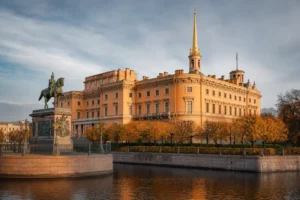 Saint Michael's Castle, Saint Petersburgabout 1.4 km away (~23 min walk) · typical visit: 1.5–2 hours
Main image: AI-generated illustration. It may not show the place exactly as it looks.
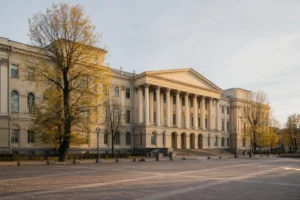 Russian Ethnographic Museum, Saint Petersburgabout 1.4 km away (~23 min walk) · typical visit: 2–3 hours
Main image: AI-generated illustration. It may not show the place exactly as it looks.
Metro stations near Dostoevskaya Metro Station, Saint Petersburg
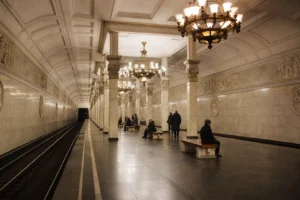 Vladimirskaya Metro Station, Saint Petersburgabout 150 m away (~2 min walk)
Main image: AI-generated illustration. It may not show the place exactly as it looks.
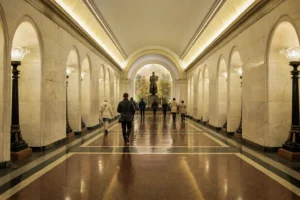 Pushkinskaya Metro Station, Saint Petersburgabout 1.2 km away (~20 min walk)
Main image: AI-generated illustration. It may not show the place exactly as it looks.
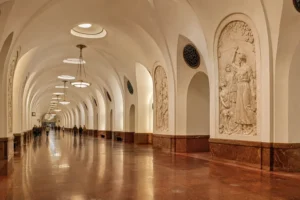 Ploshchad Vosstaniya Metro Station, Saint Petersburgabout 900 m away (~14 min walk)
Main image: AI-generated illustration. It may not show the place exactly as it looks.
Train stations and river piers near Dostoevskaya Metro Station, Saint Petersburg
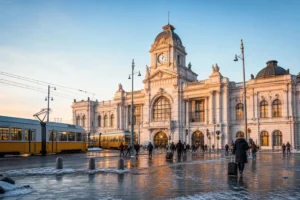 Moskovsky Railway Station, Saint Petersburgabout 900 m away (~15 min walk)
Main image: AI-generated illustration. It may not show the place exactly as it looks.
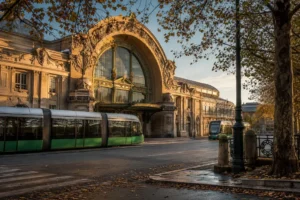 Vitebsky Railway Station, Saint Petersburgabout 1.2 km away (~20 min walk)
Main image: AI-generated illustration. It may not show the place exactly as it looks.
 Saint Petersburg Central Bus Stationabout 1.8 km away (~29 min walk)
Main image: AI-generated illustration. It may not show the place exactly as it looks.
Related guides
 Anichkov Bridge Pier, Saint Petersburg: Fontanka Boat Trips
Main image: AI-generated illustration. It may not show the place exactly as it looks.
 Palace Pier, Saint Petersburg: Boat Trips on the Neva
Main image: AI-generated illustration. It may not show the place exactly as it looks.
 Ploshchad Aleksandra Nevskogo Metro Station, Saint Petersburg: Guide
Main image: AI-generated illustration. It may not show the place exactly as it looks.
 Gostiny Dvor Metro Station, Saint Petersburg: Visitor Guide
Main image: AI-generated illustration. It may not show the place exactly as it looks.
 Nevsky Prospekt Metro Station, Saint Petersburg: Exits Guide
Main image: AI-generated illustration. It may not show the place exactly as it looks.
Browse more: More in Tsentralny District · All Metro Stations · All Saint Petersburg · All Sightseeing in Saint Petersburg
FAQ: Dostoevskaya Metro Station, Saint Petersburg
Who is Dostoevskaya named after?
The writer Fyodor Dostoevsky, who lived in this part of the city and used it as a setting for several novels. The station opened in the year of the 170th anniversary of his birth.
When did the station open?
On 30 December 1991, as part of the section between Ploshchad Aleksandra Nevskogo and Sadovaya.
How deep is Dostoevskaya?
About 62 metres below the surface, so the escalator ride is long.
Is there a transfer to another line?
Yes. Underground walkways lead to Vladimirskaya on Line 1. You change without paying again.
What is the hall decorated with?
A scheme in the style of illustrations for Dostoevsky's novels. Confirm the exact form of the panels on site.
Is the museum close to the station?
Yes. Dostoevsky's last apartment, now the writer's literary and memorial museum, is in Kuznechny Lane, across Vladimirskaya Square.
Why was the Delvig House mentioned?
In the 1980s it was due to be demolished for the station. In 1986 heritage defenders led by Dmitry Likhachev saved it, and the station was built around it.
Is it worth a special trip?
Yes, if you like literary places or want to see the museum and the market. Otherwise it is a quick stop on Line 4.
Russia Vibes is a one-person project. A coffee keeps it going
Last updated: October 16, 2026. Found an error or something out of date? Report it and we will check and fix it.
How we research and update our guides
About this guide: AI assistance and accuracy
This guide is created with the help of AI and is based on official sources where available. Mistakes can still happen. Opening hours, prices, rules and other details are given to the best of our knowledge as of the date shown and can change without notice. It offers general recommendations only, not professional, legal or travel advice. Please confirm important details with the official source before you travel; you are responsible for your own plans and decisions.
International sanctions affect payments between Russia and many other countries. In practice, cards issued in the EU, the UK, the US and several other countries often do not work in Russia, Russian cards usually do not work abroad, and some booking platforms, airlines and payment providers limit or suspend their services for Russia. The situation changes frequently. We do not give legal or financial advice, and this site does not encourage anyone to break or circumvent sanctions. Whatever you plan, you are responsible for following the laws and regulations that apply to you, including those of your country of residence and citizenship. Many travelers still organise their stay lawfully. It is worth asking your bank or payment provider what is currently permitted, contacting hotels, tour operators and carriers directly about the payment methods they accept, and checking which services are open to customers from your country. Clarify payment, cancellation and refund terms before you commit to a booking, and keep your plans flexible. Partner links on this site may not be available in every country, and prices, availability and rules in our guides can differ from what you see when you book.Paying for your trip: please read

Take this guide with you
Get a free PDF of this guide to print or read offline: key facts, tips and a map link on a few clean pages.