
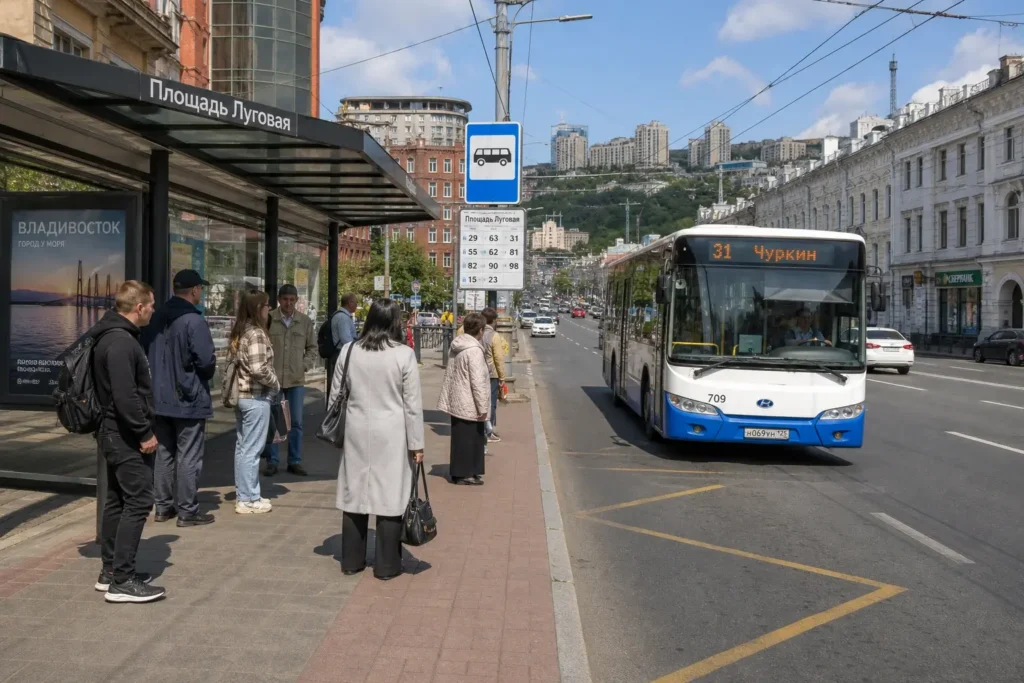
This guide is for international visitors who want to move around Vladivostok without renting a car or hailing a taxi for every journey. You will learn how to board buses and marshrutkas, how to pay, and what to expect during peak and off-peak hours.
How to use public transport in Vladivostok means understanding that the city relies almost entirely on buses and shared minibuses (marshrutkas), as most trams were removed decades ago. A single tram line still runs but carries tourists more than commuters. Buses are the recommended option: they are frequent, affordable and cover the city grid from early morning until late evening.
Quick answer: Board a bus from any marked stop, pay the driver in cash or with a card as you exit from the front door, or tap a Dolphin card if your bus accepts it. Downtown trips take 15–45 minutes depending on distance and traffic; expect crowding during rush hours (roughly 8–10am and 5–7pm).
At a Glance
| Total time | 15–45 minutes per journey depending on distance and traffic |
|---|---|
| Typical cost | ₽ |
What You Need Before You Start
- Cash in Russian rubles, or a Russian debit card (Visa and Mastercard issued outside Russia do not work)
- Know the bus or marshrutka route number (displayed on the vehicle and at stops)
- Understand basic Cyrillic letters to read route signs
- Have small-denomination notes if paying cash to the driver
- Check operating hours: most buses run 6am–11pm; fewer services after 10pm
Compare Your Options
| Option | Duration | Price | Notes |
|---|---|---|---|
| City bus (recommended) | 15–45 minutes downtown; up to 2 hours to outer suburbs | ₽ | Frequent (every 5–15 minutes on main routes during the day), reliable, and covers most neighborhoods. Downtown fares are flat; suburban routes cost more. Buses run 6am–11pm; after 10pm, service is sparse. Expect crowding during rush hours (8–10am, 5–7pm). |
| Marshrutka (shared minibus) | 10–30 minutes on main routes; flexible | ₽ | Faster and more flexible than buses—departs when full, and stops anywhere on request. Runs roughly 6am–10pm. Routes are displayed in Cyrillic and can be difficult to identify for non-Russian speakers. No electronic payment; cash only. Noisier and more crowded than buses. |
| Trolleybus | 20–45 minutes | ₽ | Quiet, electric, runs on fixed routes along main arteries. Operates early morning to about 10pm. Less crowded than buses and marshrutkas. Routes are limited, so not useful for all destinations. Fare similar to buses. Pay cash or card on board. |
| Tram (line 6 heritage service) | 30–45 minutes for the full line | ₽ | Only one line remains, running from Minnyy Gorodok to Sakhalinskaya. Infrequent service, mostly for tourists and heritage. Not practical for reaching most destinations quickly. Pay the driver on board. |
| Taxi or ride-hailing app | 10–30 minutes depending on traffic | ₽₽–₽₽₽ | Faster and more direct, but significantly more expensive than public transport. Apps like Yandex.Taxi, Uber, and Gett operate in Vladivostok. Drivers accept card payment via app. Useful for late nights (after 11pm when buses stop) or when carrying luggage. |
| Walking or cycling | Highly variable | Free | Vladivostok is hilly but compact in the center. The waterfront and downtown neighborhoods are walkable. Hills and weather can make cycling challenging. Useful for exploring historic streets and the harbor area without time pressure. |
₽ budget · ₽₽ moderate · ₽₽₽ upscale · ₽₽₽₽ splurge. Price levels are estimates compared with typical prices for visitors.
Step-by-Step Instructions
Step 1: Find a bus stop
Look for a small shelter or sign on the street showing a bus symbol and route numbers. Many stops in central Vladivostok display electronic signs with bus numbers and estimated arrival times. Stops are usually spaced every few blocks along main roads. Ask locals or check a transport map app (Busti or Yandex.Maps) to find the nearest stop for your route.
Tip: Downtown stops are more frequent and more clearly marked than suburban stops.
Step 2: Wait for your route
Buses in Vladivostok are frequent but do not run on a published timetable—they depart when they are full or at intervals. Check the electronic sign if available, or ask other passengers. During rush hours (morning 8–10am, evening 5–7pm), buses arrive every 5–15 minutes on main routes. Late evening and night service is sparse.
Tip: Keep small denominations of cash (50 or 100-ruble notes) ready to pay the driver.
Step 3: Board from the rear door
When your bus arrives, board from the back entrance. There is no ticket machine or turnstile. You enter, find a place to stand or sit, and prepare to pay on exit. During rush hours, buses are crowded; push toward the middle and hold the handles firmly.
Tip: Do not try to enter from the front door—that is exit only.
Step 4: Pay as you exit
When you reach your stop, move toward the front door. As you exit, hand cash to the driver or tap your payment card on the terminal near the driver's seat. If paying cash, announce your destination or hold up the amount; the driver will confirm the fare. If paying by card, tap for 2–3 seconds until you hear two beeps.
Tip: The driver expects you to have the correct amount or small change. Large notes may not be welcomed during busy times.
Step 5: Request your stop
Tell the driver your destination or the name of the street as you board, or press the stop-request button if available (usually a bell or button on the wall). Not all buses have electronic stop displays. Many drivers stop on request even if no button is pressed—look alert and make eye contact if you are near the front.
Tip: If you miss your stop, you can ask the driver to let you off; fare remains the same regardless of exactly where you exit.
Step 6: Use the Dolphin card for frequent trips (optional)
Some municipal buses accept a refillable Dolphin smart card issued by a local bank. Cards can be bought and topped up at automated kiosks at major bus stops and metro stations. To pay, tap the card on the terminal near the driver for 2–3 seconds. The card also works as a debit card in some shops. This saves time if you make several trips in one day.
Tip: The Dolphin card is optional. Cash is always accepted and more convenient for one-off trips.
Step 7: Consider marshrutkas for speed
If a bus route is crowded or delayed, marshrutkas (small shared minibuses seating 12–20 people) offer an alternative. They follow fixed routes but may stop anywhere on request. Board from the side or rear, pay the driver before departure or as you board, and request your stop by tapping on the ceiling or telling the driver. Marshrutkas run from roughly 6am to 10pm.
Tip: Marshrutkas are faster than buses but noisier and more crowded. Routes are displayed in Cyrillic only; ask locals for help if unsure.
Step 8: Use the remaining tram line for tourism or curiosity
Only one tram line (line 6, roughly 5.5 km) operates, running from Minnyy Gorodok to Sakhalinskaya on reserved track. Trams are rare and mostly run for heritage rather than practical transport. Board at marked tram stops, pay the driver as you board, and disembark at your requested stop. Tram service is infrequent compared to buses.
Tip: The tram is a curiosity and photo opportunity rather than a practical way to cross the city; take a bus or taxi if you need to reach a destination quickly.
Common Mistakes to Avoid
- Trying to enter from the front door: buses board from the rear and exit from the front. Drivers will stop you if you try to use the wrong door.
- Not having small cash denominations ready: drivers often carry little change, especially during rush hours. Have 50 or 100-ruble notes ready, or use a card.
- Expecting a published timetable: buses do not follow a strict schedule. They depart based on fullness and intervals. Check the electronic sign at stops in central areas, or be prepared to wait.
- Using foreign Visa or Mastercard: these do not work in Russia. Bring cash, use a Russian bank card if you have one, or use the Dolphin card.
- Boarding marshrutkas without knowing the route: marshrutka routes are displayed in Cyrillic only. Ask locals or use a transport map app before boarding.
- Trying to use the tram for practical transport: the single remaining tram line is infrequent and heritage-focused. Use a bus or marshrutka to reach your destination reliably.
Tickets, Payment and Booking
Tickets are bought on board, not in advance.
Payment methods:
- Cash in Russian rubles (preferred; have small notes ready)
- Russian debit cards (Visa and Mastercard issued outside Russia do not work)
- Dolphin smart card (refillable, sold and topped up at automated kiosks at major stops and transit hubs)
Where to buy a transport card: Automated kiosks are located at main bus stops, metro stations, and transit hubs. You can purchase and reload the Dolphin card using Russian cash or a Russian bank card. The card also doubles as a debit card in selected shops.
Warnings: Do not rely on ticket resellers or unofficial vendors. All fares should be paid directly to the driver or via official payment terminals. If a vendor approaches you at a stop offering tickets, politely decline.
Helpful Links
Compare hotel pricesSearch flights
Advertisement: these are partner links. If you book or buy through them, we may earn a commission at no extra cost to you.
Russia Vibes Tips
- Download the Busti or Yandex.Maps app before your trip. Both show real-time bus locations, route numbers, stops, and estimated arrival times using GPS. Yandex.Maps works offline if you download the map of Vladivostok in advance.
- Avoid traveling during rush hours (8–10am and 5–7pm on weekdays) if possible. Buses are extremely crowded, pickpocketing increases, and journeys take longer. If you must travel then, keep valuables secure and stand away from the doors.
- Late-night buses (after 10–11pm) are rare. If you are out after 10pm, use a taxi app (Yandex.Taxi or Uber) rather than waiting for a bus that may not arrive. The fare will be higher but more reliable.
- The city is very hilly. Bus routes may require transfers to reach higher neighborhoods. Plan extra time and ask the driver or other passengers if you need to change buses. Most central attractions are accessible without transfers.
- Buses and marshrutkas are extremely crowded during their first and last runs of the day (roughly 6–7am and 10–11pm). Avoid these times unless necessary, as you may not find a seat and may have difficulty exiting.
Explore Nearby How to Use Public Transport in Vladivostok, Vladivostok
Browse more: All How-To · All How-To in Vladivostok · All Metro and Trains · All Vladivostok
FAQ
Can I use my foreign credit card on Vladivostok buses?
No. Foreign Visa and Mastercard cards do not work in Russia. Bring Russian rubles in cash, get a Russian bank card or MIR card before your trip, or purchase a Dolphin smart card at a kiosk. You can also use cash at ATMs to withdraw rubles.
What time do buses start and stop running?
City buses run roughly 6am to 11pm. Marshrutkas run 6am to 10pm. Trolleybuses run early morning to about 10pm. After 11pm, buses are rare or nonexistent. Use a taxi app for late-night travel.
How much does a bus ticket cost?
Downtown bus fare is flat and budget-level. Suburban routes cost slightly more. Marshrutka fares are similar to buses or slightly higher. Trolleybus fares are comparable to buses. Exact prices change; ask the driver or check a local transport website for current rates.
Do I need to buy a ticket in advance?
No. All tickets are bought on board. You pay the driver as you exit the bus (by cash or card) or as you board a marshrutka. There are no advance tickets or passes for single trips.
Is the tram still operating in Vladivostok?
Only one tram line remains (line 6), running from Minnyy Gorodok to Sakhalinskaya. Service is infrequent and mainly for heritage value. Most trams closed by 2010. Use buses or marshrutkas for practical transport across the city.
Are buses and marshrutkas crowded during the day?
Yes, especially during rush hours (8–10am and 5–7pm on weekdays). Buses and marshrutkas are extremely crowded at these times. Travel is slower, and pickpocketing increases. Travel outside rush hours if possible, or use a taxi app.
Can I bring luggage on buses and marshrutkas?
Yes, but space is limited, especially during rush hours. Small bags and backpacks fit easily. Large suitcases may not fit comfortably and take up seat space; consider a taxi if traveling with heavy luggage.
What is a marshrutka, and how is it different from a bus?
A marshrutka is a small shared minibus (12–20 seats) that runs on fixed routes but stops anywhere on request. It departs when full rather than on a schedule. Marshrutkas are faster than buses but noisier, more crowded, and only accept cash. Routes are displayed in Cyrillic, making them challenging for non-Russian speakers.
Russia Vibes is a one-person project. A coffee keeps it going
How we research and update our guides
About this guide: AI assistance and accuracy
This guide is created with the help of AI and is based on official sources where available. Mistakes can still happen. Opening hours, prices, rules and other details are given to the best of our knowledge as of the date shown and can change without notice. It offers general recommendations only, not professional, legal or travel advice. Please confirm important details with the official source before you travel; you are responsible for your own plans and decisions.

Take this guide with you
Get a free PDF of this guide to print or read offline: key facts, tips and a map link on a few clean pages.
Report an issue on this page
Paying for your trip: please read
International sanctions affect payments between Russia and many other countries. In practice, cards issued in the EU, the UK, the US and several other countries often do not work in Russia, Russian cards usually do not work abroad, and some booking platforms, airlines and payment providers limit or suspend their services for Russia. The situation changes frequently.
We do not give legal or financial advice, and this site does not encourage anyone to break or circumvent sanctions. Whatever you plan, you are responsible for following the laws and regulations that apply to you, including those of your country of residence and citizenship.
Many travelers still organise their stay lawfully. It is worth asking your bank or payment provider what is currently permitted, contacting hotels, tour operators and carriers directly about the payment methods they accept, and checking which services are open to customers from your country. Clarify payment, cancellation and refund terms before you commit to a booking, and keep your plans flexible.
Partner links on this site may not be available in every country, and prices, availability and rules in our guides can differ from what you see when you book.