
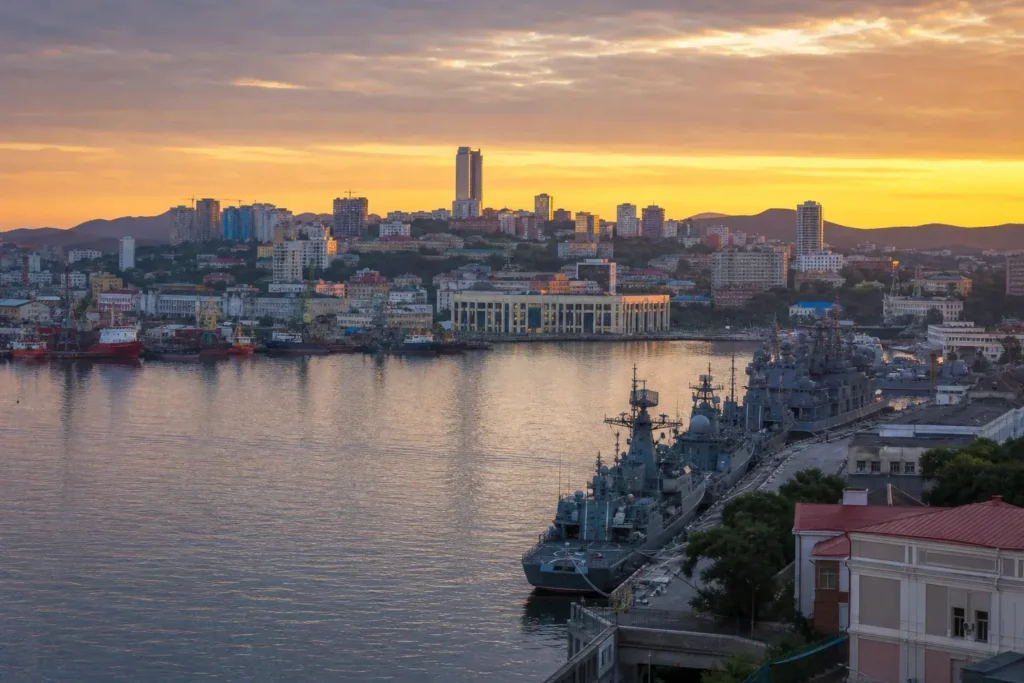
If you’re planning to visit Vladivostok, Russia’s Far East port city, you’ll need to obtain the right visa before entering the country. Your visa options depend on your nationality: citizens of 64 countries can apply for the quick electronic visa online, while citizens of the United States, United Kingdom, Canada, Australia and New Zealand must apply for a traditional visa through a Russian consulate. This guide explains how to get a visa for Vladivostok and help you understand which type applies to you.
Vladivostok follows Russia’s general visa and entry requirements. Whether you arrive by plane, ferry or train, the same visa rules apply as anywhere else in the country.
Current access notice: As of October 2026: eVisa is available to citizens of 64 countries with a permitted stay of up to 30 days. Traditional visas continue to be issued by Russian consulates worldwide. Visa requirements and eligible countries may change. Consult the official Ministry of Foreign Affairs website (kdmid.ru) before applying, as rules may vary by nationality and update without notice.
Quick answer: Your visa route depends on your nationality. For eligible countries: apply online for the electronic visa at evisa.kdmid.ru (4–5 days, requires passport, photo, and medical insurance). For US, UK, Canadian, Australian and New Zealand citizens: apply for a traditional visa at a Russian consulate (7–10+ working days, requires invitation letter). Both allow stays of up to 30 days.
At a Glance
| Total time | 4–5 days (electronic visa) or 7–10+ working days (traditional visa through consulate) |
|---|---|
| Typical cost | ₽ (electronic visa) to ₽₽ (traditional visa with consular fees) |
What You Need Before You Start
- Valid machine-readable passport with at least 6 months validity and 2 blank pages
- Recent passport-style digital photo (for eVisa) or printed photos (for traditional visa)
- Travel medical insurance valid in Russia for your entire stay
- For traditional visa: invitation letter (visa voucher) from a Russian tour operator or hotel
- For traditional visa: completed application form printed from the official Ministry of Foreign Affairs website
Compare Your Options
| Option | Duration | Price | Notes |
|---|---|---|---|
| Electronic visa (eVisa) – recommended if eligible | 4–5 days processing | ₽ | Available to citizens of 64 countries. Fully online application. No invitation required. Valid for stay up to 30 days. Fastest option. |
| Traditional tourist visa through consulate | 7–10+ working days (varies by location) | ₽₽ | Required for US, UK, Canadian, Australian, New Zealand citizens. Requires invitation letter and more documentation. Applied in person or by mail at your local consulate. |
| Visa processing service | 5–15 days depending on service | ₽₽₽ | Private agencies handle the traditional visa application on your behalf. Adds cost but simplifies the process for those unfamiliar with consulate procedures. Useful for complex cases or if you cannot visit the consulate in person. |
| Visa-free entry (for eligible nationalities) | Immediate on arrival | Free | Citizens of over 60 countries can enter Russia without a visa. Requires online ruID app registration 3 days before arrival. Stay limited to 30 days. Not available to most Western passport holders. |
₽ budget · ₽₽ moderate · ₽₽₽ upscale · ₽₽₽₽ splurge. Price levels are estimates compared with typical prices for visitors.
Step-by-Step Instructions
Step 1: Check your nationality eligibility
Not all nationalities can use the electronic visa. Citizens of the United States, United Kingdom, Canada, Australia and New Zealand are not eligible for the eVisa and must use the traditional visa route. Citizens of 64 other countries, including EU member states, China, India, Japan, Mexico, Saudi Arabia and Turkey, can apply online. Check the official Ministry of Foreign Affairs website to confirm your country is listed.
Tip: If you have dual nationality and hold an eligible passport (such as an EU passport), you can apply using that passport for the eVisa.
Step 2: For eVisa applicants: gather required documents
You need only three items: a machine-readable passport valid for at least 6 months with space for entry stamps, a recent passport-style digital photo in JPEG format (full-face, clear quality, colour), and travel medical insurance that covers the entire territory of Russia for your entire stay. Unlike traditional visas, you do not need an invitation letter, hotel booking or flight tickets.
Tip: Medical insurance is mandatory—some insurance policies require explicit confirmation they cover Russia. Check your policy details before applying.
Step 3: For eVisa applicants: apply on the official portal
Go to evisa.kdmid.ru, the only official portal for electronic visa applications. Register to create a personal account, then fill out the application form. You can complete it in English or Russian (select the language in the upper right corner). Do not change the language while filling the form. Submit your passport photo and insurance information when prompted. Complete and submit your application 4 to 86 days before your planned arrival in Russia. Do not submit within 4 days of entry.
Tip: Save your application ID and password—you'll need them to track your status on the portal.
Step 4: For eVisa applicants: await approval
The application is typically processed within 4 calendar days. Once approved, your eVisa is valid for 120 days from the issue date, but you can only enter Russia once within that period. Your permitted stay is up to 30 calendar days from your date of entry. Print a copy of your approved eVisa notification—you must present it at border control in Vladivostok.
Tip: Your eVisa is not a physical stamp in your passport; it's an electronic document you must carry printed or on your phone.
Step 5: For traditional visa applicants: obtain an invitation letter
If you're from the US, UK, Canada, Australia or New Zealand, you must first obtain a Russian visa invitation (also called a visa voucher or visa support letter) from a licensed Russian tour operator or hotel. This is a mandatory document for your consulate application. Order it online from authorised services and have it sent to you—it typically arrives within 1–2 business days. Keep this letter; you'll include it with your visa application.
Tip: Do not confuse the invitation letter with a hotel booking confirmation. The invitation is a specific official document issued by Russian tour operators and hotels.
Step 6: For traditional visa applicants: complete the online application form
Visit visa.kdmid.ru (the official Russian Foreign Ministry visa portal), register, and complete the detailed visa application form online. Print the completed form with your application password. The form asks for personal details, passport information, travel dates, purpose of visit and address in Russia. Choose your country and the appropriate Russian consulate jurisdiction for your country of residence.
Tip: The online form is lengthy and detailed. Allow 45 minutes to an hour to complete it carefully. Save a copy for your records.
Step 7: For traditional visa applicants: book a consulate appointment and submit documents
Find the Russian consulate or visa center serving your country (listed on the Ministry of Foreign Affairs website). Make an appointment online before submitting documents. Prepare: original passport, printed visa application form, invitation letter, 1–2 passport-size photos (3.5 × 4.5 cm), travel medical insurance, and consular fee. Submit all documents to the consulate on your appointment date. Some locations accept applications by mail or through visa processing services.
Tip: Processing time varies by location. EU consulates often process in 7–10 working days; other locations may take longer. Ask the consulate for their current processing time when booking.
Step 8: For traditional visa applicants: receive your visa
Once approved, your visa will be stamped into your passport. The consulate will notify you when it's ready for collection or will mail it to you. Your tourist visa is typically valid for 30 days of stay. Check the visa carefully for accuracy of dates and spelling before leaving the consulate.
Tip: Your visa is valid from the issue date, not your travel date. Some visas have 'from–to' dates; you must enter Russia on or before the 'to' date.
Step 9: At Vladivostok border control: present your visa
On arrival at Vladivostok International Airport, the ferry terminal or railway station, proceed to border control. Present your passport and visa (either printed eVisa or passport with traditional visa stamp). Have your medical insurance certificate ready to show if requested. Border officials may ask questions about the purpose of your visit. Answer briefly and honestly.
Tip: Border queues can be long at airports, especially in summer. Allow extra time at the airport before your domestic flight if you're connecting to another Russian city.
Step 10: Register your accommodation within 7 days
After entering Russia, you are required to register your place of stay within 7 calendar days (not counting weekends and public holidays). Hotels and most rental accommodations handle this automatically when you check in. If you're staying with friends or in a private apartment without a host registration service, you must register at the local Ministry of Interior office. Failure to register within the deadline may result in fines.
Tip: Ask your hotel or host for confirmation that registration has been completed. Keep the registration document; you may need it when leaving Russia.
Common Mistakes to Avoid
- Assuming that entry requirements for Vladivostok differ from those applying to Russia generally. It does not—the same visa rules apply as anywhere else in Russia. The Free Port of Vladivostok's early eVisa system has been replaced by the unified eVisa for the whole country.
- Confusing eVisa eligibility with general Russian entry rules. Many countries exempt citizens from visas for short stays, but these countries may not be on the 64-country eVisa list. Check the official eVisa portal to confirm your country's eligibility for electronic application.
- Waiting too long to apply. The eVisa cannot be applied for fewer than 4 days before your planned entry date. Submit at least one week in advance to avoid missing your flight due to processing delays.
- Applying at third-party websites. Only evisa.kdmid.ru (for eVisa) and visa.kdmid.ru (for traditional visa application forms) are official. Fraudulent sites may steal your information or process invalid applications.
- Forgetting medical insurance. It is mandatory for both eVisa and traditional visa holders entering Russia. Arriving without insurance or with insurance that does not cover Russia may result in denial of entry.
- Submitting an expired or damaged passport. Your passport must be machine-readable, valid for at least 6 months from application date, and have at least 2 blank pages. A damaged machine-readable zone will result in automatic rejection.
Tickets, Payment and Booking
Electronic Visa (eVisa): Apply exclusively on the official portal evisa.kdmid.ru. No agency or intermediary is required. Complete the application in English or Russian, upload your digital photo and insurance details, and pay the fee online with any international card. Foreign Visa and Mastercard cards do not work in Russia, but many e-payment systems accept them for online payments to Russian government portals. Check your card issuer’s restrictions.
Traditional Visa: Submit your application through the Russian consulate or visa center in your country. Complete the application on visa.kdmid.ru, print it, and deliver it in person or by mail with your invitation letter and supporting documents. Do not use third-party websites claiming to process visas online; these are not official.
Invitation Letters: Order from licensed Russian tour operators or hotels. Many operate online and send invitations by email within 1–2 days. Verify the provider is authorised by the Russian Ministry of Foreign Affairs before paying.
Medical Insurance: Book before applying. Purchase travel insurance that explicitly covers Russia and medical emergencies for the duration of your stay. Present a certificate or policy document with your visa application or print your eVisa approval.
Helpful Links
Compare hotel pricesSearch flights
Advertisement: these are partner links. If you book or buy through them, we may earn a commission at no extra cost to you.
Russia Vibes Tips
- Check your passport validity now. If your passport expires within 6 months of your intended Vladivostok trip, renew it before applying for a visa. A visa application will be rejected if your passport does not meet the 6-month rule.
- The eVisa allows you to enter Russia only once within its 120-day validity period. If you plan to leave Russia and return, you must apply for a new eVisa for your second entry—a single eVisa cannot be used twice.
- Your eVisa stay of 30 days is calendar days, not 24-hour periods. If you enter on September 1 and leave on September 30, that is 30 calendar days and your maximum permitted stay.
- Ferry arrivals in Vladivostok from South Korea (Donghae, Sokcho) accept eVisas. However, always confirm with the ferry operator before booking that your visa type is accepted, as policies may change.
- Do not assume your home country's consulate will process your visa in time for your trip. Contact the consulate first to confirm current processing times. Summer months can have longer delays.
- Print a copy of your eVisa or carry it on your phone. The border guard at Vladivostok will ask to see it. Showing only the reference number is not sufficient; you must show the complete approval document with your photo and details.
Explore Nearby How to Get a Visa for Vladivostok, Vladivostok
Browse more: All How-To · All How-To in Vladivostok · All Other · All Vladivostok
FAQ
Can I enter Vladivostok without a visa?
No, with few exceptions. Most foreign nationals require either an eVisa or a traditional visa. Citizens of approximately 60 countries exempt from Russian visa requirements do not need a visa, but they must still register via the ruID app 3 days before arrival. Check the official list on the Ministry of Foreign Affairs website to confirm if your country is visa-exempt.
How long does it take to get a visa for Vladivostok?
For the eVisa: 4–5 calendar days. For a traditional visa through a consulate: 7–10 working days on average, but some consulates take longer. Always allow extra time and apply well in advance of your trip. Do not rely on expedited services, which are expensive and not always available.
What if my country is not on the eVisa list?
Apply for a traditional tourist visa through the Russian consulate or visa center in your country. You will need an invitation letter, passport, photos, medical insurance and the completed online application form. The process takes longer than eVisa but is available to all nationalities.
Do I need travel insurance to enter Vladivostok?
Yes. Travel medical insurance valid in Russia for your entire stay is mandatory for all foreign visitors on both eVisa and traditional visa. Present a copy or certificate at the border if requested. Some insurance policies exclude Russia; verify your coverage before purchasing.
Can I extend my visa while in Vladivostok?
Visa extensions are complex and rarely approved for tourists. Plan your stay within your original visa validity. If you need to stay longer, consult the local Ministry of Interior office in Vladivostok (UFMS) before your visa expires, but do not rely on an extension being granted.
What happens if my visa application is rejected?
For eVisa, rejections are rare if you meet the requirements. If rejected, log in to your account to see the reason. You may reapply. For traditional visas, the consulate will notify you of the reason. You can correct documents and reapply, though some grounds for refusal (e.g. criminal record) are not appealable.
Is the invitation letter the same as a hotel booking?
No. An invitation letter is an official document issued by a Russian tour operator or hotel specifically to support your visa application. A hotel booking is a reservation confirmation. You need the invitation letter for the consulate application; the booking is separate and helps plan your stay.
Can I travel to other Russian cities with a Vladivostok visa?
Yes. Whether you obtain your visa for Vladivostok or any other entry point, it is valid for travel throughout Russia during the permitted stay. There are no regional restrictions inside Russia—you can move freely between cities without additional visas.
Russia Vibes is a one-person project. A coffee keeps it going
Not legal advice. This is general information for visitors. Rules on visas, entry, registration, customs and similar matters change often and can depend on your nationality. Check the official source and, if in doubt, ask your embassy or a qualified adviser.
How we research and update our guides
About this guide: AI assistance and accuracy
This guide is created with the help of AI and is based on official sources where available. Mistakes can still happen. Opening hours, prices, rules and other details are given to the best of our knowledge as of the date shown and can change without notice. It offers general recommendations only, not professional, legal or travel advice. Please confirm important details with the official source before you travel; you are responsible for your own plans and decisions.

Take this guide with you
Get a free PDF of this guide to print or read offline: key facts, tips and a map link on a few clean pages.
Report an issue on this page
Paying for your trip: please read
International sanctions affect payments between Russia and many other countries. In practice, cards issued in the EU, the UK, the US and several other countries often do not work in Russia, Russian cards usually do not work abroad, and some booking platforms, airlines and payment providers limit or suspend their services for Russia. The situation changes frequently.
We do not give legal or financial advice, and this site does not encourage anyone to break or circumvent sanctions. Whatever you plan, you are responsible for following the laws and regulations that apply to you, including those of your country of residence and citizenship.
Many travelers still organise their stay lawfully. It is worth asking your bank or payment provider what is currently permitted, contacting hotels, tour operators and carriers directly about the payment methods they accept, and checking which services are open to customers from your country. Clarify payment, cancellation and refund terms before you commit to a booking, and keep your plans flexible.
Partner links on this site may not be available in every country, and prices, availability and rules in our guides can differ from what you see when you book.