
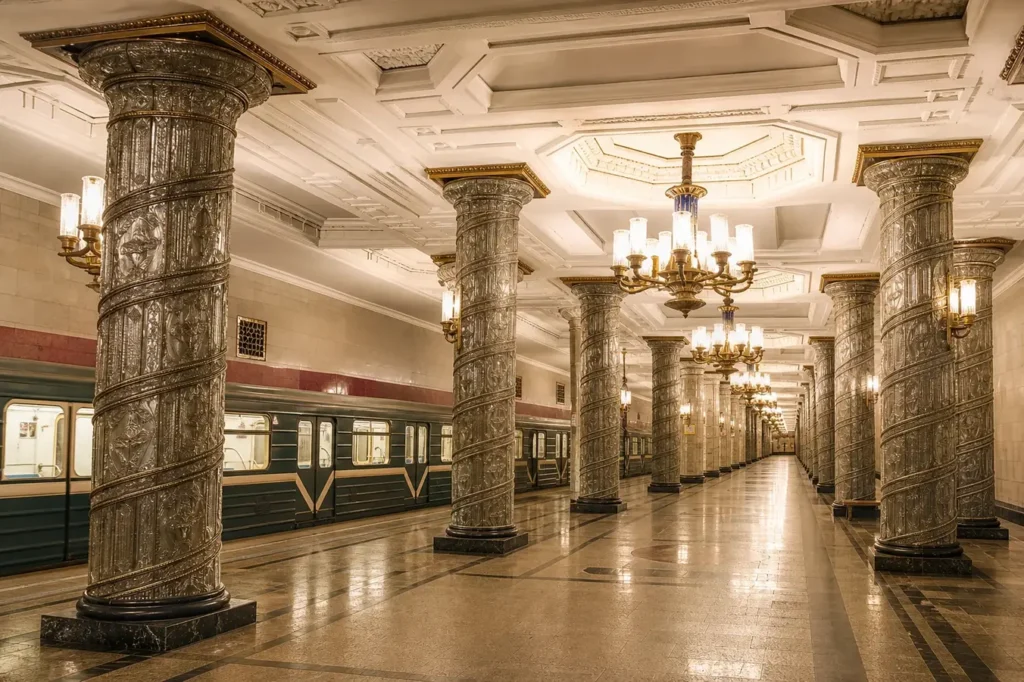
How to Use the Metro, Saint Petersburg is a practical guide for first-time visitors exploring Russia’s northern capital. The underground railway connects the historic centre with residential neighbourhoods, railway terminals, museums and districts across the Neva River. Its colourful lines are straightforward to navigate once you understand the station names, train directions and interchange passages.
Start with the official metro map, find the nearest entrance and follow the line towards the correct terminal station. Most journeys require only a few simple decisions. Around Nevsky Prospekt in the central Tsentralny District, several lines meet beneath busy streets, while stations such as Avtovo reveal the decorative architecture of the original Leningrad Metro, which opened in 1955. This guide explains each stage, from the entrance to the final street exit.
Current access notice: As of October 2026, Park Pobedy and Frunzenskaya stations on Line 2 are closed for reconstruction. Trains continue along the line, but passengers cannot board or leave at these stations. Check the Saint Petersburg Metro's official station repair information before travelling.
Ploshchad Aleksandra Nevskogo 1 has restricted weekday entrance access from 17:50 to 19:00 until 11 December 2026. Chkalovskaya has a comparable weekday entrance restriction until 16 December 2026. These restrictions concern station access rather than a complete suspension of train service. Other vestibules may operate on different schedules.
Quick answer: Find your station on the official map, enter through the turnstiles, follow the correct line and terminal direction, and change trains inside the network if needed. Allow 15–35 minutes for a typical central journey. Cost: ₽.
At a Glance
| Total time | 15–35 minutes for a typical central journey |
|---|---|
| Typical cost | ₽ |
| Last updated | October 17, 2026 |
What You Need Before You Start
- Your destination and its nearest metro station
- An up-to-date Saint Petersburg Metro map
- A suitable metro ticket or accepted payment method
- An offline city map showing station entrances
- Enough time for escalators and interchange passages
- An accessible-route plan if travelling with mobility limitations
- Knowledge of your destination station's exit and closing time
Compare Your Options
| Option | Duration | Price | Notes |
|---|---|---|---|
| Direct metro journey — recommended | Approximately 10–25 minutes for many central routes | ₽ | Best when the departure and destination stations share a line. Identify the correct terminal direction and remain on the same train. Trains run frequently during the day, with service typically beginning around early morning and continuing until after midnight at many stations. Exact first and last departures vary by station and direction. The operator publishes the individual station schedules, updated as of October 2026. |
| Metro journey with one interchange | Approximately 15–35 minutes | ₽ | Useful for reaching destinations on another line without leaving the underground network. Central connections include Nevsky Prospekt–Gostiny Dvor, Mayakovskaya–Ploshchad Vosstaniya and the interconnected Sennaya Ploshchad–Sadovaya–Spasskaya stations. Some interchanges have long passages and escalators. The operator states that transfers between lines close at 00:15 under the standard timetable. |
| Metro combined with a city bus, tram or trolleybus | Approximately 25–55 minutes, depending on the route | ₽ | Helpful when the closest metro station is still some distance from a hotel, museum or residential address. The metro covers the main part of the journey and surface transport completes the final section. Service frequency and operating hours vary by route. Check the official Saint Petersburg city transport information before choosing a connection, particularly when travelling outside the central districts or later in the evening. |
| Short central walk instead of an additional metro segment | Approximately 10–25 minutes on foot | ₽ | Often convenient for neighbouring destinations in the historic centre, especially between Nevsky Prospekt, Kazan Cathedral, the Griboyedov Canal and the Admiralty area. Walking avoids another deep escalator journey and makes it easier to appreciate the city at street level. Distance and weather matter: a short-looking journey on the schematic metro map may involve a longer walk than expected. |
| Assisted journey for passengers with reduced mobility | Varies by stations, transfer complexity and assistance requirements | ₽ | Saint Petersburg Metro operates a dedicated passenger mobility assistance service. Staff can help wheelchair users, passengers with visual or hearing impairments and eligible passengers travelling with prams. The service operates during metro opening hours, with specialist lifting equipment for suitable routes. Arrange assistance through the operator before travelling where possible. Independent step-free travel is not available through every station entrance or transfer. |
₽ budget · ₽₽ moderate · ₽₽₽ upscale · ₽₽₽₽ splurge. Price levels are estimates compared with typical prices for visitors.
Step-by-Step Instructions
Step 1: 1. Find the nearest metro entrance
Begin by locating your departure station on the official Saint Petersburg Metro map. In central Saint Petersburg, entrances may appear as freestanding buildings, doors within larger buildings or stairways leading beneath the pavement. Around Nevsky Prospekt, several entrances serve interconnected stations. Look for the metro symbol and confirm the station name before entering. If you are starting near Kazan Cathedral, Nevsky Prospekt is a convenient station; other central landmarks may be closer to Admiralteyskaya or Gostiny Dvor.
Tip: Check the actual entrance location on a street map, not just the station symbol on the simplified metro diagram.
Step 2: 2. Plan your line and direction
Find your destination station and identify its numbered, colour-coded line. The network has six lines as of October 2026: red, blue, green, orange, purple and brown. Each train direction is identified by the terminal station at that end of the line. For example, from Nevsky Prospekt on the blue Line 2, Parnas indicates northbound trains and Kupchino indicates southbound trains. Check whether your journey stays on one line or needs an interchange.
Tip: Write down the terminal station name as well as your destination. It is the quickest way to confirm your platform direction.
Step 3: 3. Enter the station and complete the entrance checks
Inside the entrance hall, follow the route towards the turnstiles. Metro entrances have security screening arrangements, including metal-detector areas, and staff may ask passengers to present belongings for inspection. Large bags may require additional attention. Keep moving through the entrance when directed, and follow staff instructions. Ordinary personal photography without flash is distinct from professional filming, which requires permission under the operator's rules. Drones and certain dangerous items are prohibited inside the network.
Tip: Keep your bag organised so that any requested inspection can be completed without unpacking everything.
Step 4: 4. Pass through the turnstiles
After arranging your fare using one of the official methods explained in the booking information section, approach a suitable entrance turnstile. Present your travel medium to the reader or insert the token into the designated slot, depending on the equipment. Wait for the gate to indicate permission to pass and move through promptly. If the gate rejects your travel medium, do not force it. Ask the station attendant for assistance, especially if you are unfamiliar with the reader.
Tip: Watch which gates other passengers are using for the same type of travel medium, as not every gate necessarily has identical equipment.
Step 5: 5. Descend to the platform
Follow the signs towards your line and platform. Many Saint Petersburg stations lie deep underground, so the descent on the escalator can feel considerably longer than in smaller metro systems. The operator's passenger guidance recommends standing on the right, facing forward and holding the handrail. Keep wheeled luggage steady and clear of the moving edges. At the bottom, walk away from the escalator promptly and follow the arrows towards the trains rather than stopping in the narrow exit area.
Tip: Allow a few extra minutes at deep stations even when the train journey itself looks very short.
Step 6: 6. Check the train's final destination
Before boarding, read the platform direction information and compare it with the terminal station you identified on the map. At Nevsky Prospekt, for example, trains towards Parnas travel north through Gorkovskaya and Petrogradskaya, while trains towards Kupchino travel south through Sennaya Ploshchad. Station signs and diagrams identify the stops along each route. Wait behind the platform safety markings until the train has stopped. Allow passengers to exit before boarding, then move away from the doors.
Tip: If uncertain, count the remaining stations on the platform diagram before stepping aboard.
Step 7: 7. Change lines without leaving the metro
If your journey requires another line, leave the train at the designated interchange and follow the signs towards the connecting station. Some interconnected stations have different names. For example, Nevsky Prospekt on Line 2 connects with Gostiny Dvor on Line 3. To travel from Nevsky Prospekt towards Vasileostrovskaya, follow the passage to Gostiny Dvor and board a green-line train towards Begovaya. You reach Vasileostrovskaya after one stop. Stay within the signed interchange passages throughout.
Tip: At complex junctions, follow the coloured line number as well as the station name to avoid heading towards a street exit.
Step 8: 8. Leave through the correct street exit
When your destination station is announced, move towards the doors and exit onto the platform. Follow the signs for the street or landmark nearest your destination. Large interchange stations may have several vestibules opening onto different roads or parts of an avenue. At Ploshchad Vosstaniya, for example, one exit serves Moskovsky Railway Station while another leads towards Vosstaniya Street. At street level, check your map before setting off, particularly if you have emerged on the opposite side of a busy road.
Tip: Save the street-exit name in advance when travelling to a railway station, theatre or accommodation with a specific entrance.
Common Mistakes to Avoid
- Confusing similarly named interchange stations. Nevsky Prospekt and Gostiny Dvor are connected underground but belong to different lines. Follow interchange signs rather than looking for both names on the same platform.
- Choosing a train by line colour without checking the terminal direction. Every line serves two directions, and boarding the wrong train can take you several stops away from your destination.
- Assuming the entire network closes at one fixed time. Station entrance hours, final train departures and interchange closing times can differ significantly.
- Using an outdated map that omits Line 6. The brown line opened with Putilovskaya and Yugo-Zapadnaya in December 2025, so older diagrams may not show these stations.
- Leaving an interchange station by the first visible exit. Returning to the underground network can create an unnecessary new journey when the intended connecting line was accessible through an internal passage.
- Assuming every metro entrance has a lift. Deep escalators, stairways and passages make some stations difficult to use independently with wheelchairs or heavy equipment.
- Treating all luggage as ordinary hand baggage. The operator has size limits for free carriage, additional arrangements for larger permitted items and restrictions on oversized objects.
Tickets, Payment and Booking
Buying tickets: As of October 2026, the Saint Petersburg Metro offers single-journey tokens, the rechargeable Podorozhnik transport card, eligible travel passes and payment through supported contactless bank cards. Tokens and transport products can be obtained through official metro ticket offices and supported machines. Podorozhnik is useful for repeated journeys and can also support travel on participating surface transport services.
Other tickets: The operator lists combined metro-and-surface travel products, including day-based and 90-minute options. Check the conditions of each product, because their validity and re-entry rules differ. A normal metro journey permits travel and internal transfers without leaving the paid network.
International visitors: The British Foreign, Commonwealth & Development Office confirms that Visa and Mastercard cards issued outside Russia do not work at Russian merchants. Arrange a lawful, usable payment method beforehand. Sanctions affecting Russian financial services vary by jurisdiction; check your own country’s rules. Avoid unofficial ticket resellers.
Helpful Links
Compare hotel pricesSearch flights
Advertisement: these are partner links. If you book or buy through them, we may earn a commission at no extra cost to you.
Russia Vibes Tips
- Try to avoid the busiest commuter periods if you are travelling primarily to admire station architecture. The central interchange passages are more comfortable outside the morning and evening rush.
- For a quick introduction to the original Leningrad Metro, visit Avtovo on the red line. Its decorated columns and spacious underground hall reveal the architectural ambitions of the system that opened in 1955.
- At Tekhnologichesky Institut, examine the platform signs carefully. The interchange between the red and blue lines has a different arrangement from a conventional passage between two distant platforms.
- For the State Hermitage Museum and Palace Square, Admiralteyskaya may be a more convenient final station than Nevsky Prospekt. Check the street-level walking route rather than choosing the most familiar central station name.
- Saint Petersburg's metro map is schematic, not geographically proportional. Two nearby-looking stations can be separated by a river, long streets or a considerable walk. Use a street map for the final portion of a journey.
- For an architecture-focused ride, combine Avtovo, Narvskaya and Ploshchad Vosstaniya along Line 1. These stations provide a practical introduction to the early system without requiring a complicated series of interchanges.
Explore Nearby How to Use the Metro, Saint Petersburg
Metro stations near How to Use the Metro, Saint Petersburg
 Nevsky Prospekt Metro Station, Saint Petersburg
Main image: AI-generated illustration. It may not show the place exactly as it looks.
 Gostiny Dvor Metro Station, Saint Petersburg
Main image: AI-generated illustration. It may not show the place exactly as it looks.
 Admiralteyskaya Metro Station, Saint Petersburg
Main image: AI-generated illustration. It may not show the place exactly as it looks.
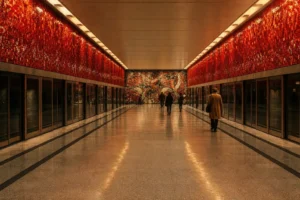 Mayakovskaya Metro Station, Saint Petersburg
Main image: AI-generated illustration. It may not show the place exactly as it looks.
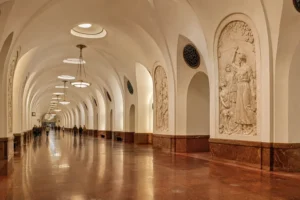 Ploshchad Vosstaniya Metro Station, Saint Petersburg
Main image: AI-generated illustration. It may not show the place exactly as it looks.
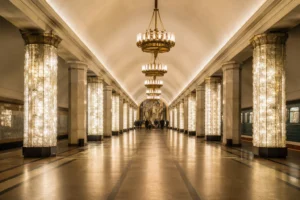 Avtovo Metro Station, Saint Petersburg
Main image: AI-generated illustration. It may not show the place exactly as it looks.
Browse more: All How-To · All How-To in Saint Petersburg · All Metro and Trains · All Saint Petersburg
FAQ
Is the Saint Petersburg Metro easy for tourists who do not speak Russian?
Yes. The lines are numbered and colour-coded, making it possible to navigate without understanding long announcements. The most important information is the station name, the terminal direction and the interchange point. Some signs and maps include English transliterations. Save your destination in advance and compare the station sequence on the platform diagram with your route.
Does the Saint Petersburg Metro run 24 hours a day?
Not under its normal operating schedule. Many entrances open around 05:30–06:00, while last trains generally run around midnight or later, depending on the station and direction. Special event services may differ, but they should not be assumed. The official Metro station timetable, rather than a general city-wide closing time, is the reliable reference for late journeys.
Can children travel on the Saint Petersburg Metro for free?
Under the Saint Petersburg Metro's official passenger rules, children under seven may travel free when accompanied by an adult. Staff may request documentation confirming a child's age. Families should also pay attention to station depth and escalator arrangements. Travelling with a stroller requires assistance from metro employees when using an escalator or moving walkway, rather than attempting to carry it independently.
Can I take a large suitcase on the Saint Petersburg Metro?
Yes, within the operator's luggage limits. Hand baggage with a combined length, width and height of up to 120 centimetres falls within the normal free allowance. Permitted baggage measuring 121–150 centimetres in total requires an additional baggage fare. Larger items may be prohibited. These dimensions are measured as the sum of three sides, not simply by suitcase height. Check the official rules before bringing oversized equipment.
Are Saint Petersburg Metro stations wheelchair accessible?
Accessibility depends on the station and the assistance required. The operator provides mobility support at all stations during operating hours and uses specialist equipment for wheelchair access. Some newer stations have lifts, but many older stations rely on deep escalators. Powered wheelchairs are subject to equipment compatibility and weight restrictions. Contact the official passenger assistance service before travelling to confirm a workable route.
Is photography allowed inside Saint Petersburg Metro stations?
Ordinary personal photography can be undertaken without the special permission required for professional equipment, provided other metro rules are followed. Flash photography and photography or filming with professional or stationary equipment require written permission from the operator. Keep equipment clear of moving passengers, respect directions from station staff and do not interfere with safe movement along platforms or escalators.
Which metro stations are best for visiting Saint Petersburg's famous attractions?
Nevsky Prospekt serves Kazan Cathedral and central Nevsky Prospekt. Admiralteyskaya is useful for Palace Square and the Hermitage, while Gorkovskaya provides access towards the Peter and Paul Fortress. Gostiny Dvor is convenient for the historic shopping streets and central museums. The best station depends on the attraction's actual entrance, so allow time for the walk above ground.
Does the metro go directly to Pulkovo International Airport?
No. Pulkovo Airport does not have a direct passenger metro station. Travellers normally use an airport bus to connect with the underground network. Moskovskaya, on the blue Line 2, is a principal interchange for airport bus services and provides a direct metro route towards Nevsky Prospekt. Check the airport's official ground transport information for the operating routes and timetables.
Russia Vibes is a one-person project. A coffee keeps it going
Not legal advice. This is general information for visitors. Rules on visas, entry, registration, customs and similar matters change often and can depend on your nationality. Check the official source and, if in doubt, ask your embassy or a qualified adviser.
Last updated: October 17, 2026.
How we research and update our guides
About this guide: AI assistance and accuracy
This guide is created with the help of AI and is based on official sources where available. Mistakes can still happen. Opening hours, prices, rules and other details are given to the best of our knowledge as of the date shown and can change without notice. It offers general recommendations only, not professional, legal or travel advice. Please confirm important details with the official source before you travel; you are responsible for your own plans and decisions.
International sanctions affect payments between Russia and many other countries. In practice, cards issued in the EU, the UK, the US and several other countries often do not work in Russia, Russian cards usually do not work abroad, and some booking platforms, airlines and payment providers limit or suspend their services for Russia. The situation changes frequently. We do not give legal or financial advice, and this site does not encourage anyone to break or circumvent sanctions. Whatever you plan, you are responsible for following the laws and regulations that apply to you, including those of your country of residence and citizenship. Many travelers still organise their stay lawfully. It is worth asking your bank or payment provider what is currently permitted, contacting hotels, tour operators and carriers directly about the payment methods they accept, and checking which services are open to customers from your country. Clarify payment, cancellation and refund terms before you commit to a booking, and keep your plans flexible. Partner links on this site may not be available in every country, and prices, availability and rules in our guides can differ from what you see when you book.Paying for your trip: please read
Report an issue on this page

Take this guide with you
Get a free PDF of this guide to print or read offline: key facts, tips and a map link on a few clean pages.