
Updated
Matsesta is a microdistrict in Khostinsky City District in Sochi, Krasnodar Krai, Russia, primarily known as a spa and resort on the Black Sea coast. The curative springs of Matsesta, meaning “fire water,” were first discovered by ancient Greek and Venetian merchants during their intensive exploration of these shores.
The sulphurous springs are responsible for Sochi’s existence as a health resort since in the early 1900s. The facility still serves up to 2,000 patients per day. Visitors can come for full balneotherapy treatments or day visits without a sanatorium voucher, soaking in pools fed by the naturally heated mineral water.
Quick Facts
| Russian name | Мацеста |
|---|---|
| Address | ул. Челтенхема, 14, Сочи 354024, Россия Google MapsApple MapsYandex Maps2GISOpenStreetMap |
| District | Khostinsky City District |
| Opening hours | Daily 07:45-12:45 |
| Admission | ₽₽ |
| Best time to visit | Spring (April–May) and autumn (September–October) offer comfortable temperatures for outdoor walks and park time between treatments, with fewer crowds than summer. Summer (June–August) attracts the most visitors, bringing full capacity and longer waits; book well ahead. Winter remains open year-round with fully heated indoor facilities and fewer external visitors. Avoid midday heat (12:00–16:00) in July and August by scheduling treatments early or late. |
| Recommended duration | 2–3 hours |
| Website | matsesta.info |
What Is (and Isn't) Part of a Visit to Matsesta, Sochi?
| Part | Status | Notes |
|---|---|---|
| Main Spa Complex (Building No. 4) | Included in the standard ticket | The primary thermal bath building open to day visitors; most core balneotherapy treatments occur here. |
| Hydrogen Sulfide Springs (source areas) | Included in the standard ticket | Source pools and spring viewing areas accessible to spa visitors; underground caves where springs originate are closed to the public. |
| Parks and embankments | Included in the standard ticket | Landscaped grounds, river embankments, and walking paths around the spa complex are accessible during spa operating hours. |
| Dacha Stalina (Stalin's Summer House) | Separate ticket or institution | Separate property requiring a guided tour ticket; not included in spa admission but within walking distance in Matsesta neighborhood. |
| Sanatoriums and residential complexes | Outside / not part of it | Soviet-era sanatoriums in other parts of Matsesta are separate institutions; individual buildings require their own credentials or bookings. |
| Sochi Aquarium (Akvarium Na Novoy Matseste) | Outside / not part of it | Located in New Matsesta near the coast; separate ticket and institution, about 4 km from main spa. |
Why Visit Matsesta, Sochi?
Founded in 1902 on hydrogen sulfide springs found near the Matsesta River, people come here to restore the skin and scars after surgery, infertility treatment and musculoskeletal system. Beyond medical applications, the resort preserves distinctive Soviet-era architecture and sits in a lush river valley setting. Not far from the balneological institution was Stalin’s dacha. The complex combines wellness treatment with historical atmosphere and subtropical gardens.
How Matsesta, Sochi Is Laid Out
Matsesta is located in the Matsesta River valley and consists of four parts. Novaya Matsesta (New Matsesta) is located at the coast, Srednyaya Matsesta (Middle Matsesta) is upstream the river, and Staraya Matsesta (Old Matsesta) is even further from the sea. Verkhnyaya Matsesta (Upper Matsesta) is located uphill from Srednyaya Matsesta.
The monumental building of the Balneary (No. 4), built in 1940, is located in the Old Matsesta area, 3.8 kilometers from the Black Sea coast. It is located on the bank of the Matsesta River, where a stone embankment was built in the same years. Most visitors focus on the main spa complex in Old Matsesta; other parts contain sanatoriums and residential areas.
Highlights of Matsesta, Sochi
Main Spa Complex (Building No. 4)
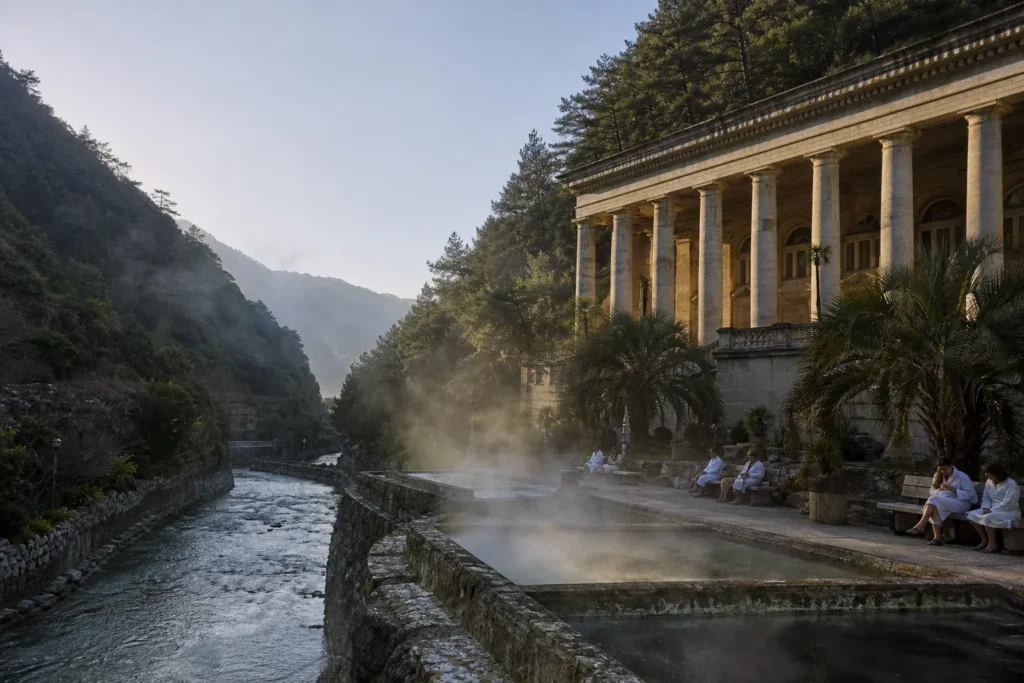
Built in 1940 by architect A.O. Golubev, the institution is one of many Soviet-era treatment centers still open today for those curious to try a hot mineral-water bath or enjoy a hydromassage. The building commands a hillside overlooking the river valley and features monumental columns and period Soviet architecture. Look for the classical portico entrance and the thermal pool complex inside.
Tip: The complex is open to all visitors from 7.45 am to 2.15 pm. Book ahead for better availability; day visitors without a voucher can access the facility.
Hydrogen Sulfide Springs
The complex is built on the site of the main sources of hydrogen sulfide water. Its transportation to other sanatoriums, even within Sochi, is impossible, as the water loses its medicinal properties. A small lake at the source of Matsesta is filled with white water with a characteristic smell of hydrogen sulfide. Nearby there are caves where the first hydrogen sulfide springs were found. The water maintains a natural warm temperature year-round.
Tip: The springs at source level are viewable from designated areas; the water's pungent sulfur smell is your guide. There is a water spring to the right, next to the VIP hall, where you can breathe in the water's healing properties.
Soviet Balneotherapy Architecture
The Old Matsesta is especially famous — it is a monumental Soviet-era structure that looks like an ancient temple. It is sometimes called the "palace of health", then "hydrotherapy No. 4". Treatments take place indoors, and outside there is a lush park with ponds, sculptures and hundreds of different plants. The building exemplifies Stalinist spa architecture with its imposing colonnades and modernist interior layout.
Tip: The grounds are open for walking and photography year-round; the architecture is particularly striking in late afternoon light. The stone embankment along the river offers views back toward the main building.
Matsesta River Valley
In Matsesta, which is located in the valley of the river of the same name, routes to the mountains also begin, including the road to Mount Akhun. The valley provides subtropical vegetation including palms and dense forest cover unusual for this latitude. Matsesta is located in the mouth of the Matsesta River, halfway between the center of Sochi and Adler.
Tip: The river embankment path is pleasant for walks before or after treatment; the mountain roads branching from the valley lead to viewpoints and longer hikes.
Balneotherapy Treatments
The Matsesta spa has several unique types of procedures: in addition to sulphur baths, there is an iodine-bromine balneotherapy relying on the local mineral springs. Bathing in mineral-rich warm water has virtually no contraindications, and it has a positive effect on the cardiovascular and nervous systems, increasing the human body's overall immunity. The more traditional health procedures are also complemented by mud treatment. The Matsesta spa offers plenty of ways to sink from head to toe in choice healing mud that is heated to a comfortable temperature and that contains sulphur, iron, potassium, sodium, magnesium, nitrogen and more. Such a procedure relieves aching joints and makes varicose veins retreat.
Tip: Day visitors can book single treatments; the mud baths are popular and should be reserved in advance. Bring swimwear and a shower cap.
Dacha Stalina (Stalin's Summer House)
Visitors can explore Dacha Stalina, the former summer residence of Joseph Stalin, on guided tours that offer a glimpse into history. A huge incentive in the development of Matsesta as a balneological resort and the whole of Sochi as a beach resort was the construction of Stalin's Summer Cottage in 1931. He personally chose the place for it. The dacha is now a museum open to visitors and offers context for the Soviet-era resort development.
Tip: The dacha is a separate property from the main spa; arrange a guided tour in advance through your accommodation or contact the dacha directly for visiting hours and tour availability.
Atmosphere
Matsesta feels frozen in productive Soviet-era leisure. The air carries the distinctive rotten-egg smell of hydrogen sulfide—faint near the pools, stronger at the spring sources. Spa robes and slippers are uniform wear among daytime visitors, many of them on medical treatment courses. The grounds blend subtropical gardens (palms, magnolias, dense pines) with 1940s columned buildings and Soviet-era sculptures.
Mornings are quieter; midday brings therapeutic activity and the sound of water treatment equipment. The river valley echoes with bird calls and the hum of the embankment fountains. Groups of pensioners and middle-aged visitors from across Russia predominate. By early afternoon most day visitors have departed. The complex maintains a purposeful, medical atmosphere rather than festive luxury.
History of Matsesta, Sochi
The sulphur springs in Matsesta were first mentioned in literature in 1841. It was repeatedly proposed to found a spa here, until in 1901 the decision was taken by the authorities. The spa was opened on September 15, 1902, and Matsesta developed as a settlement serving the sulfur baths.
A turning point was the scientific recognition of the healing properties of the Matsesta hydrogen sulfide springs. Early bathhouses served aristocrats and wealthy vacationers during the Imperial and early Soviet periods. During the early Soviet period, Lenin issued a decree concerning public access to the Black Sea coast around Sochi, including the mineral springs of Matsesta, as part of the development of health resorts.
General Secretary Josef Stalin was not the first to think of making Sochi a socialist resort, but few would refute how much has been done on his orders to turn the city into the luring paradise it was during the Soviet period. Sochi got more than 1 billion rubles for its transformation in the 1930s — a fantastic sum by the standards of the time. Much of the money went to develop Matsesta’s healing sulfur springs, which a multitude of the country’s political leaders have used to regain their strength and beat off aging. Stalin came to Sochi to soak in the Matsesta baths as a way to treat his rheumatism.
Built in 1940 by architect A.O. Golubev, the institution is one of many Soviet-era treatment centers still open today for those curious to try a hot mineral-water bath or enjoy a hydromassage. It was said that the indefatigable communist leader Leonid Brezhnev could never have stayed in power for so long had he not immersed himself in Matsesta’s medicinal baths for several weeks each year. The complex expanded through the Soviet period and continues operating as Russia’s premier sulfur spa resort.
Legends and Myths about Matsesta, Sochi
Matsesta Means Fire Water
Legend – historically unreliable. The name Matsesta derives from ancient Circassian and means "fire water," referring to the warm springs that rise from underground. The curative springs of Matsesta, meaning "fire water," were first discovered by ancient Greek and Venetian merchants during their intensive exploration of these shores. Local legend holds that the springs were sacred to ancient peoples and feared as supernatural fire emerging from the earth.
The Bowl on Sochi's Seal
Legend – historically unreliable. A cup filled with Matsesta water is in the center of Sochi's official seal. The fiery bowl on the coat of arms of Sochi is a symbol of the place. The bowl represents Matsesta's central role in making Sochi a resort destination and symbolizes the healing waters that built the city's reputation.
Tickets and Booking for Matsesta, Sochi
| Ticket | Price | Includes |
|---|---|---|
| Day Visit (single bath or treatment) | ₽₽ | Access to thermal pools, changing facilities, and basic balneotherapy bath |
| Day Spa Package | ₽₽₽ | Multiple treatments such as sulfur bath, mud therapy, massage and hydromassage in one day |
₽ budget · ₽₽ moderate · ₽₽₽ upscale · ₽₽₽₽ splurge. Price levels are estimates compared with typical prices for visitors.
The official website is matsesta.info. Day visitors without a sanatorium voucher can purchase treatments through the polyclinic department year-round. The complex is open to all visitors from 7.45 am to 2.15 pm.
Contact by phone (+7 862 555-28-50) or visit in person to book treatments. On the territory of Matsesta, patient care is provided not only for sanatorium-resort vouchers. The course of treatment is also available for those who came to Sochi without a voucher. For this, the polyclinic department works all year round, where therapists and gynecologists are receiving appointments. Same-day availability depends on the season; advance booking is recommended during summer months (June–August).
International visitors should note that pricing for foreign citizens and Russian citizens differs. Concession rates apply to pensioners, children, and military personnel with appropriate documentation. Check the official website for current rates and all visitor categories.
Plan and Book
Advertisement: these are partner links. If you book or buy through them, we may earn a commission at no extra cost to you.
Suggested itineraries Matsesta, Sochi
2–3 hours
Arrive early (before 10:00 am) to secure a slot for a single treatment—a sulfur bath or mud application. Change in provided facilities. Enjoy the treatment followed by time in the thermal pool. Walk the landscaped grounds and embankment before departure by early afternoon.
Half day (4–5 hours)
Book a day spa package combining treatments: thermal bath, mud therapy, and massage or hydromassage. Spend morning on treatments (arrival by 08:00), afternoon relaxing in public pools and walking grounds. Have lunch at on-site cafeteria or nearby restaurants.
Full day (6–8 hours)
Combine spa treatments with exploration of the Matsesta district. Morning: thermal baths and mud therapy. Midday: lunch and walk to Dacha Stalina (book guided tour separately). Afternoon: return for additional soaks or massage; explore river embankment and park paths before evening departure.
How to Get to Matsesta, Sochi
Matsesta has no direct metro access. From central Sochi, take a bus or marshrutka (shared minibus) along Kurortny Prospekt heading toward Khoста or Adler. The journey takes 20–30 minutes depending on traffic. Ask the driver for “Matsesta” or show the address: Челтенхема Алея, 14 (Cheltenkhema Alley).
By taxi or ride-hailing app: about 20 minutes from central Sochi beachfront; specify the destination as Matsesta Kurort (Matsesta Resort) or provide the address to ensure correct routing to the main spa complex rather than other Matsesta locations.
Drivers should note that Matsesta is approximately halfway between central Sochi (20 km north) and Adler (20 km south). Parking is available near the main spa building for a small fee.
Accessibility
The monumental building of the Balneary (No. 4), built in 1940, is located in the Old Matsesta area. The 1940 complex has elevator access to main treatment levels; some older facilities may have steps. The spa staff can advise on which treatment areas are wheelchair-accessible when you call ahead. Companions accompanying patients may qualify for reduced admission; inquire at the polyclinic desk. Thermal pools have handrails and entry steps; in-water support available through therapy staff.
Food Nearby
An on-site cafeteria serves Russian spa meals (soups, grains, minimal salt and fat). Food stalls near the main entrance offer light snacks and beverages. For more substantial meals, restaurants cluster in nearby Novaya Matsesta (New Matsesta) beachfront area or back toward central Sochi; these are 2–4 km away by bus or taxi. Pack water and light snacks if planning a long day visit.
What to Bring
Swimwear, shower shoes, towel, and a robe or loose cover-up. Bring a change of clothes and toiletries; the spa provides lockers but not towels or cosmetics for day visitors. Sunscreen if visiting outdoor pools in warm months. A small bag for valuables; lockers are available. No special equipment is required for standard thermal baths.
Best Views and Photo Spots of Matsesta, Sochi
Main Building Portico at Sunset
The 1940s columned entrance with classical Soviet architecture frames dramatically against the river valley and forested slopes in late afternoon light. The stone colonnade casts strong shadows; visitors in spa robes add human scale.
Best time: 16:00–17:30 in any season; the building's north face catches warm sidelight and the tree-covered hills provide dark contrast.
Matsesta River Embankment Looking Back at Spa Complex
The spa building perches on a hillside above the stone-lined river with subtropical vegetation framing both banks. The river's modest width emphasizes the scale of the building. Morning mist often rises from the warm water in cooler months.
Best time: Early morning (08:00–09:00) when light is soft and the complex casts reflections in the still water.
Thermal Pool Outdoor Section
Steaming thermal pools with visitors in light robes, the surrounding landscaped garden with mature trees, and the hillside complex in background create a strong sense of the spa experience. Mist rises visibly in cooler weather.
Best time: Cooler months (October–April) when steam is most visible; early morning or late afternoon for best light without excessive sun glare.
Hydrogen Sulfide Spring Source Pool (Public Viewing)
The small, mineral-whitened pool at the spring source surrounded by cave-bearing rock formations and subtropical undergrowth. The sulfur-yellow water and mineral deposits on rocks create distinctive color contrast.
Best time: Morning light (08:00–10:00) before afternoon crowds; overcast days show colors well without harsh shadows.
Photography Rules
Photography is permitted in public areas including pools, grounds, and the main building exterior. Flash photography is discouraged indoors near treatment facilities to avoid disturbing other visitors. No photography during active medical treatments in private areas. Drones and professional camera equipment may require permission; ask at the entrance.
Family Suitability
Matsesta is primarily a medical spa; families with young children may find it less festive than a beach resort. Children and infants are welcome in thermal pools if not undergoing medical treatment. Families can book family-package treatments combining adult and child care, though specific sessions are limited. Strollers cannot easily access the hilly grounds; older children who can walk are more suited. The quiet, healing-focused atmosphere appeals to older children and teens interested in history or wellness tourism.
Russia Vibes Tips
- Arrive by 08:00 to secure same-day treatment slots, especially in summer. Peak capacity is reached by 11:00, after which wait times exceed one hour.
- The main building No. 4 is the primary tourist facility. Do not confuse it with other Matsesta locations (New Matsesta beachfront, sanatoriums) or you may end up in the wrong district.
- The thermal water is naturally warm (around 37–43°C depending on source) but loses medicinal properties if transported or cooled. Do not take it away; enjoy treatments on-site.
- Book Dacha Stalina tours (Stalin's house museum) as a separate activity through your hotel or directly; it is not included in spa admission and requires a guide.
- Bring ruble cash for small purchases and tips; card payment is available but not guaranteed everywhere on-site.
- Do not expect luxury resort amenities. Matsesta is clinical and functional—spa robes, therapeutic focus, and Soviet-era architecture define the experience. It rewards visitors seeking authentic treatment and history over pampering.
Explore Nearby Matsesta, Sochi
Related guides
 Khosta, Sochi: Quiet Beaches, Dendrarium and Mountain Views
Main image: AI-generated illustration. It may not show the place exactly as it looks.
Browse more: More in Khostinsky City District · All Neighborhoods · All Neighborhoods in Sochi · All Parks · All Sochi
FAQ: Matsesta, Sochi
Can I visit Matsesta for a day without a sanatorium voucher?
Yes. Day visitors can book individual treatments or packages through the polyclinic department. Call ahead or visit in person in the morning. Treatments must be completed by 14:15 (complex closes to day visitors at 12:45 for new arrivals; some evening departures allowed).
What is the difference between Matsesta and Sochi's beaches?
Matsesta is a river-valley mineral spa 20 km from central Sochi's Black Sea beaches. It offers thermal medical treatments, not seaside swimming. The two can be combined in a multi-day trip but serve different purposes.
Is Dacha Stalina (Stalin's house) part of Matsesta Spa?
No. Stalin's summer residence is a separate museum property nearby. It requires a separate guided tour ticket and is not included in spa admission. Arrange tours through your hotel or contact the dacha directly.
Why does Matsesta smell like rotten eggs?
The hydrogen sulfide mineral content creates a distinctive sulfur smell. This is the source of therapeutic properties; the smell decreases in outdoor areas and may fade during your visit as you acclimate.
Do I need to speak Russian to visit?
English is limited among staff. Bring a phrasebook or translation app, or book through a hotel concierge who can communicate on your behalf. Medical staff in the polyclinic may speak some English.
What should I wear to Matsesta?
Bring swimwear and shower shoes. The spa provides robes and changing facilities. Loose, comfortable clothes for before and after are practical; the complex expects visitors to move between pools and treatment areas in spa attire.
Are there restaurants or cafés at Matsesta?
An on-site cafeteria serves simple spa meals. For more variety, nearby Novaya Matsesta (2–3 km away) has restaurants; otherwise plan meals in central Sochi or bring snacks.
How long does a typical visit take?
A single treatment takes 1–2 hours including changing time. A day spa package with multiple treatments and rest time takes 4–5 hours. Plan accordingly and book early to ensure your desired treatment window.
Russia Vibes is a one-person project. A coffee keeps it going
How we research and update our guides
About this guide: AI assistance and accuracy
This guide is created with the help of AI and is based on official sources where available. Mistakes can still happen. Opening hours, prices, rules and other details are given to the best of our knowledge as of the date shown and can change without notice. It offers general recommendations only, not professional, legal or travel advice. Please confirm important details with the official source before you travel; you are responsible for your own plans and decisions.

Take this guide with you
Get a free PDF of this guide to print or read offline: key facts, tips and a map link on a few clean pages.
Report an issue on this page
Paying for your trip: please read
International sanctions affect payments between Russia and many other countries. In practice, cards issued in the EU, the UK, the US and several other countries often do not work in Russia, Russian cards usually do not work abroad, and some booking platforms, airlines and payment providers limit or suspend their services for Russia. The situation changes frequently.
We do not give legal or financial advice, and this site does not encourage anyone to break or circumvent sanctions. Whatever you plan, you are responsible for following the laws and regulations that apply to you, including those of your country of residence and citizenship.
Many travelers still organise their stay lawfully. It is worth asking your bank or payment provider what is currently permitted, contacting hotels, tour operators and carriers directly about the payment methods they accept, and checking which services are open to customers from your country. Clarify payment, cancellation and refund terms before you commit to a booking, and keep your plans flexible.
Partner links on this site may not be available in every country, and prices, availability and rules in our guides can differ from what you see when you book.