
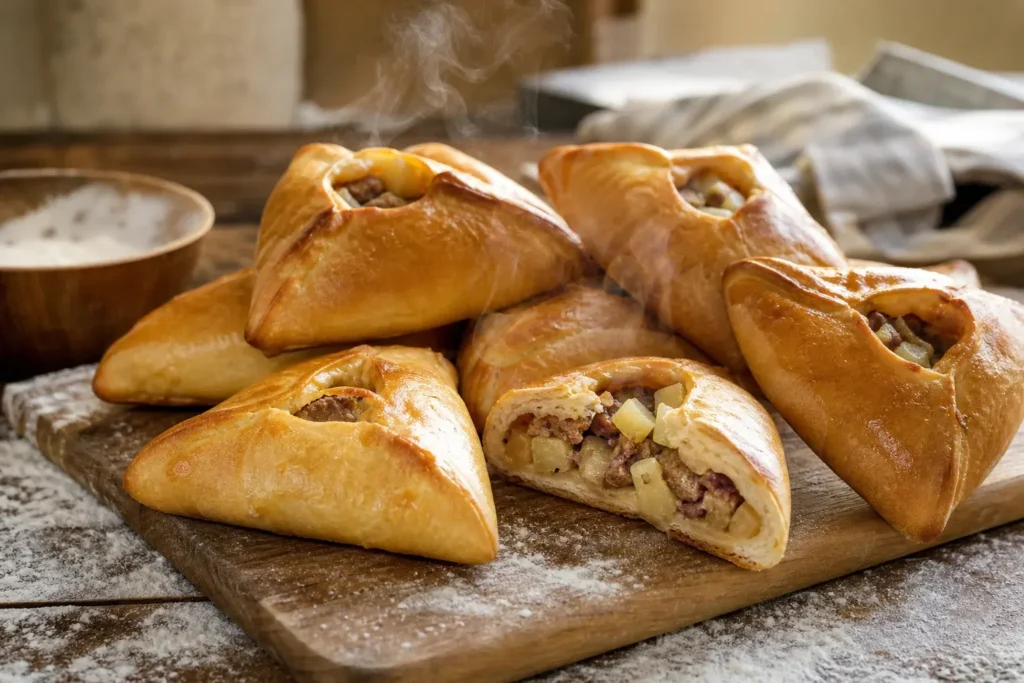
Echpochmak—ech meaning the number three in Tatar, and pochmak meaning angle—is a pie with three corners, or triangular pie. This is the dish you will encounter everywhere in Kazan, from street stalls to bakeries on every corner. It looks simple: a golden pastry triangle with a small hole at the top. What makes it special is what happens inside during baking.
This guide shows you how to make traditional echpochmak from scratch at home. The key is that the filling goes in uncooked and the whole thing bakes until the dough turns golden and the meat and potato juice soaks into the interior. You will end up with a juicy, flavorful pie that tastes nothing like most of the mass-produced versions sold on the street.
Quick answer: Make a yeast dough, fill it with raw minced meat, diced potato and onion, shape into triangles, and bake for 30–40 minutes until the dough turns golden and the filling cooks inside. Total time: 2–3 hours including dough rise.
At a Glance
| Type | Dishes |
|---|---|
| Local name | эчпочмак |
| Origin | A symbol of Tatar culture, echpochmak has its origins in the nomadic days of the Tatars. Leading a nomadic life, the Tatar people used to travel long distances across the steppe, and echpochmaks became a nourishing and quick food solution, making their camping stops shorter. |
| Servings | 4–6 people as a main course (makes about 10–12 triangles) |
| Total time | 2–3 hours total (includes 1–2 hours dough rise and 30–40 minutes baking) |
| Difficulty | Medium |
History and Story of Echpochmak, Kazan
Echpochmaks have been cooked for centuries by nomad Turkic people. Historically, it was cooked and eaten in the open air during long military campaigns. Today, potatoes are always added to echpochmaks. Potatoes were cultivated on a mass scale throughout Russia only in the first half of the 19th century. This means the echpochmak as we know it today—with potatoes—is a relatively modern refinement of an ancient dish.
Ingredients
- 500 g all-purpose flour
- 200 ml warm milk
- 7 g instant yeast (one standard packet)
- 1 large egg
- 100 g butter (unsalted, melted)
- 1 tsp sugar
- 1 tsp salt
- 500 g beef chuck or a cut with some fat
- 400 g potatoes (peeled)
- 2 medium onions
- 50 g cold butter (for filling)
- 180 ml beef broth (kept warm)
- Black pepper to taste
How Echpochmak, Kazan Is Made
Step 1: Make the dough base
Warm the milk to lukewarm—not hot, as this will kill the yeast. Stir in the yeast and sugar, and let the mixture stand for 5–10 minutes until it froths slightly. In a large bowl, whisk the egg with the melted butter. Add the yeast mixture to the butter and egg, then add the flour and salt.
Tip: Use a stand mixer with a dough hook to knead for about 5 minutes, or knead by hand for 8 minutes until smooth and slightly elastic.
Step 2: First rise
Place the dough in a warm spot for 1–2 hours until it doubles in size. A warm oven (turned off but with a light on) or a proofing box works well.
Tip: You can cover the dough with a plastic bag or a damp towel to keep it from drying out.
Step 3: Prepare the filling
Cut the meat into small pieces and place in a bowl. Cut the raw potatoes into cubes about 5–7 mm in size—roughly the same size as the meat pieces. Dice the onion into small pieces as well. Mix the meat, potatoes, onion, salt, and black pepper in a bowl. Add the cold butter cut into small pieces.
Tip: The raw filling will steam and cook inside the sealed pie, so uniform cube sizes help everything cook evenly.
Step 4: Shape the triangles
After the dough has risen, divide it into 10–12 equal portions (about the size of a small tangerine). Roll each portion flat into a circle about the size of a saucer. Place 1.5–2 tablespoons of filling in the center, then fold the dough up and pinch it firmly into a triangle shape, creating a small hole at the top.
Tip: Leave the hole intentionally—this is where you will pour the broth during baking.
Step 5: Prepare for baking
Place the triangles on a greased baking sheet, leaving space between them. Heat the oven to 200 degrees Celsius (about 390°F).
Tip: If you prefer, you can brush the triangles lightly with egg wash for extra shine, but this is optional.
Step 6: Initial bake
Bake at 200°C for 5 minutes, then reduce the temperature to 170°C (about 340°F) and bake for another 20–25 minutes until the dough turns golden and crispy.
Tip: Watch the color; the triangles should be light golden, not dark brown.
Step 7: Add broth and finish
Tatar tradition calls for it to be served with a hot broth—usually toqmaç (homemade noodle soup)—which you pour through the small hole at the top of the triangle so the dough softens and blends with the filling. When the pies are nearly done (around minute 25), use a small spoon to carefully pour warm beef broth through the hole at the top of each triangle. Bake for the final 5–10 minutes until fully golden.
Tip: The broth should be hot but not boiling, and pour it slowly so it soaks into the pie without making the dough soggy.
Variants
- Echpochmak with beetroot-coloured dough
- Echpochmak made with lamb instead of beef
- Echpochmak made with duck or goose meat
- Echpochmak made with chicken
Common Mistakes to Avoid
- Echpochmak is not a snack, it is a first course. Tatar tradition calls for it to be served with a hot broth which you pour through the small hole at the top. Eating it dry or without broth means you miss the essential juiciness.
- Using very lean meat without fat will result in a dry, tough filling. Any meat except pork can be used; for fatty meat, use beef or lamb with fat. If there is no fat on the meat, add sheep-tail fat, clarified butter or fresh butter.
- Skipping the small hole at the top means the broth cannot be poured in, and the filling will not soften properly.
- Filling the triangles with cooked filling instead of raw filling defeats the entire purpose—the raw filling cooks and releases its juices inside the sealed dough.
- Cutting the potatoes and meat into pieces that are too large will leave them undercooked. Keep pieces uniform at about 5–7 mm cubes.
- Opening the oven door frequently during baking disrupts the rise and can dry out the dough. Resist the urge to peek until the final 10 minutes.
- Letting the filled triangles sit too long before baking (more than 30 minutes) will make the dough dry and less fluffy.
How to Order and Eat It
The small hole at the top of the triangle allows broth to be poured in so the dough softens and blends with the filling. Tatar triangles are traditionally served alongside soups or enjoyed with a cup of hot meat broth. Tatars eat it from morning to evening: as breakfast, a between-meals snack, or a proper main course. Order them hot from the oven. By evening the filling can dry out.
To order: Мне, пожалуйста, эчпочмак [Mne, pozhaluysta, echpochmak]
Diet and Allergens
- Contains gluten (yeast dough)
- Contains dairy (milk, butter, egg)
Russia Vibes Tips
- The best echpochmak comes fresh from the oven. Order them hot from the oven. By evening the filling can dry out. If buying from a bakery or cafe, ask whether a fresh batch has just come out before ordering.
- In Kazan, you can find echpochmak in literally every bakery. Street stalls on Bauman Street are particularly famous for them. Many vendors will let you taste before you buy.
- The key difference between homemade echpochmak and mass-produced versions is the broth poured in at the end. This step takes seconds but transforms the pie from dry to wonderfully juicy.
- If you do not have beef broth on hand, you can use warm melted butter mixed with a little water as a substitute, though traditional recipes use hot meat broth.
- Echpochmak tastes good hot, but you may find it tastes even better at room temperature. Many Tatars eat them cold as a snack the next day.
- The small hole at the top is structural and essential—it allows steam to escape during baking and the broth to be poured in afterward. Do not seal it closed.
Explore Nearby Echpochmak, Kazan
Browse more: All Food & Drink · All Food & Drink in Kazan · All Kazan · All Other
FAQ
What is the difference between echpochmak and peremyach?
The echpochmak is not fried in oil, but baked in the oven. Peremyach is the fried Tatar pie cousin, typically round with a small hole, while echpochmak is triangular and baked. Both use similar fillings of meat, potato and onion.
Can I use pork in echpochmak?
Any meat except pork can be used in echpochmaks. For religious reasons, traditional Tatar cuisine does not include any products from pigs.
Do I have to use beef, or can I use other meat?
The filling might be mutton, beef or veal, chicken, duck or goose—any meat from domestic animals or poultry, preferably meat with fat. Lamb is traditional in many regions.
What is the hole in the top for?
The hole at the top is where broth is poured through, so the dough softens and blends with the filling. This is not just decoration—it is essential to traditional preparation.
Is echpochmak a snack or a main course?
Echpochmak is not a snack, it is a first course. Tatar tradition calls for it to be served with a hot broth. When served on the street without broth, it is eaten as a quick snack, but traditionally it is a more substantial dish.
Can I make echpochmak with ground meat instead of small cubes?
You can make echpochmak with minced meat instead of cutting it into small pieces by running it through a meat grinder. This breaks with tradition, but it will not affect the flavor.
How long can I keep echpochmak?
Echpochmak is best eaten hot from the oven, but it keeps well at room temperature for a day and can be reheated gently. Refrigerate leftovers and warm before eating.
What should I drink with echpochmak?
Echpochmak is usually eaten with bouillon or with tea. Hot broth is traditional, but strong tea (often with milk) is also common.
Russia Vibes is a one-person project. A coffee keeps it going
How we research and update our guides
About this guide: AI assistance and accuracy
This guide is created with the help of AI and is based on official sources where available. Mistakes can still happen. Opening hours, prices, rules and other details are given to the best of our knowledge as of the date shown and can change without notice. It offers general recommendations only, not professional, legal or travel advice. Please confirm important details with the official source before you travel; you are responsible for your own plans and decisions.

Take this guide with you
Get a free PDF of this guide to print or read offline: key facts, tips and a map link on a few clean pages.
Report an issue on this page
Paying for your trip: please read
International sanctions affect payments between Russia and many other countries. In practice, cards issued in the EU, the UK, the US and several other countries often do not work in Russia, Russian cards usually do not work abroad, and some booking platforms, airlines and payment providers limit or suspend their services for Russia. The situation changes frequently.
We do not give legal or financial advice, and this site does not encourage anyone to break or circumvent sanctions. Whatever you plan, you are responsible for following the laws and regulations that apply to you, including those of your country of residence and citizenship.
Many travelers still organise their stay lawfully. It is worth asking your bank or payment provider what is currently permitted, contacting hotels, tour operators and carriers directly about the payment methods they accept, and checking which services are open to customers from your country. Clarify payment, cancellation and refund terms before you commit to a booking, and keep your plans flexible.
Partner links on this site may not be available in every country, and prices, availability and rules in our guides can differ from what you see when you book.