
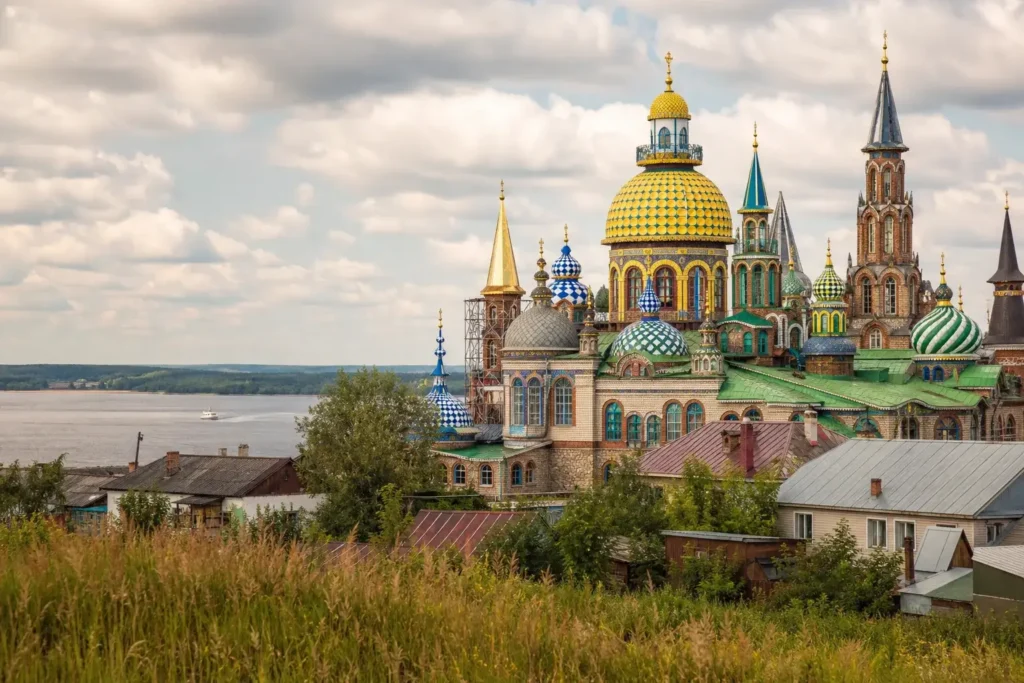
The Temple of All Religions, also called the Universal Temple, is one of Kazan‘s most unusual sights. It stands in Staroye Arakchino, a suburban settlement in Kirovsky district on the Volga bank. A cluster of domes, pointed windows and mosaic-covered walls rises above the surrounding houses and looks like nothing else in the region.
Despite the name, it is not a working church, mosque or synagogue. It is a private cultural centre and museum of world religions, with no services, rites or prayers. The Kazan artist, sculptor and healer Ildar Khanov began it in the early 1990s, and construction has never fully stopped. Expect a half-finished, personal and slightly eccentric monument rather than a polished museum.
Quick Facts
| Russian name | Вселенский храм (Храм всех религий) |
|---|---|
| Built / opened | 1994 |
| Architect(s) | Ildar Khanov |
| Address | Старо-Аракчинская улица, 4, Старое Аракчино, Кировский район, Казань, 420079 OpenStreetMap · Google Maps |
| District | Kirovsky |
| Opening hours | Daily 09:00-18:00 |
| Admission | Entry ticket: ₽ for adults, with a cheaper child ticket.
Guided tour (per group of up to 10): ₽₽. |
| Best time to visit | The exterior and the Volga setting are at their best from late spring to early autumn, when you can walk around the building comfortably and the light stays good into the evening. Summer hours are reported to be longer than winter hours at the city tourism portal, but check the official website for the current schedule.
The stained glass in the Catholic (Gothic) hall works best in bright daylight, so aim for late morning or early afternoon on a sunny day. In winter the days are short and the temple closes early, so an afternoon visit can mean flat or fading light. No official visitor numbers or crowd patterns were found. If you want a quieter walk through the halls, arrive soon after opening and avoid planning around tour-group timings you cannot verify. |
| Recommended duration | 1–2 hours |
| Website | вселенскийхрам.рф |
| Last updated | October 18, 2026 |
What Is (and Isn't) Part of a Visit to Temple of All Religions, Kazan?
| Part | Status | Notes |
|---|---|---|
| Exterior, domes and mosaic walls | Included in the standard ticket | You can walk around the building and photograph the domes, stained glass and mosaic symbols from outside, even if you decide not to go in. |
| Orthodox, Catholic (Gothic) and Egyptian halls | Included in the standard ticket | These are the interior halls that the city's official tourism portal names as open, so they are the core of a standard visit. |
| Shiva hall and contemporary art galleries | Included in the standard ticket | The official website describes the Shiva hall, which is also used for practices, and the galleries show and sell work by living artists. Ask on arrival whether the hall is open that day. |
| Guided tour | Separate ticket or institution | The temple sells the tour separately from entry, per group of up to 10, and guides are not always free on the day. |
| Parts still under construction or fire damage | Not open to visitors | Building work has gone on since the founder's death and the 2017 fire, so some halls named in older articles (Buddha, Krishna, Judaism and others) may be closed and should not be planned around. |
| Services, prayer and religious rites | Outside / not part of it | It is a cultural centre and museum of world religions, not a working church, mosque or synagogue, and no services are held. |
| Group trips from central Kazan | Separate ticket or institution | Other operators run these, often combined with Sviyazhsk, with their own price and schedule. Check with the operator whether entry to the temple is included. |
| Free parking by the railway crossing | Included in the standard ticket | The official website mentions free parking near the turn at the railway crossing. |
| Kazan Kremlin and the city centre | Outside / not part of it | The temple is in the suburban settlement of Staroye Arakchino, on the Volga bank outside the centre, so it needs its own trip rather than a short detour. |
Why Visit Temple of All Religions, Kazan?
This is a place for people who like singular, handmade architecture. One man’s vision, carried on by his family, still shapes it.
- Symbols of many faiths sit side by side in the wall mosaics, from the crescent and stars to the menorah and the all-seeing eye.
- Inside is a sequence of themed halls, among them Orthodox, Catholic (Gothic), Egyptian and Shiva rooms, each with its own style, lighting and decoration.
- The building can be seen from Volga boats and passing trains, so it is also a good photo stop if you only stay outside.
- It shows a side of Kazan beyond the Kremlin and the old town, and the story of the 2017 fire and the rebuilding gives the visit real weight.
How Temple of All Religions, Kazan Is Laid Out
The temple is one large, irregular building rather than a campus. Its core was once Ildar Khanov’s parents’ wooden house, and halls were added around it over the years. From outside you see the 16 domes, the stained-glass windows and the mosaic niches. Inside there is no single straight route: the halls open off one another, and new rooms and details keep appearing as construction continues.
A sensible order for a visit:
- Walk around the exterior first and look for the mosaic symbols on the walls and friezes.
- Go in and see the open halls: the small Orthodox hall, the large Catholic (Gothic) hall and the Egyptian hall.
- Finish with the Shiva hall and the galleries of contemporary art.
Other halls named in various sources, such as Krishna, Buddha, Judaism and the Tatar Khans hall, may be closed or still under work, so do not plan around them. A guided tour is the easiest way to be shown whatever is open. Signage and entrances inside are not documented, so follow the staff’s directions on arrival.
Highlights of Temple of All Religions, Kazan
The 16 domes and exterior
The exterior is the most recognisable part of the temple and can be enjoyed on its own. Sixteen domes crown the building, one for each world religion in Khanov's plan. The number reflects the symbolism of the project, not 16 finished halls.
Look for the pointed windows, stained glass and the friezes and mosaic niches running across the walls. From the Volga or from a passing train, the silhouette of domes stands out against the low houses of the settlement.
Tip: Walk all the way around the building before going in. Different sides show different details, and the mosaics are easiest to read in daylight.
Mosaic symbols of world religions
Walls and niches carry mosaics that bring together signs from many traditions. You can pick out the crescent and stars, the menorah and the all-seeing eye, set beside Christian and other motifs.
This is the idea behind the whole project: instead of one faith, a shared visual language of spiritual symbols. Khanov was a sculptor, so the decoration feels hand-made and personal rather than academic.
Tip: Treat it as a spotting game: identify the symbols you know, then ask the guide about the rest.
The Orthodox hall
A small chapel-like room decorated with icons and glass-mosaic images. The city's official tourism information lists it among the halls open to visitors.
The atmosphere is calmer than in the larger, more theatrical halls. It is a decorative and museum space, not a church.
Tip: Visit it early, while it is quiet. The contrast with the Gothic and Egyptian halls is the point.
The Catholic (Gothic) hall
The official site describes this as the largest hall. Tall windows are filled with stained glass showing saints, knightly orders and coats of arms, and the room is used for concerts and creative evenings.
The heraldic details reward a slow look, and the coloured light shifts through the day. It is the best place to see how Khanov mixed historical styles into one fantasy.
Tip: Choose a sunny day if you can. The stained glass works far better in direct daylight.
The Egyptian hall
A room built around columns, mosaic panels and bas-reliefs of gods. You will also see copies of the Nefertiti bust, statues and a pharaoh's tomb.
These are decorative recreations made for this temple, not ancient objects, so it helps to see the room as a stage set built by an artist. It is reported open and is among the most photographed.
Tip: Look at the bas-reliefs up close: the hand-worked surfaces show how personal the whole project is.
The Shiva hall
The centrepiece is a statue of Shiva under a painted vaulted ceiling, with mosaics, gold bas-reliefs and carefully designed lighting. The official site calls it one of the most awaited halls and says it is used for practices such as yoga.
The room is deliberately theatrical. The light and the decorated vault make it feel more like a stage than a shrine.
Tip: Because practices are held here, ask whether the hall is in use before you walk in.
Contemporary art galleries
Besides the themed halls, the temple has galleries that show, and sell, works by contemporary artists. They show that the complex is a living cultural centre, not only a memorial to Khanov.
It is easy to walk past them while chasing the famous halls.
Tip: Leave a few minutes at the end for the galleries. They are the quietest part of the visit.
The Volga setting and the rebuilt core
The temple stands on the Volga bank, which is why it shows up from river boats and trains. At its heart was Khanov's parents' wooden house, the starting point of the whole building and the core that burned in 2017.
Some of what you see is therefore new work done after the fire, and building continues.
Tip: Older articles name many halls that may not be open today, so treat any list of halls as a wish list.
Atmosphere
From the road the temple looks like a fairy-tale fortress dropped among ordinary suburban houses. Domes of different shapes cluster together, and the walls glitter with coloured mosaic and glass.
Inside, the mood shifts from room to room. A small icon-filled chapel gives way to a tall Gothic space full of coloured light, then to the columns and gods of ancient Egypt. Lighting is part of the design, so some halls feel dim and theatrical while others glow when the sun hits the stained glass.
It is not a quiet pilgrimage site but an eccentric, personal museum, and work on the building is still going on, so it feels like a project in progress. Outside, the Volga bank and the nearby railway add a rough, suburban edge.
History of Temple of All Religions, Kazan
The temple is the life’s work of Ildar Khanov, a Kazan artist, sculptor and healer. He conceived it as a place where the symbols of the world’s religions could stand together, and he built it largely with his own funds.
The early 1990s. Sources disagree on the exact start: groundwork and design are dated to 1992, and the start of construction to 1993 or 1994, so “early 1990s” is the safest description. Svyatoslav Roerich, son of the painter Nicholas Roerich, is recorded as taking part in the concept. Khanov built around his parents’ wooden house, which became the core of the complex.
Growth. Over the following decades the building expanded into a maze of themed halls, with 16 domes representing the religions in the scheme. It was never a consecrated place of worship. It is sometimes called the International Cultural Centre of Spiritual Unity. The Tatarstan culture ministry found no grounds to list it as a heritage site, so it has no state museum status.
2013. Ildar Khanov died on 9 February 2013 with the temple unfinished. His brother Ilgiz, an icon painter, and his sister Flyura Galeeva took over the work.
The dispute and the fire. Before 2017 there was a dispute over control of the building between Khanov’s heirs and a man who had worked with him, and the matter went to court. On 10 April 2017 a major fire destroyed several halls, including the Buddhist hall, Khanov’s library and many of his works. The wooden parental house at the heart of the building burned, and one person died.
Reopening. After the fire the temple was closed for repair and then reopened as a tourist site with guided tours. The owners planned to restore the Islamic and Orthodox rooms and an exhibition first. The exact reopening date is not confirmed.
Today. Building continues, and new halls and details appear over time. Older web pages that describe the temple as closed to the public, or open only for consultations with Khanov, are out of date.
Tickets and Booking for Temple of All Religions, Kazan
| Ticket | Price | Includes |
|---|---|---|
| Adult entry | ₽ | Entry to the open halls and galleries. The official website lists a fixed adult ticket, while the city tourism portal describes entry as a charitable donation. |
| Child entry | ₽ | A cheaper child ticket is listed on the official website. The age limit is not stated there, so ask at the entrance. |
| Guided tour (group of up to 10) | ₽₽ | A guide leads the group through whatever halls are open. The price is for the whole group, not per person, and it is separate from the entry ticket. |
₽ budget · ₽₽ moderate · ₽₽₽ upscale · ₽₽₽₽ splurge. Price levels are estimates compared with typical prices for visitors.
Tickets. The temple sells its own entry ticket (adult and cheaper child versions: ₽) and, separately, a guided tour for groups of up to 10 (₽₽ per group). The city tourism portal describes entry as a charitable donation, and some sources say young children enter free. These statements conflict, so confirm the current rule on the official website.
How to buy. Buy at the temple. A guide can be arranged on the spot if one is free, or in advance by phone using the number on the official website. No online sales were found.
Opening hours. The official website shows daily 09:00–18:00. The city tourism portal gives longer summer hours (roughly May to September) and 09:00–18:00 in winter, so plan for the shorter day and check before you go. No closed days were found.
Current access. As of October 2026 the temple is open on a normal schedule and no closure notice was found. Construction continues and some parts are closed, so check the official website.
Organised trips. Excursions from Kazan, some combined with Sviyazhsk, are run by other operators with their own prices and schedules, and the temple is only one stop. Ask the operator whether entry is included.
Plan and Book
Suggested itineraries Temple of All Religions, Kazan
1 hour
Start outside and walk all the way around the building, looking for the crescent and stars, the menorah and the all-seeing eye in the mosaics. Go in and see the Orthodox hall, then the large Catholic (Gothic) hall. Finish in the Egyptian hall. This is a quick visit without a guide.
2 hours
Spend about 20 minutes outside on the domes, windows and mosaic niches. Inside, see the Orthodox, Catholic (Gothic) and Egyptian halls in that order, which goes from calm to theatrical. Then look into the Shiva hall if it is open and finish in the contemporary art galleries.
3 hours (with a guided tour)
Arrange a guide on the phone beforehand or at the entrance. Take the tour first, so you are shown whatever is open and told which pieces are copies and which were made by the founder's team. Afterwards go back to the halls you liked, then to the galleries. Leave time for the exterior and for photographs from the Volga bank.
Half day
Count the trip out from central Kazan, then see the exterior, the open halls and the galleries at your own pace, with a guide if one is free. Use the rest of the time on the Volga bank near the temple and for the return trip. Do not add other sights nearby, as the settlement is small.
How to Get to Temple of All Religions, Kazan
The temple is in Staroye Arakchino, a suburban settlement in Kirovsky district on the Volga bank, roughly 8 km from the centre. No Kazan metro station is verified for this site, so plan on train, bus or taxi.
- Suburban train: trains run from Kazan station to Staroye Arakchino, followed by a short walk. This is not confirmed by an official timetable, so check it with the railway operator.
- Bus: buses go to a stop called “Staroye Arakchino”. Route numbers differ between sources, so confirm the current route in a local map app.
- Taxi: the simplest option from the centre. Show the driver the address in Russian: Старо-Аракчинская улица, 4, Старое Аракчино. Arrange your return in advance or order a car on site, because suburban pick-ups can take longer than in the centre.
- By car: the official website mentions free parking, with a turn at the railway crossing.
Follow your map app to the address from the stop or station. The domes act as a landmark once you are close.
Accessibility
The official website gives no accessibility details. A third-party accessible-travel assessment says the building is not accessible to wheelchair users because of the stairs leading to it. Viewing the exterior is possible.
No information was found on lifts, ramps, benches or companion rules. Because the halls open off one another and construction continues, expect steps and uneven areas inside.
If you or someone in your group has limited mobility, phone the temple before travelling to ask about access to specific halls. The number is on the official website.
Food Nearby
No cafés or restaurants near the temple could be verified, so none are named here. Staroye Arakchino is a residential suburb, so expect little more than small local shops.
Eat in central Kazan before or after the trip, and carry water and a snack with you.
What to Bring
Bring comfortable, closed shoes. There are stairs, and the grounds of a site still under construction can be uneven, muddy after rain or icy in winter.
Dress for the weather, with a hat and sunscreen in summer. No religious dress code has been published, since this is not a working place of worship, but modest, practical clothing is a sensible choice. Bring a camera or a phone with enough battery for the exterior and the coloured interiors.
Best Views and Photo Spots of Temple of All Religions, Kazan
The road-side view of the domes
The full cluster of domes and mosaic walls rising above the neighbouring houses, with the contrast between ordinary suburb and fantasy architecture.
Best time: Late morning to afternoon on a clear day
Mosaic niches and friezes
Close-ups of religious symbols such as the crescent and stars, the menorah and the all-seeing eye on the outer walls.
Best time: Daylight, when colours show clearly
The Catholic (Gothic) hall windows
Stained glass with saints and coats of arms, lit from behind by the sun.
Best time: Bright sunny day, late morning or early afternoon
The Egyptian hall
Columns, mosaic panels, bas-reliefs and the copy of the Nefertiti bust as a stage-set composition.
Best time: Any time of day, since it is lit artificially
Photography Rules
The exterior is the main subject: the domes, mosaic niches and stained-glass windows photograph well in daylight, and the building is easiest to capture from a few steps back along the road.
Photography inside is reported to be allowed. No official rules on flash, tripods or drones were found, so ask staff before using any of them. Interiors are often dim and mixed with coloured light, so steady hands or a phone night mode help.
Family Suitability
The temple suits children who enjoy colourful, fairy-tale buildings, and the domes, mosaics and Egyptian hall tend to hold their attention. The visit is short, around one to two hours.
The stairs, uneven ground and the lack of accessibility information make pushchairs awkward. Children under about 10 may enter free according to some sources, but the official website lists a child ticket, so check on site.
Russia Vibes Tips
- Check which halls are open when you buy your ticket. Older articles describe halls that may be closed while building continues.
- Arrive soon after opening for the quietest walk through the halls, and allow extra time if you travel by suburban train, since the connection and the walk add to the journey.
- Combine the temple with the Kazan Kremlin and old town on a separate half-day rather than trying to fit all three into one short morning.
- Learn a few religious symbols before you go. The mosaics are more fun if you can recognise the menorah, the crescent and the all-seeing eye on sight.
Explore Nearby Temple of All Religions, Kazan
Related guides
 Green Point Hostel, Kazan: Central Budget Stay with Shared Rooms
Main image: AI-generated illustration. It may not show the place exactly as it looks.
 Bilyar Palace Hotel, Kazan: Central 4-Star Stay with Tatar Style
Main image: AI-generated illustration. It may not show the place exactly as it looks.
 Azimut Hotel Bauman Kazan: Central Location, Modern Rooms, Bauman Street Access
Main image: AI-generated illustration. It may not show the place exactly as it looks.
 DoubleTree by Hilton Kazan City Center: Booking, Location and Rooms
Main image: AI-generated illustration. It may not show the place exactly as it looks.
 Ramada Kazan City Centre: Central Hotel Near Railway Station and Kremlin
Main image: AI-generated illustration. It may not show the place exactly as it looks.
Browse more: More in Kirovsky · All Architecture · All Kazan · All Sightseeing · All Sightseeing in Kazan
FAQ: Temple of All Religions, Kazan
Is the Temple of All Religions in central Kazan?
No. It is in Staroye Arakchino, a suburban settlement in Kirovsky district, roughly 8 km from the centre, and no metro station is verified for it.
Is the temple finished?
No. Construction and restoration continue, new halls and details appear over time, and some halls are closed. The 16 domes represent a plan, not 16 completed halls.
Can I visit just to see the outside?
Yes. The domes, mosaics and windows are visible from outside, and the building can also be seen from Volga boats and passing trains.
Is the temple a protected heritage site or a state museum?
No. The Tatarstan culture ministry found no grounds to list it as a heritage site, and it has no state museum status. It is a private cultural centre.
How long should I allow?
Plan one to two hours for the exterior and the open halls. Add travel time from central Kazan.
Russia Vibes is a one-person project. A coffee keeps it going
Last updated: October 18, 2026.
How we research and update our guides
About this guide: AI assistance and accuracy
This guide is created with the help of AI and is based on official sources where available. Mistakes can still happen. Opening hours, prices, rules and other details are given to the best of our knowledge as of the date shown and can change without notice. It offers general recommendations only, not professional, legal or travel advice. Please confirm important details with the official source before you travel; you are responsible for your own plans and decisions.
International sanctions affect payments between Russia and many other countries. In practice, cards issued in the EU, the UK, the US and several other countries often do not work in Russia, Russian cards usually do not work abroad, and some booking platforms, airlines and payment providers limit or suspend their services for Russia. The situation changes frequently. We do not give legal or financial advice, and this site does not encourage anyone to break or circumvent sanctions. Whatever you plan, you are responsible for following the laws and regulations that apply to you, including those of your country of residence and citizenship. Many travelers still organise their stay lawfully. It is worth asking your bank or payment provider what is currently permitted, contacting hotels, tour operators and carriers directly about the payment methods they accept, and checking which services are open to customers from your country. Clarify payment, cancellation and refund terms before you commit to a booking, and keep your plans flexible. Partner links on this site may not be available in every country, and prices, availability and rules in our guides can differ from what you see when you book.Paying for your trip: please read
Report an issue on this page

Take this guide with you
Get a free PDF of this guide to print or read offline: key facts, tips and a map link on a few clean pages.